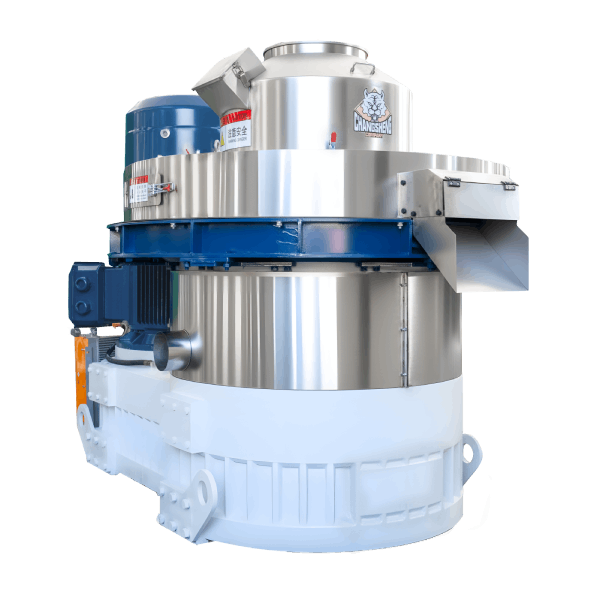
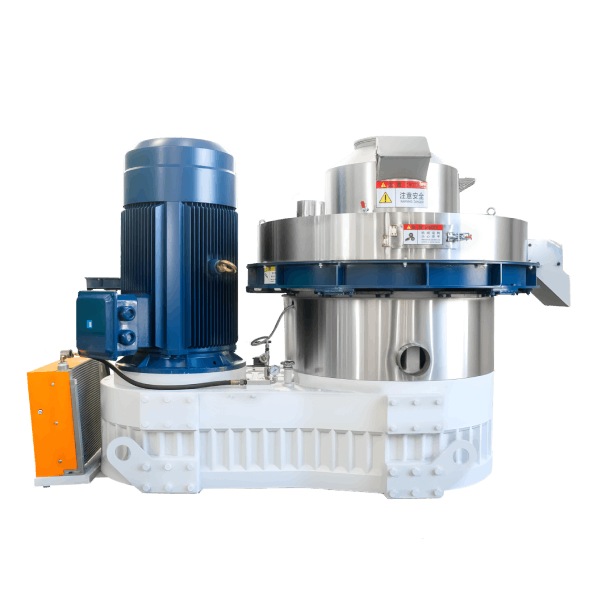
Rice Husk Pellet Machine for Biomass Fuel Production
News 2026-03-31
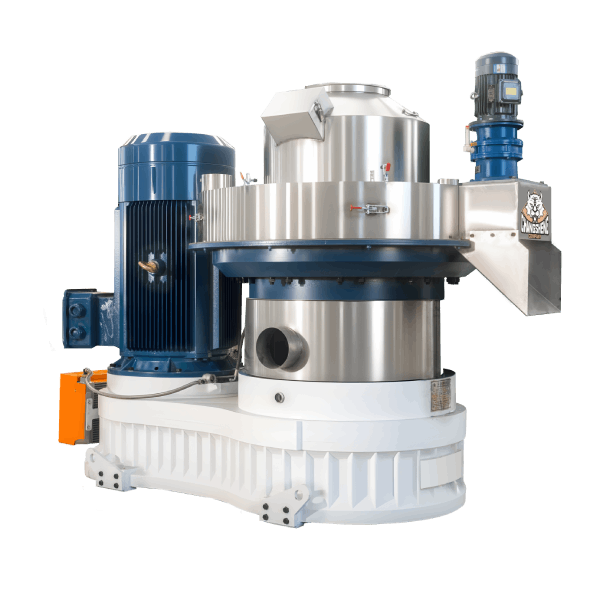
A rice husk pellet machine is an industrial biomass densification system designed to compress rice husk residues into high-density fuel pellets. Using a ring-die compression mechanism, the machine converts loose husk material into cylindrical pellets suitable for industrial boilers, biomass power plants, and renewable energy applications.
Technical Parameters and Specifications
Typical industrial specifications for a rice husk pellet machine used in biomass pellet plants are as follows:
| Parameter | Specification Range |
|---|---|
| Production capacity | 1 – 5 tons/hour |
| Pellet diameter | 6 mm / 8 mm |
| Main motor power | 90 – 132 kW |
| Raw material moisture | 10% – 15% |
| Pellet density | 1.1 – 1.3 g/cm³ |
| Pellet length | 10 – 30 mm |
| Die type | Ring die |
| Compression ratio | 1:7 – 1:9 |
| Raw material particle size | ≤4 mm |
| Machine weight | 4 – 6.5 tons |
These parameters are commonly applied in commercial biomass pellet production lines using rice husk as feedstock.
Structure and Material Composition
A typical rice husk pellet machine consists of several integrated mechanical systems designed for continuous biomass pellet production.
Main Structural Components
1. Feeding System
- Variable-speed screw feeder
- Anti-blocking feed hopper
- Magnetic metal separator
2. Pelletizing Chamber
- Ring die made of wear-resistant alloy steel
- Compression rollers with hardened surfaces
- Die clamping mechanism
3. Drive Transmission
- High-efficiency electric motor
- Heavy-duty gearbox
- Elastic coupling for overload protection
4. Lubrication System
- Automatic grease lubrication unit
- Bearing temperature monitoring
5. Cooling and Ventilation
- Air cooling fan
- Pellet discharge system
6. Electrical Control
- PLC control cabinet
- Load monitoring
- Emergency shutdown protection
The ring die and rollers are engineered with hardened alloy steel to withstand the abrasive silica content present in rice husk materials.
Manufacturing Process (Engineering Workflow)
Industrial rice husk pellet production typically follows an integrated processing workflow.
Step 1 – Raw Material Collection and Screening
Equipment:
- Vibrating screen
- Magnetic separator
Process objective:
Remove impurities such as stones, sand, and metal fragments.
Step 2 – Crushing Process
Equipment:
- Hammer mill or fine crusher
Process requirement:
Rice husk particle size should be reduced to ≤4 mm for optimal pelletizing efficiency.
Step 3 – Moisture Adjustment
Equipment:
- Rotary drum dryer or conditioner
Process requirement:
Raw material moisture should be stabilized between 10–15% for efficient pellet formation.
Step 4 – Pelletizing
Equipment:
- Rice husk pellet machine
Process principle:
Compression rollers press the biomass material through the ring die. Friction heat softens lignin in the husk, allowing pellets to form without chemical binders.
Step 5 – Pellet Cooling and Screening
Equipment:
- Counterflow pellet cooler
- Vibrating pellet screen
Process objective:
Reduce pellet temperature and remove fines before packaging.
Step 6 – Packaging and Storage
Equipment:
- Automatic bagging machine
- Bulk storage silo
Finished biomass pellets are prepared for transportation or industrial fuel supply.
Industry Comparison
| Feature | Rice Husk Pellet Machine | Wood Pellet Machine | Briquette Machine |
|---|---|---|---|
| Raw material | Rice husk | Sawdust | Mixed biomass |
| Pellet size | 6–8 mm | 6–10 mm | 30–70 mm |
| Binder requirement | None | None | Sometimes required |
| Energy density | Medium | High | Medium |
| Abrasiveness | High (silica) | Low | Medium |
| Maintenance frequency | Medium–High | Medium | Low |
Rice husk pellet machines require specialized die materials due to the abrasive silica content of rice husks.
Application Scenarios
Industrial rice husk pellet machine systems are widely used in biomass fuel supply chains.
Biomass Energy Producers
Convert agricultural residues into renewable fuel pellets.
EPC Contractors
Install complete biomass pellet plants for power generation or industrial boiler fuel supply.
Equipment Distributors and Importers
Supply pellet equipment to local biomass fuel markets.
Agricultural Waste Processing Plants
Transform rice milling by-products into commercial biomass fuel.
Core Pain Points and Engineering Solutions
1. High Silica Content in Rice Husk
Problem: Accelerates die and roller wear.
Solution:
Use heat-treated alloy steel ring dies and reinforced roller shells.
2. Low Bulk Density of Rice Husk
Problem: Feeding instability and low compression efficiency.
Solution:
Install variable-speed feeders and material conditioning systems.
3. Moisture Sensitivity
Problem: Excess moisture causes pellet cracking.
Solution:
Integrate drying and moisture monitoring systems.
4. Dust Generation During Processing
Problem: Fine particles affect pellet quality and plant safety.
Solution:
Install dust collection systems and air filtration units.
Risk Warnings and Avoidance Strategies
Foreign object contamination
Metal fragments can damage the ring die and rollers. Magnetic separation is recommended.
Improper die compression ratio
Rice husk requires higher compression ratios than wood materials.
Inadequate drying
Moisture above 15% significantly reduces pellet density and machine efficiency.
Insufficient cooling
Pellets must be cooled to prevent deformation during storage.
Procurement and Selection Guide
When purchasing a rice husk pellet machine, professional buyers should follow a structured evaluation process.
Step 1 – Analyze raw material characteristics
Assess silica content, moisture levels, and particle size.
Step 2 – Determine required production capacity
Industrial pellet plants typically require 1–5 tons/hour per machine.
Step 3 – Evaluate die and roller material quality
High-strength alloy steel improves service life.
Step 4 – Check energy consumption and motor efficiency
Ensure optimal power usage for long-term operation.
Step 5 – Confirm spare parts availability
Rollers, dies, bearings, and lubrication systems should be easily replaceable.
Step 6 – Evaluate manufacturer engineering capability
Select manufacturers able to provide full pellet production line design.
Engineering Application Case
Project: Biomass Pellet Fuel Plant
Location: Vietnam
Raw Material: Rice husk from rice milling facilities
Project configuration:
- 3 × rice husk pellet machines (2 t/h each)
- Hammer mill crushing system
- Rotary drum drying system
- Counterflow cooling system
- Automatic pellet packaging line
Total plant capacity: 6 tons/hour
The plant converts rice milling waste into biomass pellets used as renewable fuel for industrial boilers and cement plants.
FAQ
1. What raw materials can a rice husk pellet machine process?
Primarily rice husk, but it can also process mixed agricultural residues.
2. What pellet diameter is commonly produced?
6 mm and 8 mm pellets are standard.
3. Does pellet production require binders?
No, natural lignin acts as a binding agent.
4. What moisture content is required for pelletizing?
10–15% is optimal.
5. How long does a ring die last?
Typically 700–1200 operating hours depending on silica content.
6. What is the typical pellet density?
Around 1.1–1.3 g/cm³.
7. Is a drying system required?
Yes, if raw material moisture exceeds 15%.
8. What industries use rice husk pellets?
Biomass power plants, cement factories, and industrial boilers.
9. Can rice husk pellets replace coal?
In many biomass-compatible boilers, yes.
10. Can the pellet machine operate continuously?
Yes, industrial models support 24-hour operation with scheduled maintenance.
Request Technical Information or Quotation
For engineering consultation, technical documentation, or equipment pricing regarding rice husk pellet machine systems, contact Shandong Changsheng Machinery.
Available support includes:
- Biomass pellet production line design
- Technical equipment specifications
- Engineering feasibility consultation
- Equipment quotations and project samples
Author Expertise (E-E-A-T Statement)
This article was prepared by the engineering team at Shandong Changsheng Machinery, a manufacturer specializing in biomass pellet equipment and pellet production line engineering. The company has extensive experience in agricultural residue processing technology, pellet machine manufacturing, and industrial biomass pellet plant installation.