Industrial Biomass Pellet Line: How to Design a Line That Runs at Rated Capacity
News 2026-10-01
An industrial biomass pellet line is not a collection of equipment placed in sequence. It is a production system where every stage must be matched to feedstock, moisture, particle size, capacity, and target pellet quality. When one stage is undersized or oversized, the whole line runs below rated capacity, and the cost per ton rises.
The practical question for a buyer is not which pellet mill has the largest motor. The real question is how to match crushing, drying, pelletizing, cooling, screening, and packing so the line runs at design output with your actual feedstock, and how the line will be delivered, installed, and accepted.
This guide explains how an industrial biomass pellet line is designed, how capacity is matched across stages, how feedstock affects equipment selection, how multiple pellet mills are balanced, how feedstock switching is handled, what quality standards apply, and what to confirm with the supplier before ordering. For region-specific planning, see the Argentina and Brazil project pages on this site. For small-scale systems, see the compact pelletizing unit page on this site.
What Makes a Pellet Line “Industrial”
An industrial biomass pellet line is designed for continuous operation, higher capacity, and consistent pellet quality. It usually runs 6,000 hours per year or more, uses ring die pellet mills, and includes full automation and dust control.
A compact or farm-scale line is designed for intermittent operation, lower capacity, and one feedstock. An industrial line is designed for continuous operation, larger capacity, and often multiple feedstocks or a fixed mix ratio.
The difference is not only size. It is the design logic. An industrial line must be planned around material flow, stage matching, and maintenance windows.
Capacity Ranges for Industrial Lines
Industrial biomass pellet lines typically range from about 1 t/h to about 20 t/h. This range depends on feedstock type, moisture, particle size, die specification, number of pellet mills, and configuration. Smaller industrial lines may use one pellet mill. Larger lines often use two or more pellet mills in parallel to reach the target capacity and to allow maintenance without stopping the whole line.
Capacity should not be selected from a rated output figure alone. A line rated at 5 t/h may produce 3.5 to 4.5 t/h under real conditions with variable feedstock, moisture, and particle size. Rated capacity is only meaningful when feedstock type, moisture, particle size, and pellet diameter are stated.
Matching Capacity Across Stages
Each stage in the line must be matched to the next. If one stage is undersized, the line runs below capacity. If one stage is oversized, energy cost rises unnecessarily.
A typical matching rule is to size each stage for the design capacity plus a margin of about 10 to 20 percent, except for drying, which is usually sized for the worst realistic moisture condition, not the average. The exact margin depends on feedstock consistency, operating hours, and maintenance planning. A line running one consistent feedstock may use a smaller margin. A line running mixed or variable feedstock should use a larger margin.
Stage matching example for a 5 t/h line:
Crushing and grinding: sized for 5 to 6 t/h of raw material, depending on feedstock.
Drying: sized for the highest realistic incoming moisture, not the average.
Pelletizing: one or more pellet mills sized for 5 t/h under stated feedstock conditions.
Cooling: sized for 5 t/h of hot pellets at design pellet diameter.
Screening: sized for 5 t/h plus fines recirculation.
Packing: sized for 5 t/h plus buffer storage.
If drying is undersized, moisture varies and pellet quality fluctuates. If cooling is undersized, pellets stay hot and produce more fines. If screening is undersized, fines carry into the finished product.
Feedstock and Line Design
Feedstock determines equipment selection at every stage. Wood waste, sawdust, agricultural residues, and mixed biomass all behave differently in crushing, drying, pelletizing, and cooling.
Wood waste and sawdust usually pelletize more easily because of higher lignin content. Agricultural residues such as straw and rice husk are more abrasive and require wear-resistant die and roller material. Mixed biomass requires flexible feeding and moisture control because properties vary between batches.
The correct line design depends on the dominant feedstock, the mix ratio, and whether the line will run one feedstock at a time or a fixed mix.
Feedstock Switching and Configuration Change
When an industrial line switches between feedstocks, the configuration is not identical. Wood, straw, rice husk, and bagasse each require different die compression ratio, feeder setting, moisture control, and in some cases different grinding screen size.
For switching between two feedstocks, common approaches include a fixed mix ratio with a die selected for the more challenging component, or dual die configuration with separate dies for each feedstock. Dual die configuration requires more spare parts and more planned changeover time, but gives better performance on each feedstock.
Changeover time depends on die change, roller clearance adjustment, feeder setting, moisture control, and first production stabilization. Changeover should be planned as part of the operating schedule, not treated as an emergency.
Crushing and Grinding
Crushing and grinding reduce feedstock particle size to the range suitable for the die. A hammer mill with suitable screen size is used. Screen size determines final particle size. For fibrous feedstocks such as straw, shredding before grinding improves feeding stability.
Grinding energy depends on feedstock hardness, moisture, and target particle size. Hardwood and abrasive residues require more grinding energy than softwood or sawdust. Grinding capacity should be matched to line capacity, not to peak output only.
Drying
Drying reduces moisture to the range suitable for pelletizing. A rotary dryer is commonly used for industrial lines. Drying capacity must be matched to the highest realistic incoming moisture, not the average. If drying capacity is too small, moisture varies and pellet quality fluctuates. If drying capacity is too large, energy cost rises unnecessarily.
Dryer heat source options include biomass-fired hot air generators, diesel or gas burners, and waste heat from nearby industrial processes. The heat source affects both capital cost and operating cost. A biomass-fired heat source may reduce operating cost if feedstock is available, while diesel or gas may be simpler to install but more expensive to run.
Pelletizing
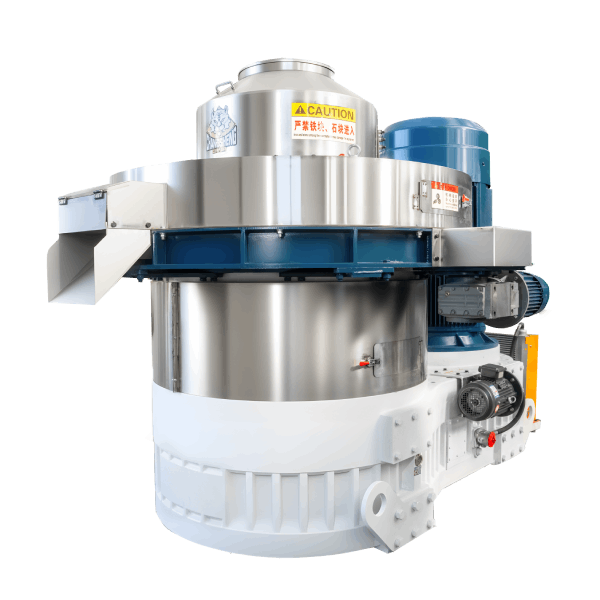
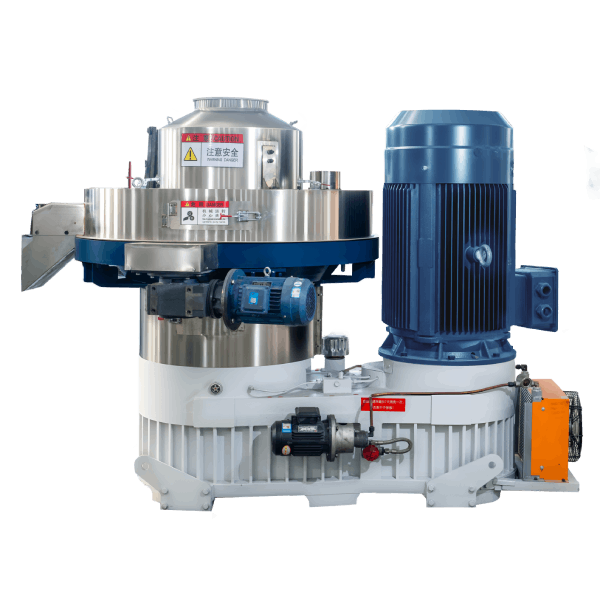
Pelletizing is the core of the line. Ring die pellet mills are used for industrial capacity. Die compression ratio and roller configuration are selected for the feedstock. For abrasive feedstocks, a die with higher wear resistance is required.
Multiple Pellet Mills in Parallel
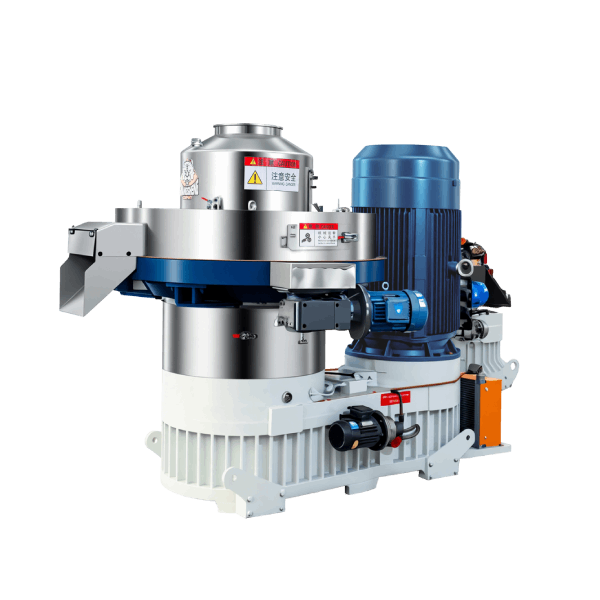
Larger industrial lines often use two or more pellet mills in parallel. This allows maintenance on one mill while the rest of the line continues to run, and reduces the impact of a single mill stoppage.
Parallel operation requires balanced feed distribution. If one mill receives more material than another, the overloaded mill runs at higher motor load, higher die temperature, and shorter die life. Feed distribution should be designed to keep motor load on each mill within the target range. In practice, this is done with a combination of conveying design, variable frequency feeders, and motor current monitoring on each mill. The control system should allow operators to see the load on each mill and adjust feed distribution accordingly.
Cooling
Cooling hardens pellets and reduces fines. Cooling capacity depends on pellet diameter, initial pellet temperature, and ambient conditions. Counterflow coolers are common in industrial lines. Cooling time should be sufficient to bring pellets to stable temperature and moisture before screening and packing.
Screening
Screening removes fines and oversize particles. Fines can be returned to the pellet mill. Oversize is removed from the product stream. Screening capacity should be matched to line capacity plus fines recirculation.
Packing
Packing prepares pellets for storage or sale. Bulk loading may be used for industrial customers. Bagging is used for retail or export markets. Packing capacity should be matched to line capacity plus buffer storage, so that short packing interruptions do not stop the line.
Dust Collection and Explosion Protection
Biomass dust is fine and poses both health and explosion risks. Dust collection with high-efficiency cyclone and filters is required. Explosion venting, spark detection, grounding, and where applicable ATEX-rated equipment are recommended for industrial lines. In regions where NFPA standards apply, reference should be made to NFPA 652 for general combustible dust requirements and NFPA 664 for wood and biomass processing facilities. ATEX applies mainly in the European Union and in some other regions that adopt ATEX requirements; local regulations should always be confirmed.
Automation and Control
Industrial lines usually include PLC control, variable frequency drives, automatic lubrication, and remote monitoring. Automation reduces labor, improves stability, and supports continuous operation. The right level depends on local labor cost, operating hours, and maintenance capability.
Power Supply and Electrical Infrastructure
Power supply is a design parameter, not an afterthought. Industrial lines require three-phase power, dedicated transformer capacity, and protection for starting current. Voltage, phase, frequency, and transformer capacity must be confirmed before ordering. A soft starter or variable frequency drive reduces starting current and improves stability.
Site Requirements
Site planning should consider feedstock storage, drying area, pelletizing building, cooling and screening area, finished pellet storage, office or control room, electrical room, dust collection, fire protection, truck access, and maintenance area. Layout should be planned around the largest piece of equipment, because installation and future maintenance require space for lifting and access.
Environmental and Workplace Factors
Industrial lines operate continuously, so noise, dust emission, and workplace safety matter. Noise should be managed with equipment layout and enclosures where required. Dust should be controlled at the source, not only at the stack. Fire protection should be planned for storage, drying, and pelletizing areas. Local regulations on noise, dust, and fire safety should always be confirmed.
Capacity Calculation and Annual Output
Required hourly capacity equals annual production target divided by annual operating hours. A capacity margin of about 20 to 30 percent is a practical starting point for feedstock variation, moisture changes, and maintenance. The exact margin depends on feedstock consistency, operating hours, and maintenance planning.
Example: a 5 t/h line running 6,000 hours per year produces approximately 30,000 tons per year at design output. With a 20 percent loss from downtime and feedstock variation, actual output may be around 24,000 tons per year. This is an illustrative example and should be adjusted for your actual feedstock and process.
Energy Consumption and Cost per Ton
Energy consumption per ton depends on feedstock type, moisture, particle size, die specification, compression ratio, feed rate, and motor efficiency. For industrial lines, energy consumption per ton is usually lower than for compact lines because of scale efficiency, but it still varies with feedstock and operation.
Cost per ton of pellets is the figure that matters, not machine price alone. Cost per ton includes raw material, power, labor, depreciation, maintenance, and spare parts. For abrasive feedstocks, spare parts and downtime often dominate total cost.
Cost Structure and What Determines It
The cost of an industrial biomass pellet line depends on capacity, feedstock, drying requirement, automation, cooling and screening scope, packing, electrical system, dust collection, civil works, installation, and spare parts.
Equipment cost is only one part. Auxiliary equipment, drying, electrical infrastructure, and civil works often represent a significant part of total project cost. A complete line and a machine-only quotation are in different cost categories.
Buyers comparing quotations should compare scope of supply and landed project cost, not equipment price alone.
Spare Parts and Maintenance Planning
Dies and rollers are wear parts. Their life depends on feedstock abrasiveness, moisture, compression ratio, and operating conditions. For abrasive feedstocks, die and roller life may be shorter than for clean wood. Expected die and roller life should be confirmed with the supplier based on similar material, not assumed from a general figure.
A practical spare parts plan for an industrial line includes at least one spare die per pellet mill, one or two spare roller shell sets per mill, bearings, belts, seals, lubricants, and critical electrical spares such as contactors and relays. A maintenance area with tools, spare parts, and workspace is required.
Die change procedure should be planned as part of the operating schedule. A die change requires production stop, die removal, roller inspection, die installation, clearance adjustment, and first production stabilization. Downtime cost depends on production rate, labor cost, and the value of lost output.
Pellet Quality and Standards
For export or higher-grade markets, pellet quality may need to meet standards such as ISO 17225 for solid biofuels. Key quality parameters include moisture, ash content, durability, fines, and pellet diameter. Ash content depends on feedstock and bark content. Durability depends on lignin content, compression ratio, die temperature, and cooling. Fines should be controlled by proper cooling and screening.
Exact grade limits should be confirmed against the current official standard, not assumed from a general figure. Certification requires testing and documentation that go beyond the production line itself.
Acceptance Test and Performance Guarantee
The acceptance test should be agreed in the contract and should include feedstock type, moisture, particle size, pellet diameter, running hours, output, pellet quality, and power consumption. The performance guarantee should reference the same conditions. A capacity guarantee without these conditions cannot be verified.
The acceptance test should be run with actual feedstock, not with an ideal material. Output and pellet quality should be recorded and compared with the guaranteed values. If the line does not meet the guarantee, the contract should define the remedy.
Typical Project Scenario
The following summarizes typical project parameters from industrial biomass pellet projects. Specific customer names, locations, and contact details are not included.
Typical project: wood and agricultural residue pellet production.
Raw material: mixed wood waste and agricultural residues in controlled mix ratio.
Capacity: 5 t/h.
Configuration: ring die pellet mills with crushing, drying, pelletizing, cooling, screening, and packing.
Application: industrial boiler fuel and export market supply.
Acceptance: trial run with actual material, output and pellet quality recorded before shipment.
The parameters above are typical ranges and should be confirmed with actual test records.
Procurement Checklist
Before signing a contract, confirm the following with the supplier:
Capacity with stated feedstock, moisture, particle size, and pellet diameter.
Die compression ratio and die material per pellet mill.
Roller shell material and hardness.
Feeder type and whether variable frequency control is included.
Crushing and grinding scope, including hammer mill screen size.
Drying system capacity and dryer heat source.
Cooling, screening, and packing scope.
Dust collection and explosion protection scope, including reference to applicable NFPA or local standards where relevant.
Motor power, total connected load, voltage, phase, frequency, and transformer capacity.
Automation level and control system scope.
Feed distribution and mill balancing provisions for multiple mills.
Spare parts list with part numbers and recommended first order.
Warranty scope, wear part definition, and response process.
Acceptance test method and performance guarantee conditions.
Frequently Asked Questions
What capacity does an industrial biomass pellet line have?
Industrial lines typically range from about 1 t/h to about 20 t/h, depending on feedstock, moisture, pellet diameter, number of pellet mills, and configuration. Larger lines often use multiple pellet mills in parallel.
How do I match capacity across stages?
Each stage should be sized for the design capacity plus a margin of about 10 to 20 percent, except for drying, which is usually sized for the worst realistic moisture condition. The exact margin depends on feedstock consistency, operating hours, and maintenance planning. If one stage is undersized, the line runs below capacity.
Do I need a dryer for an industrial biomass pellet line?
Drying is required when feedstock moisture is above the suitable range for pelletizing. Agricultural residues and wet wood waste usually require drying. Dry sawdust may not.
Should I use one pellet mill or multiple mills?
Smaller industrial lines may use one pellet mill. Larger lines often use two or more mills in parallel to reach target capacity and to allow maintenance without stopping the whole line. Parallel operation requires balanced feed distribution and motor current monitoring on each mill.
How is feedstock switching handled on an industrial line?
Feedstock switching requires die change, roller clearance adjustment, feeder setting, moisture control, and first production stabilization. Common approaches include a fixed mix ratio with a die selected for the more challenging component, or dual die configuration with separate dies for each feedstock.
What power supply does an industrial line need?
Industrial lines require three-phase power, dedicated transformer capacity, and protection for starting current. Voltage, phase, frequency, and transformer capacity must be confirmed before ordering.
How much does an industrial biomass pellet line cost?
Cost depends on capacity, feedstock, drying requirement, automation, cooling and screening scope, packing, electrical system, dust collection, civil works, installation, and spare parts. Equipment cost is only one part of landed project cost. A machine-only quotation and a complete line quotation are in different cost categories. Final cost should be confirmed against a written scope of supply.