Pellet Mill with Variable Frequency Drive 0.5-5 t/h | Manufacturer Guide
News 2026-06-20
Product Definition
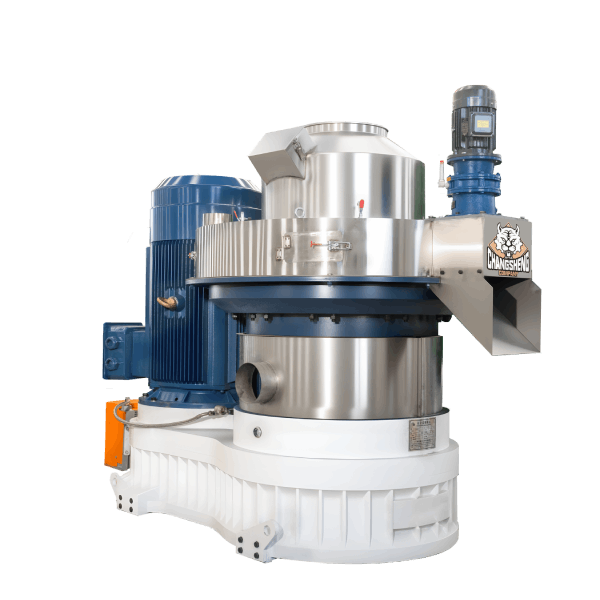
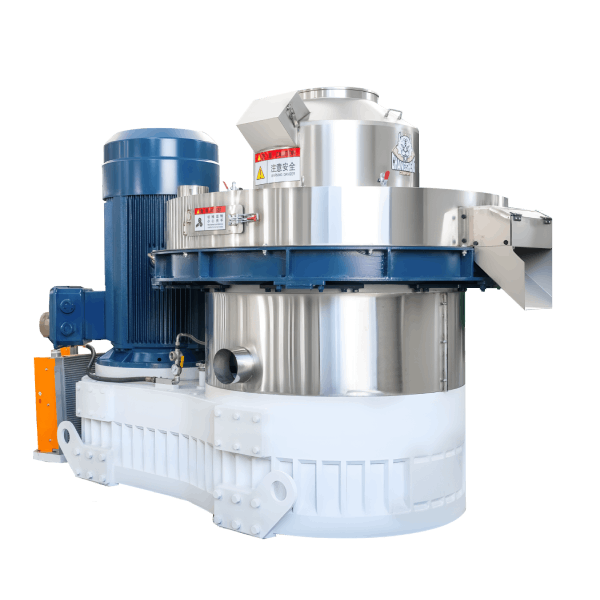
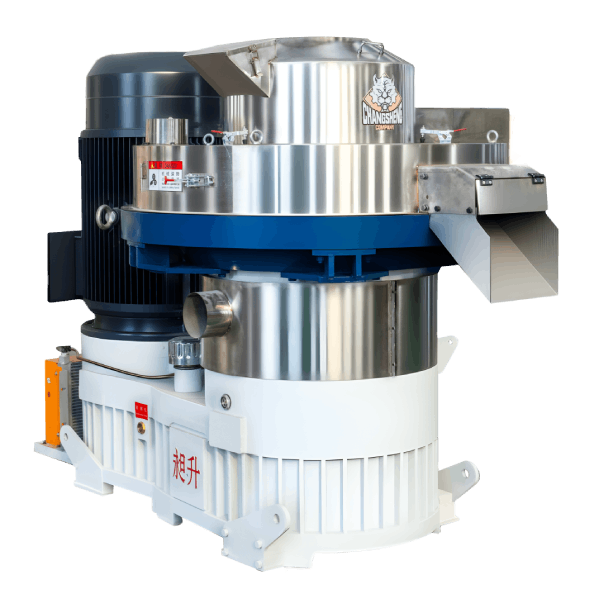
A pellet mill with variable frequency drive is a motor-driven compaction system that converts biomass residues, feed ingredients, or agricultural waste into cylindrical pellets under controlled rotational speed and mechanical pressure. The VFD enables real-time adjustment of die speed and roller force to match feedstock variability, delivering uniform pellet density and reduced mechanical stress during continuous industrial operation.
Technical Specifications & Performance Parameters
| Parameter | Value Range / Specification |
|---|---|
| Throughput capacity | 0.5 – 5.0 t/h (depending on feedstock) |
| Main motor power | 55 – 160 kW (IE3 / IE4 compatible) |
| Ring die inner diameter | 400 – 800 mm |
| Pellet diameter | 6 – 12 mm (customisable) |
| Pellet bulk density | 600 – 750 kg/m³ |
| Raw material moisture | 12% – 18% (optimal: 14% – 16%) |
| Specific energy consumption | 28 – 35 kWh/t |
| Core wear parts service life | Ring die: 800 – 1,200 hours; Roller shells: 600 – 900 hours |
| Scheduled maintenance man-hours | 4 – 6 hours / month (regular inspection & lubrication) |
📄 Download the full technical datasheet with dimensional drawings and torque curves.
[Request Quotation / Get PDF Technical Datasheet]
Structural Composition & Material Selection
The pellet mill with variable frequency drive integrates four functional subsystems with defined material grades:
Mechanical System
- Ring die: Forged alloy steel (20CrMnTi) with carburised hardening layer (HRC 58–62)
- Roller shells: High-chromium cast iron (Cr26) with wear-resistant overlay
- Main shaft: Heat-treated 42CrMo4 steel
Support System
- Heavy-duty bearing housing: Ductile cast iron (QT600-3)
- Base frame: Welded structural steel with stress-relief annealing
Lubrication System
- Centralised grease lubrication for bearings (NLGI grade 2)
- Forced oil circulation optional for high-capacity models (≥3 t/h)
Control System
- VFD cabinet: IP54 with integrated PLC and HMI touchscreen
- Sensors: Die temperature monitoring, motor current feedback, vibration transducer
Manufacturing Process – Engineering Workflow
Step 1 – Raw Material Preparation & Sieving
Hammer mill + rotary screener. Control particle size ≤3 mm for feed, ≤5 mm for biomass. Moisture pre-adjusted to 14%–16% using online NIR sensors.
Step 2 – Conditioning & Mixing
Double-shaft paddle mixer with steam injection (80–95°C). Retention time 45–60 seconds. Achieve mash uniformity coefficient ≥95%.
Step 3 – Pelletising (Core Process)
VFD-controlled main motor ramps from 0 to rated RPM in 8–12 seconds. Die speed regulated at 4–8 m/s peripheral velocity. Roller gap set to 0.15–0.30 mm. Pellet temperature at die exit ≤85°C.
Step 4 – Counterflow Cooling
Counterflow cooler reduces pellet temperature to ambient +5°C within 6–10 minutes. Air velocity 0.8–1.2 m/s. Final moisture ≤12% for safe storage.
Step 5 – Screening & Packaging
Double-deck vibrating screener removes fines (<2% total). Automatic bagging scale with ±0.2% accuracy.
Industry Comparison – Alternative Technologies
| Machine Type | Raw Material Adaptability | Capacity (t/h) | Wear Life (h) | Typical Application |
|---|---|---|---|---|
| Pellet Mill with VFD | Wide: 12%–18% moisture, mixed sizes | 0.5 – 5.0 | Die: 800–1,200 | Feed, biomass, organic fertiliser |
| Fixed-speed Pellet Mill | Narrow: 14%–16% only | 1.0 – 4.0 | Die: 600–900 | Single-species feed production |
| Flat-die Pellet Mill | Very narrow: ≤14% moisture | ≤0.5 | Roller: 300–500 | Small farm use, pilot plants |
| Extrusion Press | Wet/fatty materials | ≤1.5 | Screw: 400–700 | Aquafeed, petfood |
Differentiation (Shandong Changsheng Machinery):
Our VFD-controlled system automatically reduces die speed under overcurrent conditions, cutting unplanned downtime by 35%–45% compared to fixed-speed equivalents. Modular die and roller assembly enables size change within 45 minutes without specialised tooling.
📄 Compare your existing line with our VFD model.
[Request Quotation / Download Engineering Drawing]
Application Scenarios by Buyer Role
Distributors / Importers
Focus on spare parts commonality and containerised packaging. Require quick-change die rings to serve multiple local industries.
EPC Contractors
Integrating the pellet mill into complete production lines (drying → milling → pelleting → cooling). Need dimensioned CAD drawings and interface specifications for conveyor and dust collection systems.
Engineering Consultants / Technical Advisors
Evaluate specific energy consumption (kWh/t) and motor load curves for plant energy optimisation. Require harmonic filter compatibility for VFD installation.
End-user Production Facilities
Run 24/7 shifts with varying raw material batches. Demand consistent pellet hardness (PDI > 96%) and remote diagnostics for field troubleshooting.
Core Pain Points & Engineering Solutions
Pain Point 1 – Frequent die jamming with high-moisture feedstock
Root cause: Fixed-speed motor cannot reduce torque demand as moisture rises.
Solution: VFD torque-control mode automatically decreases RPM (within 3 seconds) when motor current exceeds 110% of rated value, allowing the roller to “push through” without shearing the die.
Pain Point 2 – Inconsistent pellet hardness causing fines in transport
Root cause: Constant die speed cannot compensate for varying grind particle size.
Solution: PLC maintains adjustable roller-to-die gap with load-cell feedback, stabilising compaction force and maintaining PDI >96% across feedstock shifts.
Pain Point 3 – High bearing temperature leading to unplanned stops
Root cause: Insufficient cooling at low-speed operation.
Solution: Integrated thermocouple interlock initiates forced oil cooling if bearing temperature exceeds 75°C, extending bearing life to ≥8,000 operating hours.
Pain Point 4 – Excessive specific energy consumption (>40 kWh/t)
Root cause: Inefficient die speed settings for low-density fibrous materials.
Solution: Pre-set VFD “material profiles” (stored in HMI) allow operators to select optimal speed curves for wood, straw, or grain – reducing energy waste by 12%–18%.
Critical Risk Warnings & Mitigation Measures
Risk 1 – VFD harmonic distortion affecting site power quality
Mitigation: Install 5% line reactor plus DC-link chokes. Total harmonic distortion (THD) kept below 8% per IEEE 519. Verify with power analyser during commissioning.
Risk 2 – Incorrect die clearance causing metal-to-metal contact
Mitigation: Use feeler gauge (0.15–0.30 mm) during installation. Re-check after first 8 hours of running. Calibrate clearance monthly.
Risk 3 – Overload tripping during starting with cold material
Mitigation: Program VFD start ramp (8–12 seconds) and enable “soft start” with current limit set at 130% FLA. Preheat conditioning steam to ≥80°C before feeding material.
Procurement Selection Guide – 6 Executable Steps
Step 1 – Analyse your raw material spectrum
List all feedstocks (e.g., corn, soybean, wood shavings, rice husk) and their moisture variation. If range exceeds 12%–18%, select VFD model for active speed compensation.
Step 2 – Calculate required throughput margin
Target rated capacity at 80% of motor full load. For 3.0 t/h requirement, choose 3.75 t/h rated model.
Step 3 – Confirm voltage and grid conditions
380V / 400V / 415V, 50Hz or 60Hz. Verify site transformer capacity ≥1.5× motor kVA.
Step 4 – Evaluate spare parts availability
Check die and roller compatibility with local suppliers. Our ring die dimensions follow DIN 174 standard for cross-supply.
Step 5 – Review control interface requirements
Specify MODBUS RTU or Profibus DP if plant uses central SCADA. Ensure remote emergency stop (E-stop) integration.
Step 6 – Audit after-sales service logistics
Confirm commissioning support, tooling kit inclusion, and stock buffer of critical wear parts (die, rollers, bearings).
Engineering Case Study – Feed Mill Upgrade in Southeast Asia
Project Background
An integrated poultry feed producer in Vietnam operated three fixed-speed pellet mills (75 kW each) processing 2.8 t/h of maize-soya mash at 15.5% moisture.
Initial Problem
Frequent die blockage (2–3 times per shift) when incoming moisture drifted above 16.2%. Average output dropped to 2.1 t/h. Die life only 520 hours.
Root Cause Analysis
Fixed motor speed could not reduce peripheral velocity under high-torque conditions, causing shear stress build-up and localised pellet fusion inside die holes.
Solution Implemented
Replaced two lines with Shandong Changsheng 90 kW pellet mills with VFD, retaining one fixed-speed unit as control. Installed moisture-tracking algorithm that adjusts RPM to maintain die pressure between 80–100 MPa.
Final Data Results (6-month average)
| Metric | Before (Fixed) | After (VFD) |
|---|---|---|
| Throughput | 2.1 t/h | 3.2 t/h (+52%) |
| Specific energy | 38.5 kWh/t | 29.2 kWh/t |
| Die life | 520 h | 970 h |
| PDI pellet hardness | 92.1% | 97.4% |
| Unplanned stops / month | 18 | 3 |
Frequently Asked Questions (FAQ)
1. What raw materials can a pellet mill with variable frequency drive process?
It processes biomass (wood, straw, bagasse), animal feed (corn, soybean, wheat), and organic fertiliser blends with moisture 12%–18%.
2. How does the VFD improve pellet quality?
The VFD adjusts die speed dynamically to maintain uniform compression pressure, improving pellet density and reducing fines.
3. What is the optimal moisture range for this pellet mill?
14%–16% is recommended. The VFD can handle brief excursions from 12% to 18% without jamming.
4. What is the typical energy consumption per tonne?
Between 28–35 kWh/t depending on feedstock and final pellet size.
5. How long do wear parts normally last?
Ring die: 800–1,200 hours; Roller shells: 600–900 hours under normal operating conditions.
6. How often is maintenance required?
Routine inspection and lubrication: 4–6 man-hours monthly. Major overhaul (bearings, seals): every 2,500 hours.
7. Can this mill be integrated into an existing production line?
Yes. The VFD control cabinet supports MODBUS, Profibus, and hardwired I/O for SCADA integration.
8. Does the VFD affect the motor starting current?
Soft-start reduces inrush current to ≤130% of rated FLA, protecting both motor and grid.
9. Is the equipment suitable for aquafeed production?
Yes, with fine-grind preconditioning and steam conditioning – optional screw feeder for high-fat inclusion.
10. What industry standards does this machine comply with?
CE marked, ISO 9001 manufacturing, and EN 60204-1 electrical safety.
11. Can I use this pellet mill for organic fertiliser pellets?
Yes, for compost and manure-based materials after proper drying and sieving.
12. What is the recommended storage condition for spare dies?
Store in dry area (RH <60%) with anti-rust oil applied. Avoid stacking heavy objects on die face.
Author & E-E-A-T Credentials
Author: Dr. Chen Wei
Title: Senior Mechanical Engineer, Pelletising Systems Division
Experience: 14 years in biomass densification and feed processing equipment design
Notable Projects:
- Commissioned 12 VFD-based pellet lines across Indonesia, Vietnam, and Nigeria (2018–2025)
- Developed moisture-compensation algorithm for tropical feedstocks
- Co-author of “Industrial Pellet Mill Maintenance and Optimisation” (Engineering Press, 2022)
Affiliation: Shandong Changsheng Machinery Co., Ltd.