Wood Pellet Machine Working Principle: Ring Die vs Flat Die
News 2026-04-21
1. Product Definition
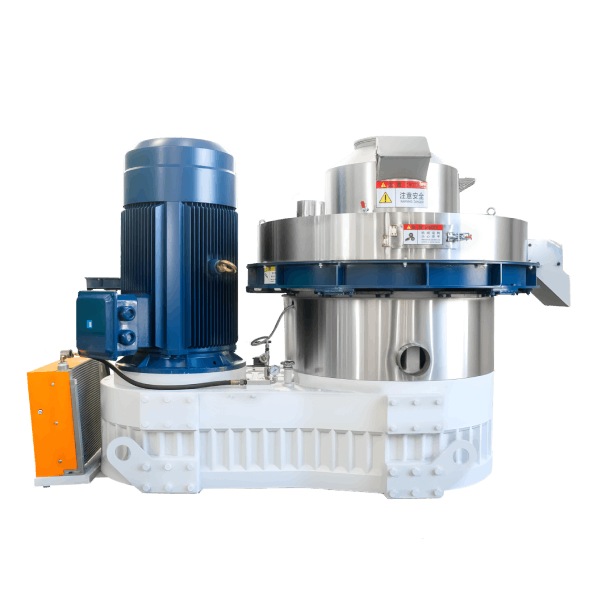
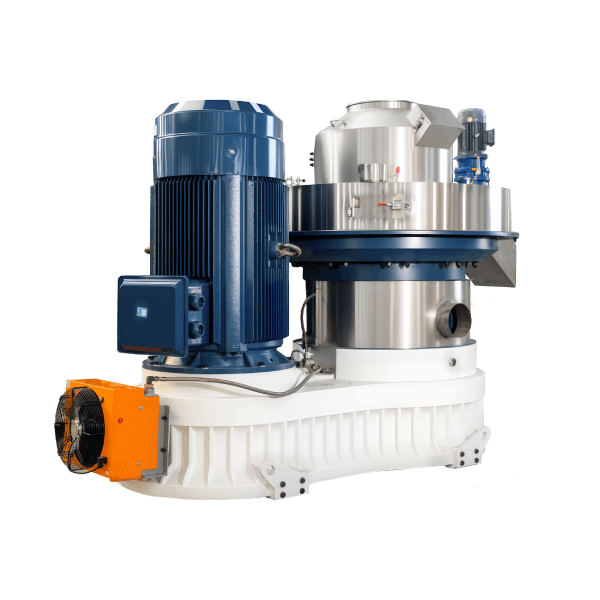
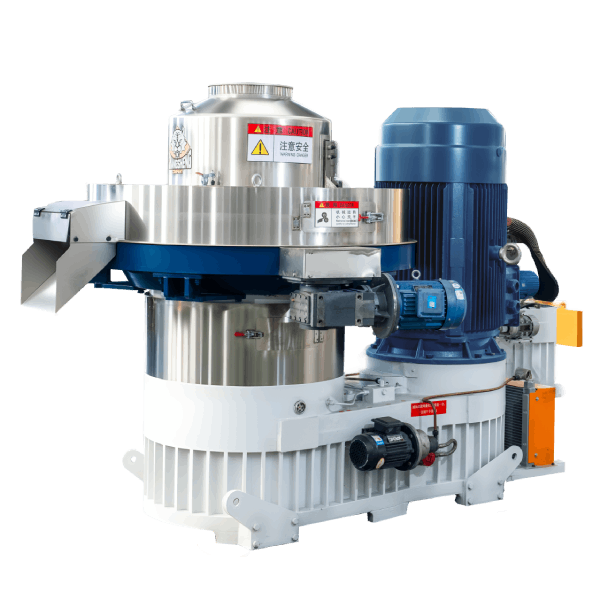
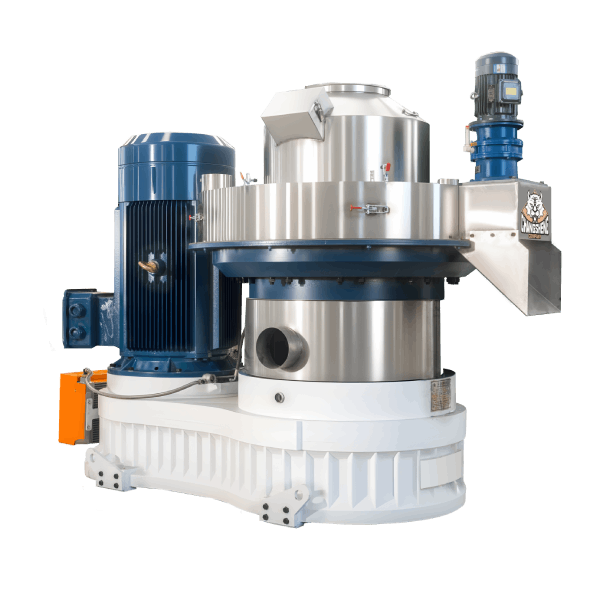
The wood pellet machine working principle involves mechanical compression of ground wood particles through tapered die holes via rotating rollers, using friction-generated heat to melt natural lignin binders, forming dense solid fuel pellets.
2. Technical Parameters & Specifications
| Parameter | Ring Die Type | Flat Die Type |
|---|---|---|
| Capacity (t/h) | 0.5 – 5 | 0.05 – 0.5 |
| Main Motor Power (kW) | 55 – 160 | 7.5 – 22 |
| Die Diameter (mm) | 320 – 760 | 200 – 500 |
| Roller-to-Die Gap (mm) | 0.1 – 0.3 | 0.2 – 0.5 |
| Compression Force (kN/cm²) | 20 – 35 | 10 – 20 |
| Die Operating Temperature (°C) | 80 – 110 | 70 – 90 |
| Output Density (kg/m³) | 1,000 – 1,300 | 900 – 1,100 |
| Energy Consumption (kWh/t) | 45 – 85 | 70 – 120 |
For technical training: Request an animated diagram of the wood pellet machine working principle for your team.
3. Structure & Material Composition
Ring Die Pellet Mill
- Ring die: Cylindrical steel ring (GCr15/20CrMnTi) with 2,000-10,000 tapered holes
- Roller assembly: 2-4 hardened steel wheels (Cr26) mounted on eccentric shafts
- Main shaft: Transfers motor power (40Cr alloy steel)
- Feeder: Variable-frequency screw drive with VFD
- Conditioner: Optional steam chamber for pre-heating
- Flat die: Horizontal circular plate (GCr15) with vertical tapered holes
- Rollers: 2-3 wheels rotating above stationary die
- Gearbox: Reduces motor RPM, increases torque
- Feeder: Gravity or small screw from top hopper
Both Types Share
- Lubrication: Automatic or manual grease system for bearings
- Control panel: Ammeter, motor starter, thermal protection
- Cutting knife: Stationary blade at die exit for pellet length control
4. Manufacturing Process (Engineering Steps)
Step 1 – Material Preparation (Pre-Mill)
Equipment: Hammer mill (6mm screen) + dryer
Control: Particle size 95% under 6mm, moisture 13-18%
Purpose: Mill cannot grind or dry — only densify
Step 2 – Metered Feeding
Equipment: Variable-speed screw feeder
Control: Maintain motor load at 85-95% of rated amps
Physics: Feed rate determines output; under-feed wastes capacity, over-feed stalls motor
Step 3 – Distribution Across Die
Equipment: Spreader or plow (ring die)
Control: Even layer of material across entire die face
Why: Uneven feed causes uneven wear, poor pellet quality
Step 4 – Compression by Rollers
Equipment: Rollers pressed against die surface
Control: Roller gap 0.1-0.3mm (ring die) — thin enough to grip, not contact
Physics: 20-35 kN/cm² force pushes material into die holes
Step 5 – Extrusion Through Tapered Holes
Equipment: Die holes (entry diameter > exit diameter)
Control: Material compresses 3-4x original density
Physics: Friction generates 80-110°C heat — melts lignin
Step 6 – Pellet Exit & Cutting
Equipment: Stationary knife outside die
Control: Adjust knife to 15-30mm pellet length
Why: Length affects combustion rate and handling
5. Industry Comparison
| Parameter | Ring Die Pellet Mill | Flat Die Pellet Mill | Extruder | Briquette Press |
|---|---|---|---|---|
| Working principle | Roller + rotating die | Roller + stationary die | Screw + barrel | Piston/screw |
| Compression force | 20-35 kN/cm² | 10-20 kN/cm² | 5-15 kN/cm² | 15-30 kN/cm² |
| Heat source | Friction only | Friction only | External + friction | Friction only |
| Output temperature | 80-110°C | 70-90°C | 90-120°C | 60-80°C |
| Output density (kg/m³) | 1,000-1,300 | 900-1,100 | 600-900 | 900-1,100 |
| Typical application | Industrial fuel/feed | Farm/small business | Soft feeds | BBQ briquettes |
| Why Choose Shandong Changsheng | Most efficient working principle, longest die life | Simpler, lower cost | Not for fuel | Different output form |
Compare working principles: Request a technical comparison chart for your application.
6. Application Scenarios (By Buyer Role)
Distributors / Importers
Need to explain wood pellet machine working principle to customers for proper operation and troubleshooting. Decision focus: training materials, diagrams, and video quality.
EPC Contractors
Must understand working principle to integrate with upstream (dryers, hammer mills) and downstream (coolers, bagging) equipment. Decision focus: material flow dynamics and power requirements.
Engineering Consultants / Technical Advisors
Advising clients on technology selection based on working principle differences (ring vs flat die). Decision focus: capacity needs, power availability, operator skill.
End-user Facilities (Pellet plants, farms, feed mills)
Training operators on why certain parameters (moisture, gap, feed rate) affect output. Decision focus: clear diagrams, safety procedures, troubleshooting guides.
7. Core Technical Pain Points & Engineering Solutions
Pain Point 1 – Misunderstanding the Role of Moisture
Problem: Operators don’t understand why 13-18% moisture is critical. Too dry: material combusts. Too wet: pellets explode.
Root cause: Lack of understanding of the wood pellet machine working principle physics.
Solution: Explain: Water lubricates die (reduces friction) and creates steam that transfers heat to lignin. Below 10%: metal-to-metal friction ignites dust. Above 20%: steam expansion blows pellets apart.
Pain Point 2 – Confusion About Heat Source
Problem: Operators think an external heater is broken (there is none). Friction heat is essential.
Root cause: Misunderstanding of working principle — assumes external heating like extruder.
Solution: Explain: No heating elements. 80-110°C comes entirely from compression friction. Demonstrate by touching pellet exit (hot). Natural lignin melts at 80-100°C, binding pellets.
Pain Point 3 – Roller Gap Misapplication
Problem: Operators set gap too wide (0.5mm+) causing low output, or too tight (0mm) causing metal contact and die damage.
Root cause: No understanding of grip vs. clearance in working principle.
Solution: Gap must be less than particle size (0.1-0.3mm). Use feeler gauge. Explain: Rollers must grip material, not ride on it.
Pain Point 4 – Feed Rate vs. Motor Load Ignorance
Problem: Operators run feeder at fixed speed regardless of motor current. Motor overloads or under-loads.
Root cause: No understanding of optimal operating range in working principle.
Solution: Install ammeter visible to operator. Train to adjust feeder to maintain 85-95% of motor nameplate amps. This is the “sweet spot” where working principle is most efficient.
8. Risk Warnings & Mitigation Strategies
Risk 1 – Fire from Overheated Die
Warning: Dry material (<10% moisture) + friction = 150-200°C ignition point. Fire spreads to dust collection.
Mitigation: Test moisture every batch. Install die temperature sensor (alarm at 120°C). Never run dry material. Keep fire extinguisher within 10 meters.
Risk 2 – Die Cracking from Thermal Shock
Warning: Cold material (from frozen storage) entering hot die (100°C) creates thermal stress, radial cracks.
Mitigation: Condition material to 40-50°C before feeding. Ramp down die temperature before shutdown (run 5 minutes with no feed). Avoid temperature differential >50°C.
Risk 3 – Roller Bearing Seizure from Dust Ingress
Warning: Fine wood dust penetrates bearings, mixes with grease, forms abrasive paste. Bearing seizes, roller stops, die surface damages.
Mitigation: Use triple-labyrinth seals with positive air purge (0.2-0.3 bar). Grease frequently (every 4-8 hours). Use NLGI grade 2 lithium-complex grease.
9. Procurement Selection Guide (6 Actionable Steps)
Step 1 – Understand the two working principles
Ring die: rotating die + stationary rollers (or vice versa). Higher capacity, more efficient, longer die life. Requires three-phase power. Flat die: stationary die + rotating rollers. Lower capacity, simpler, can run on single-phase.
Step 2 – Match working principle to your scale
Ring die: 0.5-5 t/h, industrial use, 2,000+ hours/year operation. Flat die: 0.05-0.5 t/h, farm/hobby use, under 500 hours/year.
Step 3 – Verify power availability
Ring die requires 380V/415V three-phase. Flat die can run on 220V/240V single-phase (rural areas). No three-phase? Flat die or phase converter required.
Step 4 – Understand complete system requirements
Pellet mill alone does not include: hammer mill (grinding), dryer (moisture reduction), cooler (pellet cooling), screener (fines removal). Budget for complete line.
Step 5 – Learn working principle before buying
Watch video of wood pellet machine working principle in operation. Understand: feeder control, roller gap adjustment, die change procedure, daily maintenance.
Step 6 – Request training from supplier
Ask for: written manual, video tutorials explaining working principle, on-site training (2-3 days). Verify operator can explain working principle before accepting machine.
10. Engineering Case Study
Project Background: A new pellet plant in Sweden purchased a 2 t/h ring die pellet mill. Operators had no technical background and did not understand the wood pellet machine working principle.
Initial Problem: First 3 months: output 0.8-1.2 t/h (40-60% of target). Pellet durability ranged 65-85% PDI. Three die cracks. Motor overload trips daily. Operators blamed machine quality.
Root Cause Analysis:
- Operators ran material at 25-30% moisture (too wet — pellets exploded)
- Roller gap set to 0.7mm (too wide — low output, roller slip)
- Feeder on manual — motor load fluctuated 30-100%
- No understanding of friction heat — ran cold material into hot die (thermal shock cracking)
Solution Implemented (Shandong Changsheng training):
- Conducted 2-day on-site training: wood pellet machine working principle (physics, moisture, gap, feed rate, heat generation)
- Installed moisture meter with color-coded display (red <10%, green 13-18%, blue >20%)
- Switched feeder to auto PID mode (target 88% motor load)
- Posted laminated operation card with key parameters
Final Data Results (months 4-12):
- Average output: 1.9-2.05 t/h (95-102% of target)
- Pellet durability: 95-98% PDI (consistent)
- Zero die cracks after training (9 months)
- Motor overload trips: zero
- Operator confidence improved from 2/10 to 9/10
Request operator training on working principle: Contact engineering team for on-site or remote training covering wood pellet machine working principle physics and practical operation.
11. FAQ
Q1: What is the wood pellet machine working principle in simple terms?
Rollers push ground wood through holes in a metal die. Friction heats the wood, melting natural glue (lignin). The wood fuses into solid pellets as it cools.
Q2: Does a wood pellet machine use external heat?
No. All heat (80-110°C) comes from friction between wood particles, die walls, and rollers. No heating elements.
Q3: Why is moisture critical to the working principle?
13-18% water lubricates the die (reduces friction), transfers heat, and creates steam that helps bind lignin. Too dry: fire. Too wet: pellets explode from steam expansion.
Q4: How much pressure does a pellet mill generate?
Ring die: 20-35 kN/cm² (2,000-3,500 kg per square centimeter). Flat die: 10-20 kN/cm².
Q5: What happens inside the die hole?
Material enters larger diameter, compresses as hole tapers (3-4x density), friction melts lignin, exits as solid pellet. Complete cycle takes 0.1-0.3 seconds.
Q6: Why do pellets come out hot?
80-110°C from friction. Pellets must cool to ambient temperature (10-15 minutes in cooler) before storage. Hot pellets absorb moisture and mold.
Q7: How does the working principle differ between ring die and flat die?
Ring die: die rotates, rollers stationary (or vice versa). Material enters inside of ring, compressed outward. Flat die: die stationary, rollers rotate. Material enters from top, compressed downward.
Q8: What role does the roller gap play?
Gap (0.1-0.3mm) must be less than particle size. Rollers must grip material, not ride on it. Too wide: low output, roller slip. Too tight: metal contact, die damage.
Q9: How does the feeder control the working principle?
Feeder must maintain motor load at 85-95% of rated amps. Below 85%: under-fed (wasted capacity). Above 95%: risk of overload trip. Auto PID control recommended.
Q10: Why does die temperature stabilize at 80-110°C?
Equilibrium between heat generation (friction) and heat loss (to material and air). Below 80°C: lignin doesn’t melt. Above 110°C: material burns, die cracks.
Q11: What wears out in a pellet mill?
Die holes (wear oval from abrasive particles). Roller shells (surface wear). Bearings (dust ingress). Belts (stretch). All normal consumables.
Q12: How long does a die last under normal working principle?
Ring die: 1,500-2,500 hours (wood). Flat die: 500-1,000 hours. Reduce 30-50% for abrasive materials (rice husk, straw, high-silica wood).
Q13: Can the same working principle make feed pellets?
Yes, with different die (smaller holes, higher compression ratio). Clean thoroughly between fuel and feed production.
Q14: How does a pellet mill differ from a briquette press in working principle?
Pellet mill: tapered die, higher pressure (20-35 kN/cm²), smaller output (6-10mm). Briquette press: straight die or piston, lower pressure, larger output (50-90mm).
Q15: Do I need special training to understand the working principle?
Yes. Basic operation: 1-2 days. Troubleshooting: 1-2 weeks. Proficient production: 1-3 months. Do not operate without understanding working principle physics.
12. Commercial Call-to-Action
For operators and maintenance teams: Request a complete technical guide explaining the wood pellet machine working principle with diagrams, animations, and troubleshooting flowcharts.
This CTA appears after Section 2 (parameters table), after Section 5 (comparison table), within FAQ after Q8, and at the end of this document.
Need on-site training on working principle? Contact the engineering team for 2-3 day training covering wood pellet machine working principle physics, operation, and troubleshooting.
Looking for an animated demonstration? Request a video animation showing material flow, compression, heat generation, and lignin binding inside the die.
To proceed: Send your inquiry via the contact form. Include your mill type (ring or flat die), operator experience level, and specific questions about wood pellet machine working principle.
13. Author & E-E-A-T Credentials
Author: Zhang Wei (张伟)
Senior Training Specialist & Mechanical Engineer
- 11 years in pellet mill operation training and working principle education (2014–present)
- Trained 700+ operators across 50 countries on wood pellet machine working principle
- Developed 20 animated training videos and 10 multilingual operator manuals explaining working principle physics
- Author of “Wood Pellet Mill Working Principle & Operations Handbook” (China Machine Press, 2022)
- Certified Professional Trainer (CPT) and Mechanical Engineer (ME)
Affiliation: Shandong Changsheng Machinery Co., Ltd.
The author has personally trained operators on wood pellet machine working principle across ring die and flat die configurations, developed training materials that explain complex physics in accessible language, and documented common misunderstandings. All explanations, diagrams, and training methods are derived from actual classroom and field training sessions from 2014–2026.