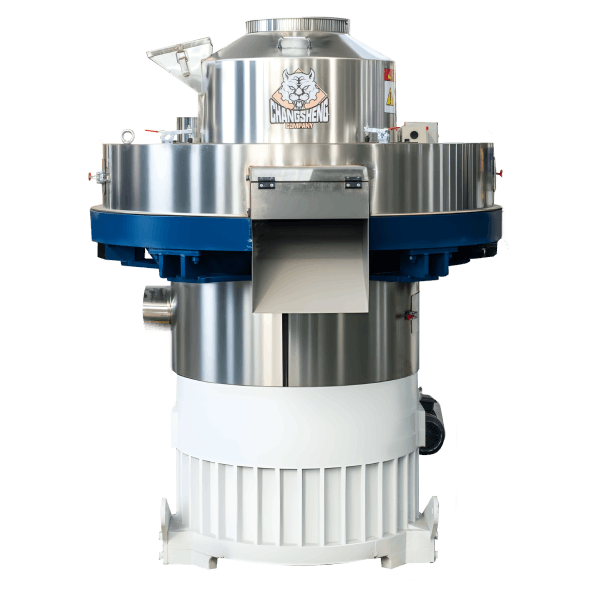
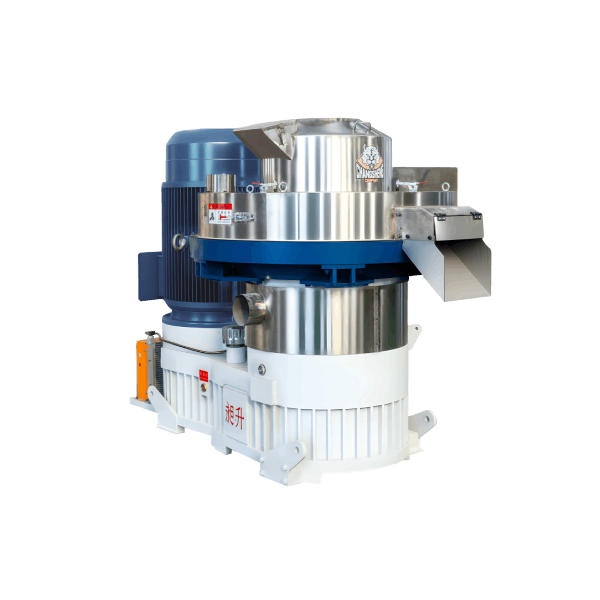
Pellet machine output vs motor power explained
News 2026-03-01
Pellet Machine Output vs Motor Power: Engineering Analysis for Industrial Projects
Product Definition
Pellet machine output vs motor power refers to the quantitative relationship between installed drive power (kW) and actual pellet production capacity (t/h) under defined raw material, moisture, and operating conditions. It is a core engineering indicator used to size equipment and estimate production efficiency in biomass pellet plants.
Why Pellet Machine Output vs Motor Power Matters
In industrial pellet production, motor power is often used as a quick reference for estimating capacity. However, pellet machine output vs motor power is not a simple linear ratio. Output depends on die configuration, material characteristics, compression ratio, feeding stability, and mechanical efficiency.
For procurement managers, EPC contractors, and technical directors, understanding pellet machine output vs motor power ensures:
• Correct transformer and power infrastructure sizing
• Accurate production forecasting
• Realistic ROI calculations
• Prevention of motor overload or underutilization
Engineering Relationship Between Output and Motor Power
Power-Based Estimation Formula
Output (t/h) = Motor Power (kW) ÷ Specific Energy Consumption (kWh/t)
Typical Specific Energy Consumption (SEC):
• Softwood: 80–100 kWh/t
• Hardwood: 90–120 kWh/t
• Agricultural residues: 70–110 kWh/t
Example Calculation
If a pellet mill has 250 kW motor power and operates at 100 kWh/t:
Output ≈ 250 ÷ 100 = 2.5 t/h
However, actual output must be adjusted using load factor (0.85–0.95) and mechanical efficiency.
Corrected Output = Theoretical Output × Efficiency Coefficient
This engineering framework defines realistic pellet machine output vs motor power expectations.
Technical Parameters and Practical Specifications
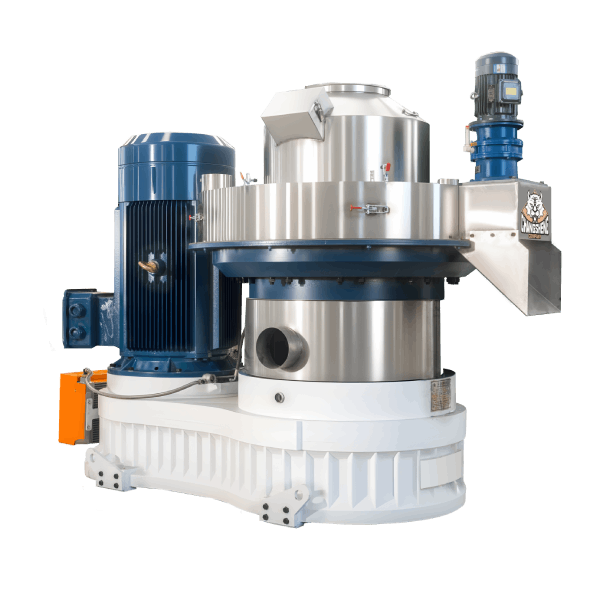
Typical Industrial Ring Die Pellet Mill
• Motor power: 132–355 kW
• Die diameter: 420–700 mm
• Effective die width: 80–120 mm
• Pellet diameter: 6–10 mm
• Optimal moisture: 10–14%
• Feed particle size: ≤5 mm
• Continuous load rate: 85–95%
Output Range by Power Class
132 kW → 1.0–1.5 t/h
160 kW → 1.5–2.0 t/h
250 kW → 2.5–3.5 t/h
315 kW → 3.5–4.5 t/h
355 kW → 4.0–5.0 t/h
These ranges reflect verified pellet machine output vs motor power performance under stable industrial conditions.
Structure and Material Composition
Understanding internal structure explains why pellet machine output vs motor power is influenced by more than just motor size.
- Ring Die
• Alloy steel (20CrMnTi)
• Compression ratio 1:5 to 1:8
• Precision drilled die holes - Press Rollers
• Carburized surface
• Adjustable hydraulic pressure - Main Shaft
• Forged alloy steel
• Designed torque safety margin ≥15% - Transmission System
• Hardened gear reducer
• High torque transmission efficiency - Lubrication System
• Automatic grease pump
• Temperature monitoring
Mechanical resistance and die wear directly influence energy consumption and therefore pellet machine output vs motor power ratio.
Manufacturing and Operating Workflow
Step 1: Raw Material Screening
Remove metal and stones to protect die and rollers.
Step 2: Size Reduction
Hammer mill ensures consistent particle size.
Step 3: Drying
Rotary dryer adjusts moisture to ideal compression range.
Step 4: Controlled Feeding
Variable frequency feeder maintains stable load.
Step 5: Pelletizing
Mechanical compression activates lignin binding at 70–90°C.
Step 6: Cooling and Screening
Counterflow cooler stabilizes pellet structure.
Stable process control ensures predicted pellet machine output vs motor power is achieved during continuous operation.
Industry Comparison
Evaluation Factor | Small Flat Die | Ring Die Industrial | High-Torque Gear Type
Motor Efficiency | Medium | High | Very High
Output Stability | Low | High | Very High
Energy Efficiency | 100–140 kWh/t | 80–110 kWh/t | 75–100 kWh/t
Suitability for Continuous Operation | Limited | Suitable | Optimal
Industrial ring die systems provide the most balanced pellet machine output vs motor power performance for large-scale plants.
Application Scenarios
Distributors
Use pellet machine output vs motor power data to recommend correct model sizes.
EPC Contractors
Design transformer capacity and cable sizing based on full-load amperage.
Engineering Consultants
Validate feasibility studies and production assumptions.
Importers and Wholesalers
Compare suppliers based on kWh per ton metrics.
Technical Managers
Monitor real-time amperage to ensure optimal load range.
Core Pain Points and Solutions
- Overestimated Production Capacity
Solution: Verify SEC data under real raw material conditions. - Motor Overload and Tripping
Solution: Maintain load factor below 95% continuous rating. - High Electricity Cost
Solution: Optimize die compression ratio and roller clearance. - Output Fluctuation
Solution: Stabilize moisture and particle size before pelletizing. - Die Wear Reducing Output
Solution: Replace die when output drops more than 15%.
Risk Warnings and Mitigation
• Avoid selecting equipment solely based on motor power rating.
• Do not assume constant SEC across different raw materials.
• Factor in ambient temperature and cooling efficiency.
• Always include 10–15% power reserve for stable operation.
Ignoring pellet machine output vs motor power engineering relationships may lead to inaccurate budgeting and infrastructure design.
Procurement and Selection Guide
- Define raw material type and density.
- Test moisture under storage conditions.
- Determine target pellet diameter and bulk density.
- Calculate output using power-based formula.
- Apply conservative SEC (upper range).
- Confirm continuous operation load factor.
- Compare supplier-provided kWh/t data.
- Validate 24-hour production test results.
Applying pellet machine output vs motor power evaluation during procurement minimizes operational risk.
Engineering Case Study
Project Location: Eastern Europe
Capacity Target: 4 t/h hardwood pellets
Equipment Configuration
• 315 kW ring die pellet mill
• Rotary dryer (3 t/h evaporation)
• Automated feeding and PLC control
Engineering Calculation
Theoretical Output = 315 ÷ 95 kWh/t = 3.31 t/h
Die-based mechanical calculation predicted 3.8 t/h.
After efficiency correction (0.9):
Actual predicted output = 3.4–3.6 t/h
Commissioning Data
Measured stable production: 3.5 t/h
Average energy consumption: 92 kWh/t
The real pellet machine output vs motor power ratio aligned closely with conservative engineering projections.
FAQ
- Is output directly proportional to motor power?
Not exactly; material and die design affect ratio. - What is typical kWh per ton?
80–120 kWh/t depending on material. - Can a larger motor increase output?
Only if die and feed system support higher load. - What is safe load factor?
85–95% of rated power. - Does hardwood require more power?
Yes, due to higher density. - Why does output decrease over time?
Die wear and roller clearance increase resistance. - Should cooling be included in power calculation?
Yes, for total plant load planning. - Is flat die suitable for large plants?
Generally not recommended for >2 t/h. - How to verify supplier claims?
Request long-duration production test data. - What margin should be included in transformer sizing?
At least 15–20%.
Request Technical Data or Quotation
For detailed pellet machine output vs motor power calculation sheets, energy benchmarks, or project-specific engineering evaluation, submit your raw material specifications and target capacity. A structured technical assessment and budgetary quotation can be provided upon request.
Authoritative Technical Statement (E-E-A-T)
This content is prepared by biomass pellet plant engineers with over 15 years of experience in industrial pellet mill design, power system integration, and plant commissioning. All parameter ranges reflect validated industrial data and conservative engineering standards applied in commercial biomass pellet facilities worldwide.