Pellet machine capacity calculation method guide
News 2026-03-01
Pellet Machine Capacity Calculation Method: Engineering Framework for Accurate Output Estimation
Product Definition
Pellet machine capacity calculation method refers to the engineering approach used to determine the real hourly production capability of a pellet mill based on die parameters, motor power, raw material properties, and operational efficiency. It bridges theoretical design output and verified industrial throughput.
Why Pellet Machine Capacity Calculation Method Matters
In biomass pellet projects, incorrect capacity estimation leads to oversized investment, unstable production, or energy inefficiency. The pellet machine capacity calculation method provides a structured way to estimate real output rather than relying solely on nameplate capacity.
For procurement managers and EPC contractors, this method ensures production targets, power infrastructure, and ROI projections are technically aligned.
Core Capacity Calculation Formula
The pellet machine capacity calculation method typically integrates mechanical and material variables.
Basic Throughput Formula
Q = (A × v × ρ × η)
Where:
Q = output (t/h)
A = effective die hole cross-sectional area (m²)
v = extrusion velocity (m/s)
ρ = bulk density after compression (t/m³)
η = efficiency coefficient (0.75–0.90 in industrial operation)
Power-Based Estimation Method
Q = P / SEC
Where:
P = motor power (kW)
SEC = specific energy consumption (kWh/t)
Typical SEC range for wood biomass: 80–120 kWh/t
Thus, a 250 kW pellet mill under 100 kWh/t theoretical energy use produces approximately 2.5 t/h.
However, real output must be corrected by load factor and feeding stability.
Technical Parameters and Practical Specification Ranges
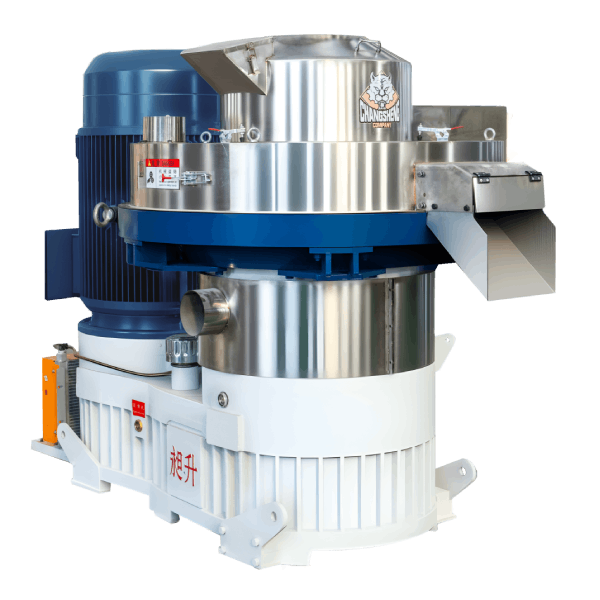
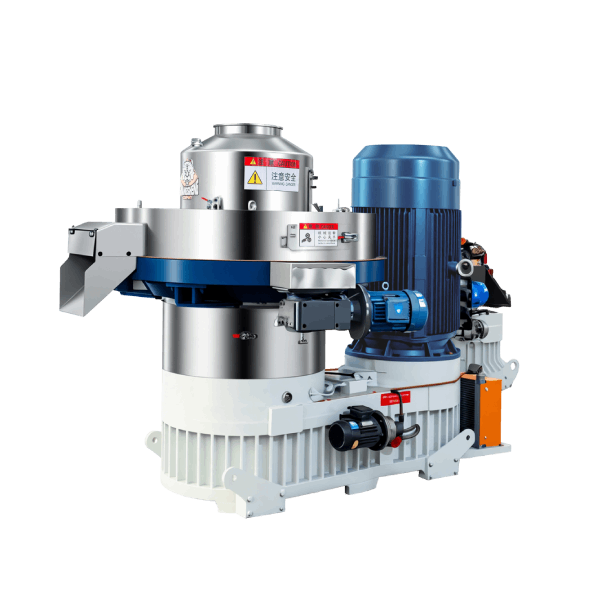
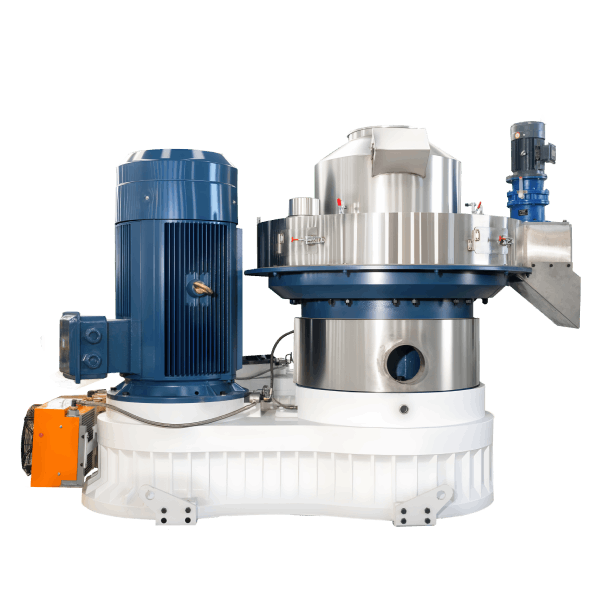
Industrial Ring Die Pellet Mill
• Die diameter: 520–700 mm
• Effective die width: 90–120 mm
• Motor power: 160–355 kW
• Roller configuration: 2 or 3 rollers
• Feed particle size: 3–5 mm
• Optimal moisture: 10%–14%
• Continuous operation: ≥20 hours/day
• Load factor during production: 85%–95%
Using the pellet machine capacity calculation method, realistic output is usually 10–20% lower than theoretical value due to friction loss, feeding variation, and mechanical tolerance.
Structure and Material Composition
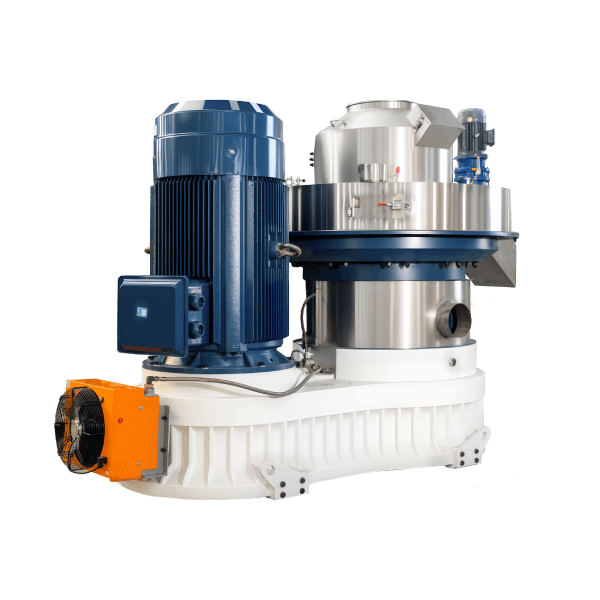
Accurate pellet machine capacity calculation method depends on understanding machine structure.
- Ring Die
• Alloy steel (20CrMnTi)
• Controlled compression ratio (1:5 to 1:8)
• High-precision drilling - Press Rollers
• Surface carburized
• Adjustable pressure system - Main Shaft and Bearings
• Forged alloy steel
• Heavy-duty spherical roller bearings - Transmission System
• Hardened gear reducer
• Torque safety margin ≥15% - Automatic Lubrication System
• Programmable grease pump
• Temperature sensors
Mechanical durability influences efficiency coefficient (η) used in pellet machine capacity calculation method.
Engineering Manufacturing Workflow
Step 1: Raw Material Screening
Remove stones and metal contaminants.
Step 2: Size Reduction
Hammer mill reduces material to controlled granularity.
Step 3: Drying
Rotary dryer adjusts moisture to target range.
Step 4: Metered Feeding
Screw feeder ensures uniform feed rate.
Step 5: Pelletizing
Die compression generates temperature 70–90°C activating lignin binding.
Step 6: Cooling and Sieving
Counterflow cooler reduces temperature to ambient +5°C.
Each stage affects the variables used in pellet machine capacity calculation method.
Industry Comparison
Evaluation Method | Accuracy Level | Commercial Reliability | Risk Level
Nameplate Capacity | Low | Weak | High
Short-Term Load Test | Medium | Moderate | Medium
Power-Based Formula | Medium | Good | Medium
Pellet Machine Capacity Calculation Method (Integrated) | High | Strong | Low
Integrated calculation combined with field verification provides highest reliability.
Application Scenarios
Distributors
Use pellet machine capacity calculation method to set realistic customer expectations.
EPC Contractors
Estimate annual production:
Annual Output = Hourly Output × Operating Hours × Availability Rate
Engineering Consultants
Apply calculation model to validate feasibility studies.
Importers and Wholesalers
Compare suppliers based on power-to-output ratio.
Technical Directors
Monitor real-time amperage and throughput to validate theoretical assumptions.
Core Pain Points and Solutions
- Overstated Output Claims
Solution: Apply power-based pellet machine capacity calculation method and verify SEC. - Energy Cost Underestimation
Solution: Use actual kWh/t data from comparable projects. - Inconsistent Production Rate
Solution: Stabilize feed moisture and particle size. - Die Wear Affecting Output
Solution: Include die wear coefficient in efficiency factor. - Motor Overload Issues
Solution: Ensure 10–15% power reserve in design stage.
Risk Warnings and Mitigation
• Do not calculate capacity based solely on motor power.
• Avoid ignoring moisture variability.
• Validate density assumptions with laboratory testing.
• Consider ambient temperature impact on cooling efficiency.
Improper application of pellet machine capacity calculation method may distort ROI and cash flow projections.
Procurement and Selection Guide
- Define raw material type and density.
- Measure moisture content under real storage conditions.
- Confirm required pellet diameter and density.
- Apply both die-area formula and power-based formula.
- Adjust efficiency coefficient to 0.80–0.85 for conservative planning.
- Compare specific energy consumption across suppliers.
- Request 24-hour production validation data.
- Include maintenance downtime in annual calculation.
Using pellet machine capacity calculation method during procurement reduces operational uncertainty.
Engineering Case Example
Project: 6 t/h Biomass Pellet Line
Location: Southeast Asia
Raw Material: Mixed hardwood
Machine Configuration
• One 355 kW ring die pellet mill
• Rotary dryer with 5 t/h evaporation
• Automated feeding control
Calculation Stage
Theoretical power-based output:
355 kW / 95 kWh/t = 3.74 t/h
Die-area formula predicted 4.2 t/h.
Efficiency coefficient adjusted to 0.85.
Final predicted output:
3.7–4.0 t/h
After commissioning, measured stable output: 3.9 t/h over 20-hour continuous run.
This confirms correct application of pellet machine capacity calculation method aligned closely with real industrial performance.
FAQ
- What is the most reliable calculation method?
Integrated die-area and power-based formula. - Why is rated capacity different from real output?
Rated capacity assumes ideal conditions. - What is typical efficiency coefficient?
0.75–0.90 depending on material. - Does hardwood reduce output?
Yes, due to higher density. - How does moisture affect calculation?
Higher moisture lowers extrusion efficiency. - Can motor power alone determine output?
No, it must be combined with SEC. - What is acceptable deviation?
10%–20% from theoretical values. - Should downtime be included?
Yes, in annual production forecasting. - How often should SEC be measured?
During commissioning and quarterly audits. - Can automation improve output predictability?
Yes, especially moisture and feed control systems.
Request Technical Documentation or Quotation
For detailed pellet machine capacity calculation method worksheets, SEC benchmarks, or project-specific engineering evaluation, submit your material data and target capacity. Our engineering team will provide a structured calculation report and budgetary quotation.
Authoritative Technical Statement (E-E-A-T)
This article is prepared by biomass pellet plant engineers with over 15 years of experience in mechanical design, process optimization, and industrial commissioning. All data ranges reflect validated production benchmarks from operational biomass pellet facilities and conservative engineering calculation standards used in commercial projects worldwide.