Wet Sawdust Clogging a Pellet Mill: Causes and Fixes
News 2026-10-31
Wet sawdust clogging a pellet mill is usually blamed on moisture. Often moisture is involved, but it is rarely the whole story, and treating it as the only variable is how operators end up buying a dryer that does not solve the problem. The fastest way to fix a clogged pellet mill is to identify where the blockage actually forms. The same wet sawdust, at the same moisture content, can bridge in the feeder, blind the die, or plug the discharge chute, and each of those points to a different root cause and a different correction.
This guide is written for operators who are clearing blockages right now and for buyers who are configuring a line that has to run on wet sawdust without choking. It separates the clogging locations, explains how moisture, particle size, and die specification interact, and shows when drying is the right fix and when it is not. Shandong Changsheng Machinery works with overseas buyers on exactly this kind of configuration question, and the diagnostic logic below reflects the way these lines are actually specified and commissioned.
Start with the conclusion
Wet sawdust clogs a pellet mill because water raises friction between the sawdust and the die wall, reduces the material’s ability to flow and compact evenly, and can cause feed to bridge before it ever reaches the die. But moisture acts together with particle size distribution, bulk density, and die compression ratio. A mill can clog at a moisture level that looks acceptable on a specification sheet if the sawdust is too fine, too fluffy, or the die is too aggressive for the feedstock.
The practical rule, then, is simple: measure moisture, but diagnose by location, and check particle size and die specification before you assume a dryer will solve a wet sawdust clogging problem.
Find where it clogs first
Before changing any setting, confirm where the blockage forms. The word clogging describes four different failure modes, and they do not share a cause.
Clogging at the feed inlet or feeder shows up as bridging or rat-holing. If wet sawdust stops flowing from the bin or feeder into the mill, the problem is flowability, not die pressure. Wet, fine sawdust tends to arch over openings and rat-hole in the bin. The mill runs starved rather than blocked, the feeder motor loads unevenly, and the die stays cool. This is a material-handling problem. Corrections usually involve feeder type, agitation, bin geometry, or reducing surface moisture before the feeder, not changing the die.
Clogging in the conditioner or steam zone looks different again. If the mill has a conditioner and material balls up or sticks there, moisture and heat are combining to make the sawdust tacky. This happens when wet sawdust is steamed without enough control over residence time. It is less common on simple sawdust lines without conditioning, but it matters whenever steam is used to assist pelletizing. The correction is usually conditioner residence time, steam quantity, or pre-drying, not die changes.
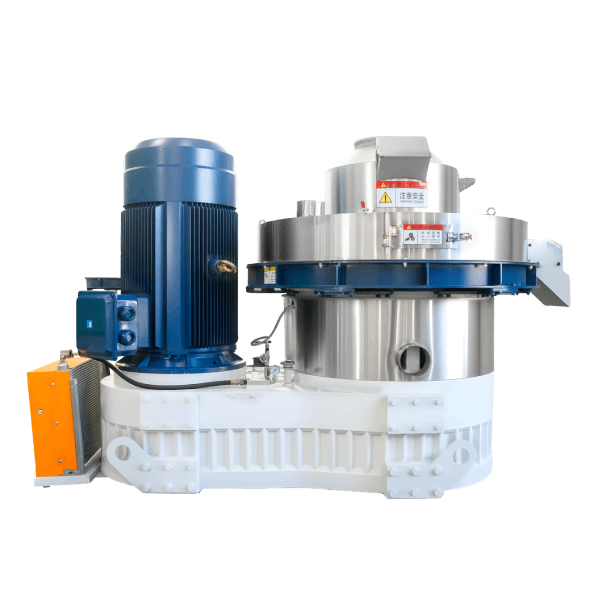
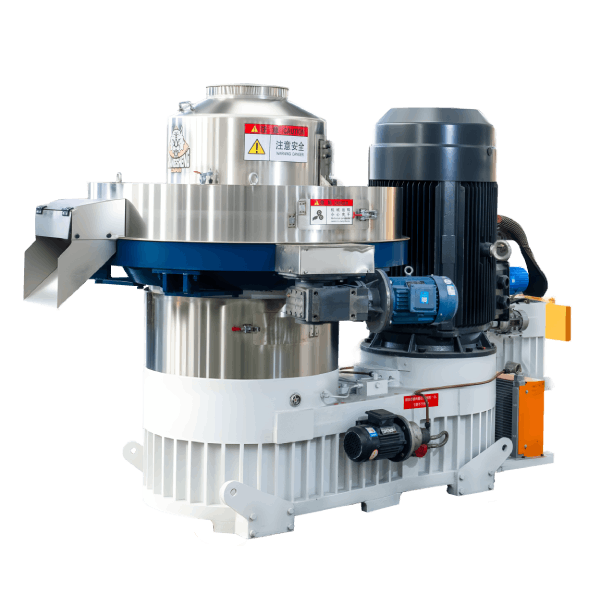
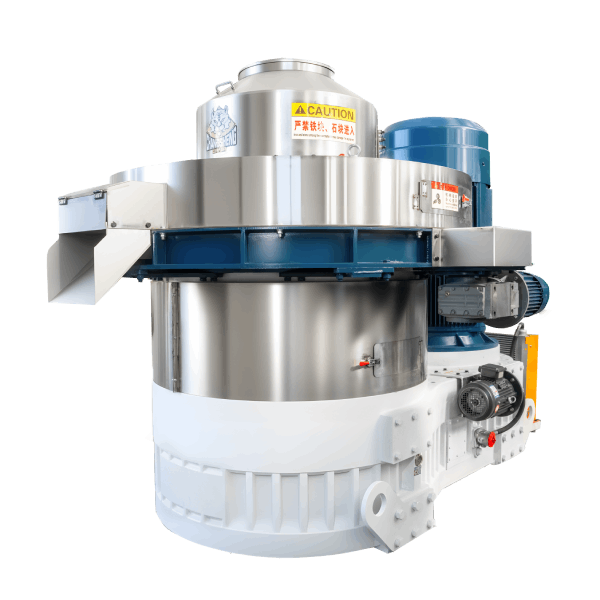
Clogging at the die is the classic wet sawdust clogging pellet mill symptom. Wet material slips under the rollers instead of being forced through the die holes. Holes blind over, the roller skids, throughput collapses, and die temperature drops. The cause is a combination of moisture, die compression ratio, and particle size, and this is where both drying and die specification can be the answer.
Clogging at the discharge or chute points downstream. If formed pellets or partially formed material plug the discharge, the issue is cooling, conveying, or chute angle. Wet or soft pellets that deform and stick are a sign the die is producing weak pellets, which loops back to moisture and die specification, but the immediate fix is often discharge geometry and cooling rather than the mill itself.
Why wet sawdust clogs: the mechanism, not the label
In a pellet mill, the die and rollers generate pressure and friction that heat and compact the material. Lignin in the sawdust softens under that heat and pressure and acts as a natural binder. Water changes both sides of that equation. Too much moisture lowers friction and die temperature, so the material slips rather than compacts. It also occupies space in the die holes and reduces the material’s ability to densify. The result is weak, soft pellets, blinded holes, and reduced throughput.
Wet is not a single number either. Sawdust can carry surface moisture, which is free water on the surface from rain or storage, and inherent moisture, which is bound in the fiber. Surface moisture affects flowability and feeder bridging more than die behavior; inherent moisture affects compaction and die temperature. Two sawdust samples at the same total moisture can behave differently depending on how much is surface water and how the material has been stored. That is why a single moisture reading does not fully predict whether a pellet mill will clog.
Moisture is necessary but not sufficient
The mistake that leads to the wrong equipment is treating moisture as the only variable. At the die, three variables interact.
Moisture content comes first. There is no universal correct moisture number for all sawdust and all dies. The workable range depends on sawdust type, particle size, die compression ratio, and whether steam or binder is used. A number quoted for one feedstock and die should not be copied to another. What matters is whether the material can be compacted at the die without slipping and without blinding, and that has to be confirmed by testing the actual sawdust on the actual die configuration.
Particle size distribution and bulk density come second. Very fine, dry sawdust from sanding operations behaves differently from coarse sawdust from a sawmill. Fine material has high surface area, lower bulk density, and a greater tendency to bridge at the feeder and to blind die holes when wet. Coarse material feeds and compacts differently. A line designed around an average sawdust size can clog when the actual feed shifts finer or wetter, which is why particle size distribution and bulk density should be measured rather than assumed.
Die compression ratio and hole specification come third. Compression ratio, the ratio of hole length to hole diameter, controls how much resistance the material meets. A die with a high compression ratio is aggressive and suits dry, well-prepared material; run wet sawdust through it and the mill may stall, slip, or blind. A die matched to the feedstock and moisture is part of the solution. Hole diameter, open area, and roller clearance all interact with moisture, and changing the die is sometimes a more direct fix than adding drying capacity, though sometimes it is not enough on its own.
The practical implication is worth stating plainly. If the mill clogs at the die, do not assume a dryer is the only answer. Confirm moisture, particle size, and die specification together, because any one of the three can be the limiting factor in wet sawdust clogging a pellet mill.
When drying is the right fix, and how to size it
Drying is the right fix when the sawdust is genuinely too wet for the die and feedstock combination, and when moisture is high enough that no die specification can compensate. At that point the question is not whether to dry but how much drying capacity, matched to what throughput.
Dryer sizing is a system calculation, not a catalog lookup. The dryer must remove enough water to bring the actual incoming sawdust to a moisture level the die can handle, at the mass flow rate the mill needs to hit its target output. If the dryer is undersized, the mill runs wet part of the time and clogs intermittently, which is one of the most common and most misdiagnosed line problems. If the dryer is oversized, energy cost rises and over-drying risk increases. The sizing basis should be the actual incoming moisture range and the target moisture at the die, not a nominal average. This is one of the details Shandong Changsheng Machinery asks buyers to confirm before a line configuration is proposed, because a dryer sized on an average moisture figure is a reliable way to keep a mill running wet at the worst part of the season.
Over-drying creates its own problems. Very dry, fine sawdust becomes dusty, flows poorly, and may not compact well without re-moistening or conditioning. Over-dried material can also increase fire and dust risk in handling. Some lines intentionally dry to a controlled level and then re-moisten or condition before the mill. A dryer does not mean as dry as possible; it means dry enough, and controlled.
Dryer type matters less than the sizing basis. Rotary dryers are common for sawdust at larger throughputs, while flash or other continuous dryers may suit specific layouts. The right choice depends on throughput, initial moisture, available heat source, footprint, and dust control, and it should be made against the actual sawdust data rather than a generic assumption.
When drying is not the fix
If moisture is already in a workable range for the feedstock but the mill still clogs, drying more will not help and may make things worse. Look elsewhere.
Die specification changes come first. A die that is too aggressive for the feedstock and moisture can cause slipping and blinding. Reviewing compression ratio, hole diameter, and open area against the actual sawdust can resolve die clogging without changing the drying system, and this should be done with the die supplier or mill manufacturer using real material data.
Feeder and conditioning adjustments come next. If clogging is at the feeder, the issue is flow. Feeder type, agitation, bin geometry, and feed rate control matter more than moisture reduction alone. Uniform feed also stabilizes die temperature and reduces intermittent clogging at the die.
Particle size correction is the third lever. If the sawdust is too fine or too variable, a hammer mill or screening step can bring the particle size distribution into a range the die handles well. This is often overlooked because attention stays fixed on moisture.
A practical diagnostic sequence
Confirm the blockage location first, whether feeder, conditioner, die, or discharge, because it determines everything that follows. Then measure actual moisture of the sawdust as fed, not from a supplier certificate, and note the range over a shift rather than a single reading. Check particle size distribution and bulk density, since fine, fluffy, wet sawdust behaves differently from coarse sawdust. Record the die specification, including compression ratio and hole diameter, and compare it with the feedstock and moisture.
From there, decide the limiting factor. If moisture is clearly above the workable range for the die, drying is indicated. If moisture is in range and the die is blinding, review die specification and particle size first. Change one variable at a time and watch throughput, die temperature, and pellet quality, and avoid changing dryer settings and die specification simultaneously. Confirm with a test on the actual sawdust before committing to equipment changes.
What to specify to a supplier so the line does not clog
Most clogging problems in new lines trace back to incomplete information at the quotation stage. Before requesting a configuration, provide the sawdust source and type, whether sawmill, sanding, mixed, or an agricultural blend. Give the actual moisture range as received, including seasonal variation, and the particle size distribution and bulk density, or a sample for testing. State the target capacity in tons per hour and the target pellet diameter, the available power supply with voltage, frequency, and phase, and whether steam, binder, or conditioning is intended. Add site conditions such as ambient humidity, storage, and whether the sawdust is stored covered.
Ask the supplier to state the dryer sizing basis, meaning the incoming moisture range and the target moisture, the die specification matched to your sawdust, and the acceptance test to be run on your material. A quotation that lists capacity and motor power but omits these items leaves the wet sawdust clogging risk with you.
Procurement risks that show up later as clogging
A capacity mismatch is common. The mill is rated on dry material, the line runs on wet sawdust, real throughput is lower, and clogging gets blamed on the mill. Dryer undersizing is just as common, with the dryer sized on average moisture rather than the wet end of the range, so the mill runs wet intermittently. A die chosen for general biomass rather than the actual sawdust and moisture will blind and slip. Missing dust and fine handling lets wet fines bridge and blind, because dust control was treated as an afterthought. An unclear performance guarantee leaves no agreed acceptance test on the buyer’s material, so clogging disputes have no reference point. An incomplete quotation designs feeder, conditioner, dryer, and discharge separately rather than as a matched system.
Bottom line
Wet sawdust clogging a pellet mill is a system symptom, not a single fault. Locate the blockage first, then check moisture, particle size, and die specification together. Dry when the moisture genuinely exceeds what the die can handle, and size the dryer to the wet end of the actual range rather than an average. When moisture is already workable, correct the die, feeder, or particle size instead of drying harder. Specify the full material data to your supplier so the line is configured for your sawdust, and agree on an acceptance test before shipment.