Pellet Mill Motor Overload Fix: A Complete Troubleshooting and Prevention Guide
News 2026-09-15
Page SEO Summary: This troubleshooting guide helps pellet mill operators and maintenance engineers diagnose and fix pellet mill motor overload problems—covering root causes, corrective actions, parameter adjustments, and prevention strategies for continuous production.
A pellet mill motor overload stops production immediately. The amperage spikes, the overload relay trips, and the machine shuts down. For operators, this is one of the most common and most disruptive problems in pellet production. But resetting the breaker is not a fix. It is only a delay. The real work begins with understanding why the pellet mill motor overloaded in the first place.
This guide is written for the people who have to keep the line running: plant managers, maintenance engineers, and procurement professionals who need to understand what causes motor overload, how to diagnose it systematically, and how to prevent it from happening again.
Start With the Amperage, Not the Breaker
The first mistake most operators make when a pellet mill motor overload occurs is resetting the overload relay and restarting the machine. This is dangerous. If the root cause is still present—a clogged die, a wet batch of material, a misaligned coupling—the motor will overload again, and each event brings it closer to winding failure.
A pellet mill motor is designed to run at a specific full load amperage (FLA), which is stamped on the motor nameplate. For a typical 110 kW motor running on a 380V three-phase supply, full load current is roughly 200 A. The overload relay should be set at approximately 105 to 110 percent of FLA, meaning it trips around 210 to 220 A. If the motor is tripping at a much lower current, the relay may be misconfigured. If it is tripping at the correct point, the machine is genuinely overloaded.
Before touching anything, record three things: the amperage at the moment of trip, the motor temperature, and the operating condition, including feed rate, material batch, and time since startup. These three data points often point directly to the cause of the pellet mill motor overload.
The Five Root Causes of Motor Overload
In practice, motor overload on a pellet mill almost always traces back to one of five categories. Experienced maintenance teams work through them in order, from most likely to least likely.
Material problems are the most common cause. Material that is too wet, above 15 percent moisture, requires significantly more energy to compress. The motor draws more current to push the same volume through the die. Material that is too coarse, with particles above 5 mm, has the same effect: the die resists flow, and the motor labors. Conversely, material that is too dry can cause excessive friction and binding, also raising motor load. The relationship is not linear, and every material has its own optimal moisture window, usually 10 to 12 percent for wood and slightly higher for some agricultural residues.
Die condition is the second most common cause. A clogged die, even partially clogged, forces the motor to work harder to push material through the remaining open holes. A worn die with enlarged holes may seem like it should reduce load, but in practice, worn dies often cause uneven flow, which leads to surging and overload. A die with the wrong compression ratio for the material is a specification error that will cause chronic overload until corrected.
Roller condition and gap come third. If the roller gap is too narrow, the rollers press too hard against the die, dramatically increasing friction and motor load. If rollers are worn, they lose grip, and material slips instead of being compressed. The motor spins but does not move material efficiently, and load fluctuates. Roller bearings that are worn or under-lubricated add friction that the motor must overcome.
Operational factors, including feed rate, conditioning temperature, and startup procedure, are next. Feeding material too fast, especially at startup before the die has warmed up, is a classic cause of overload trips. Insufficient steam conditioning means the material enters the die cold and hard, requiring more force. A cold die at startup is particularly vulnerable: the first few minutes of operation should always be at reduced feed rate until the die reaches operating temperature.
Electrical and mechanical issues are less common but more serious when they occur. Low voltage, below 90 percent of rated, forces the motor to draw higher current to deliver the same power. Phase imbalance across the three supply lines causes uneven heating and torque. Loose terminal connections increase resistance and heat. On the mechanical side, worn main shaft bearings, a failing gearbox, or a misaligned coupling all increase the load the motor must drive.
Diagnosing the Cause in the Field
A systematic diagnosis takes about thirty minutes and saves hours of trial and error. Start by inspecting the die. Remove it if necessary and check for clogged holes. A partially clogged die is often visible as a ring of blocked holes on the die face, or as uneven pellet extrusion across the working surface.
Next, check the roller gap. Use a feeler gauge between the roller and the die at several points around the circumference. The gap should be consistent and within the manufacturer’s specification, typically 0.2 to 1.0 mm depending on material. An uneven gap indicates misalignment or a bent shaft.
Then check the material. Take a moisture reading from the current batch. If the reading is above 14 percent, drying is the issue. If below 10 percent, the material may need moisture addition. Check particle size with a sieve. If more than 10 percent of the sample is above 5 mm, the hammer mill screen may be worn or the grinding process is inconsistent.
Finally, check the electrical supply. Measure voltage at the motor terminals under load, not at the panel. A voltage drop of more than 5 percent between no-load and full-load indicates an undersized supply cable or a loose connection. Measure current on each phase. An imbalance of more than 2 percent points to a supply problem.
If you need help interpreting these readings for your specific material and motor, our engineers can review your operating data and recommend corrective action.
Corrective Actions That Actually Work
Once the cause is identified, the fix is usually straightforward, but it must address the root cause, not the symptom.
If the die is clogged, clean it thoroughly. Do not force material through with steel tools. Use a brass or copper rod, or soak the die in oil if the material has hardened. If the die is worn or has the wrong compression ratio, replace it. A die is a consumable, and continuing to run a worn die costs more in motor stress and downtime than a replacement die costs.
If the roller gap is incorrect, adjust it according to the manufacturer’s procedure. This is not a task to rush. Take the time to set the gap evenly at multiple points. If rollers are worn, replace them. Worn rollers cannot be restored by adjustment.
If the material is out of specification, correct it before restarting. Dry wet material, add moisture to overly dry material, or regrind coarse material. It is far cheaper to fix the material than to replace a motor.
If the electrical supply is the problem, address it at the source. Check transformer capacity, cable sizing, and terminal tightness. In some cases, a soft starter or variable frequency drive can reduce starting current and smooth the load profile, but this is an engineering decision that should be made with the motor supplier’s input.
Preventing Recurrence: The Operating Discipline That Matters
Motor overload is almost always a symptom of an operating discipline problem. The plants that avoid it share a common set of practices.
They monitor amperage continuously, not just at the panel but with a dedicated ammeter that operators can see. They train operators to recognize the early signs of overload, including a slow rise in amperage, a change in pellet quality, or a slight increase in motor noise, before the relay trips.
They control material moisture rigorously. A moisture meter at the intake is not optional equipment. It is the first line of defense against pellet mill motor overload. They check die and roller condition on a fixed schedule, not when a problem appears.
They follow a proper startup procedure every time: warm the die with a small amount of material, increase feed gradually, and watch the amperage as the die reaches temperature. This single practice prevents a large share of overload events.
They also maintain spares. A spare die, a set of rollers, and a spare set of bearings on the shelf mean that when a component wears out, it is replaced in hours, not days, and the motor is not run beyond its limits while waiting for parts.
A Case From the Field
A wood pellet plant in Eastern Europe running a 110 kW pellet mill was tripping the overload relay two to three times per shift. Production uptime had fallen to about 60 percent. The maintenance team had reset the relay repeatedly and replaced the motor once, without solving the problem.
A systematic diagnosis found three overlapping issues. The die was partially clogged and worn, with an enlarged hole pattern that caused surging flow. The roller gap had been set too narrow, at 0.1 mm instead of the specified 0.3 mm, by an operator trying to improve pellet density. The incoming material was averaging 16 to 18 percent moisture because the dryer was being run below its rated capacity to save fuel.
The fix required discipline rather than complexity. A new premium die was installed, the roller gap was reset to 0.3 mm, a moisture meter was installed at intake and the drying process was adjusted to target 11 to 12 percent moisture, and the feed rate was stabilized. Within two weeks, overload trips had dropped to zero to one per week, amperage stabilized at 190 to 200 A, and uptime recovered to over 90 percent.
The lesson is consistent across the industry: a pellet mill motor overload is rarely a motor problem. It is a system problem, and the fix is in the system.
Procurement Notes for Buyers
For procurement professionals specifying a pellet mill, motor overload prevention starts at the selection stage. Specify a motor with a service factor of at least 1.15, and confirm the overload relay is correctly sized and adjustable. Confirm that the die specification matches the intended material. A die selected for softwood will overload on hardwood. Confirm that the supplier provides a moisture meter and a documented startup procedure as part of the package.
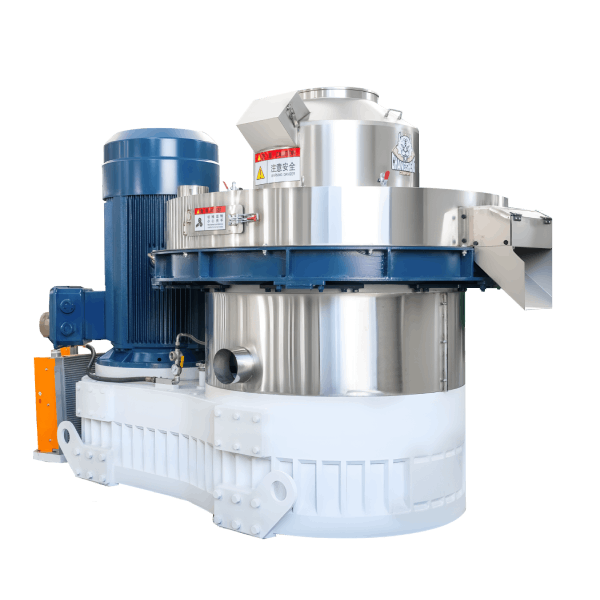
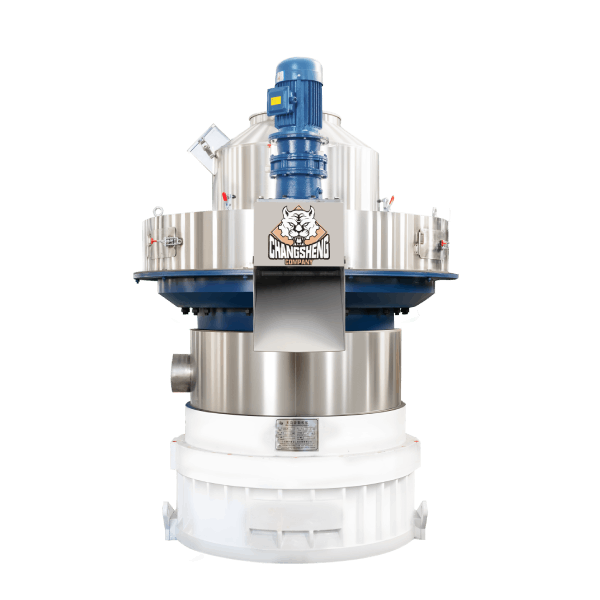
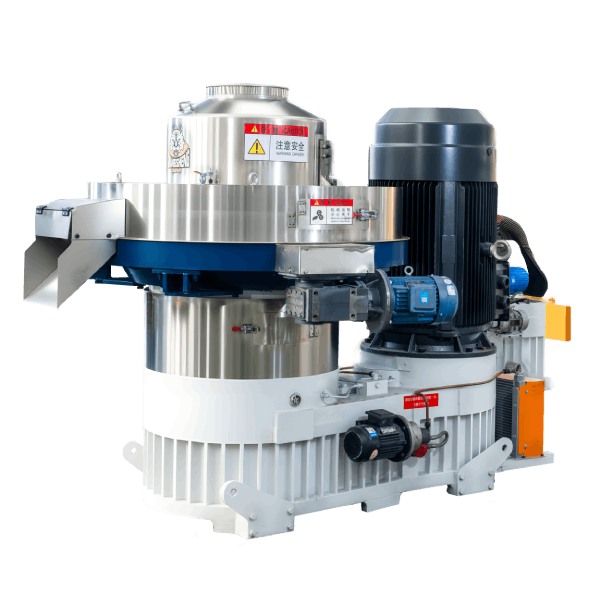
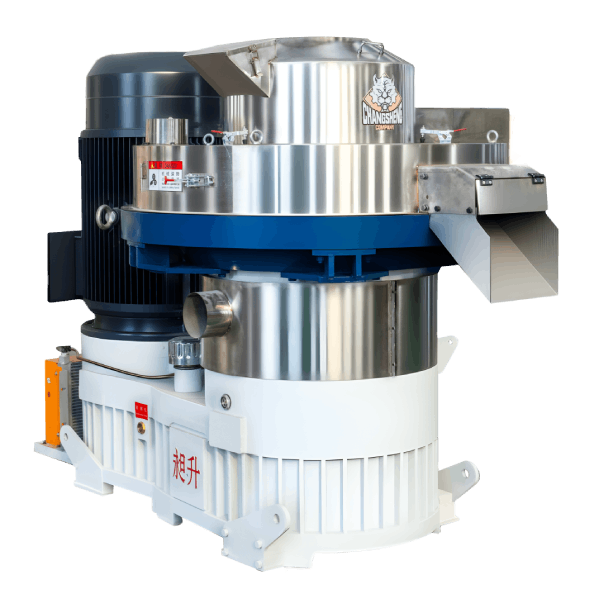
A pellet mill from Shandong Changsheng Machinery Co., Ltd. is supplied with a motor specification matched to the buyer’s site voltage and frequency, a die selected for the intended raw material, and a documented commissioning and startup procedure. For buyers who want to review the motor and control specification before purchase, technical documentation and drawings can be requested directly from the engineering team.
Frequently Asked Questions
1. What causes pellet mill motor overload?
The most common causes are high material moisture, a clogged or worn die, an incorrect roller gap, and excessive feed rate. Electrical issues such as low voltage or phase imbalance are less common but more serious.
2. How do I fix motor overload?
Stop the mill, identify the root cause, correct it by cleaning or replacing the die, adjusting the roller gap, or fixing the material, then reset the relay and restart with close amperage monitoring. Never simply reset the relay and restart.
3. What is the most common cause?
High moisture content and a clogged die together account for the majority of overload events in the field.
4. What roller gap should I use?
Typically 0.2 to 1.0 mm depending on the material and die. Start at the manufacturer’s specification and adjust based on amperage and pellet quality. Do not narrow the gap to improve density, as this overloads the motor.
5. Can low voltage cause overload?
Yes. A motor running below 90 percent of rated voltage draws higher current to deliver the same power. Measure voltage at the motor terminals under load.
6. What should I do if the overload relay keeps tripping?
Investigate the root cause. Do not increase the relay setting. Increasing the setting allows the motor to run beyond its design limit and risks winding failure.
7. Can motor overload damage the motor?
Yes. Repeated overload causes winding insulation degradation, bearing failure, and eventually motor burnout. Each trip shortens motor life.
8. How do I prevent motor overload?
Control moisture and particle size, maintain die and rollers, set the roller gap correctly, monitor amperage, and follow a proper startup procedure every time.
9. How do I monitor motor load?
Install an ammeter visible to the operator. Normal operating range is 80 to 95 percent of full load amperage. A slow upward trend indicates developing problems.
10. Should I add a VFD or soft starter?
For large motors on weak grids, a soft starter or VFD reduces starting current and smooths the load profile. This is an engineering decision to be made with the motor supplier.
About the Author
Zhang Wei – Senior International Sales Engineer, Shandong Changsheng Machinery Co., Ltd.
Zhang Wei has over 12 years of experience in the biomass and feed pellet mill industry, with a background in mechanical engineering and international project execution. He has helped clients across Southeast Asia, the Middle East, Africa, Europe, and Latin America diagnose and fix motor overload problems in pellet production lines.
With hands-on experience in both the manufacturing workshop and client-side operations, Zhang brings practical insights into successful troubleshooting, from the factory floor to the customer’s production site.