Pellet Manufacturing Equipment: Complete System Planning Guide
News 2026-08-21
Page SEO Summary: This comprehensive guide helps you plan a pellet manufacturing system—covering equipment types, process flow, capacity options, investment costs, and project implementation.
Pellet manufacturing is a growing industry that converts raw materials into valuable products—wood pellets for heating, feed pellets for livestock, and biomass pellets for energy. A complete pellet manufacturing system requires careful planning and the right equipment.
This guide provides a comprehensive framework for understanding, selecting, and planning pellet manufacturing equipment.
What Is Pellet Manufacturing Equipment?
Definition
Pellet manufacturing equipment refers to the complete system of machinery used to process raw materials into finished pellets. The system includes preparation, processing, and finishing equipment.
Products
| Product | Application | Equipment Focus |
|---|---|---|
| Wood pellets | Heating; power | Wood pellet mills |
| Feed pellets | Animal nutrition | Feed pellet mills |
| Biomass pellets | Energy | Biomass pellet mills |
Main Equipment Types
1. Raw Material Preparation
| Equipment | Function | Specifications |
|---|---|---|
| Receiving hopper | Accept raw material | Match delivery |
| Conveyor | Move material | Capacity match |
| Screening | Remove debris | Match capacity |
| Magnetic separator | Remove metal | Protect equipment |
2. Drying Equipment
| Equipment | Function | Specifications |
|---|---|---|
| Rotary dryer | Reduce moisture | 10-12% moisture |
| Belt dryer | Gentle drying | Lower capacity |
3. Grinding Equipment
| Equipment | Function | Specifications |
|---|---|---|
| Hammer mill | Size reduction | 2-5 mm particle size |
| Crusher | Primary reduction | Tough materials |
4. Pelletizing Equipment
| Equipment | Function | Specifications |
|---|---|---|
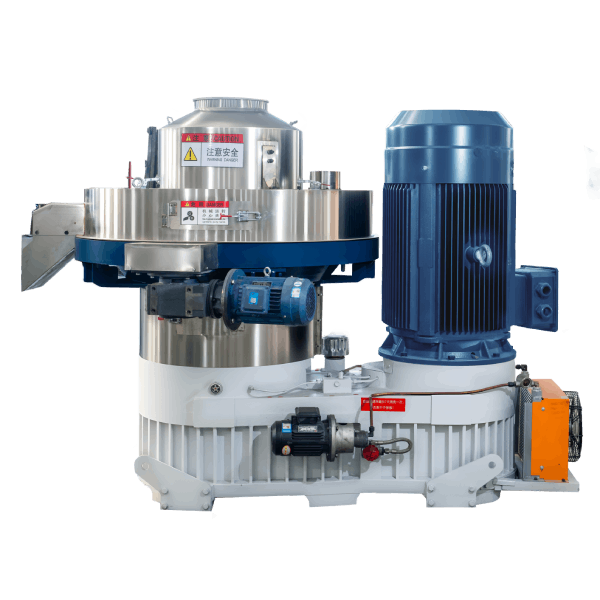
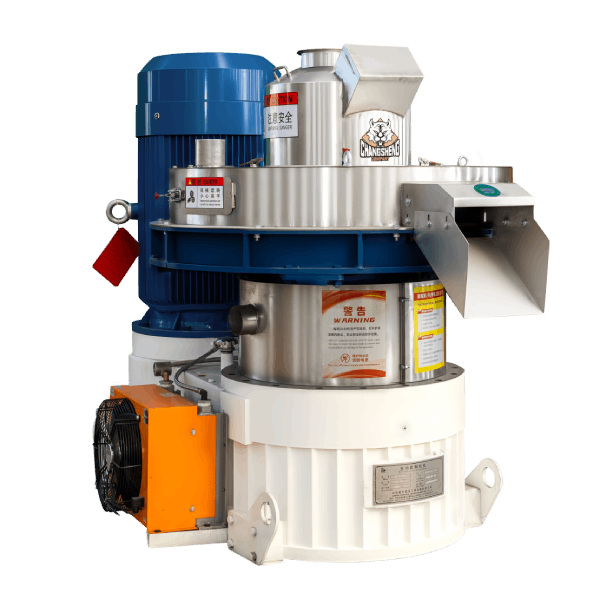
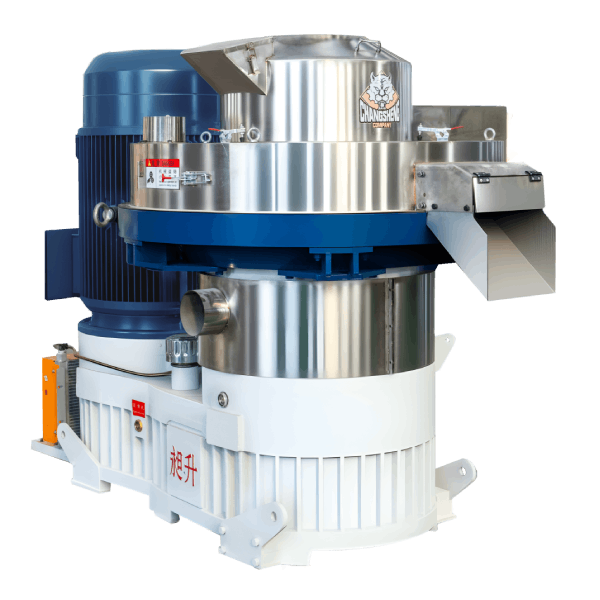
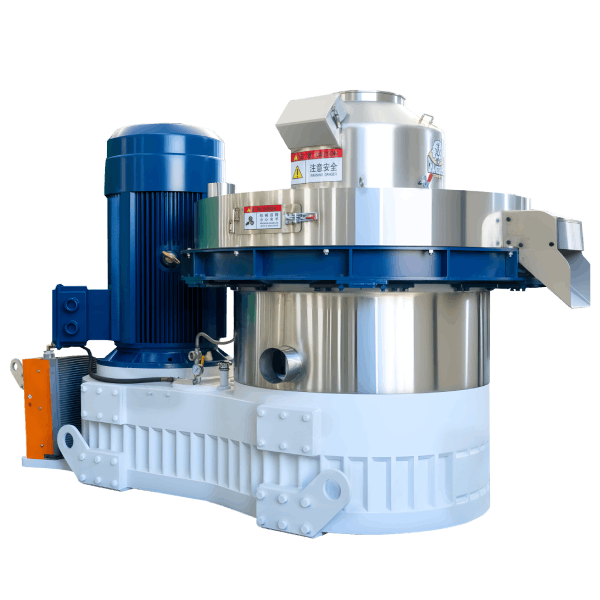
| Pellet mill | Form pellets | Ring die; flat die |
| Conditioner | Pre-heat material | 80-100°C |
5. Post-Processing
| Equipment | Function | Specifications |
|---|---|---|
| Cooler | Cool pellets | Ambient |
| Screening | Remove fines | Fines return |
| Packaging | Bag or bulk | Customer preference |
6. Control System
| Equipment | Function | Specifications |
|---|---|---|
| Control panel | Central control | Manual or PLC |
| PLC system | Automation | HMI interface |
Production Process
Complete Process Flow
| Stage | Equipment | Parameters | Purpose |
|---|---|---|---|
| 1. Receiving | Hopper; conveyor | — | Raw material intake |
| 2. Screening | Vibrating screen | Remove debris | Protect equipment |
| 3. Drying | Dryer | 10-12% moisture | Reduce moisture |
| 4. Grinding | Hammer mill | 2-5 mm | Size reduction |
| 5. Conditioning | Conditioner | 80-100°C | Heat activation |
| 6. Pelletizing | Pellet mill | High pressure | Form pellets |
| 7. Cooling | Cooler | Ambient | Stabilize pellets |
| 8. Screening | Fines screen | — | Remove fines |
| 9. Packaging | Bagging | — | Final product |
Equipment Selection
By Material
| Material | Equipment Considerations |
|---|---|
| Wood | Standard configuration |
| Agricultural residues | Heavy-duty; higher compression |
| Abrasive materials | Premium die and rollers |
| Feed ingredients | Fine grinding; specific die |
By Scale
| Scale | Equipment | Typical Capacity |
|---|---|---|
| Small | Flat die | 30-300 kg/h |
| Medium | Ring die | 300-1,500 kg/h |
| Large | Multiple ring dies | 1.5-10+ t/h |
Capacity Options
Production Line Sizes
| Scale | Capacity | Annual Output | Typical Use |
|---|---|---|---|
| Small | 0.5-1 t/h | 1,000-3,000 tons | Small commercial |
| Medium | 1-3 t/h | 3,000-9,000 tons | Commercial |
| Large | 3-5 t/h | 9,000-15,000 tons | Industrial |
| Industrial | 5-10+ t/h | 15,000-30,000+ tons | Large-scale |
Equipment Capacity Matching
| Production Line | Pellet Mill | Dryer | Hammer Mill | Cooler |
|---|---|---|---|---|
| Small (0.5-1 t/h) | 0.5-1 t/h | 1-2 t/h | 1-2 t/h | 1-2 t/h |
| Medium (1-3 t/h) | 1-3 t/h | 2-4 t/h | 2-4 t/h | 2-4 t/h |
Investment Costs
Equipment Cost by Scale
| Scale | Equipment Cost (USD) | Complete Line Cost (USD) |
|---|---|---|
| Small (0.5-1 t/h) | $50,000-100,000 | $100,000-200,000 |
| Medium (1-3 t/h) | $100,000-250,000 | $200,000-500,000 |
| Large (3-5 t/h) | $250,000-500,000 | $500,000-1,000,000 |
| Industrial (5-10+ t/h) | $500,000-1,500,000 | $1,000,000-3,000,000+ |
Cost Breakdown
| Component | % of Total | Notes |
|---|---|---|
| Drying system | 20-30% | Largest cost |
| Pellet mill | 20-25% | Core equipment |
| Grinding | 10-15% | Hammer mill |
| Post-processing | 10-15% | Cooling; screening |
| Handling | 10-15% | Conveyors |
| Control | 5-10% | Automation |
Project Planning
Implementation Timeline
| Phase | Activities | Duration |
|---|---|---|
| 1. Feasibility | Market; raw materials; business case | 1-3 months |
| 2. Design | Process design; equipment selection | 2-4 months |
| 3. Procurement | Supplier selection; contracting | 1-2 months |
| 4. Manufacturing | Equipment production | 2-4 months |
| 5. Installation | Site prep; equipment installation | 2-4 months |
| 6. Commissioning | Testing; start-up | 1-2 months |
| Total | 9-19 months |
Key Success Factors
| Factor | Why Critical |
|---|---|
| Raw material supply | Must be reliable |
| Equipment quality | Affects reliability |
| Market demand | Must exist |
| Project management | On time; on budget |
Procurement Checklist
Project Definition
- □ Product type confirmed (wood/feed/biomass)
- □ Raw material identified
- □ Capacity target confirmed
- □ Budget established
Equipment Planning
- □ Complete equipment list developed
- □ Capacity matched across all equipment
- □ Space requirements confirmed
- □ Utility requirements confirmed
Supplier Evaluation
- □ Multiple suppliers compared
- □ References contacted
- □ Factory visited/verified
- □ Proposals evaluated
Project Management
- □ Implementation timeline developed
- □ Milestones established
- □ Risk assessment completed
Frequently Asked Questions
1. What equipment is needed for pellet manufacturing?
Key equipment: receiving hopper, conveyor, dryer, hammer mill, conditioner, pellet mill, cooler, screening, and packaging. Auxiliary equipment includes magnetic separators and control systems.
2. What is the most important equipment?
The pellet mill is the core equipment, but the dryer is often the largest cost and most critical for quality.
3. What materials can be processed?
Wood (sawdust, chips), agricultural residues (straw, rice husk, corn stover), feed ingredients, and many other biomass materials.
4. How much does pellet manufacturing equipment cost?
Small lines: $100,000-200,000. Medium lines: $200,000-500,000. Large lines: $500,000-1,000,000+. Industrial: $1,000,000-3,000,000+.
5. What is the most expensive equipment?
Drying systems are typically the largest cost (20-30% of total). Pellet mills are the second largest.
6. How long does it take to implement?
Typically 9-19 months from planning to production, depending on scale and complexity.
7. What are the main challenges?
Raw material supply consistency, moisture control, equipment reliability, and market demand are the main challenges.
8. Do I need both drying and grinding?
Yes, unless your raw material is already at the correct moisture and particle size.
About the Author
Zhang Wei – Senior International Sales Engineer, Shandong Changsheng Machinery Co., Ltd.
Zhang Wei has over 12 years of experience in the biomass and feed pellet mill industry, with a background in mechanical engineering and international project execution. He has helped clients across Southeast Asia, the Middle East, Africa, Europe, and Latin America plan and implement pellet manufacturing projects.
With hands-on experience in both the manufacturing workshop and client-side operations, Zhang brings practical insights into successful project execution—from the factory floor to the customer’s production site.