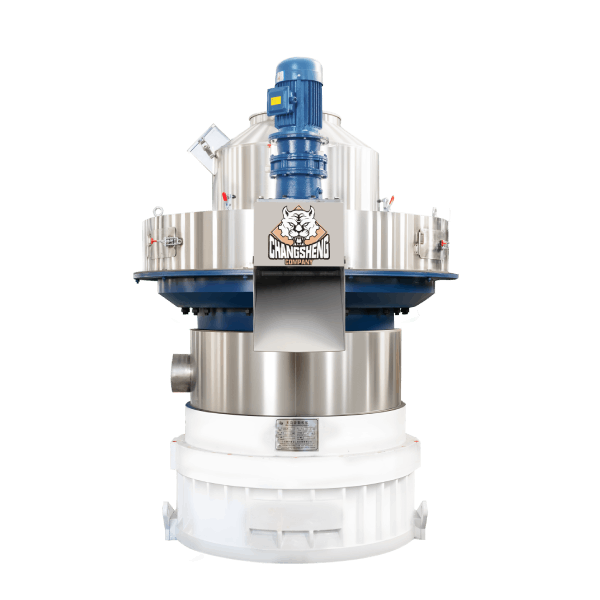
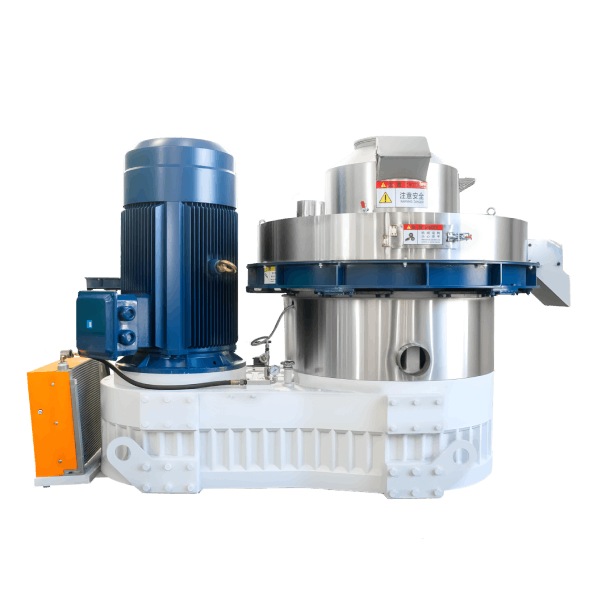
Pellet Mill Feeder Auger Screw 0.5-5t/h | Feeding System Guide
News 2026-06-26
Product Definition
A pellet mill feeder auger screw is a helical conveying device that transports conditioned mash or meal from a hopper into the pellet mill inlet at a controlled, adjustable rate. The auger screw ensures consistent material flow to the pelletising chamber, preventing feed starvation or overloading that causes production variability and mechanical stress.
Technical Specifications & Performance Parameters
| Parameter | Value Range / Specification |
|---|---|
| Feeding capacity | 0.5 – 5.0 t/h (feedstock-dependent) |
| Auger screw diameter | 100 – 300 mm |
| Auger screw length | 800 – 2,500 mm |
| Flight pitch | 80 – 250 mm (variable or constant) |
| Flight thickness | 6 – 12 mm |
| Shaft diameter | 40 – 100 mm |
| Drive motor power | 0.75 – 4.0 kW (IE3) |
| Auger speed (standard) | 20 – 80 rpm (variable via VFD) |
| Material temperature (max) | 95°C (for hot conditioned mash) |
| Screw material | Carbon steel (standard) or stainless steel (food-grade/corrosive) |
| Flight material | Abrasion-resistant steel (Hardox 400 or equivalent) |
| Bearing type | Flanged or pillow block (grease lubricated) |
| Typical flight life | 3,000 – 8,000 hours (feedstock-dependent) |
| Maintenance man-hours | 2 – 4 h / month (inspection and cleaning) |
Structural Composition & Material Selection
The feeder auger screw comprises precision-engineered components with defined material grades:
Auger Assembly
- Auger shaft: Carbon steel (45# / AISI 1045) or stainless steel (304/316L)
- Flighting: Abrasion-resistant steel (Hardox 400 or AR400) – welded to shaft
- Flight pitch: Constant or variable (tapered for compression)
- End bearings: Flanged or pillow block with heavy-duty seals
Drive System
- Gearmotor: Helical gearbox with VFD (0.75–4.0 kW)
- Coupling: Direct shaft coupling or chain drive
- Torque limiter: Overload protection for auger
Hopper Interface
- Inlet hopper: Steel (3–6mm) with optional agitator
- Level sensor: Capacitance or ultrasonic for flow control
- Feeder tube: Steel pipe with wear-resistant lining (optional)
Control Integration
- VFD: Speed control via 4–20mA signal from pellet mill
- Interlock: Auger stops when pellet mill stops
- Amperage feedback: Speed adjusts to maintain pellet mill load
Manufacturing Process – Engineering Workflow
Step 1 – Raw Material Storage & Conditioning
Conditioned mash (80–95°C, 14%–16% moisture) discharges from conditioner into surge hopper above auger feeder.
Step 2 – Metered Material Conveying
Auger screw rotates at controlled speed (20–80 rpm), conveying material along the tube. Flighting design ensures uniform flow without segregation.
Step 3 – Discharge to Pellet Mill Inlet
Material discharges from auger tube into pellet mill feed chute. Guide plates direct material uniformly across die face.
Step 4 – Integrated Flow Control
VFD adjusts auger speed based on pellet mill motor amperage feedback. Speed increases when mill load drops; decreases when load rises. Maintains optimal motor load (85%–95% FLA).
Step 5 – System Automation
PLC coordinates auger operation with pellet mill and upstream equipment. Auger stops automatically if pellet mill stops. Alarm for low hopper level or auger overload.
Industry Comparison – Feeding Auger Options
| Auger Type | Feed Accuracy | Maintenance | Cost | Typical Application |
|---|---|---|---|---|
| Variable Pitch Auger | ±3% | Moderate | High | Consistent flow, all materials |
| Constant Pitch Auger | ±5% | Low | Low-Medium | Free-flowing dry materials |
| Tapered Auger | ±4% | Moderate | Medium | Compacting, de-airing |
| Belt Feeder (Alternative) | ±3% | Low | Moderate | Hot/sticky materials |
| Vibratory Feeder | ±8% | Low | Low | Dry, free-flowing only |
Differentiation (Shandong Changsheng Machinery):
Our feeder auger screw features variable-pitch flighting – progressive reduction in pitch toward discharge reduces material compaction and ensures consistent flow. Hardox 400 flighting provides 2–3× longer wear life compared to standard carbon steel. VFD integration with pellet mill amperage feedback maintains optimal feed rate within ±3%. Complete auger assemblies are balanced to ISO 1940 G6.3 for vibration-free operation.
Application Scenarios by Buyer Role
Distributors / Importers
Focus on auger compatibility with standard pellet mill models. Require flight material options and wear life data for customer selection.
EPC Contractors
Integrating auger feeder into complete production lines. Need dimensional drawings, motor specification, and control integration details for system design.
Engineering Consultants / Technical Advisors
Evaluate auger feeding accuracy and wear life. Require energy consumption and maintenance data for operational cost modelling.
End-user Production Facilities
Processing variable feedstock with consistent quality requirements. Demand reliable auger feeding with minimal maintenance and wear.
Core Pain Points & Engineering Solutions
Pain Point 1 – Inconsistent feed rate causing motor load fluctuation
Root cause: Constant-pitch auger with no VFD feedback – material flow varies with hopper level.
Solution: Variable-pitch auger with VFD and amperage feedback. Maintains feed rate ±3% and motor load at 85%–95% FLA.
Pain Point 2 – Flighting wear from abrasive materials
Root cause: Standard carbon steel flighting wears rapidly when conveying abrasive feed ingredients or biomass.
Solution: Hardox 400 flighting (2–3× wear life). Replaceable flight segments reduce maintenance cost.
Pain Point 3 – Material bridging in auger tube
Root cause: Sticky or moist conditioned mash adheres to auger flights and tube wall – causing flow interruption.
Solution: Variable-pitch flighting reduces compression. Optional agitator in hopper. Anti-stick coating on auger tube.
Pain Point 4 – Auger bearing failure from contamination
Root cause: Material ingress into bearings from seal wear or inadequate sealing.
Solution: Heavy-duty seals with positive pressure purge. Labyrinth seals for dust protection. Grease lubrication at 8–12 hour intervals.
Critical Risk Warnings & Mitigation Measures
Risk 1 – Auger run-on when pellet mill stops
Mitigation: Install interlock – auger stops when pellet mill stops. Use PLC control with fail-safe logic. Manual reset required after interlock.
Risk 2 – Overloading from foreign objects in material
Mitigation: Install magnetic separator upstream. Torque limiter on auger drive protects against overload. Check tramp metal removal regularly.
Risk 3 – Flighting detachment from shaft
Mitigation: Full-penetration weld on flighting. Inspect weld integrity monthly. Replace auger if flighting shows cracking or separation.
Procurement Selection Guide – 7 Executable Steps
Step 1 – Determine required feed rate range
Match auger capacity to pellet mill throughput (0.5–5.0 t/h). Auger capacity should be 20%–30% above maximum requirement.
Step 2 – Analyse material characteristics
Temperature, moisture (12%–18%), bulk density, flowability, abrasiveness. Select flight material (standard, Hardox, or stainless) accordingly.
Step 3 – Select flight configuration
Constant pitch for free-flowing dry materials. Variable pitch for sticky or moist materials. Tapered for compacting/de-airing.
Step 4 – Specify auger dimensions
Screw diameter (100–300mm), length (800–2,500mm), and flight pitch (80–250mm). Consult factory for specific application.
Step 5 – Verify drive motor and VFD compatibility
Motor power 0.75–4.0 kW – match to pellet mill control system. VFD with 4–20mA or MODBUS integration. Confirm voltage and phase (400V, 3-phase).
Step 6 – Plan for control integration
Interlock with pellet mill starter. Amperage feedback for speed control. Hopper level sensor integration. Alarm outputs for SCADA.
Step 7 – Establish maintenance schedule
Weekly: visual inspection, bearing lubrication. Monthly: flighting wear measurement, seal inspection. Annual: auger shaft straightness check.
Engineering Case Study – Feed Mill in Thailand
Project Background
A pig feed mill in Nakorn Pathom operates a 90kW pellet mill at 2.5–3.0 t/h with conditioned mash temperature 85°C, moisture 15%. Previous auger feeder with constant pitch had feed rate variation ±8%.
Initial Problem
Inconsistent feed rate caused motor load fluctuation 75%–100% FLA – overload trips 2–3 times weekly. Pellet PDI varied 92%–96% due to feed rate changes. Constant-pitch auger flights wore after 4,000 hours.
Root Cause Analysis
Constant-pitch auger lacked flow control. Hopper level changes affected feed rate. Standard carbon steel flighting insufficient for abrasive feed ingredients (corn, soybean).
Solution Implemented
Installed Shandong Changsheng variable-pitch auger with Hardox 400 flighting. VFD control with 4–20mA feedback from pellet mill amperage. Hopper level sensor for consistency.
Final Data Results (12-month average)
| Metric | Before (Constant Pitch, Std Steel) | After (Variable Pitch, Hardox 400) |
|---|---|---|
| Feed rate variation | ±8% | ±2.5% |
| Motor load fluctuation | ±25% FLA | ±8% FLA |
| Overload trips (weekly) | 2.8 | 0.3 |
| PDI variation | ±4.0% | ±1.2% |
| Flight life | 4,200 h | 9,800 h |
Frequently Asked Questions (FAQ)
1. What does a feeder auger screw do?
It conveys conditioned mash or meal from the hopper to the pellet mill inlet at a controlled, adjustable rate.
2. What feed rate accuracy can I expect?
±3% with variable-pitch flighting and VFD control – significantly better than constant-pitch augers.
3. What flight material is recommended?
Hardox 400 for abrasive feed ingredients – 2–3× longer life than standard carbon steel. Stainless steel for corrosive/food-grade applications.
4. What is the typical auger speed range?
20–80 rpm, variable via VFD depending on required feed rate.
5. What is the drive motor power?
0.75–4.0 kW depending on auger size and capacity.
6. Can the auger handle hot conditioned mash?
Yes – up to 95°C. Specify high-temperature seals and bearing lubrication.
7. How is the auger controlled?
VFD with 4–20mA feedback from pellet mill amperage. PLC integration for interlock and alarms.
8. What maintenance is required for the auger?
Weekly: visual inspection, bearing grease. Monthly: flighting wear measurement. Annual: shaft straightness check.
9. What causes auger flighting wear?
Abrasive feed ingredients (corn, minerals, biomass). Hardox 400 flighting resists abrasion better than carbon steel.
10. Can the auger be retrofitted to existing pellet mills?
Yes – available in various diameters, lengths, and configurations to match existing hoppers and pellet mill inlets.
11. What is the typical flight life?
3,000–8,000 hours depending on feedstock abrasiveness and flight material. Hardox 400 extends life significantly.
12. What is the cost of auger replacement?
Contact factory for pricing – varies by diameter, length, and flight material. Replacing only flighting (vs complete auger) reduces cost.
Author & E-E-A-T Credentials
Author: Dr. Chen Wei
Title: Senior Mechanical Engineer, Pelletising Systems Division
Experience: 14 years in biomass densification and feed processing equipment design
Notable Projects:
- Designed feeder auger systems for 30+ pellet mills across Southeast Asia and Africa (2015–2025)
- Developed wear-resistant flighting specification for abrasive feed ingredients
- Co-author of “Industrial Pellet Mill Maintenance and Optimisation” (Engineering Press, 2022)
Affiliation: Shandong Changsheng Machinery Co., Ltd.