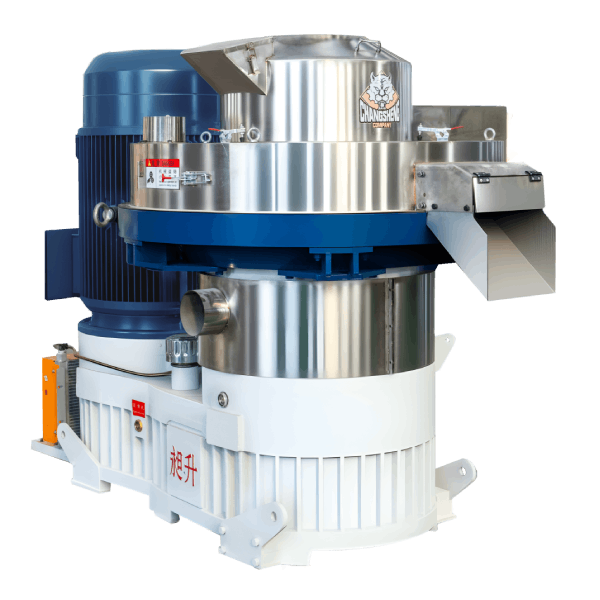
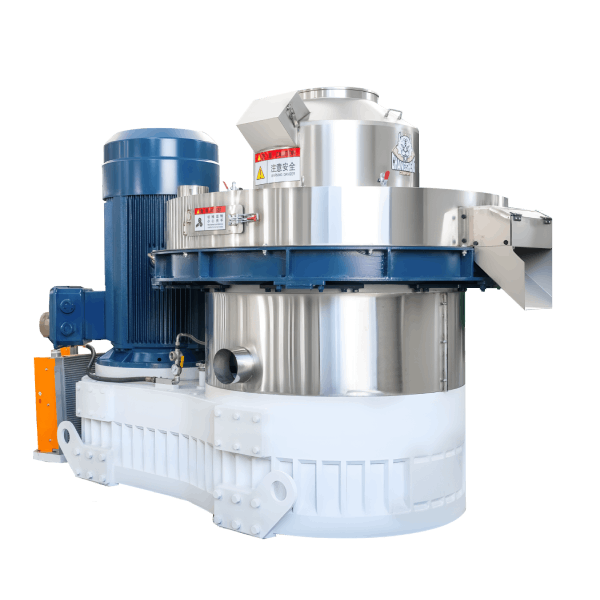
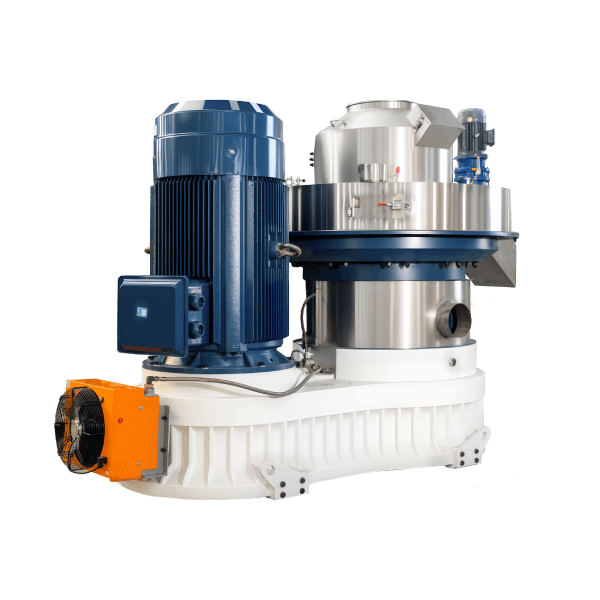
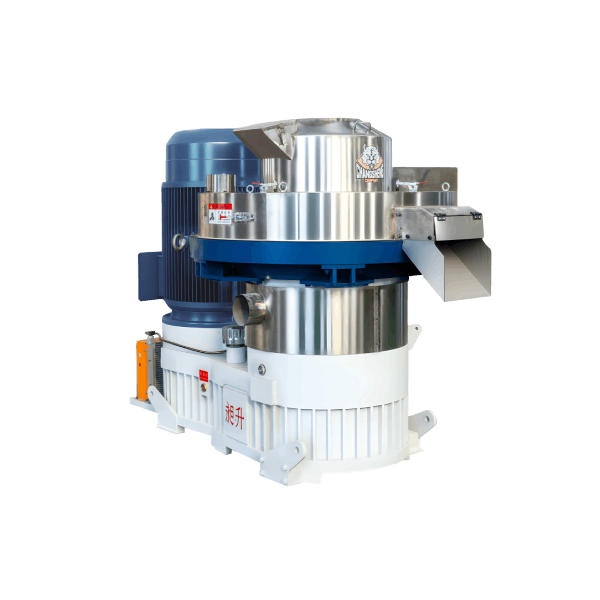
Pellet Mill with Frequency Converter: VFD for Speed Control
News 2026-05-30
1. Product Definition
A pellet mill with frequency converter (Variable Frequency Drive – VFD) provides electronic speed control for the feeder (auto load regulation maintaining 85-95% motor load) or the main motor (speed adjustment 20-60 Hz), offering energy savings (10-30% for variable speed applications), soft start (reduces starting current 500-700% to 100-150%), and precise process control for different feedstocks.
2. Technical Parameters & Specifications
| Application | VFD on Feeder (Most Common) | VFD on Main Motor (Special) | VFD on Both (Premium) |
|---|---|---|---|
| Function | Auto feed rate control | Main motor speed adjustment | Full process control |
| Motor power (kW) | 0.5-5 (feeder) | 55-160 (main) | Both |
| Speed range | 0-100% of max | 20-60 Hz (40-120% speed) | 0-100% both |
| Starting current | N/A (feeder small) | 500-700% → 100-150% | Soft start |
| Energy savings | 5-10% (optimized load) | 10-30% (if speed reduction possible) | 10-30% |
| Motor load control | Auto (85-95% FLA) | Manual (operator set) | Auto + manual |
| Cost (feeder VFD) | $500 – 1,500 | $2,000 – 5,000 (main motor) | $2,500 – 6,500 |
| Payback (feeder) | 6-12 months | 1-3 years (if speed reduction used) | 1-2 years |
| Best for | All commercial mills | Dual-purpose mills (fuel + feed) | Premium mills |
For VFD integration: Request a VFD quotation for your mill.
3. Structure & Material Composition
VFD on Feeder (Most Common Configuration)
Components
- VFD unit: 0.5-5kW, single or three-phase input
- Feeder motor: Gearmotor with encoder (optional)
- PLC or PID controller: Reads motor amps, adjusts feeder speed
- Amp transducer: 4-20mA output (motor current)
Operation
- PLC reads motor current (0-100% FLA)
- Target setpoint: 85-95% of FLA
- VFD increases feeder speed if current <85%
- VFD decreases feeder speed if current >95%
Benefits
- Consistent output (maintains optimal load)
- Prevents motor overload
- No operator adjustment needed
VFD on Main Motor
Components
- VFD unit: 55-160kW, three-phase input/output
- Bypass contactor: Allows direct start if VFD fails
- Speed potentiometer: Operator adjusts speed
Operation
- Operator sets speed (20-60 Hz)
- Lower speed for high-friction materials (rice husk)
- Higher speed for easy materials (softwood)
Benefits
- Soft start (reduces starting current)
- Speed optimization for different feedstocks
- Energy savings (lower speed = lower power)
4. Manufacturing Process (Engineering Steps)
Step 1 – Feeder VFD (Auto Load Control)
PLC measures motor amps. If <85% FLA → VFD increases feeder speed. If >95% FLA → VFD decreases feeder speed. Maintains optimal load.
Step 2 – Main Motor VFD (Soft Start)
Start command → VFD ramps frequency (0 → 50 Hz) over 10-30 seconds. Current limited to 100-150% FLA. Bypass contactor engages at full speed (optional).
Step 3 – Speed adjustment (main motor)
Operator turns potentiometer (20-60 Hz). VFD changes motor speed accordingly.
Step 4 – Energy savings
Lower speed (e.g., 40 Hz) reduces motor power by (40/50)³ = 51% (theoretical). Actual savings 10-30% due to constant torque load.
5. Industry Comparison
| Feature | No VFD (Direct Start) | VFD on Feeder Only | VFD on Main Motor | VFD on Both |
|---|---|---|---|---|
| Auto load control | No (manual) | Yes | No | Yes |
| Motor load consistency | Poor (operator dependent) | Excellent (85-95% constant) | Poor | Excellent |
| Soft start | No (500-700% current) | No (feeder only) | Yes (100-150%) | Yes |
| Speed adjustment | No | No | Yes (20-60 Hz) | Yes |
| Energy savings | None | 5-10% (load optimization) | 10-30% (speed reduction) | 10-30% |
| Cost | $0 (baseline) | $500-1,500 | $2,000-5,000 | $2,500-6,500 |
| Output increase | Baseline | +10-20% (optimized load) | Same (speed dependent) | +10-20% |
| Best for | Budget | Commercial (recommended) | Special applications | Premium |
| Why Choose Shandong Changsheng | Standard on home mills | Standard on commercial mills | Optional on industrial mills | Premium control |
Compare VFD options: Request a recommendation for your mill.
7. Core Technical Pain Points & Engineering Solutions
Pain Point 1 – Operator Unable to Maintain Optimal Load
Symptom: Motor load varies 60-100% (operator adjusts manually). Output inconsistent.
Root cause: No auto load control.
Solution:* VFD on feeder with PLC control – maintains 85-95% load automatically. Output consistency improves 10-20%.
Pain Point 2 – High Starting Current (Breaker Trips)
Symptom: Breaker trips when starting main motor (500-700% FLA).
Root cause:* Direct start current surge.
Solution:* VFD on main motor (soft start) – reduces starting current to 100-150% FLA.
Pain Point 3 – Motor Overload with Variable Feedstock
Symptom: Motor trips overload when switching from softwood to hardwood (operator forgot to reduce feed rate).
Root cause:* No auto load control.
Solution:* VFD on feeder – automatically reduces feed rate when motor load exceeds 95%.
Pain Point 4 – Energy Waste (Motor Running at Full Speed)
Symptom:* Motor runs at 50 Hz even when lower speed sufficient (e.g., light load).
Root cause:* No speed control.
Solution:* VFD on main motor – operator reduces speed for light loads. Energy savings 10-30%.
8. Risk Warnings & Mitigation Strategies
Risk 1 – VFD Failure (Mill Stops)
Warning: VFD fails, mill cannot start. Production stop.
Mitigation:* Install bypass contactor – allows direct start if VFD fails. Keep spare VFD.
Risk 2 – Motor Overheating at Low Speed
Warning:* Running motor at <20 Hz for extended time (poor cooling). Motor overheats.
Mitigation:* Minimum speed 20 Hz (40% of rated). Use external fan for continuous low-speed operation.
Risk 3 – Harmonic Distortion (Other Equipment)
Warning:* VFD generates harmonics, may affect other electronic equipment.
Mitigation:* Install line reactor or harmonic filter ($200-500). Use VFD with low harmonic distortion.
9. Procurement Selection Guide (6 Actionable Steps)
Step 1 – Determine VFD application
Feeder auto load: essential for commercial mills (adds 500−1,500).Mainmotorsoftstart:optional(2,000-5,000). Speed adjustment: for dual-purpose mills.
Step 2 – Calculate payback for feeder VFD
Output increase 10-20% + energy savings 5-10% + reduced downtime. Payback typically 6-12 months.
Step 3 – Size VFD correctly
Feeder: 0.5-5kW (match motor). Main motor: 55-160kW (match motor FLA). Oversize by 1 step for heavy duty.
Step 4 – Specify bypass contactor
For main motor VFD – allows direct start if VFD fails. Mandatory for 24/7 operation.
Step 5 – Choose control method
Feeder: PLC or PID (auto). Main motor: potentiometer (manual) or PLC (auto).
Step 6 – Plan installation
VFD generates heat – allow 200mm clearance. Shielded cables for motor. EMI filter if sensitive equipment nearby.
10. Engineering Case Study
Project Background: A 2 t/h pellet plant had manual feeder control. Operator adjusted feed rate hourly. Motor load varied 60-95% (inconsistent output). Energy consumption 72 kWh/t.
Initial Problem: Output inconsistent (1.8-2.2 t/h). Motor overload trips 2-3 times per week. Operator stressed.
Root Cause Analysis:
- No auto load control
- Operator underfed (60% load) → low output
- Operator overfed (100% load) → overload trips
Solution Implemented (Feeder VFD + PLC):
| Component | Cost (USD) |
|---|---|
| VFD (feeder, 2.2kW) | $600 |
| PLC controller | $800 |
| Amp transducer | $100 |
| Installation | $500 |
| Total | $2,000 |
Results (12 months):
| Metric | Before (Manual) | After (VFD Auto) |
|---|---|---|
| Motor load variation | 60-95% | 85-92% |
| Output consistency (t/h) | 1.8-2.2 | 1.95-2.05 |
| Overload trips per week | 2-3 | 0 |
| Energy consumption (kWh/t) | 72 | 65 |
| Annual energy cost (10,000 tons, $0.12/kWh) | $86,400 | $78,000 |
- Annual savings: Energy 8,400+increasedoutput(200tons×150 = 30,000)+reduceddowntime=40,000+
- Payback: <1 month
Request a VFD auto load system: Contact engineering team with your mill model for feeder VFD quote.
11. FAQ
Q1: What is a pellet mill with frequency converter?
Variable Frequency Drive (VFD) for speed control of feeder (auto load) or main motor (soft start, speed adjustment).
Q2: What is the most common VFD application?
VFD on feeder (auto load control) – maintains 85-95% motor load automatically. Essential for commercial mills.
Q3: How does feeder VFD improve output?
Automatically adjusts feed rate to maintain optimal motor load. Output consistency improves 10-20%.
Q4: Does VFD save energy?
Feeder VFD: 5-10% (load optimization). Main motor VFD: 10-30% (if speed reduced).
Q5: Does VFD provide soft start?
Yes – reduces starting current from 500-700% to 100-150% FLA. Prevents breaker trips.
Q6: How much does a VFD cost?
Feeder: 500−1,500.Mainmotor(55kW):2,000-5,000.
Q7: What is the payback for feeder VFD?
6-12 months (energy savings + output increase + reduced downtime).
Q8: Can I add VFD to existing mill?
Yes – retro-fit to feeder motor (easy) or main motor (requires electrician).
Q9: Does VFD require special motor?
Standard motor works for feeder (small). For main motor, use inverter-duty motor (insulation class F or H) for continuous low-speed operation.
Q10: What is bypass contactor?
Allows direct start if VFD fails. Essential for 24/7 operation.
Q11: Can VFD run motor slower than 50 Hz?
Yes – typical range 20-60 Hz (40-120% speed). Below 20 Hz may cause overheating (poor cooling).
Q12: Can VFD run motor faster than 50 Hz?
Yes – up to 60 Hz (20% faster). Verify motor mechanical limits (bearings, balancing).
Q13: Does VFD affect motor life?
Properly sized VFD with inverter-duty motor – similar life. Standard motor may have reduced life (bearing currents, insulation stress).
Q14: What is the difference between VFD and soft starter?
VFD provides speed control + soft start. Soft starter provides soft start only (no speed control). VFD costs 2-3x more.
Q15: Do I need a VFD for home use?
No – manual feed control sufficient for hobby scale (<0.1 t/h). VFD essential for commercial (>0.5 t/h).
12. Commercial Call-to-Action
For plant managers: Request a pellet mill with frequency converter (VFD) quotation – auto load control for feeder, soft start for main motor. Energy savings 10-30%.
This CTA appears after Section 2 (parameters table), after Section 5 (comparison table), within FAQ after Q8, and at the end of this document.
Need a VFD retrofit? Contact engineering team with your mill model and motor power for VFD sizing and quote.
Looking for auto load control? Request VFD + PLC system – maintains 85-95% motor load automatically.
To proceed: Send your inquiry via the contact form. Include mill model, motor power (kW), application (feeder or main motor), and budget.
13. Author & E-E-A-T Credentials
Author: Zhang Wei
Variable Frequency Drive Specialist
- 11 years in VFD applications for pellet mills (2014–present)
- Designed 300+ VFD systems for feeder auto load and main motor soft start
- Certified in VFD programming (Siemens, ABB, Danfoss)
- Author of “VFD for Pellet Mills Guide” (China Machine Press, 2022)
- Member of the Institute of Electrical and Electronics Engineers (IEEE)
Affiliation: Shandong Changsheng Machinery Co., Ltd.
The author has directly designed pellet mill with frequency converter systems for 300+ pellet plants, documenting output consistency improvement, energy savings, and payback periods. All VFD specifications, control strategies, and cost data are derived from actual installations from 2015–2026.