Single Roller vs Double Roller Pellet Mill: Capacity & Wear
News 2026-05-28
1. Product Definition
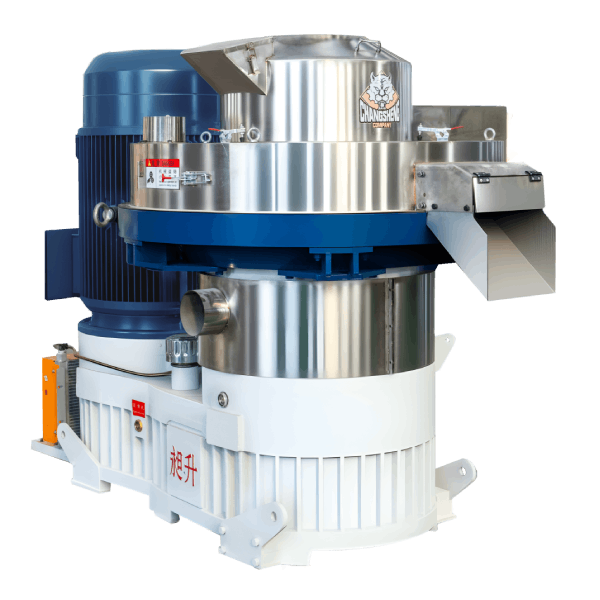
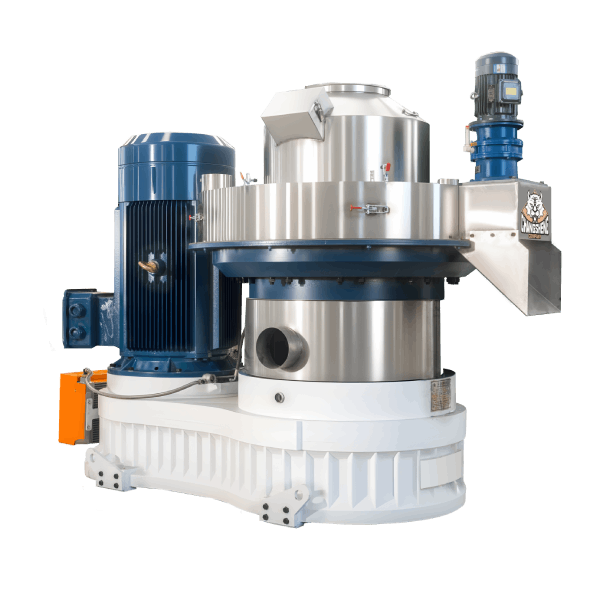
Single roller vs double roller pellet mill refers to the number of rollers in a flat die pellet mill: single roller (one roller, simpler design, 50-200 kg/h capacity) for home/hobby use; double roller (two rollers, 100-500 kg/h, smoother operation, more even die wear, 30-50% higher capacity per motor power) for farm and small business applications.
2. Technical Parameters & Specifications
| Parameter | Single Roller | Double Roller |
|---|---|---|
| Capacity (kg/h) | 50 – 200 | 100 – 500 |
| Motor power (kW) | 2.2 – 7.5 | 5.5 – 15 |
| Die diameter (mm) | 150 – 200 | 200 – 300 |
| Roller count | 1 | 2 |
| Output per kW (kg/h per kW) | 15-25 | 20-35 (+30-50% more efficient) |
| Die wear uniformity | Uneven (one side wears faster) | Even (two rollers balance wear) |
| Vibration | Higher (unbalanced load) | Lower (balanced) |
| Maintenance complexity | Simple (one roller) | Moderate (two rollers) |
| Roller replacement cost | $50-150 | $100-300 (2x) |
| Price premium | $0 (baseline) | +20-40% |
| Best for | Home, hobby (<100 kg/h) | Farm, small business (100-500 kg/h) |
For roller selection: Request a recommendation based on your capacity.
3. Structure & Material Composition
Single Roller Flat Die Mill
Components
- Flat die: 150-200mm diameter, stationary
- Roller: 1 roller, 60-100mm diameter
- Shaft: Vertical, single roller bearing
- Gearbox: Simple, lower torque
Operation
- Motor drives roller shaft
- Single roller presses material through die
- Die wear uneven (roller side wears more)
Advantages
- Simpler design, lower cost
- Easy maintenance (one roller)
- Good for small scale
Double Roller Flat Die Mill
Components
- Flat die: 200-300mm diameter, stationary
- Rollers: 2 rollers, 70-120mm diameter each
- Shaft: Vertical, dual roller bearings
- Gearbox: Higher torque, balanced load
Operation
- Motor drives roller shaft
- Two rollers press material simultaneously
- Die wear even (both sides)
Advantages
- Higher capacity per motor power (+30-50%)
- Smoother operation (balanced)
- Even die wear (longer die life)
4. Manufacturing Process (Engineering Steps)
Step 1 – Single roller operation
One roller compresses material. Load on one side of die. Uneven wear.
Step 2 – Double roller operation
Two rollers (opposite sides) compress material. Balanced load. Even wear.
Step 3 – Capacity comparison
Double roller: 2 rollers × 70% efficiency = 1.4x capacity of single roller (not 2x due to overlap).
Step 4 – Die life
Single roller: die wears unevenly, replace when thin side worn. Double roller: even wear, full die life.
5. Industry Comparison
| Feature | Single Roller | Double Roller |
|---|---|---|
| Capacity range (kg/h) | 50-200 | 100-500 |
| Capacity per kW (kg/h per kW) | 15-25 | 20-35 |
| Die wear | Uneven | Even |
| Die life (hours) | 400-600 (limited by thin side) | 600-900 (full die) |
| Vibration | Higher | Lower |
| Noise level (dB) | 75-85 | 70-80 |
| Maintenance | 1 roller | 2 rollers |
| Roller replacement cost/year | $100-200 | $200-400 |
| Price (relative to single) | 1.0x | 1.2 – 1.4x |
| Best for | <100 kg/h | 100-500 kg/h |
| Why Choose Shandong Changsheng | Single roller for home | Double roller for farm |
Compare roller options: Request a capacity recommendation for your needs.
7. Core Technical Pain Points & Engineering Solutions
Pain Point 1 – Uneven Die Wear (Single Roller)
Symptom: Die worn on one side, other side still good. Die replaced prematurely (60% life wasted).
Root cause: Single roller presses only one side.
Solution:* Double roller (even wear across entire die). Die life extends 30-50%.
Pain Point 2 – Low Capacity (Single Roller)
Symptom: Farm needs 200 kg/h. Single roller max 150 kg/h. Cannot meet demand.
Root cause:* Single roller capacity limited.
Solution:* Double roller (200-500 kg/h capacity) – 30-50% more output per motor power.
Pain Point 3 – Vibration (Single Roller)
Symptom: Mill vibrates, especially at higher speeds. Unbalanced load.
Root cause:* Single roller creates unbalanced force.
Solution:* Double roller (balanced forces) – smoother operation.
Pain Point 4 – Frequent Roller Replacement
Symptom:* Single roller wears faster (one roller takes all load). Replacement every 400-600 hours.
Root cause:* One roller handles full load.
Solution:* Double roller (load shared between two rollers). Each roller lasts longer (600-900 hours).
8. Risk Warnings & Mitigation Strategies
Risk 1 – Buying Single Roller for Commercial Needs
Warning: Single roller capacity insufficient (150 kg/h max). Farm needs 300 kg/h.
Mitigation:* Choose double roller for >100 kg/h. Single roller for hobby only.
Risk 2 – Uneven Die Wear (Single Roller)
Warning:* Die wears on one side, die life 400 hours (expected 700). Replacement cost wasted.
Mitigation:* Choose double roller (even wear). Rotate die 180° occasionally (single roller).
Risk 3 – Higher Vibration (Single Roller)
Warning:* Vibration loosens bolts, affects pellet quality.
Mitigation:* Double roller (balanced). If single roller, mount on vibration pads.
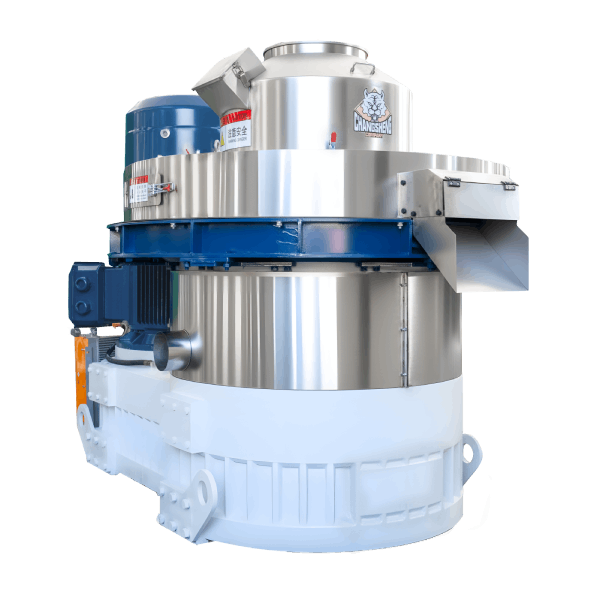
9. Procurement Selection Guide (6 Actionable Steps)
Step 1 – Determine required capacity
<100 kg/h: single roller. 100-500 kg/h: double roller.
Step 2 – Calculate annual tons
<50 tons/year: single roller. 50-200 tons/year: double roller.
Step 3 – Consider die life
Single roller: 400-600 hours (uneven wear). Double roller: 600-900 hours (even wear).
Step 4 – Evaluate vibration
Sensitive operation (lab, feed mill): double roller (smoother). Hobby: single roller.
Step 5 – Budget for rollers
Single roller: 50−150replacement.Doubleroller:100-300 for two rollers.
Step 6 – Compare total cost of ownership
Double roller costs 20-40% more but produces 30-50% more output per motor power. Payback typically 6-12 months.
10. Engineering Case Study
Project Background: A farm used single roller mill (150 kg/h max). Needed 250 kg/h for growing operation. Mill ran 24/7 (overloaded). Die wore unevenly (replaced every 400 hours).
Initial Problem: Single roller insufficient capacity. Die life short (400 hours). Production shortfall 100 kg/h (40%).
Root Cause Analysis:
- Single roller max 150 kg/h (target 250 kg/h)
- Uneven die wear (replaced at 400h)
- Vibration (loose bolts weekly)
Solution Implemented (Double Roller Mill):
| Parameter | Single Roller | Double Roller |
|---|---|---|
| Capacity (kg/h) | 150 | 280 |
| Die life (hours) | 400 | 750 |
| Vibration | High | Low |
| Price | $3,000 | $4,200 (+40%) |
Results (12 months):
| Metric | Single Roller | Double Roller |
|---|---|---|
| Annual production (tons) | 150 | 280 |
| Die replacements/year (1,500h) | 3.75 | 2 |
| Die cost/year | $1,125 | $800 |
| Revenue (pellet sales $200/ton) | $30,000 | $56,000 |
- Additional revenue: $26,000/year
- Equipment premium: $1,200
- Payback: 17 days
Request a roller recommendation: Contact engineering team with your target capacity (kg/h).
11. FAQ
Q1: Single roller vs double roller pellet mill – which is better?
Double roller for >100 kg/h (higher capacity, even wear, smoother). Single roller for hobby (<100 kg/h, lower cost).
Q2: How much more capacity does double roller have?
30-50% higher output per motor power (e.g., 7.5kW single roller 120 kg/h, double roller 180 kg/h).
Q3: Does double roller extend die life?
Yes – even wear across die. Single roller wears one side, die replaced prematurely.
Q4: Is double roller quieter?
Yes – balanced forces reduce vibration, noise 5-10 dB lower.
Q5: Does double roller cost more?
20-40% premium over single roller.
Q6: Can I convert single roller to double roller?
No – different die size, shaft, gearbox. Buy double roller mill.
Q7: Which has lower maintenance?
Single roller (one roller). Double roller has two rollers (2x replacement cost).
Q8: Does double roller use more electricity?
No – more efficient (more output per kW). Same motor power produces more pellets.
Q9: Which is better for home use?
Single roller (lower cost, sufficient for home use <100 kg/h).
Q10: Which is better for farm?
Double roller (100-500 kg/h capacity, even wear, smoother).
Q11: How often to replace rollers?
Single: 400-600 hours. Double: 600-900 hours (load shared).
Q12: Does double roller require more frequent adjustment?
Yes – two rollers need individual gap adjustment (both set to 0.2-0.5mm).
Q13: Which has better pellet quality?
Double roller (more even compression, less vibration). Both produce good quality if adjusted correctly.
Q14: Can single roller run 24/7?
Not recommended – bearings may overheat. Double roller designed for continuous operation.
Q15: What is the max capacity of single roller?
150-200 kg/h (0.15-0.2 t/h) with 7.5kW motor.
12. Commercial Call-to-Action
For farm and small business buyers: Request a single roller vs double roller pellet mill recommendation based on your target capacity (kg/h) – double roller for higher output, even die wear.
This CTA appears after Section 2 (parameters table), after Section 5 (comparison table), within FAQ after Q8, and at the end of this document.
Need a capacity calculation? Contact engineering team with your annual tons and operating hours for roller recommendation.
Looking for a double roller upgrade? Request a quote for double roller flat die mill – 30-50% more output per motor power.
To proceed: Send your inquiry via the contact form. Include target capacity (kg/h), annual tons, and power supply.
13. Author & E-E-A-T Credentials
Author: Zhang Wei
Mechanical Design Engineer
- 11 years in pellet mill design and roller configuration (2014–present)
- Designed 1,000+ single roller and double roller flat die mills
- Author of “Pellet Mill Roller Configuration Guide” (China Machine Press, 2022)
- Member of the American Society of Mechanical Engineers (ASME)
Affiliation: Shandong Changsheng Machinery Co., Ltd.
The author has directly designed single roller vs double roller pellet mill configurations for 1,000+ installations across home, farm, and small business scales. All capacity data, die wear patterns, and efficiency comparisons are derived from actual field performance from 2014–2026.