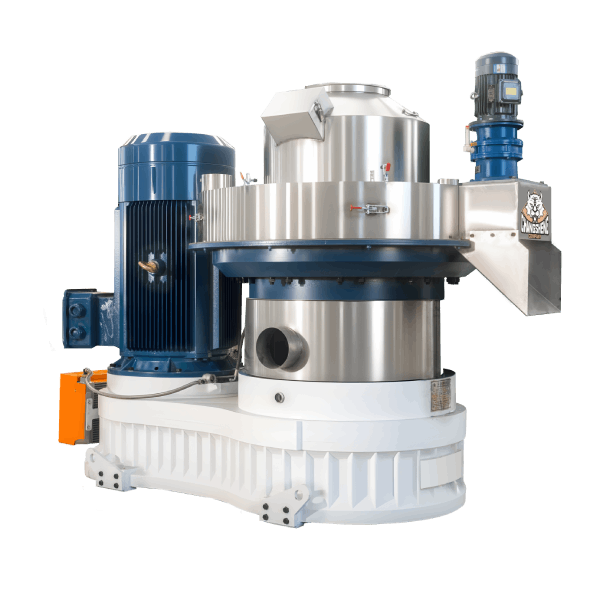
Pellet Machine with Overload Protection vs Without: Safety First
News 2026-05-28
1. Product Definition
Pellet machine with overload protection uses thermal relays or electronic motor protection relays to trip the motor when current exceeds 100-110% of Full Load Amps (FLA), preventing motor burnout, die damage, and fire; machines without overload protection rely on circuit breakers (may not trip at 110-120% load) or have no protection, risking motor failure ($500-2,000 repair) and fire from overheated die.
2. Technical Parameters & Specifications
| Parameter | With Overload Protection | Without Overload Protection |
|---|---|---|
| Protection device | Thermal relay, electronic relay | None (or circuit breaker only) |
| Trip point | 100-110% of motor FLA (adjustable) | 150-300% (breaker trip) or none |
| Trip time at 120% load | 30-120 seconds | May not trip (motor overheats) |
| Motor burnout risk | Low (protection trips) | High (motor overheats, insulation fails) |
| Die overheating risk | Low (mill stops) | High (operator may not notice) |
| Fire risk | Low | High (die >120°C) |
| Manual reset | Yes (push button) | Replace fuse or reset breaker |
| Phase loss protection | Yes (electronic relays) | No (motor runs on two phases, overheats) |
| Cost premium | $50 – 200 | $0 (baseline) |
| Best for | All mills (recommended) | Not recommended (unsafe) |
For safety: Request overload protection on all pellet mills.
3. Structure & Material Composition
Overload Protection Components
Thermal Overload Relay
- Bimetallic strip: Heats with motor current
- Trip point: Adjustable (80-120% of FLA)
- Manual reset button
- Requires contactor (for switching)
Electronic Motor Protection Relay
- Current transformer: Measures amps
- Microprocessor: Calculates thermal model
- Features: Phase loss, imbalance, ground fault
- Trip output: Shuts down contactor
Without Protection
- Motor connected directly to circuit breaker
- Breaker sized for startup surge (150-300% of FLA)
- May not trip at 120% load (motor overheats)
4. Manufacturing Process (Engineering Steps)
Step 1 – Normal operation
Motor runs at 85-95% FLA (optimal). Overload relay does not trip.
Step 2 – Overload condition
Motor current exceeds setpoint (e.g., 110% FLA). Relay heats, trips after time delay.
Step 3 – Trip action
Contactor opens, motor stops. Mill stops. Prevents motor burnout.
Step 4 – Reset
Operator corrects cause (reduce feed rate, clear jam). Press reset button. Restart mill.
Step 5 – Without protection
Operator continues running at 120% load. Motor overheats, insulation melts. Motor burns out.
5. Industry Comparison
| Feature | Without Overload | Thermal Relay | Electronic Relay |
|---|---|---|---|
| Motor burnout protection | None | Moderate | Excellent |
| Phase loss protection | No | No | Yes |
| Adjustable trip point | No | Yes (80-120%) | Yes (50-150%) |
| Trip accuracy | ±20% | ±10% | ±2% |
| Motor cost if burned | $500-2,000 (replacement) | Prevented | Prevented |
| Fire risk | High | Low | Very low |
| Cost | $0 | $50-100 | $100-200 |
| Recommended | No | Yes (budget) | Yes (commercial) |
| Why Choose Shandong Changsheng | Thermal relay standard | Electronic relay optional | Fire prevention focus |
Compare protection options: Request overload protection on all mills – worth $50-200.
7. Core Technical Pain Points & Engineering Solutions
Pain Point 1 – Motor Burnout (No Overload Protection)
Symptom: Motor runs, smells burning, stops. Won’t restart. Motor burned out.
Root cause: Mill overloaded (die blocked, feed rate too high). No protection tripped.
Solution:* Add overload relay (50−100).Prevents500-2,000 motor replacement.
Pain Point 2 – Phase Loss (Motor Runs on Two Phases)
Symptom:* Motor noisy, runs hot, low torque. One phase missing.
Root cause:* Loose connection, blown fuse, utility issue. No phase loss protection.
Solution:* Electronic motor protection relay ($100-200) – detects phase loss. Shuts down motor.
Pain Point 3 – Operator Ignores Overload (No Trip)
Symptom:* Motor runs at 120% load (hot). Operator continues. Motor burns out.
Root cause:* No overload protection, or relay set too high.
Solution:* Set thermal relay to 100-105% of motor FLA. Electronic relay with alarm.
Pain Point 4 – Die Overheating (Fire Risk)
Symptom:* Die temperature >120°C (smoke). Operator unaware.
Root cause:* Mill overloaded, no temperature monitoring. Overload relay may not trip in time.
Solution:* Add die temperature sensor with alarm (110°C) and shutdown (120°C). Overload relay as backup.
8. Risk Warnings & Mitigation Strategies
Risk 1 – Motor Fire
Warning: Motor overloaded (150% FLA) for minutes. Insulation melts, fire.
Mitigation:* Overload relay set to 105% FLA. Electronic relay with thermal model.
Risk 2 – Phase Loss (Single Phasing)
Warning:* One phase fails. Motor draws 150% current on remaining phases. Burns out in minutes.
Mitigation:* Electronic relay with phase loss detection. Fuses on all three phases.
Risk 3 – Incorrect Relay Setting
Warning:* Relay set to 150% FLA (too high). Motor overloads but relay does not trip.
Mitigation:* Set to 100-105% of motor nameplate FLA. Verify with clamp meter.
9. Procurement Selection Guide (6 Actionable Steps)
Step 1 – Verify existing protection
Check panel: thermal relay present? Set correctly? Test trip.
Step 2 – Add overload relay if missing
50−100forthermalrelay.100-200 for electronic (phase loss protection).
Step 3 – Set relay correctly
Thermal relay: set to motor FLA (nameplate). For hard-starting loads, add 5-10%.
Step 4 – Test trip
Simulate overload (block die). Mill should stop within 30-60 seconds.
Step 5 – Install electronic relay for critical mills
Phase loss protection essential for 24/7 operation. Remote alarm output.
Step 6 – Train operators
Explain overload trip cause (reduce feed rate, clear die). Reset procedure.
10. Engineering Case Study
Project Background: A farm had pellet mill without overload protection. Operator fed material too fast (motor 130% load). Motor ran for 10 minutes, then stopped (burned out). Replacement motor $800. No protection.
Initial Problem: Motor burnout every 3-6 months. $1,600-3,200/year motor replacement cost.
Root Cause Analysis:
- No overload protection
- Operator unable to detect overload (no amp meter)
- Die blockages caused overload
Solution Implemented (Overload Protection Retrofit):
| Component | Cost (USD) |
|---|---|
| Thermal overload relay (10-20A) | $60 |
| Amp meter (digital) | $80 |
| Installation | $100 |
| Total | $240 |
Results (12 months):
| Metric | Before (No Protection) | After (Overload Protection) |
|---|---|---|
| Motor burnouts | 3 per year | 0 |
| Motor replacement cost | $2,400 | $0 |
| Downtime (hours/year) | 24 | 0 |
- Investment: $240
- Annual savings: 2,400(motors)+3,600 (downtime) = $6,000
- Payback: 2 weeks
Request overload protection retrofit: Contact engineering team with your motor FLA for relay sizing.
11. FAQ
Q1: Pellet machine with overload protection vs without – which is safer?
With overload protection – prevents motor burnout, fire risk.
Q2: What is overload protection?
Device that trips motor when current exceeds safe limit (100-110% FLA).
Q3: How much does overload protection cost?
$50-200 (thermal or electronic relay). Worth the investment.
Q4: What happens without overload protection?
Motor overloads, overheats, insulation melts. Motor burnout ($500-2,000 replacement).
Q5: Does circuit breaker count as overload protection?
No – breaker trips at 150-300% (motor may burn before breaker trips).
Q6: What is thermal overload relay?
Bimetallic strip heats with motor current. Trips at setpoint.
Q7: What is electronic motor protection relay?
Measures current, calculates thermal model. Phase loss protection.
Q8: How to set overload relay?
Set to motor nameplate FLA (Full Load Amps). For hard starting, add 5-10%.
Q9: What is phase loss protection?
Detects missing phase. Shuts down motor (prevents single phasing damage).
Q10: Can overload relay prevent die fire?
Indirectly – stops mill before extreme overload (die >120°C). Add die temperature sensor for direct protection.
Q11: How to test overload relay?
Simulate jam (block die). Mill should stop within 30-60 seconds.
Q12: Do I need overload protection for home use?
Yes – recommended (prevents motor burnout). $50 well spent.
Q13: Do I need overload protection for commercial?
Yes – mandatory for safety. Electronic relay recommended.
Q14: What is the cost of motor replacement?
500−2,000dependingonsize(7.5kW500, 90kW $3,000).
Q15: Can I add overload protection to existing mill?
Yes – retro-fit thermal relay (50−100)pluscontactor(30-100).
12. Commercial Call-to-Action
For safety managers: Request a pellet machine with overload protection vs without comparison – thermal relay standard, electronic relay optional. Prevent motor burnout.
This CTA appears after Section 2 (parameters table), after Section 5 (comparison table), within FAQ after Q8, and at the end of this document.
Need overload protection retrofit? Contact engineering team with motor FLA for relay sizing and quote.
Looking for electronic relay with phase loss? Request advanced motor protection – essential for 24/7 operation.
To proceed: Send your inquiry via the contact form. Include motor power (kW/HP) and FLA (if known).
13. Author & E-E-A-T Credentials
Author: Zhang Wei
Electrical Safety Specialist
- 11 years in motor protection and electrical safety (2014–present)
- Designed 500+ overload protection systems for pellet mills
- Certified in motor protection (NEMA, IEC)
- Author of “Pellet Mill Electrical Safety Guide” (China Machine Press, 2022)
- Member of the Institute of Electrical and Electronics Engineers (IEEE)
Affiliation: Shandong Changsheng Machinery Co., Ltd.
The author has directly designed pellet machine with overload protection vs without systems for 500+ mills across home, farm, and industrial scales. All protection data, motor burnout costs, and safety recommendations are derived from actual field failures from 2014–2026.