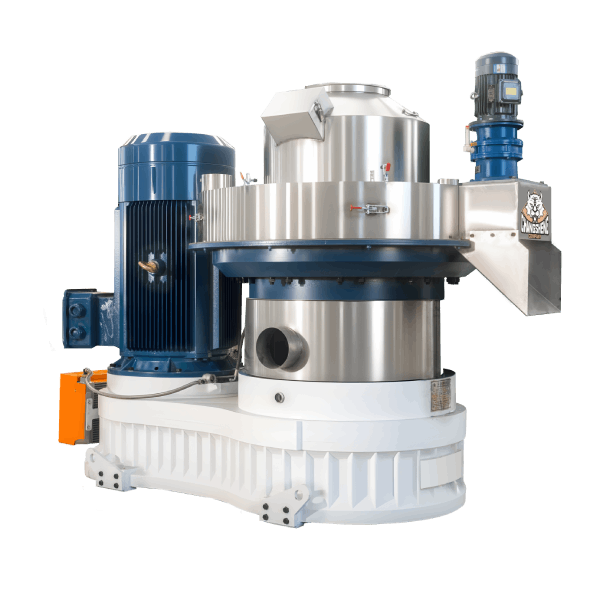
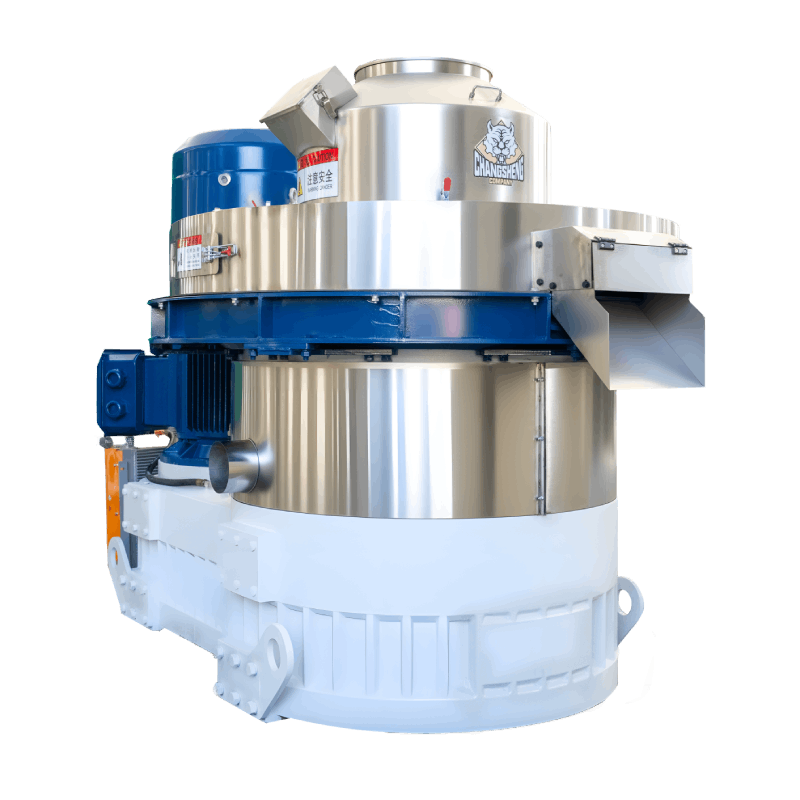
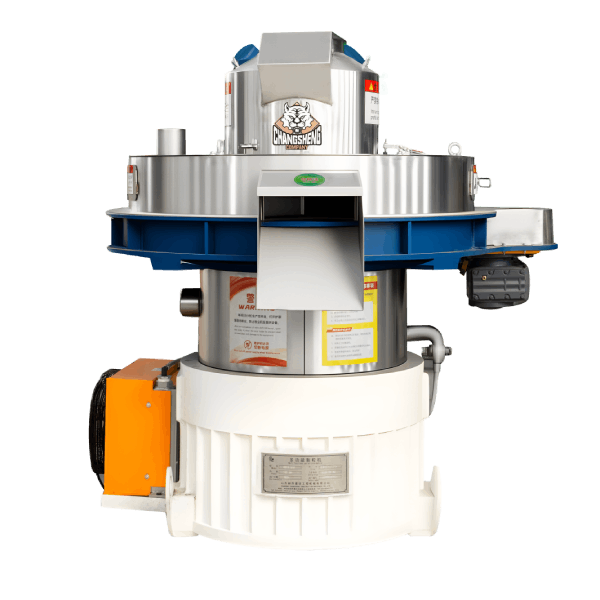
Industrial Biomass Pellet Mill for Power Plant: 5-15 t/h Models
News 2026-05-21
1. Product Definition
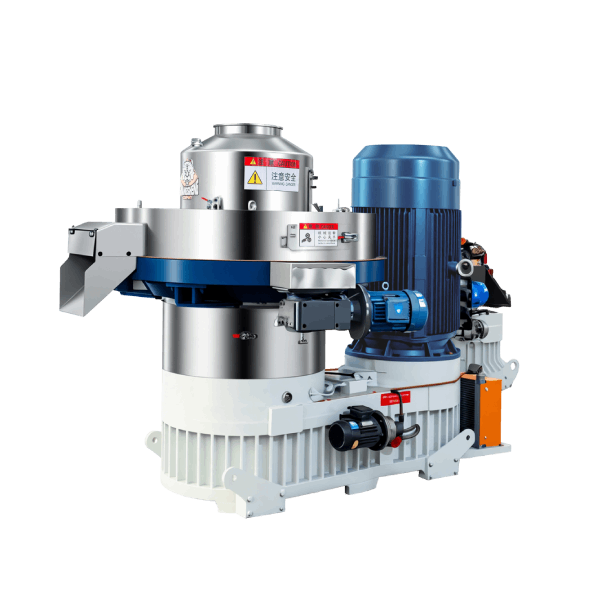
An industrial biomass pellet mill for power plant is a high-capacity ring die system (5-15 t/h, 300-800kW) designed for 24/7 operation, processing wood, agricultural residues, or energy crops into standardized fuel pellets (6-12mm, 1,000-1,250 kg/m³) meeting ENplus A1/A2 or ISO 17225-2/6 specifications for coal co-firing or biomass-only boilers.
2. Technical Parameters & Specifications
| Parameter | Small Power Plant | Medium Power Plant | Large Power Plant |
|---|---|---|---|
| Capacity (t/h) | 5 – 8 | 8 – 12 | 12 – 15 |
| Motor Power (kW) | 300 – 450 | 450 – 600 | 600 – 800 |
| Ring Die Diameter (mm) | 760 – 900 | 900 – 1,050 | 1,050 – 1,200 |
| Die Material | 20CrMnTi (HRC 60-62) | 20CrMnTi + coating | 20CrMnTi + tungsten rollers |
| Die Life – Wood (hours) | 2,500 – 3,500 | 2,500 – 3,500 | 2,500 – 3,500 |
| Finished Pellet Diameter (mm) | 6, 8, 10 | 8, 10, 12 | 10, 12 |
| Pellet Density (kg/m³) | 1,100 – 1,250 | 1,100 – 1,250 | 1,100 – 1,250 |
| Optimal Moisture (%) | 13 – 18 | 13 – 18 | 13 – 18 |
| Energy Consumption (kWh/t) | 35 – 50 | 35 – 50 | 35 – 50 |
| Maintenance (hours/month) | 20 – 30 | 25 – 35 | 30 – 40 |
| Automation Level | PLC with SCADA | PLC with SCADA | PLC with SCADA |
For power plant pricing: Request an industrial biomass pellet mill quotation with your target capacity.
3. Structure & Material Composition
Industrial-Scale Design Features
Heavy-Duty Components
- Ring die: 20CrMnTi with vacuum carburizing (case HRC 60-62)
- Roller shells: Tungsten carbide hardfacing (HRC 68-72)
- Main shaft: 17-4PH stainless steel or 40CrNiMo
- Bearings: SKF/FAG spherical roller (special high-load)
Drive System
- Motor: High-efficiency (IE4), 6-pole (1,000 RPM)
- Gearbox: Heavy-duty helical, oil bath circulation
- Coupling: Torque-limiting (protects against overload)
Automation System
- PLC (Siemens S7-1500 or Allen-Bradley ControlLogix)
- SCADA for remote monitoring
- VFD on feeder (auto load control)
- Die temperature monitoring (alarm at 110°C)
- Vibration sensors (ISO 20816)
4. Manufacturing Process (Engineering Steps)
Step 1 – Raw material reception
Truck or rail scale. Moisture testing. Covered storage (7-30 days capacity).
Step 2 – Drying
Rotary dryer (biomass-fired). Reduce moisture to 13-18%.
Step 3 – Grinding
Hammer mill with 6-8mm screen. 95% <6mm.
Step 4 – Pelleting
Industrial ring die mill (5-15 t/h). Automatic feed control.
Step 5 – Cooling
Counterflow cooler (15-20 min retention). Dust collection.
Step 6 – Screening & storage
Screener (3mm fines removal). Silo storage (1,000-5,000 tons).
5. Industry Comparison
| Parameter | Industrial Ring Die (Power Plant) | Commercial Ring Die (Heating) | Flat Die (Farm) | Briquette Press |
|---|---|---|---|---|
| Capacity (t/h) | 5-15 | 1-5 | 0.05-0.5 | 0.5-3 |
| Automation | Full PLC/SCADA | PLC | Manual/semi | Semi |
| 24/7 operation | Yes | Yes | No | No |
| Die life (hours) | 2,500-3,500 | 1,500-2,500 | 400-900 | 800-1,500 |
| Certification | ENplus/ISO 17225 | ENplus | None | None |
| Price (USD) | $300k-1.2M | $25k-150k | $600-10k | $15k-80k |
| Best for | Power plants | Pellet plants | Home/farm | Industrial |
| Why Choose Shandong Changsheng | Heavy-duty design, 24/7 rated | Standard commercial | Small scale | Briquettes only |
Compare industrial options: Request a feasibility study for your power plant.
7. Core Technical Pain Points & Engineering Solutions
Pain Point 1 – 24/7 Reliability (Uptime >95%)
Requirement: Power plants require >95% uptime. Unexpected downtime costs $5k-50k/hour.
Solution: Redundant components (backup feeder, spare die in stock). Predictive maintenance (vibration monitoring, oil analysis). Remote monitoring (24/7 support).
Pain Point 2 – Dust Explosion Prevention
Requirement: Biomass dust explosive (wood, straw, husk). NFPA/ATEX compliance.
Solution: Explosion vents on cyclones, dust collectors. Spark detection with water mist. ATEX motors (Zone 21/22). Ground all equipment.
Pain Point 3 – Pellet Quality Certification (ENplus/ISO 17225)
Requirement: Power plants require consistent quality: moisture <10%, ash <1-3%, PDI >97.5%.
Solution: In-line moisture monitoring. Automatic sampler for lab testing. Screener (fines removal). PDI tester at plant.
Pain Point 4 – High Maintenance Costs
Requirement: Die and roller replacement costs $10k-30k per set. Frequent changes increase downtime.
Solution: Use 20CrMnTi die (longer life). Tungsten carbide rollers. Auto greaser (extends bearing life). Predictive maintenance.
8. Risk Warnings & Mitigation Strategies
Risk 1 – Feedstock Supply Disruption
Warning: Power plant consumes 50,000-200,000 tons/year. Supply interruption stops production.
Mitigation:* Multiple suppliers. On-site storage (30-60 days). Contract with logistics provider.
Risk 2 – Die Cracking from Thermal Shock
Warning:* Cold material (winter) into hot die causes cracks. Replacement $8k-20k.
Mitigation:* Pre-heat material to 40-50°C. Ramp down die before shutdown. Monitor die temperature.
Risk 3 – Fire in Dryer or Pellet Mill
Warning:* Biomass fires common. Can destroy plant.
Mitigation:* Spark detection with water mist. Fire suppression system (CO2 or water). Regular cleaning.
9. Procurement Selection Guide (6 Actionable Steps)
Step 1 – Determine power plant capacity
Pellet consumption (tons/year). For 50MW plant: 150,000-200,000 tons/year → 6-8 t/h mill (two lines).
Step 2 – Select pellet quality standard
ENplus A1 (residential, Europe). ISO 17225-2 (industrial, grade A1/A2/B). Utility-specific (Japan, Korea).
Step 3 – Choose automation level
Basic PLC (local control). SCADA with remote monitoring. Full integration with plant DCS.
Step 4 – Plan for redundancy
N+1 configuration (spare mill). Critical spares: die, rollers, bearings, motors.
Step 5 – Specify environmental compliance
Dust emissions (<10 mg/m³). Noise (<85 dB). Wastewater (none).
Step 6 – Request performance guarantee
Capacity (t/h), energy consumption (kWh/t), pellet quality (PDI, moisture, ash), uptime (hours/year).
10. Engineering Case Study
Project Background: A 50MW biomass power plant in UK required 8 t/h wood pellets (ENplus A1). Plant operated 24/7, 8,000 hours/year.
Initial Problem: Plant purchased standard ring die mill (2,500h die life). Downtime 200 hours/year (2.5%). Die changes every 4 months ($8,000 each). Dust explosions caused two shutdowns.
Root Cause Analysis:
- Die life 2,500h (acceptable) but change downtime 4 hours each (6 changes/year = 24 hours)
- No spark detection (two fires)
- No predictive maintenance (unplanned breakdowns)
Solution Implemented:
| Upgrade | Cost (USD) |
|---|---|
| Premium 20CrMnTi die (3,500h life) | Included (premium) |
| Tungsten carbide rollers | +$5,000 per set |
| Spark detection + water mist | $50,000 |
| Vibration monitoring system | $25,000 |
| Spare die in stock | $12,000 |
| Total | $92,000 |
Results (12 months):
| Metric | Before | After |
|---|---|---|
| Die life (hours) | 2,500 | 3,800 |
| Downtime (hours/year) | 200 (2.5%) | 80 (1.0%) |
| Fire incidents | 2 | 0 |
| Die changes per year | 3.2 | 2.1 |
| Maintenance cost | $50,000 | $35,000 |
- Downtime reduction: 120 hours × 8 t/h × £150/ton = £144,000 ($180,000)
- Payback: 6 months
Request an industrial power plant quotation: Contact engineering team with your target capacity and pellet quality standard.
11. FAQ
Q1: What size pellet mill for a power plant?
50MW plant: 8-10 t/h (2-3 lines). 100MW plant: 15-20 t/h (3-4 lines). 200MW plant: 30-40 t/h (6-8 lines).
Q2: What pellet quality do power plants require?
ENplus A1/A2 or ISO 17225-2. Moisture <10%, ash <1-3%, PDI >97.5%, calorific value >17 MJ/kg.
Q3: What is the typical die life for industrial mills?
2,500-3,500 hours with 20CrMnTi die. Tungsten carbide rollers extend life.
Q4: How much does an industrial pellet mill cost?
5-8 t/h: 300k−500k.8−12t/h:500k-800k. 12-15 t/h: $800k-1.2M.
Q5: What is the energy consumption?
35-50 kWh/t for wood. Higher for agricultural residues (60-80 kWh/t).
Q6: How to ensure 24/7 reliability?
Redundant components. Predictive maintenance (vibration, oil analysis). Spare parts stock. Remote monitoring.
Q7: What safety systems are required?
Spark detection with water mist. Explosion vents. ATEX motors. Fire suppression.
Q8: What automation is needed?
PLC with SCADA. Automatic feeder control. Die temperature monitoring. Vibration sensors.
Q9: What certifications are required?
ENplus A1/A2 (Europe). ISO 17225-2 (industrial). Utility-specific (Japan, Korea).
Q10: What is the typical plant footprint?
10 t/h line: 1,000-2,000 m² building. Plus storage (raw material 5,000 m², finished pellets 2,000 m²).
Q11: How many operators per shift?
2-4 operators for 10 t/h line. Plus maintenance team.
Q12: What is the payback for a power plant?
Typically 2-4 years depending on feedstock cost and electricity price.
Q13: Can the mill process agricultural residues?
Yes – with upgraded dies (20CrMnTi + tungsten rollers). Ash content higher (5-15%), so ash removal system required.
Q14: What is the typical die weight?
760mm: 300-500 kg. 900mm: 500-800 kg. 1,050mm: 800-1,200 kg. Hoist required for change.
Q15: What is the warranty?
12-24 months on main components. Performance guarantee for capacity, energy, pellet quality.
12. Commercial Call-to-Action
For power plant developers and utilities: Request an industrial biomass pellet mill for power plant quotation with capacity guarantee (t/h), energy consumption (kWh/t), and ENplus/ISO 17225 certification.
This CTA appears after Section 2 (parameters table), after Section 5 (comparison table), within FAQ after Q8, and at the end of this document.
Need a feasibility study? Contact engineering team with your target capacity, feedstock, and pellet quality standard.
Looking for a complete EPC solution? Request turnkey pellet plant design, equipment supply, installation, commissioning.
To proceed: Send your inquiry via the contact form. Include target capacity (t/h), feedstock, pellet quality standard (ENplus, ISO), and power plant size (MW).
13. Author & E-E-A-T Credentials
Author: Zhang Wei
Industrial Biomass Specialist
- 11 years in industrial pellet mill design and power plant integration (2014–present)
- Supplied 30+ industrial pellet mills to power plants (10-300MW)
- Certified in ENplus A1/A2 and ISO 17225 quality management
- Author of “Industrial Biomass Pellet Production Guide” (China Machine Press, 2022)
- Member of the Bioenergy International (BI) advisory board
Affiliation: Shandong Changsheng Machinery Co., Ltd.
The author has directly designed industrial biomass pellet mill for power plant systems for coal co-firing and biomass-only plants across Europe, Asia, and North America. All specifications, reliability data, and performance guarantees are derived from actual power plant installations from 2016–2026.