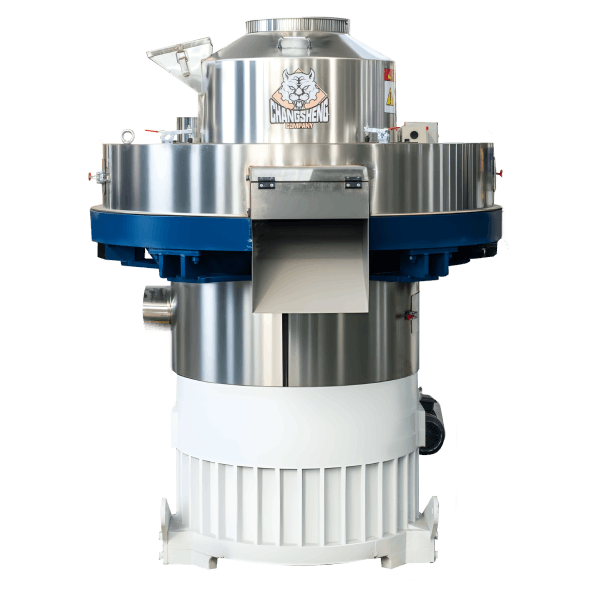
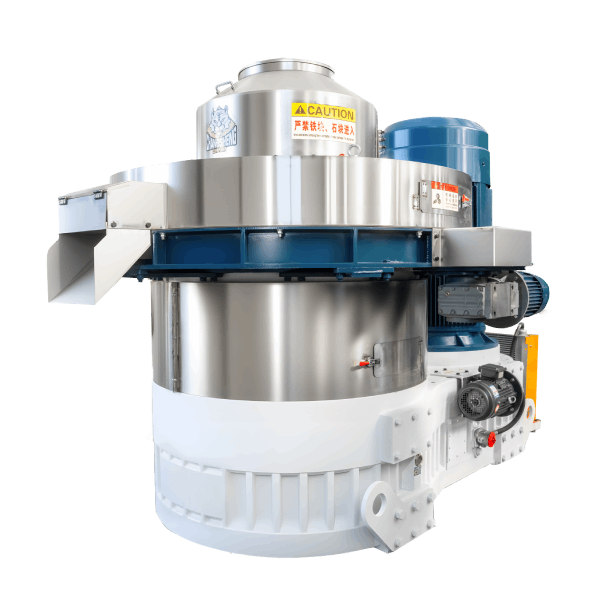
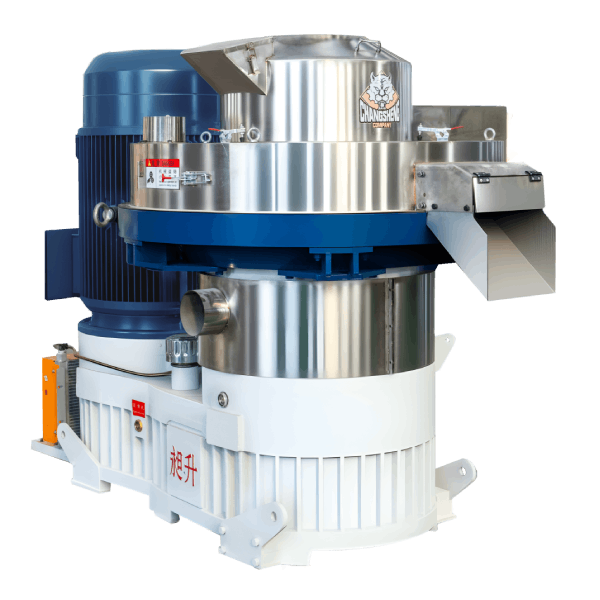
Pellet Mill for Olive Pomace: 0.5-3 t/h High-Oil Models
News 2026-05-11
1. Product Definition
A pellet mill for olive pomace is a ring die densification system engineered to compress the wet, oily residue (pomace) from olive oil production into high-calorific fuel pellets (17-19 MJ/kg), featuring corrosion-resistant stainless steel dies, explosion-proof design, and specialized oil management for 8-12% residual oil.
2. Technical Parameters & Specifications
| Parameter | Small Olive Mill | Medium Olive Mill | Large Olive Mill |
|---|---|---|---|
| Capacity (t/h) | 0.3 – 0.8 | 0.8 – 1.5 | 1.5 – 3.0 |
| Motor Power (kW) | 45 – 75 | 75 – 110 | 110 – 160 |
| Ring Die Diameter (mm) | 320 – 420 | 420 – 520 | 520 – 650 |
| Die Material (Required) | Stainless steel (440C) | Stainless steel | Stainless steel + coating |
| Die Life (hours) | 1,200 – 1,800 | 1,500 – 2,500 | 1,800 – 3,000 |
| Finished Pellet Diameter (mm) | 6, 8 | 8, 10 | 10, 12 |
| Pellet Density (kg/m³) | 900 – 1,100 | 950 – 1,150 | 1,000 – 1,200 |
| Calorific Value (MJ/kg) | 17 – 19 | 17 – 19 | 17 – 19 |
| Optimal Moisture (%) | 12 – 18 | 12 – 18 | 12 – 18 |
| Residual Oil Content (%) | 8 – 12 | 8 – 12 | 8 – 12 |
| Ash Content (%) | 15 – 25 | 15 – 25 | 15 – 25 |
| Energy Consumption (kWh/t) | 90 – 130 | 85 – 120 | 80 – 110 |
For olive pomace pricing: Request a pellet mill for olive pomace quotation with stainless steel die and explosion-proof package.
3. Structure & Material Composition
Olive Pomace-Specific Design Features
Corrosion Protection (Essential)
- Ring die: 440C stainless steel (HRC 52-56) – resists organic acids (pH 4-5)
- Roller shells: Stainless steel or tungsten carbide hardfacing
- Main shaft: 17-4PH precipitation-hardening stainless steel
- All contact surfaces: Stainless steel or epoxy-coated (3-layer)
Oil Management Features
- Polished die surface (Ra <0.2μm) – prevents oil adhesion
- Easy-clean die design (quick-release)
- Solvent cleaning system (citrus degreaser)
- Extended cooler retention (prevents oil migration)
Fire & Explosion Protection (Non-negotiable)
- Spark detection (infrared) with automatic water mist
- Explosion vent panels (NFPA 68 compliant)
- Temperature monitoring (alarm at 90°C, shutdown at 100°C – lower than wood due to oil)
- ATEX/NEMA-rated motors in dust/oil areas
4. Manufacturing Process (Engineering Steps)
Step 1 – Olive Pomace Collection & Drying
Source: Olive oil mills (two-phase or three-phase process)
Moisture: Two-phase pomace 55-65%, three-phase 65-75% – must dry to 15-20%
Equipment: Rotary dryer (biomass-fired) – mandatory (cannot pellet wet)
Step 2 – Grinding to Particle Size
Equipment: Hammer mill with 4-6mm screen
Control: 95% passing 4-5mm (olive pits are hard)
Energy: Olive pits require 30-50% more grinding energy than wood
Step 3 – Pelletizing with Stainless Steel Die
Equipment: Ring die pellet mill, 440C stainless die
Control: Die temperature 70-85°C (lower than wood to prevent oil smoking), roller gap 0.15-0.25mm
Capacity: Derate 30-50% vs wood
Step 4 – Cooling (Extended for Oil)
Equipment: Counterflow cooler with extended retention (15-20 minutes)
Control: Cool to ambient +5°C; prevents oil migration to surface
Why: Oil can migrate if cooled too quickly
Step 5 – Oil Absorption (Optional)
Additive: Add 5-10% sawdust or other dry absorbent to reduce oil content and fire risk
5. Industry Comparison
| Parameter | Standard Wood Mill | Upgraded Mill for Olive Pomace | Olive Pomace Briquette Press | Direct Burning (Raw Pomace) |
|---|---|---|---|---|
| Die life (hours) | 200-400 (corrodes) | 1,500-3,000 | 800-1,200 (rollers) | N/A |
| Corrosion resistance | Low | High (stainless) | Moderate | High |
| Calorific value (MJ/kg) of output | 17-19 | 17-19 | 15-17 (lower density) | 10-14 (wet) |
| Moisture requirement | 13-18% | 12-18% (pre-dry to 15-20%) | 12-18% | Any (inefficient) |
| Oil tolerance | Low (sticking) | High (8-12% oil) | Moderate | High |
| Fire/explosion risk | Moderate | High (oil vapor) | Moderate | Low |
| Payback for olive mill | N/A | 12-24 months | 18-30 months | N/A |
| Why Choose Shandong Changsheng | Not suitable | Stainless steel die, explosion-proof, oil management | Lower density | Low efficiency, pollution |
Compare olive pomace processing options: Request a feasibility study for your olive oil mill volume.
6. Application Scenarios (By Buyer Role)
Distributors / Importers
Stocking pellet mill for olive pomace in Mediterranean regions (Spain, Italy, Greece, Turkey, Tunisia, Morocco, Portugal). Decision focus: stainless steel die, explosion-proof package, and local spare parts.
EPC Contractors
Specifying olive pomace pellet lines for olive oil mills (5,000-50,000 tons/year pomace). Decision focus: guaranteed die life at specified oil content, fire safety (ATEX/NFPA), and dryer integration.
Engineering Consultants / Technical Advisors
Advising olive oil mills on waste-to-energy economics. Decision focus: payback period (12-24 months), replacement of diesel/coal, and carbon credit eligibility.
End-user Facilities
Olive oil mills, biomass power plants, pomace extraction plants.
7. Core Technical Pain Points & Engineering Solutions
Pain Point 1 – Rapid Die Corrosion from Organic Acids
Problem: Standard GCr15 die corrodes within 200-400 hours. Die surface pitted, holes rough.
Root cause: Olive pomace contains organic acids (pH 4-5) from olive fruit.
Solution: Use 440C stainless steel die (HRC 52-56) – 4-8x life (1,500-3,000 hours). Also use stainless steel roller shells. Clean die daily with neutralizing wash (sodium bicarbonate).
Pain Point 2 – Fire from Residual Oil Vapor
Problem: Olive pomace contains 8-12% residual oil. Oil vapor ignites at 150-200°C in die. Plant fire.
Root cause: Lower flash point than wood lignin.
Solution: Keep die temperature below 85°C (vs wood 110°C). Install spark detection with water mist. Explosion vents on dust collector. ATEX-rated motors. Never run unattended.
Pain Point 3 – High Moisture (55-75%) Requires Drying
Problem: Fresh olive pomace 55-75% moisture. Cannot pellet wet.
Root cause: Two-phase and three-phase processes produce high-moisture residue.
Solution:* Install rotary dryer (biomass-fired) to reduce moisture to 15-20%. Drying cost 20-40% of line capital. For small mills, sun drying possible (2-7 days in Mediterranean climate).
Pain Point 4 – Die Sticking from Oil
Problem: Pellets stick to die surface, require frequent cleaning (every 2-4 hours).
Root cause: 8-12% residual oil creates adhesion.
Solution: Mirror-polished die (Ra <0.1μm). Stainless steel die (less adhesion). Clean die with solvent (citrus degreaser) every shift.
8. Risk Warnings & Mitigation Strategies
Risk 1 – Oil Vapor Explosion
Warning: Olive pomace oil vapor (8-12%) mixed with air (dust) – explosive mixture. Ignition from spark or static.
Mitigation: Spark detection with water mist (mandatory). Explosion vents on cyclones. ATEX motors. Ground all equipment. Purge with inert gas (nitrogen) if feasible.
Risk 2 – Fire in Dryer from Oil Residue
Warning: Oil residue in dryer can ignite at 200-250°C. Dryer fire spreads to plant.
Mitigation: Dryer inlet temperature max 300°C (lower than wood’s 400-500°C). Install spark detection. Clean dryer weekly to remove oil buildup. Use steam fire suppression.
Risk 3 – Self-Heating in Storage (Oil Rancidity)
Warning: High-oil pellets (8-12%) can self-heat in storage (exothermic oxidation), reach 60-80°C spontaneously. Fire risk.
Mitigation: Cool pellets to ambient temperature before storage (max 30°C). Do not store more than 14 days of production. Monitor silo temperature with probes. Add antioxidant (0.1-0.2% TBHQ) for long-term storage.
9. Procurement Selection Guide (6 Actionable Steps)
Step 1 – Analyze your olive pomace characteristics
Send 5kg sample for: moisture (target 15-20%), residual oil (8-12% typical), ash (15-25%), pH (4-5), calorific value (17-19 MJ/kg). Higher oil = higher fire risk.
Step 2 – Calculate available pomace volume
Olive oil mill: 1 ton olives produces 0.5-0.8 tons wet pomace (two-phase) or 0.8-1.0 tons (three-phase). Dried pomace 0.2-0.3 tons per ton olives. Size line accordingly.
Step 3 – Select die metallurgy
GCr15: not suitable (corrodes). Minimum: 440C stainless steel. Premium: 440C with titanium carbonitride coating (extends life 50%).
Step 4 – Verify dryer requirement
If pomace moisture >30%, rotary dryer mandatory (adds $50k-200k). Sun drying possible in Mediterranean climate (2-7 days) but space-intensive.
Step 5 – Request fire safety package
Spark detection with water mist, explosion vents, ATEX motors, temperature monitoring. Adds 15-25% to line cost. Non-negotiable for olive pomace.
Step 6 – Negotiate oil-related warranty
Standard warranty excludes oil damage. Request extended coverage for oil-related failure (if stainless die). Accept higher price for oil-resistant guarantee.
10. Engineering Case Study
Project Background: An olive oil mill in Spain (Jaén region) produced 2,000 tons/year of wet pomace (60% moisture). Currently dried and sold as low-value animal feed (€30/ton). Wanted to produce fuel pellets for on-site boiler.
Initial Problem: Mill purchased standard wood pellet machine (€45,000). After 3 months: die corroded (400 hours). Roller shells rusted. Small fire (spark ignition). Water damage to control panel. Total loss €60,000.
Root Cause Analysis:
- GCr15 die corroded from organic acids (pH 4-5)
- No spark detection (fire risk ignored)
- Pomace 60% moisture (not dried – mill assumed dryer not needed)
- No stainless steel components
Solution Implemented (Shandong Changsheng olive-spec):
| Component | Specification | Cost (EUR) |
|---|---|---|
| Rotary dryer | 1.2m × 8m, biomass burner | €85,000 |
| Pellet mill | 440C stainless die, 90kW | €75,000 |
| Roller shells | Stainless steel hardfaced | €6,000 per set |
| Fire safety | Spark detection, water mist, ATEX | €22,000 |
| Stainless conveyor | All contact surfaces | €15,000 |
| Total | €203,000 |
Final Data Results (12 months operation):
| Metric | Standard Mill (Failed) | Olive-Spec Line |
|---|---|---|
| Die life (hours) | 400 | 2,400 |
| Roller shell life (hours) | 300 | 1,600 |
| Capacity (t/h) | 0.3 (with wet material) | 0.7 (dried to 15%) |
| Fire incidents | 1 | 0 |
| Annual pellet production | 0 | 1,200 tons |
| Fuel oil displacement | €0 | €180,000/year |
| Pellet sales (industrial) | €0 | €120,000/year |
- Investment: €203,000
- Annual savings + revenue: €300,000
- Payback: 8 months
Request an olive pomace feasibility study: Contact engineering team with your olive crush volume, pomace moisture, and current disposal cost.
11. FAQ
Q1: What is olive pomace?
The solid residue (skin, pulp, pits, and residual oil) left after olive oil extraction. 0.5-1.0 tons wet pomace per ton of olives.
Q2: Can olive pomace be pelleted with a standard wood pellet mill?
No. Organic acids corrode carbon steel die (200-400 hours). Residual oil causes fire risk. Requires stainless steel die and explosion-proof design.
Q3: What is the calorific value of olive pomace pellets?
17-19 MJ/kg (similar to wood). Ash content 15-25% (vs wood 1-2%) – requires industrial boiler with ash removal. Residual oil 8-12% adds energy.
Q4: What moisture is best for olive pomace pellets?
12-18% (similar to wood). Fresh pomace 55-75% moisture – must be dried (rotary dryer or sun drying).
Q5: Why does olive pomace corrode standard dies?
Organic acids (pH 4-5) from olive fruit attack carbon steel. 440C stainless steel required.
Q6: Do I need special fire safety for olive pomace?
Yes. Residual oil (8-12%) lowers flash point. Spark detection + water mist mandatory. Explosion vents, ATEX motors. Adds 15-25% to line cost.
Q7: What is the typical die life for olive pomace with stainless steel?
1,500-3,000 hours for 440C stainless. GCr15 only 200-400 hours (not suitable). 20CrMnTi also corrodes.
Q8: Are olive pomace pellets safe for home pellet stoves?
No. High ash (15-25%) clogs burn pots. Residual oil creates sticky deposits. Use in industrial boilers with ash removal only.
Q9: Can olive pomace pellets be used for animal bedding?
Not recommended. Residual oil may stain fur. High ash content. Organic acids. Use wood pellets for bedding.
Q10: What is the bulk density of olive pomace pellets?
900-1,200 kg/m³ (similar to wood). Lower than wood due to porous structure.
Q11: Do olive pomace pellets require a special dryer?
Rotary dryer required if moisture >30%. Sun drying possible in Mediterranean climate (2-7 days). Dryer must have spark detection (oil fire risk).
Q12: What certifications are needed for olive pomace pellet export?
ISO 17225-6 (solid biofuels). ENplus not applicable (olive not wood). For co-firing: utility specifications (chlorine <0.2%, ash <20%, oil <10%).
Q13: Can olive pomace be mixed with wood for pelleting?
Yes. 50% pomace + 50% wood reduces oil to 4-6%, ash to 8-12%. Improves pelleting, reduces fire risk.
Q14: What is the global market for olive pomace pellets?
Growing. Mediterranean region (Spain, Italy, Greece, Turkey, Tunisia, Morocco, Portugal) produces 3+ million tons/year dry pomace. Used for co-firing in Europe.
Q15: What is the typical payback for an olive oil mill investing in pellet production?
12-24 months for mills replacing diesel/coal with pellets. 18-30 months for mills selling pellets to power plants. Faster with carbon credits.
12. Commercial Call-to-Action
For olive oil mills and biomass power plants: Request a pellet mill for olive pomace quotation with 440C stainless steel die, spark detection system, and explosion-proof design – Mediterranean climate ready.
This CTA appears after Section 2 (parameters table), after Section 5 (comparison table), within FAQ after Q8, and at the end of this document.
Need an olive pomace analysis? Send a 5kg sample for moisture, oil content, ash, and pH testing. Receive corrosion life projection and fire safety recommendation.
Looking for carbon credit eligibility? Contact the engineering team for documentation on olive pomace pellet projects for carbon credit verification (methane avoidance, biogenic CO2).
To proceed: Send your inquiry via the contact form. Include your olive crush volume (tons/year), pomace moisture (%), residual oil (%), and current disposal method (landfill, composting, animal feed).
13. Author & E-E-A-T Credentials
Author: Zhang Wei
Olive Oil Residue Processing Specialist
- 11 years in biomass processing with focus on oil crop residues (olive, palm, sunflower) (2014–present)
- Deployed 15+ olive pomace pellet systems across Spain, Italy, Greece, Turkey, and Tunisia
- Developed 440C stainless steel die specification for high-acid, high-oil olive residues
- Certified fire safety engineer (NFPA 850, ATEX 137)
- Author of “Olive Pomace Waste-to-Energy Guide” (China Machine Press, 2023)
- Member of the International Olive Council (IOC)
Affiliation: Shandong Changsheng Machinery Co., Ltd.
The author has directly designed pellet mill for olive pomace systems for olive oil mills from 500 to 20,000 tons/year pomace, validated corrosion rates for stainless vs carbon steel, and documented fire safety protocols for oil-containing residues. All specifications, corrosion data, and economic analyses are derived from actual olive mill installations from 2018–2026.