Pellet Mill With Mixed Materials: Blending and Selection
News 2026-11-03
A pellet mill running a single material is a simpler machine to specify than one running a blend, and the difference shows up in every stage of the line. Mixed materials vary in lignin, ash, moisture, particle size, and bulk density, and a blend can behave in ways that neither of its components would behave on its own. The pellet mill has to be specified for the blend, not for the average of the components, and the feeding and conditioning stages have to be designed for a material whose consistency changes batch by batch.
This page is written for operators whose mill is not performing on a mixed feed and for buyers who need to decide how to blend, what the blend means for the die and the feeder, and what to test before committing to equipment. Shandong Changsheng Machinery configures biomass pellet lines for blended feedstocks as well as single materials, and the guidance below reflects how those lines are specified and where mixed-material problems actually come from.
The short answer
A pellet mill with mixed materials fails or underperforms for two reasons. The blend may have a binding behavior that is worse than either component alone, because a material with good lignin can be diluted by one with poor binding. And the blend may feed unevenly, because components with different bulk density and particle size separate in the bin, the feeder, and the die.
The fix is to treat the blend as its own material. Screen the blend ratios against the end-market limits before any test, test the actual blend, specify the die against the blend and the target pellet diameter, design the feeding and mixing stages to keep the blend uniform, and confirm the capacity on the blend rather than on either component.
The practical rule: do not assume a blend will behave like its best component, and do not assume it will behave like its worst. Test it.
Why mixed materials behave differently from single materials
Binding is not additive. Lignin softens under heat and pressure and acts as a natural binder. A material with high lignin can carry a blend only within a limit that depends on the components, the moisture, and the die, and the limit cannot be calculated from the weighted average of the component lignin values. Beyond that limit, the low-lignin component dilutes the binding effect and the pellet durability falls. The boundary has to be established by testing the blend on the intended die.
Separation happens before the die. Components with different bulk density and particle size separate in storage, in the feed bin, and in the feeder. A blend that is uniform when it is mixed can arrive at the die as a series of bands, so the die sees a material that changes from minute to minute. That destabilizes die temperature and produces inconsistent pellet quality even when the average blend is correct.
Moisture and drying requirements differ. Components may arrive at different moisture levels, and a blend of wet and dry material may need a different drying approach from either component alone. The target moisture at the die should be established on the blend, not on the components.
Ash and silica add up. A blend of two moderate-ash materials can produce a pellet with ash above the limit for the end market, and the abrasiveness of the blend affects die and roller life. The ash and silica of the blend should be calculated and tested, not assumed.
How to screen blend ratios before testing
The first pass on a blend is arithmetic, not trial. The ash, chlorine, and silica of the blend can be estimated from the components and their ratios, and those estimates can be compared with the end-market limits before any material is mixed. If the estimated ash already exceeds the limit, or the estimated chlorine is above the limit for the destination market, the ratio is not viable and there is no point in testing it.
The arithmetic does not replace the trial, because binding and durability are not additive and cannot be estimated this way. But it removes the ratios that cannot meet the specification for reasons that are fully determined by the components, and it narrows the trial to the ratios that have a chance.
When the components carry different chlorine levels, the chlorine limit is often the binding constraint, because some markets apply a hard ceiling that no amount of blending can exceed. The blend ratio should be screened against that ceiling first.
How to decide whether to blend at all
Blending is a solution to a supply or quality problem, not a goal in itself. It is worth considering when a single material is not available in sufficient volume, when the available material has a binding or ash problem that a second material can offset, or when the end market accepts a blended pellet and the blend improves the economics.
It is not worth doing when the blend produces a pellet that fails the end market’s ash, chlorine, or durability limits, or when the cost of mixing, testing, and managing variability exceeds the benefit. The decision should be made on the specification of the finished pellet and on the cost of the blend, not on the availability of the components alone.
How the blend changes the die specification
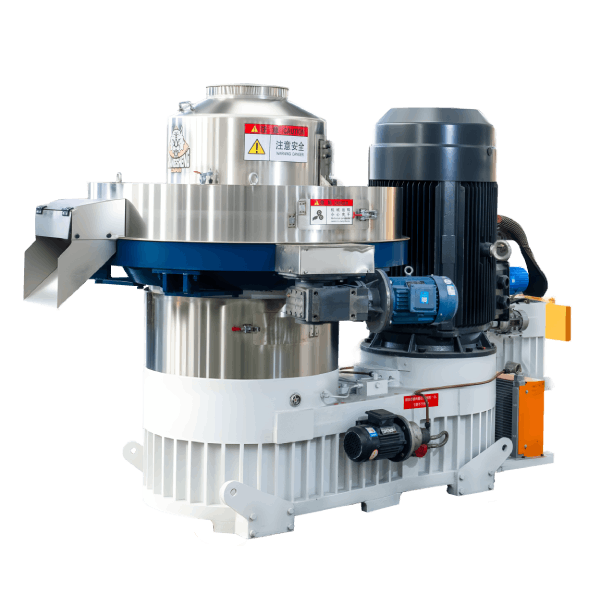
The die compression ratio, hole diameter, and open area should be selected against the blend, the moisture at the die, and the target pellet diameter, and confirmed in trial production. A die that works on the high-lignin component may be too aggressive on the blend, and a die that works on the low-lignin component may not generate enough pressure on the blend. The die specification should not be taken from either component’s specification.
Because the blend can separate before the die, the die also has to cope with a feed that varies. A die that is sensitive to moisture or particle size variation will produce inconsistent quality on a blend that is not perfectly mixed, which makes the mixing and feeding stages part of the die decision.
How the blend changes feeding and mixing
The feeding system should be designed to keep the blend uniform up to the die. That means attention to bin geometry, agitation, the feeder type, and the sequence in which components are added. A blend that is mixed once and then stored can separate again, so the mixing point and the storage time matter.
Whether a force feeder or assisted feeding is needed depends on the blend’s bulk density and flow behavior, and should be confirmed in trial. The same applies to conditioning: a blend may need more or less conditioning than either component, and the settings should be established on the blend.
Once the line is running, the blend uniformity should be checked rather than assumed. A simple check is to sample at the mill inlet at intervals across a shift and compare the particle size distribution and bulk density of the samples. If those vary more than the mixing system is designed to allow, the blend is separating somewhere between the mixer and the die, and the mixing or feeding arrangement needs attention.
How the blend changes capacity
Capacity on a blend is not the average of the capacities on the components. The blend may feed more slowly because of separation, it may compact differently at the die, and it may produce a pellet with lower durability that has to be run more slowly to meet the specification. The capacity should be quoted against a defined blend, a defined moisture, and a defined pellet diameter, and confirmed in trial on the actual blend.
Where the blend ratio can vary, the capacity should be quoted for the range of ratios the line will actually run, not only for the best case. That range is a decision the buyer has to make before requesting the quotation, because it sets how much flexibility the line is being specified for. A line that meets its capacity on a 70/30 blend may not meet it on a 50/50 blend, and the difference should be known before the equipment is ordered.
How to test a blend before committing to equipment
A blend should be tested as a blend, not as a set of components. The useful test is a trial on the actual blend at the intended ratio, moisture, and particle size, on the proposed die, with the pellet durability and the output measured. The trial should include the blend at the wet end and the dry end of the moisture range the line will run, and at the ratios the line will actually use.
The material data to provide to a supplier before the trial are the components and their ratios, the moisture range of each component and of the blend, the particle size distribution and bulk density of the blend, the ash, chlorine, and silica content of the blend, and the target capacity and pellet diameter. A supplier who quotes a die specification without a trial on the blend is working from assumption rather than evidence, and the assumption will be tested in production.
A practical sequence for a mixed-material project
- Define the end-market specification for the pellet, including ash, chlorine if relevant, and durability.
- Measure the components and calculate the blend’s ash, chlorine, silica, and lignin, then screen the ratios against the end-market limits before any test.
- Decide the blend ratios the line will actually run, and the range over which they can vary.
- Design the mixing and feeding stages to keep the blend uniform up to the die.
- Specify the die against the blend, the moisture at the die, and the target pellet diameter, and confirm in trial.
- Quote capacity against a defined blend, moisture, and pellet diameter, and confirm in trial on the actual blend.
- Agree an acceptance test on the blend at the intended ratio and moisture before shipment.
What to specify to a supplier
Before requesting a quotation for a mixed-material line, provide the components and their ratios, the moisture range of each component and of the blend, the particle size distribution and bulk density of the blend, the ash, chlorine, and silica content of the blend, the target capacity and pellet diameter, the available power supply, and whether conditioning, steam, or binders are intended. Ask the supplier to state the die specification matched to the blend, the mixing and feeding arrangement, the capacity basis, and the acceptance test to be run on the blend. A quotation that lists capacity and motor power but does not state the blend basis and the acceptance test leaves the mixed-material risk with the buyer.
If you are configuring a line for a blended feedstock and need to set the mixing, feeding, die, and capacity basis together, send the component data, the blend ratios, the target capacity, and the pellet diameter, and the Shandong Changsheng Machinery team can propose a line configuration and trial plan for review.
Procurement risks that appear later as mixed-material problems
Capacity quoted on a single component. The line is rated on the high-lignin component and run on a blend, and the output falls short in a way that looks like a mill fault.
A die selected from one component’s specification. The die is chosen for the better-binding material and run on the blend, and durability falls or the die blinds.
Mixing and feeding designed for a single material. The blend separates before the die, pellet quality varies, and the operator compensates by running slower.
Ash, chlorine, or silica of the blend not screened. The pellet fails the end-market limit, or the die and roller wear faster than expected.
No acceptance test on the blend. The line is accepted on a trial with one component, and the blend behavior appears only after commissioning.
Bottom line
A pellet mill with mixed materials is specified against the blend, not against the components. Binding is not additive, separation happens before the die, moisture and ash requirements differ, and capacity on a blend is not the average of the capacities on the components. Screen the ratios against the end-market limits first, test the blend, specify the die against it, design the mixing and feeding stages to keep it uniform, quote capacity against a defined blend and moisture, and agree an acceptance test on the blend before shipment. A quotation that does not state the blend basis, the die specification, and the acceptance test leaves the mixed-material risk with the buyer.