Dry Material Not Pelleting: Causes and Fixes
News 2026-11-02
Dry material that will not pellet is usually described as a moisture problem, and moisture is often part of it. But dry material not pelleting covers several different failures, and they do not share a single cause. A mill that produces no pellets at all, a mill that produces soft crumbly pellets, a mill whose output collapses, and a mill whose die holes blind over are four different symptoms. Treating all of them by adding water is how operators end up with wet material clogging the die instead.
This guide is written for operators who are dealing with dry material that will not form pellets, and for buyers who are configuring a line and need to know what to verify before committing to equipment. Shandong Changsheng Machinery works with biomass pelleting projects across a range of feedstocks, and the diagnostic logic below reflects how these problems are typically traced on a running line.
The short answer
Dry material fails to pellet because the combination of moisture, particle size, die specification, roller gap, and natural binding does not allow the material to compact and hold together under the die. Moisture is one input in that combination, not the whole explanation. Before adding water, identify which symptom you have, because the correction for no pellets at all is often different from the correction for soft pellets or a blinded die.
The practical rule: diagnose by symptom, check moisture, particle size, die, and roller gap together, and change one variable at a time.
First, identify which symptom you actually have
No pellets form at all. The mill runs, material passes through, but nothing forms. This usually points to a feed problem, a roller gap problem, or a die that is completely mismatched to the material. If the roller gap is too large or the rollers are worn, the material is pushed around the die rather than pressed into the holes, and no pellet forms regardless of moisture.
Pellets form but are soft and crumbly. Pellets emerge but break easily and produce fines. This points to insufficient binding, which can come from low moisture, low lignin, coarse or inconsistent particle size, or a die that does not generate enough pressure for the material.
Output collapses even though pellets form. Pellets are produced but throughput is far below expectation. This can come from material that is too dry and dusty, from uneven feed, from a die with too much open area for the material, or from a mill being fed below its design load.
Die holes blind over. Holes plug and stop accepting material. This is usually associated with wet or sticky material, but it can also happen with very fine dry material that packs into holes without binding, or with material carrying oil or contaminants.
Dry material and wet material fail in opposite directions
Why wet material clogs. Excess water lowers friction and die temperature, so the material slips under the rollers instead of compacting. Water occupies space in the die holes and reduces the material’s ability to densify. The result is blinded holes, roller slip, and collapsing throughput.
Why dry material refuses to bind. Very dry material has little free moisture to assist heat transfer and particle rearrangement, and it can become dusty and free-flowing in a way that prevents the die from gripping it. Lignin needs heat and pressure to soften and act as a binder; without enough moisture and friction, the material passes through without forming a durable pellet.
Why the fix for one makes the other worse. Adding water to dry material helps only up to the point where the material can compact. Beyond that point, the same water that was helping begins to cause slip and blinding. Conversely, drying wet material helps only until the material becomes too dry to bind. The two failures sit on opposite sides of a workable window, and the window is set by the material, the die, and the mill, not by a universal number.
The variables that decide whether dry material pellets
Moisture at the die. There is no universal correct moisture figure. The workable range depends on the material, its particle size, the die compression ratio, the pellet diameter, and whether steam or conditioning is used. What matters is whether the material can be compacted at the die without slipping and without blinding. That has to be confirmed by testing the actual material on the actual die.
Particle size and bulk density. Very fine, dry material behaves differently from coarse material. Fine dry material can be dusty, flow too freely, and fail to be gripped by the rollers; it can also pack into die holes without binding. Coarse material may not fill the die evenly. Particle size distribution and bulk density should be measured rather than assumed, because a line set up for one grind can fail on another.
Die compression ratio and hole specification. Compression ratio controls how much resistance the material meets at the die. A die that is too open for dry material may not generate enough pressure to form a durable pellet; a die that is too aggressive can stall or overheat. Hole diameter and open area also affect how the material fills and compacts. The die should be selected for the material, the target pellet diameter, and the moisture at the die, and confirmed in trial production.
Roller gap and roller condition. If the roller gap is too large, the material is not pressed firmly into the die and pellets do not form. Worn rollers or incorrect gap settings produce the same symptom as a moisture problem. Roller gap should be checked and set according to the mill manufacturer’s procedure before any conclusion is drawn about the material.
Lignin and natural binding. Lignin softens under heat and pressure and acts as a natural binder. Materials with low lignin bind less readily and may need a die that generates more pressure, a finer grind, a binder, or a modest increase in moisture at the die compared with the same material at higher lignin, within the range the die can still handle without slipping. Lignin content is a property of the material, not something the operator can adjust, so it sets the boundary of what the die and the process can achieve without additives.
Adding water correctly, and when not to
Water should be added only where it can be distributed evenly through the material before the die, typically in a mixing or conditioning stage, not poured onto material in the feed hopper or on a conveyor. Uneven water produces local wet spots that blind the die while the rest of the material remains too dry, and that is the failure mode that turns a dry-material problem into a wet-material problem.
The amount should be set by testing, starting from the material’s measured moisture and moving toward the range the die can handle. The target is even distribution through the material, not a single high moisture reading. If the material cannot be mixed evenly, adding water is likely to create more problems than it solves.
Steam versus liquid water. Steam adds both moisture and heat, and the heat helps soften lignin and improve binding. Liquid water adds moisture without the heat. For materials that bind poorly, steam conditioning is often more effective than liquid water, but the need for and settings of conditioning depend on the material and the mill and should be confirmed in trials.
When water will not fix it. If the material is already within a workable moisture range and the mill still will not form pellets, adding more water will not help. At that point the problem is more likely to be roller gap, die specification, particle size, or lignin, and the correction should be directed there.
When the problem is the die or the roller, not the moisture
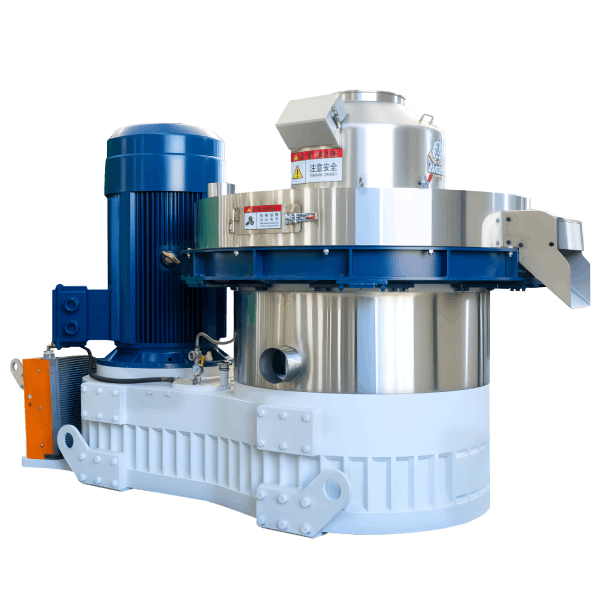
If moisture has been adjusted and the material still will not pellet, the next checks are mechanical. Roller gap and roller wear should be verified against the manufacturer’s specification. Die compression ratio, hole diameter, and open area should be reviewed against the material and the target pellet diameter. A die that worked on one material may not work on another, and a die that has been run for a long time may have worn in a way that changes its behavior. Die and roller condition are part of the diagnosis, not an afterthought.
When the problem is the raw material itself
Low lignin and poor natural binding. Some materials simply bind less readily than wood. In that case, the die can be set to generate more pressure, the grind can be made finer and more uniform, moisture at the die can be optimized within the range the die can handle, and a binder can be considered. Each of these has a cost, and none of them guarantees a durable pellet if the material’s natural binding is very low.
Blending and binders. Blending a poorly binding material with a better binding one can improve pellet quality, and binders such as lignosulfonate or starch can help. The effect depends on the material and the dosage, and the right combination should be established by testing rather than assumed.
A practical diagnostic sequence
- Confirm the symptom: no pellets, soft pellets, low output, or blinded die.
- Measure the moisture of the material as it reaches the die, not from a supplier certificate.
- Check particle size distribution and bulk density.
- Verify roller gap and roller condition against the manufacturer’s specification.
- Record the die specification, including compression ratio and hole diameter, and compare it with the material and pellet diameter.
- Decide the limiting factor: if moisture is clearly below the workable range, correct moisture; if moisture is in range and the die is blinding or not forming, review die, roller gap, and particle size.
- Change one variable at a time and observe output, die temperature, and pellet quality.
- Confirm with a trial on the actual material before committing to equipment changes.
What to specify and test before buying equipment for dry material
Before requesting a quotation, provide the material type and source, the actual moisture range as received, the particle size distribution and bulk density, the target capacity and pellet diameter, the available power supply, and whether conditioning, steam, or binders are intended. Ask the supplier to state the die specification matched to your material, the roller gap setting procedure, the moisture range the mill is expected to handle, and the acceptance test to be run on your material.
A quotation that lists capacity and motor power but does not state the die specification, the moisture basis, and the acceptance test leaves the risk of dry material not pelleting with the buyer. If you are configuring a line for a material that binds poorly or arrives very dry, send the material data and target pellet specification to the engineering team and ask for a configuration and trial plan for review.
Procurement risks that appear later as dry material not pelleting
- A mill rated on a material with good binding, then run on a low-lignin or very dry material, with no die adjustment.
- A die selected for general biomass rather than the actual material and moisture.
- Roller gap not set or checked at commissioning.
- No conditioning or water addition stage, when the material needs one.
- A performance guarantee that does not define the material, moisture, and pellet quality used for acceptance.
- An incomplete quotation that treats the pellet mill as a standalone unit rather than part of a matched line.
These risks are commercial before they are technical. Most of them are settled in the quotation and the acceptance test, long before the mill runs, and they surface later as a production problem that looks like a material or operating fault.
Bottom line
Dry material not pelleting is a symptom with several possible causes. Identify which symptom you have, check moisture, particle size, die specification, and roller gap together, and add water only where it can be distributed evenly and only when moisture is genuinely below the workable range. When moisture is already in range, correct the die, the roller gap, the grind, or the binder instead of adding more water. Specify the full material data to your supplier and agree on an acceptance test before shipment, so the line is configured for the material you will actually run.