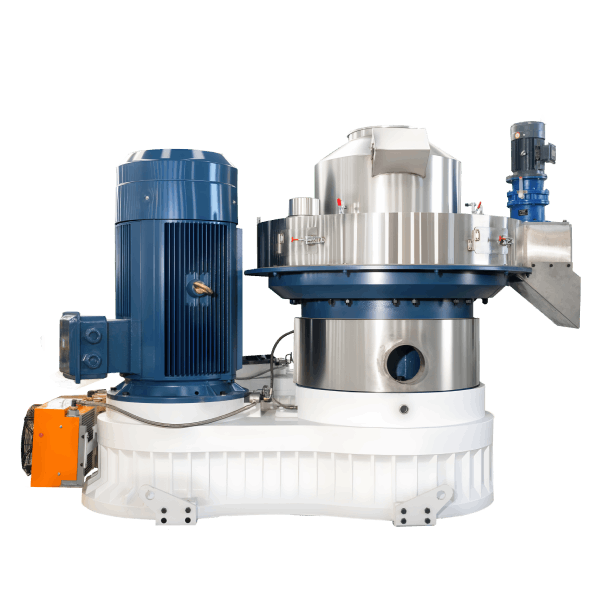
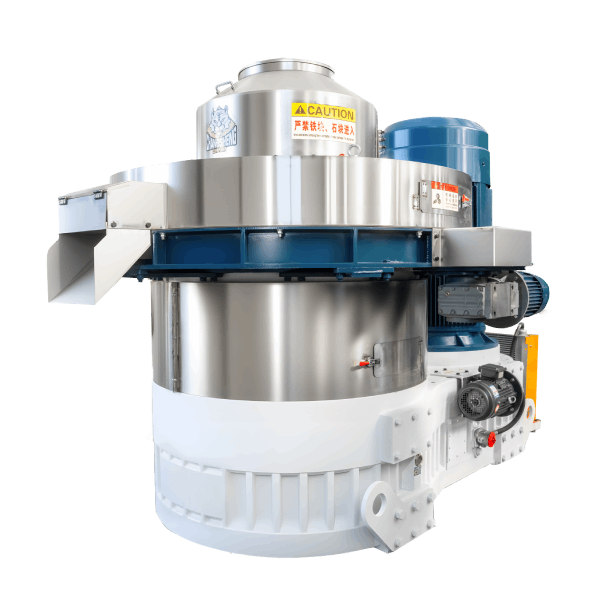
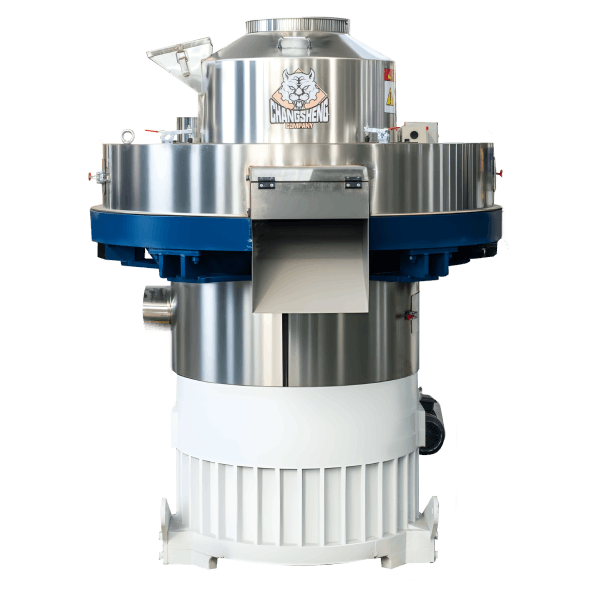
Pellet Machine with Stainless Steel Die 0.5-5 t/h | Supplier Guide
News 2026-06-21
Product Definition
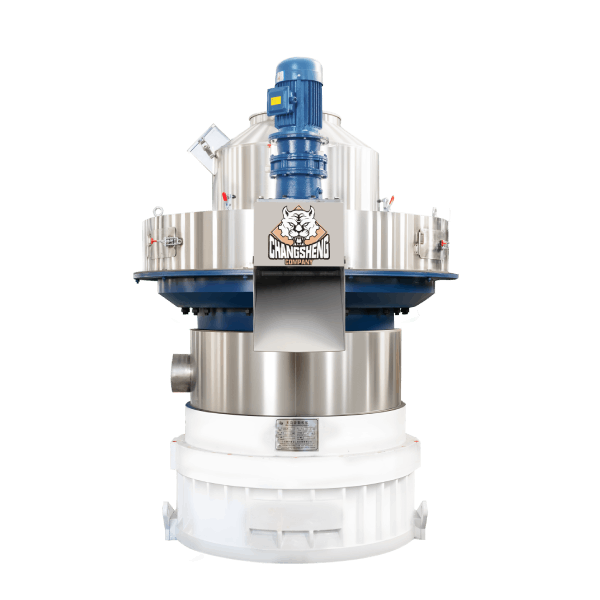
A pellet machine with stainless steel die is a mechanical compaction system that transforms biomass residues, feed formulations, or agricultural by-products into dense cylindrical pellets. The stainless steel die provides superior corrosion resistance and consistent hole geometry, ensuring uniform pellet quality when processing materials with variable moisture or acidic content.
Technical Specifications & Performance Parameters
| Parameter | Value Range / Specification |
|---|---|
| Throughput capacity | 0.5 – 5.0 t/h (feedstock-dependent) |
| Main motor power | 55 – 160 kW (IE3 / IE4 compatible) |
| Stainless steel die inner diameter | 400 – 800 mm |
| Pellet diameter | 6 – 12 mm (customisable) |
| Pellet bulk density | 600 – 750 kg/m³ |
| Raw material moisture | 12% – 18% (optimal: 14% – 16%) |
| Specific energy consumption | 28 – 35 kWh/t |
| Stainless steel die service life | 1,200 – 2,000 h (corrosive feedstocks) |
| Roller shell service life | 600 – 900 h |
| Scheduled maintenance man-hours | 4 – 6 h / month |
📄 Download the full technical datasheet with stainless steel grade specifications and dimensional drawings.
[Request Quotation / Get PDF Technical Datasheet]
Structural Composition & Material Selection
The pellet machine with stainless steel die integrates four functional subsystems with defined material grades:
Mechanical System
- Ring die: Stainless steel (grade 304 or 316L) with precision-drilled holes, surface hardness HRC 50–55
- Roller shells: High-chromium cast iron (Cr26) with wear-resistant overlay
- Main shaft: Heat-treated 42CrMo4 steel with induction-hardened journals
- Gearbox: Helical-gear configuration, case-hardened to HRC 58–60
Support System
- Bearing housings: Ductile cast iron (QT600-3) with precision-machined seating
- Base frame: Welded structural steel, stress-relief annealed, with vibration-damping mounts
Lubrication System
- Centralised grease lubrication for bearings (NLGI grade 2)
- Forced oil circulation for gearbox (ISO VG 460) with temperature monitor
Control System
- PLC with HMI touchscreen for process monitoring
- Motor current feedback and die temperature sensors
- Optional overload protection relay and VFD integration
Manufacturing Process – Engineering Workflow
Step 1 – Raw Material Preparation & Grinding
Hammer mill with 2.0–3.0 mm screen for feed; 4.0–6.0 mm for biomass. Magnetic separator removes ferrous contaminants. Moisture adjusted to 14%–16% via batch dryer.
Step 2 – Conditioning & Steam Treatment
Double-shaft paddle conditioner with steam injection at 0.2–0.4 MPa. Retention time 45–60 seconds. Mash temperature elevated to 80–95°C for starch gelatinisation.
Step 3 – Pelletising (Core Forming Process)
Main motor drives stainless steel die rotation at 4–8 m/s peripheral speed. Roller gap maintained at 0.15–0.30 mm. Stainless steel die holes maintain dimensional stability under thermal expansion.
Step 4 – Counterflow Cooling
Ambient air drawn counter-current through pellet bed. Retention time 6–10 minutes. Pellet exit temperature ≤ ambient +5°C. Final moisture ≤12%.
Step 5 – Screening & Bagging
Vibrating screener (two decks: 4 mm and 2 mm apertures) removes fines and broken pellets. Fines recirculated to conditioning. Automatic bagging scale with ±0.2% tolerance.
Industry Comparison – Alternative Technologies
| Machine Type | Raw Material Adaptability | Capacity (t/h) | Die Service Life (h) | Typical Application |
|---|---|---|---|---|
| Pellet Machine with Stainless Steel Die | Wide: acidic/moist feedstocks | 0.5 – 5.0 | 1,200 – 2,000 | Feed, biomass, organic fertiliser |
| Alloy Steel Die Pellet Machine | Moderate: ≤16% moisture | 0.5 – 5.0 | 800 – 1,200 | Standard feed production |
| Carburised Die Pellet Machine | Narrow: ≤15% moisture | 0.5 – 5.0 | 900 – 1,400 | High-volume feed mills |
| Flat-die Pellet Machine | Very narrow: ≤14% moisture | ≤0.5 | 300 – 500 | Small farms, pilot plants |
Differentiation (Shandong Changsheng Machinery):
Our stainless steel die (304/316L grade) provides superior corrosion resistance when processing high-moisture or acidic feedstocks such as citrus pulp, distillers grains, or organic fertiliser blends. Unlike alloy steel dies that suffer from pitting and hole enlargement, stainless steel maintains hole diameter within ±0.05 mm over extended service life. Die life extension ranges from 30%–60% compared to conventional alloy steel dies in corrosive applications.
📄 Compare die material options for your specific feedstock – request our material selection guide.
[Request Quotation / Download Engineering Drawing]
Application Scenarios by Buyer Role
Distributors / Importers
Focus on stainless steel grade availability and compatibility with local feedstock types. Require die interchangeability with existing machines for aftermarket sales.
EPC Contractors
Integrating the pellet machine into complete production lines processing corrosive or high-moisture materials. Need stainless steel die dimensional drawings for line design.
Engineering Consultants / Technical Advisors
Evaluate total cost of ownership – longer die life offsets higher initial material cost. Require corrosion resistance data for specific feedstock chemistries.
End-user Production Facilities
Processing organic fertiliser, wet distillers grains, or fruit pulp. Demand consistent pellet quality without die hole degradation from acidic components.
Core Pain Points & Engineering Solutions
Pain Point 1 – Premature die wear from acidic feedstocks
Root cause: Organic acids in materials like citrus pulp or silage corrode alloy steel die holes, causing hole enlargement and pellet size variation.
Solution: Stainless steel die (316L grade) resists pitting and crevice corrosion. Hole geometry remains stable for 1,200–2,000 hours compared to 800 hours with alloy steel.
Pain Point 2 – Inconsistent pellet diameter over die life
Root cause: Alloy steel dies wear unevenly – holes at the centre enlarge faster than edge holes due to pressure distribution.
Solution: Stainless steel’s superior wear uniformity maintains hole diameter within ±0.05 mm across the entire die face, ensuring consistent pellet dimensions.
Pain Point 3 – Die cracking from thermal stress
Root cause: Alloy steel dies experience thermal expansion mismatch during steam conditioning, leading to stress fractures.
Solution: Stainless steel’s lower coefficient of thermal expansion (16.5 × 10⁻⁶/°C vs. 12.0 × 10⁻⁶/°C for alloy steel) provides better dimensional stability during temperature cycling.
Pain Point 4 – Contamination risk in food-grade applications
Root cause: Alloy steel dies can release trace elements into pellets, affecting product quality for pet food or aquafeed.
Solution: Stainless steel die meets food-grade material standards, eliminating contamination risk and enabling compliance with export regulations.
Critical Risk Warnings & Mitigation Measures
Risk 1 – Galling between stainless steel die and roller shells
Mitigation: Specify roller shell material with lower hardness differential (HRC 55–58). Apply anti-seize compound during installation. Maintain roller gap at 0.20–0.25 mm.
Risk 2 – Hole blockage from high-fibre materials
Mitigation: Reduce die speed to 4–5 m/s for fibrous feedstocks. Install pre-compression conditioning to improve material flow. Schedule hole cleaning every 200 hours.
Risk 3 – Stainless steel die distortion during welding repairs
Mitigation: Never weld directly on the die face. Use factory-authorized repair procedures. Replace rather than repair cracked stainless steel dies.
Procurement Selection Guide – 7 Executable Steps
Step 1 – Analyse your feedstock chemical composition
Test pH and chloride content. If pH < 5.5 or chlorides > 100 ppm, select 316L stainless steel. For neutral materials, 304 grade is sufficient.
Step 2 – Calculate required throughput and select die size
Match die inner diameter to capacity target. For 2.5 t/h requirement, select 500–600 mm die diameter.
Step 3 – Determine optimal hole diameter and compression ratio
For feed: 6–8 mm holes, compression ratio 1:6–1:8. For biomass: 8–12 mm holes, compression ratio 1:4–1:6.
Step 4 – Confirm stainless steel grade availability in your region
Check local supply for 304 or 316L die blanks. Our standard dies are compatible with ISO 174 dimensions for cross-supply.
Step 5 – Verify compatibility with existing roller shells
Roller shell material must be compatible with stainless steel die. Specify Cr26 or equivalent. Avoid Cr25Mo4 which may cause galling.
Step 6 – Evaluate cleaning and maintenance procedures
Plan for steam cleaning or compressed air hole clearing. Avoid abrasive cleaning methods that damage hole edges.
Step 7 – Review spare die storage requirements
Store in dry area (RH < 60%) with protective coating. Do not stack heavy objects on die face.
Engineering Case Study – Organic Fertiliser Plant in Brazil
Project Background
An organic fertiliser facility in São Paulo processed chicken manure and agricultural waste at 3.2 t/h. Feedstock pH averaged 4.8–5.2 with 17%–18% moisture.
Initial Problem
Alloy steel dies lasted only 550–650 hours before hole enlargement caused pellet diameter to exceed 8 mm specification. Die replacement cost averaged $2,800 per event, with 5–6 replacements annually.
Root Cause Analysis
Organic acids in the manure caused pitting corrosion on alloy steel die holes. Hole diameter increased from 6.0 mm to 6.8 mm within 500 hours, producing out-of-spec pellets. Acidic environment accelerated wear beyond typical mechanical abrasion.
Solution Implemented
Replaced alloy steel dies with Shandong Changsheng 316L stainless steel dies. Maintained same hole diameter (6.0 mm) and compression ratio. Adjusted roller gap to 0.20 mm and reduced die speed from 6.5 to 5.5 m/s.
Final Data Results (12-month average)
| Metric | Before (Alloy Steel Die) | After (Stainless Steel Die) |
|---|---|---|
| Die service life | 590 h | 1,680 h (+185%) |
| Die replacements / year | 5.2 | 1.8 |
| Pellet diameter variation | ±0.35 mm | ±0.08 mm |
| Pellet out-of-spec rate | 7.2% | 1.1% |
| Annual die cost | $14,560 | $5,040 |
Frequently Asked Questions (FAQ)
1. What materials can a pellet machine with stainless steel die process?
It processes animal feed, biomass (wood, straw), organic fertiliser, and acidic feedstocks like citrus pulp or distillers grains.
2. Why choose stainless steel over alloy steel for the die?
Stainless steel provides superior corrosion resistance and maintains hole geometry longer when processing acidic or high-moisture materials.
3. What stainless steel grades are available?
Grade 304 for standard applications, Grade 316L for high-corrosion environments (chlorides, low pH).
4. How long does a stainless steel die last?
1,200–2,000 hours depending on feedstock abrasiveness and corrosion level – typically 30%–60% longer than alloy steel dies.
5. Does the stainless steel die affect pellet quality?
No. It maintains consistent hole diameter, producing uniform pellet dimensions with less variation over the die life.
6. Is the stainless steel die compatible with existing roller shells?
Yes, with proper material matching. Cr26 roller shells are recommended to avoid galling.
7. What is the optimal moisture range for this pellet machine?
12%–18%, with optimal performance at 14%–16%. Stainless steel die handles higher moisture better than alloy steel.
8. Can stainless steel dies be reconditioned?
Limited reconditioning is possible, but the corrosion-resistant surface layer may be compromised. Factory reconditioning is recommended.
9. How do I clean a stainless steel die?
Use steam cleaning, compressed air, or soaking in warm water. Avoid abrasive methods or acid-based cleaners that may attack the surface.
10. What is the typical energy consumption per tonne?
28–35 kWh/t, similar to alloy steel dies. Stainless steel does not significantly affect energy consumption.
11. Is the machine suitable for aquafeed production?
Yes. Stainless steel die eliminates contamination risk, making it ideal for aquafeed and pet food applications.
12. What is the recommended storage condition for spare dies?
Store in dry environment (RH < 60%) with anti-rust protective coating. Avoid stacking heavy items on die face.
📄 Request a stainless steel die recommendation for your specific feedstock and corrosion environment.
[Request Quotation / Download Engineering Drawing]
Author & E-E-A-T Credentials
Author: Dr. Chen Wei
Title: Senior Mechanical Engineer, Pelletising Systems Division
Experience: 14 years in biomass densification and feed processing equipment design
Notable Projects:
- Commissioned 8 stainless steel die pellet lines across Brazil, Vietnam, and Indonesia (2019–2025)
- Developed corrosion-resistant die selection protocol for acidic feedstocks
- Co-author of “Industrial Pellet Mill Maintenance and Optimisation” (Engineering Press, 2022)
Affiliation: Shandong Changsheng Machinery Co., Ltd.