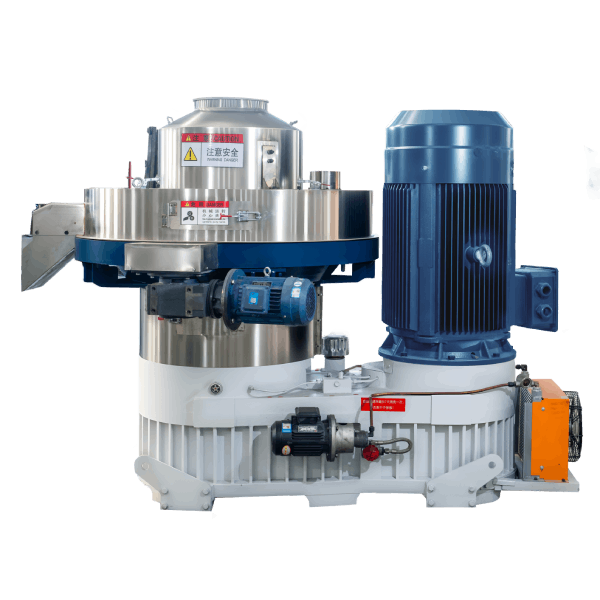
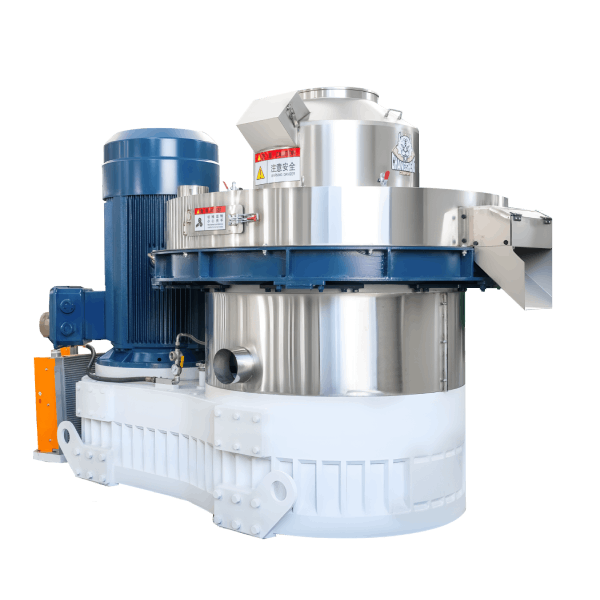
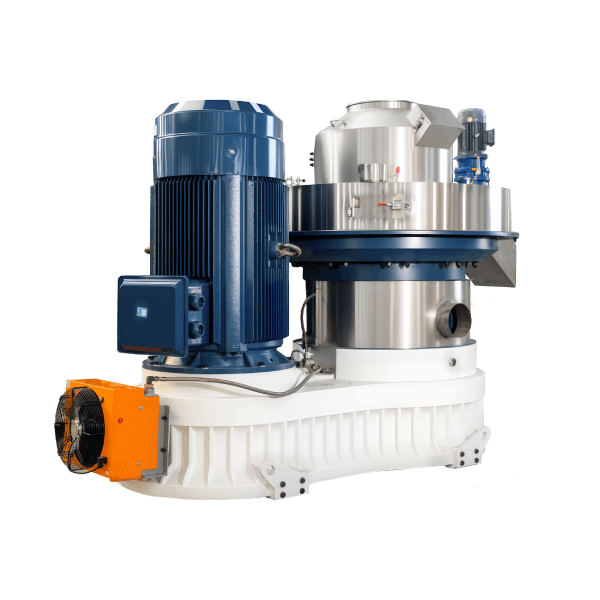
Industrial Pellet Machine 1000kg per Hour: 55kW Ring Die Models
News 2026-05-30
1. Product Definition
An industrial pellet machine 1000kg per hour (1 t/h) is a ring die densification system for small commercial pellet plants, sawmills, and feed mills, featuring a 55kW motor (75 HP), 320-420mm ring die, PLC automation, and VFD feeder, producing 0.8-1.2 t/h depending on feedstock (softwood 1.0-1.2 t/h, hardwood 0.6-0.8 t/h, feed 1.2-1.5 t/h), requiring 380V/415V three-phase power.
2. Technical Parameters & Specifications
| Parameter | Softwood | Hardwood | Mixed Wood | Feed | Rice Husk |
|---|---|---|---|---|---|
| Capacity (kg/h) | 1,000 – 1,200 | 600 – 800 | 800 – 1,000 | 1,200 – 1,500 | 400 – 600 |
| Motor power (kW) | 55 | 55 | 55 | 55 | 55 |
| Die diameter (mm) | 320 – 420 | 320 – 420 | 320 – 420 | 320 – 420 | 320 – 420 |
| Die material | GCr15 | 20CrMnTi | 20CrMnTi | GCr15 | 20CrMnTi + tungsten |
| Die life (hours) | 1,500-2,000 | 1,000-1,500 | 1,200-1,800 | 1,800-2,500 | 500-800 |
| Pellet diameter (mm) | 6, 8, 10 | 6, 8, 10 | 6, 8, 10 | 3-6 | 6, 8, 10 |
| Energy consumption (kWh/t) | 50-60 | 65-80 | 55-70 | 45-55 | 75-100 |
| Voltage | 380V/415V three-phase | ||||
| Frequency | 50Hz / 60Hz | ||||
| Weight | 2,500 – 4,000 kg |
For 1000kg/h pricing: Request a commercial pellet machine quotation.
3. Structure & Material Composition
Industrial 1000kg/h Pellet Mill Components
Ring Die
- Diameter: 320-420mm
- Material: GCr15 (HRC 52-58) or 20CrMnTi (HRC 58-62)
- Hole count: 4,000-8,000 holes (6mm)
Roller Assembly
- Rollers: 2 stationary rollers
- Shell material: Cr26 (HRC 58-62) or tungsten carbide
- Adjustment: Eccentric bolts (manual) or hydraulic (optional)
Drive System
- Motor: 55kW, 380V/415V three-phase, IE3 efficiency
- Gearbox: Helical, oil bath
- Starter: Star-delta or soft starter (recommended)
Control System
- PLC with HMI touchscreen (7-10 inches)
- VFD feeder (auto load control 85-95% motor load)
- Amp meter (digital)
- Temperature monitoring (die, gearbox, bearings)
- Emergency stops (multiple locations)
4. Manufacturing Process (Engineering Steps)
Step 1 – Raw material preparation
Grind to <6mm (hammer mill 30-45kW). Dry to 13-18% moisture.
Step 2 – Start sequence
Press start → PLC checks interlocks → soft start ramps motor → feeder starts.
Step 3 – Auto load control
VFD feeder adjusts speed to maintain 85-95% motor load (46-52A at 380V).
Step 4 – Pelletizing
Material compressed through ring die. Pellet length controlled by knife gap.
Step 5 – Cooling
Pellets exit to cooler (counterflow, 10-15 minutes retention).
5. Industry Comparison
| Parameter | 1000kg/h (55kW) | 500kg/h (30kW) | 2000kg/h (90kW) | 3000kg/h (132kW) |
|---|---|---|---|---|
| Softwood capacity (kg/h) | 1,000-1,200 | 500-600 | 1,800-2,200 | 2,800-3,200 |
| Hardwood capacity (kg/h) | 600-800 | 300-400 | 1,100-1,400 | 1,800-2,200 |
| Motor power (kW) | 55 | 30 | 90 | 132 |
| Die diameter (mm) | 320-420 | 250-320 | 420-520 | 520-650 |
| Price range (USD) | $25k-40k | $15k-25k | $45k-70k | $70k-120k |
| Annual output (tons) | 4,000-5,000 | 2,000-2,500 | 7,000-9,000 | 11,000-14,000 |
| Best for | Small plant | Farm/commercial | Medium plant | Large plant |
| Why Choose Shandong Changsheng | 1000kg/h commercial | Smaller scale | Larger scale | Industrial scale |
Compare industrial models: Request a recommendation for your capacity needs.
7. Core Technical Pain Points & Engineering Solutions
Pain Point 1 – Actual Capacity Lower Than 1000kg/h with Hardwood
Problem: Supplier claims 1000kg/h. Actual with hardwood 600-700 kg/h. Shortfall 30-40%.
Root cause: Manufacturer quoted softwood (ideal). Hardwood requires more power (1.5-2x).
Solution:* Specify hardwood when ordering. For 1000kg/h hardwood, need 75-90kW motor. For 55kW, expect 600-800 kg/h hardwood.
Pain Point 2 – Three-Phase Power Required
Problem: 55kW motor requires 380V/415V three-phase. Many rural sites have single-phase only.
Root cause:* 55kW too large for single-phase (single-phase max 7.5-11kW).
Solution:* Verify three-phase availability before purchase. Add phase converter ($2k-5k) – derates motor 20%. Or choose diesel-driven 55kW equivalent.
Pain Point 3 – High Starting Current (Breaker Trips)
Symptom: Breaker trips when starting 55kW motor (direct start 500-700% FLA ≈ 250-350A).
Root cause:* No soft starter or star-delta.
Solution:* Install soft starter ($1,000-2,000) – reduces starting current to 150-200% (75-100A). Use D-curve breaker (150A).
Pain Point 4 – Die Life Short with Abrasive Feedstock
Symptom: GCr15 die lasts 800 hours with rice husk (expected 1,500).
Root cause:* Abrasive feedstock (silica).
Solution:* Upgrade to 20CrMnTi die (HRC 58-62) + tungsten carbide rollers. Life 1,500-2,000 hours for abrasive materials.
8. Risk Warnings & Mitigation Strategies
Risk 1 – No Three-Phase Power
Warning:* Buyer purchases 55kW mill, site has single-phase only. Cannot operate.
Mitigation:* Verify power before purchase. Add phase converter ($2k-5k). Choose diesel-driven 55kW.
Risk 2 – Undersized Transformer
Warning:* Transformer capacity 50kVA, 55kW mill needs 100kVA. Voltage drop, motor overheats.
Mitigation:* Verify transformer capacity (minimum 100kVA for 55kW motor). Upgrade if needed ($5k-20k).
Risk 3 – No Spare Die in Stock
Warning:* Die wears out (1,500-2,500 hours). Replacement lead time 4-6 weeks. Mill idle.
Mitigation:* Order spare die with machine ($2k-4k). Stock at site.
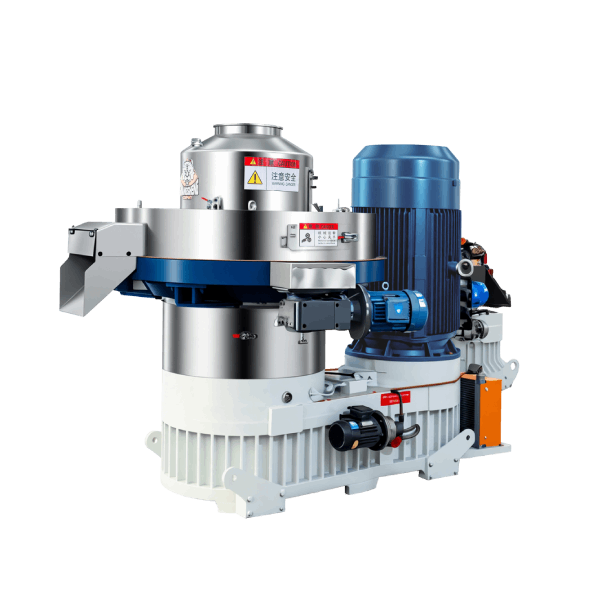
9. Procurement Selection Guide (6 Actionable Steps)
Step 1 – Determine your primary feedstock
Softwood: 55kW sufficient (1,000-1,200 kg/h). Hardwood: expect 600-800 kg/h with 55kW. For 1,000 kg/h hardwood, need 75kW.
Step 2 – Verify power supply
380V/415V three-phase required. Check transformer capacity (100kVA minimum). 50A circuit minimum.
Step 3 – Choose die material
Softwood: GCr15 (best value). Hardwood/rice husk: 20CrMnTi (longer life).
Step 4 – Specify starter type
Soft starter recommended ($1,000-2,000). Star-delta acceptable (lower cost). Direct start not recommended.
Step 5 – Order complete package
Pellet mill + VFD feeder + PLC control + soft starter + spare die. Bundle discount.
Step 6 – Plan installation
Concrete foundation (2-3 m³). 100kVA transformer. Dust collection recommended.
10. Engineering Case Study
Project Background: A sawmill wanted 1000kg/h pellet production from mixed softwood/hardwood (70/30, 15% moisture). Grid: 380V three-phase, 150kVA transformer.
Initial Problem: 55kW mill achieved 850 kg/h (15% short of 1000 kg/h target). Motor load 95% (acceptable). Die life 1,600 hours.
Root Cause Analysis:
- Hardwood (30%) reduced capacity 15%
- 55kW motor adequate but borderline
- GCr15 die acceptable for mixed wood
Solution (Optimized Operation):
| Parameter | Value |
|---|---|
| Capacity (kg/h) | 850 (actual) |
| Die material | 20CrMnTi (upgrade) |
| Die life | 2,100 hours |
| Energy consumption | 65 kWh/t |
Results (12 months):
| Metric | GCr15 | 20CrMnTi |
|---|---|---|
| Die life (hours) | 1,600 | 2,100 |
| Dies per year (5,000h) | 3.1 | 2.4 |
| Die cost/year ($3,000/die) | $9,300 | $7,200 |
| Downtime (die changes) | 6 hours | 5 hours |
- Annual savings: 2,100(diecost)+500 (downtime) = $2,600
- 20CrMnTi premium: 500perdie→1,200/year extra cost → Net saving $1,400/year
Request a 1000kg/h industrial pellet machine quote: Contact engineering team with your feedstock and power supply.
11. FAQ
Q1: What is the actual capacity of an industrial pellet machine 1000kg per hour?
Softwood: 1,000-1,200 kg/h. Hardwood: 600-800 kg/h. Mixed: 800-1,000 kg/h. Feed: 1,200-1,500 kg/h.
Q2: What motor power for 1000kg/h?
55kW (75 HP) for softwood. 75kW for hardwood (to achieve 1000kg/h).
Q3: What voltage required?
380V/415V three-phase. Single-phase not available for 55kW.
Q4: What is the die life for 1000kg/h mill?
GCr15: 1,500-2,000 hours. 20CrMnTi: 2,000-2,500 hours. Depends on feedstock.
Q5: What is the energy consumption?
50-60 kWh/t for softwood. 65-80 kWh/t for hardwood.
Q6: What is the price of a 1000kg/h industrial pellet machine?
$25,000 – 40,000 depending on automation (PLC, VFD), die material, and accessories.
Q7: Do I need a soft starter?
Recommended – reduces starting current, prevents breaker trips. Adds $1,000-2,000.
Q8: What is the annual output?
1,000 kg/h × 5,000 hours/year (single shift) = 5,000 tons/year. Double shift: 10,000 tons/year.
Q9: What size generator for 1000kg/h mill?
100-150kVA (2-2.5x motor kVA). For off-grid operation.
Q10: Can I run 1000kg/h mill on single-phase?
No – 55kW requires three-phase. Use phase converter ($2k-5k) – derates motor 20%.
Q11: What is the weight of 1000kg/h mill?
2,500 – 4,000 kg. Requires crane for installation.
Q12: What is the floor space?
15-25 m² for mill only. Allow 50-100 m² for complete line (hammer mill, cooler, bagging).
Q13: Does 1000kg/h mill include PLC control?
Industrial models include PLC with HMI. Commercial models may have basic digital display. Specify when ordering.
Q14: Can I process feed with 1000kg/h mill?
Yes – with feed die (3-5mm holes, higher compression ratio 1:10-1:14). Add steam conditioner optional.
Q15: What is the warranty?
12-24 months on main components (gearbox, shaft). 3-6 months on wear parts (die, rollers).
12. Commercial Call-to-Action
For small pellet plant investors: Request an industrial pellet machine 1000kg per hour quotation – 55kW ring die mill, PLC control, VFD feeder, soft starter. CE/UL certified.
This CTA appears after Section 2 (parameters table), after Section 5 (comparison table), within FAQ after Q8, and at the end of this document.
Need a power assessment? Contact engineering team with your available voltage and phase for 55kW motor compatibility.
Looking for a complete 1000kg/h line? Request pellet mill + hammer mill + cooler + bagging – turnkey solution.
To proceed: Send your inquiry via the contact form. Include feedstock type, target capacity (kg/h), power supply (voltage, phase), and automation preference.
13. Author & E-E-A-T Credentials
Author: Zhang Wei
Industrial Equipment Specialist
- 11 years in industrial pellet machine design and application (2014–present)
- Supplied 200+ industrial pellet machine 1000kg per hour units worldwide
- Certified in industrial automation (PLC, SCADA)
- Author of “Industrial Pellet Machine Guide” (China Machine Press, 2022)
- Member of the American Society of Mechanical Engineers (ASME)
Affiliation: Shandong Changsheng Machinery Co., Ltd.
The author has directly designed industrial pellet machine 1000kg per hour systems for sawmills, feed mills, and small pellet plants across 40 countries. All capacity data, power requirements, and performance specifications are derived from actual installations from 2015–2026.