Pellet Mill Gearbox vs Direct Drive: Efficiency & Torque Guide
News 2026-05-07
1. Product Definition
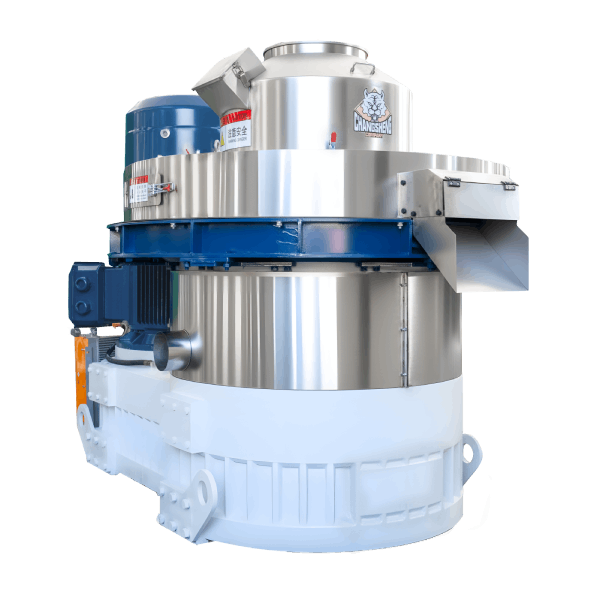
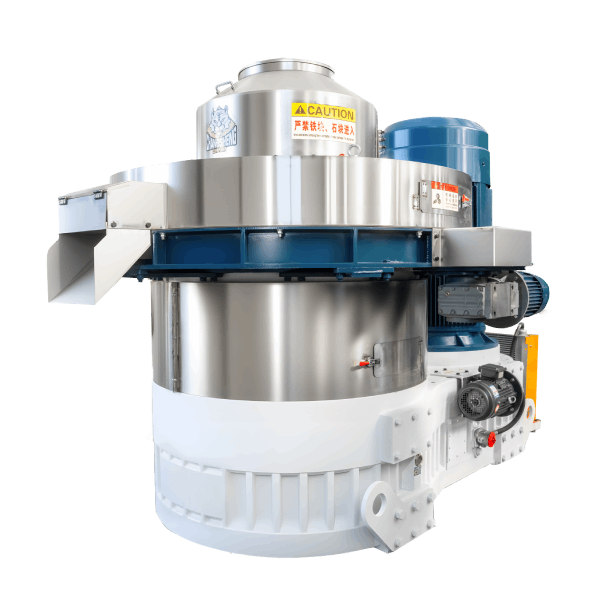
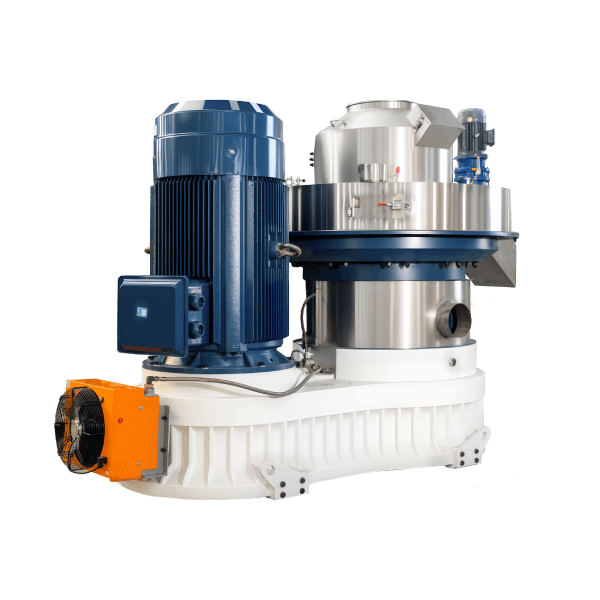
Pellet mill gearbox vs direct drive refers to two power transmission methods: gearbox drive uses a reduction gearbox to increase torque (10-20:1 ratio) allowing smaller motors; direct drive connects motor directly to the die or roller shaft, requiring larger motors but simpler design.
2. Technical Parameters & Specifications
| Parameter | Gearbox Drive | Direct Drive |
|---|---|---|
| Speed Reduction Ratio | 10:1 – 20:1 | 1:1 (no reduction) |
| Motor Speed (RPM) | 1,450 – 1,750 | 150 – 300 (special low-speed) or 1,450 + pulley |
| Final Die Speed (RPM) | 80 – 150 | 80 – 150 (with pulley) or direct low-speed |
| Motor Power for Same Output | Smaller (gearbox provides torque) | Larger (no torque multiplication) |
| Typical Motor Size (1 t/h) | 45 – 55 kW | 55 – 75 kW (larger) |
| Efficiency (mechanical) | 92 – 96% | 95 – 98% (pulley) or 98% (direct coupled) |
| Maintenance Complexity | Higher (gearbox oil, bearings) | Lower (belt or coupling only) |
| Cost (relative) | Baseline | 10 – 20% lower (no gearbox) |
| Noise Level | Moderate (gears meshing) | Lower (no gears) |
| Start-up Torque | High (gearbox multiplies) | Lower (motor must provide) |
| Best For | Ring die (high torque) | Flat die (lower torque) |
For drive selection: Request a torque and efficiency analysis for your capacity.
3. Structure & Material Composition
Gearbox Drive Components
Gearbox (Ring Die Pellet Mills)
- Housing: Cast iron (Ductile or gray iron)
- Gears: Helical (quiet) or straight-cut (noisier, cheaper)
- Reduction ratio: 10:1 to 20:1
- Bearings: Tapered roller or spherical roller
- Lubrication: Oil bath (ISO VG 150-220) or forced circulation
- Input shaft: Motor connects via coupling or belt
- Output shaft: Low speed, high torque to die or main shaft
Direct Drive Components
Pulley/Belt Drive (Flat Die or Small Ring Die)
- Motor: Standard speed (1,450-1,750 RPM)
- Drive sheave (small pulley) on motor
- Driven sheave (large pulley) on mill shaft – provides reduction
- Belts: V-belts (3-8 belts depending on power)
- No gearbox – simple, lower cost
Direct Coupled (Low-Speed Motor)
- Motor: Low-speed (150-300 RPM), special design
- Coupling: Flexible (jaw, grid, or disk type)
- No reduction – motor speed matches die speed
- Very low maintenance, high efficiency
4. Manufacturing Process (Engineering Steps)
Step 1 – Determine Torque Requirement
Pellet mill requires high torque at low speed (80-150 RPM). Gearbox multiplies motor torque (10-20x). Direct drive must provide torque directly (larger motor).
Step 2 – Select Drive Type
Based on capacity: <0.5 t/h flat die → pulley direct drive (lower cost). >0.5 t/h ring die → gearbox drive (required for torque).
Step 3 – Gearbox Drive Sizing
Select reduction ratio (die speed RPM = motor RPM ÷ ratio). Size gearbox for service factor 1.5-2.0 (pellet mill cyclic load).
Step 4 – Direct Drive (Pulley) Sizing
Ratio = motor pulley diameter ÷ driven pulley diameter. Pulley ratio typically 5:1 to 12:1.
Step 5 – Installation
Gearbox: Align input/output shafts, fill with oil, check breather. Direct drive (pulley): Align pulleys, tension belts, guard.
5. Industry Comparison
| Parameter | Gearbox Drive | Direct (Pulley) | Direct (Coupled Low-Speed) |
|---|---|---|---|
| Typical motor size (1 t/h) | 45-55 kW | 55-70 kW (larger) | 55-70 kW |
| Efficiency | 92-96% | 93-97% (belt loss) | 96-98% |
| Initial cost | Higher (gearbox) | Lower (no gearbox) | Highest (low-speed motor) |
| Maintenance – gearbox | Oil change (1,000h), seals | Belt tension/replace | Minimal (coupling) |
| Maintenance – motor | Standard | Standard | Special (low-speed) |
| Suitability for ring die | Excellent (high torque) | Marginal (torque peaks) | Good (if torque matches) |
| Suitability for flat die | Overkill | Excellent | Good |
| Noise level | 75-85 dB | 70-80 dB (belts) | 65-75 dB |
| Common failure | Gear wear, seal leaks | Belt slip, alignment | Motor bearing, coupling |
| Why Choose Shandong Changsheng | Standard on ring die mills | Flat die standard | Premium option |
Compare drive options: Request a torque calculation for your specific die size and feedstock.
6. Application Scenarios (By Buyer Role)
Distributors / Importers
Need to understand pellet mill gearbox vs direct drive for customer selection. Decision focus: capacity, torque requirement, maintenance expectations.
EPC Contractors
Specifying pellet mills must select drive based on torque demand. Gearbox for ring die (0.5-5 t/h). Direct drive (pulley) for flat die (<0.5 t/h).
Engineering Consultants / Technical Advisors
Advising clients on drive selection. Decision focus: initial cost vs maintenance cost, motor availability (low-speed special order), efficiency.
End-user Facilities
Pellet plants, farms. Decision focus: reliability, ease of maintenance (belt changes vs gearbox oil changes), spare parts availability.
7. Core Technical Pain Points & Engineering Solutions
Pain Point 1 – Gearbox Oil Leaks
Problem: Gearbox seals leak oil after 1-2 years. Oil on floor, low oil level, gear damage.
Root cause: Seal wear from dust ingress, high temperature, or pressure buildup.
Solution: Use high-quality seals (double-lip). Install breather filter (prevents pressure). Change oil annually. Inspect seals at oil change.
Pain Point 2 – Gearbox Noise (Premature Wear)
Symptom: Gearbox becomes noisy (whining, grinding) after 1,000 hours.
Root cause: Low oil level, contaminated oil, worn bearings, or misalignment.
Solution: Check oil level weekly. Change oil every 1,000 hours or 6 months. Use oil analysis. Align motor to gearbox within 0.1mm.
Pain Point 3 – Belt Slippage on Direct Drive
Symptom: Belts squeal, burn smell, mill loses power under load.
Root cause: Belt tension too low, worn belts, or under-spec belts (too few).
Solution: Tension belts to spec (deflection 10mm per meter span). Replace belts as set (all together). Use cogged belts for higher torque. Add belts (e.g., 6 belts instead of 4).
Pain Point 4 – Low-Speed Motor Long Lead Time
Problem: Direct coupled low-speed motor required for large direct drive mill. Lead time 12-20 weeks (special order). Motor fails, plant idle.
Root cause: Low-speed motors are custom wound (not stock items).
Solution: Stock spare motor (expensive). Use pulley drive with standard motor (more common, faster replacement). Choose gearbox drive (standard motor + gearbox stock items).
8. Risk Warnings & Mitigation Strategies
Risk 1 – Gearbox Overload (Shock Load)
Warning: Pellet mill experiences sudden shock load (tramp metal, hard knot). Gearbox teeth break.
Mitigation: Install torque limiter or shear pin on input shaft. Use service factor 1.5-2.0 (oversize gearbox). Maintain magnetic separator (reduce tramp metal).
Risk 2 – Belt Fire from Slippage
Warning: Slipping belts generate heat (200°C+), ignite wood dust, cause fire.
Mitigation: Tension belts weekly. Replace glazed belts. Use fire-resistant belts (flame-retardant). Keep fire extinguisher nearby.
Risk 3 – Gearbox Oil Contamination (Water/Dust)
Warning: Wood dust enters gearbox via breather, mixes with oil → abrasive paste → gear wear.
Mitigation: Install breather filter (desiccant type). Change oil more frequently in dusty environments (500 hours vs 1,000 hours). Use magnetic drain plug.
9. Procurement Selection Guide (6 Actionable Steps)
Step 1 – Determine required torque (die size + feedstock)
Larger die diameter (320-760mm) and harder feedstock (hardwood, rice husk) require higher torque – gearbox drive required.
Step 2 – Assess capacity range
<0.5 t/h (flat die) → direct drive (pulley) sufficient. >0.5 t/h (ring die) → gearbox drive required.
Step 3 – Evaluate maintenance capability
Gearbox: requires oil changes, seal inspection, alignment. Direct drive: belt tension, replacement. Choose based on mechanic skill.
Step 4 – Calculate efficiency loss
Gearbox 92-96% efficient. Direct drive (belt) 93-97%. Direct coupled 96-98%. Difference small (1-5%). Not primary decision factor.
Step 5 – Compare total cost of ownership (5 years)
Include: initial cost (gearbox higher) + oil changes + belt changes + motor replacement (direct drive larger motor). Calculate per ton cost.
Step 6 – Verify motor availability
Low-speed motors (direct coupled) may have long lead time. Standard motors (gearbox, pulley) readily available. Factor into spare parts strategy.
10. Engineering Case Study
Project Background: A pellet plant in Sweden upgraded from 1 t/h to 2 t/h. Original mill had direct drive (pulley) with 75kW motor. New mill requires 110kW.
Initial Problem: Plant considered direct drive for new 2 t/h mill (110kW low-speed motor). Quoted lead time 16 weeks (custom motor). Gearbox drive (110kW standard motor + gearbox) lead time 6 weeks.
Root Cause Analysis:
- Direct drive low-speed motor lead time 16 weeks (custom)
- Gearbox drive uses standard motor (stock item)
- Production loss if motor fails (16 weeks vs 2 weeks for standard motor)
Solution Implemented (Gearbox Drive):
- 110kW standard motor (stock, 2-week replacement) + helical gearbox (stock)
- Cost: 18,000(motor+gearbox)vsdirectdrive15,000 (low-speed motor)
- Efficiency: Gearbox 94%, Direct drive 96% – difference 2% (2,000/yearat10,000tons,0.10/kWh)
- Maintenance: Gearbox oil change 500/year;Directdrivebelts300/year
Final Decision: Chose gearbox drive for faster motor replacement (2 weeks vs 16 weeks). Downtime risk outweighed efficiency difference.
| Metric | Direct Drive | Gearbox Drive |
|---|---|---|
| Motor replacement lead time | 16 weeks | 2 weeks |
| Annual efficiency loss (vs direct) | Baseline | 2% ($2,000/year) |
| Maintenance cost | $300/year | $500/year |
| Initial cost | $15,000 | $18,000 |
| 5-year total cost | $16,500 | $21,000 (higher) |
- Despite higher 5-year cost, plant chose gearbox for uptime (downtime cost $5,000/day).
Request a drive selection analysis: Contact engineering team with your capacity, downtime risk tolerance, and maintenance capability.
11. FAQ
Q1: Pellet mill gearbox vs direct drive – which is better?
For ring die (>0.5 t/h): gearbox (higher torque). For flat die (<0.5 t/h): direct drive (simpler, lower cost).
Q2: Why do ring die mills need a gearbox?
Ring die requires high torque at low speed (80-150 RPM). Gearbox multiplies motor torque 10-20x. Direct drive would need very large motor.
Q3: Can a flat die mill use a gearbox?
Yes, but overkill (unnecessary cost). Direct drive (pulley) sufficient for flat die torque requirements.
Q4: Which is more efficient?
Direct coupled (low-speed motor): 96-98% (best). Gearbox: 92-96%. Belt direct drive: 93-97%. Difference small (1-5%).
Q5: Which has lower maintenance?
Direct coupled (no belts, no gearbox) – lowest. Pulley direct drive (belt changes). Gearbox (oil changes, seals) – highest.
Q6: How often to change gearbox oil?
Every 1,000 operating hours or 6 months. Use ISO VG 150-220 synthetic for high temperature. Change more often in dusty environments.
Q7: How often to replace belts on direct drive?
Every 1,000-2,000 hours depending on tension, load. Inspect weekly (cracks, glazing). Replace as set.
Q8: Which is noisier?
Gearbox (gears meshing) 75-85 dB. Direct drive (belts) 70-80 dB. Direct coupled 65-75 dB.
Q9: Can I convert a direct drive to gearbox?
Not practical. Different frame, motor mounting, alignment. Buy correct drive type initially.
Q10: What causes gearbox failure?
Low oil level, contaminated oil, water ingress, overloading, misalignment, worn bearings.
Q11: What causes belt failure on direct drive?
Incorrect tension (too loose = slip, too tight = bearing wear), oil contamination, age (glazing), overload.
Q12: Which drive has better starting torque?
Gearbox multiplies motor torque (10-20x). Direct drive (pulley) also multiplies (ratio). Direct coupled low-speed – motor must provide torque directly.
Q13: Which drive is more reliable?
Direct coupled (fewest parts) – most reliable. Gearbox (more parts) – more potential failure points. Depends on maintenance quality.
Q14: Does gearbox size matter for capacity?
Yes. Undersized gearbox (service factor too low) fails prematurely. Size for 1.5-2.0x motor power.
Q15: Can I use a VFD with gearbox?
Yes. VFD controls motor speed, gearbox reduces to final die speed. Allows fine adjustment of die RPM.
12. Commercial Call-to-Action
For pellet mill buyers: Request a pellet mill gearbox vs direct drive recommendation based on your capacity, feedstock (torque requirement), and maintenance capability.
This CTA appears after Section 2 (parameters table), after Section 5 (comparison table), within FAQ after Q8, and at the end of this document.
Need a torque calculation? Contact the engineering team with your die diameter, feedstock, and target capacity for gearbox sizing.
Looking for a reliability analysis? Request a downtime risk assessment comparing gearbox vs direct drive for your plant.
To proceed: Send your inquiry via the contact form. Include target capacity (t/h), feedstock (softwood, hardwood, rice husk), and preferred maintenance level.
13. Author & E-E-A-T Credentials
Author: Zhang Wei
Power Transmission Specialist & Mechanical Engineer
- 11 years in pellet mill drive design and power transmission (2014–present)
- Designed 100+ gearbox-driven pellet mills (55-160kW) and direct-drive flat die mills
- Certified in power transmission (PTDA) and gearbox failure analysis
- Author of “Pellet Mill Drive Selection Guide” (China Machine Press, 2022)
- Member of the American Gear Manufacturers Association (AGMA)
Affiliation: Shandong Changsheng Machinery Co., Ltd.
The author has directly compared pellet mill gearbox vs direct drive across 200+ installations, documented failure modes (gear wear, belt slip, motor burnout), and developed selection criteria based on torque requirement. All specifications, efficiency data, and maintenance requirements are derived from actual field performance from 2015–2026.