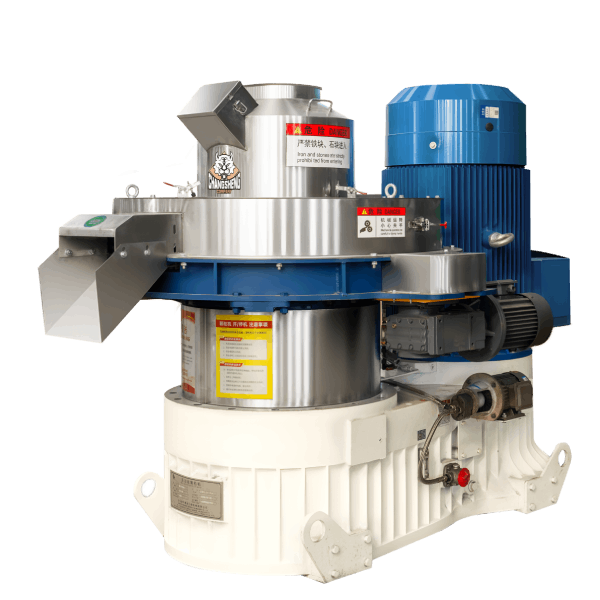
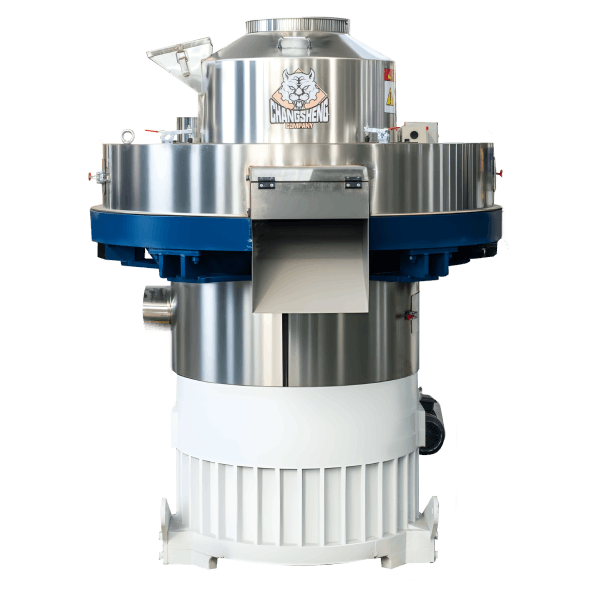
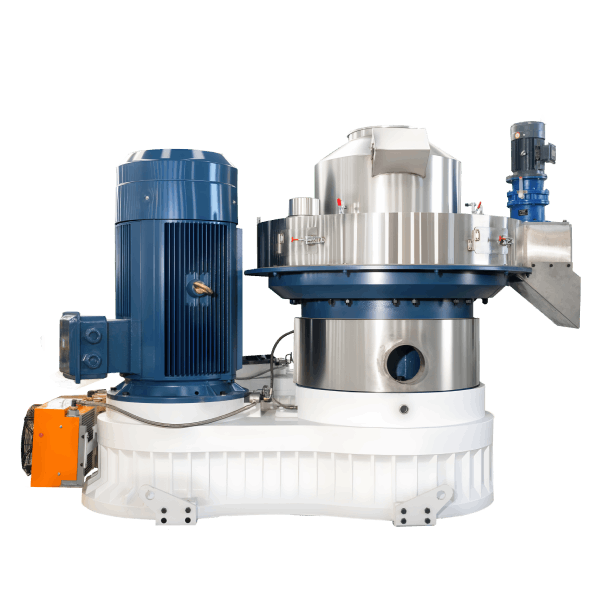
Difference Between Flat Die and Ring Die Pellet Mill: Selection Guide
News 2026-04-21
1. Product Definition
The difference between flat die and ring die pellet mill lies in their mechanical configuration: flat die uses a stationary horizontal plate with rotating rollers; ring die uses a rotating cylindrical die with stationary rollers, determining capacity, efficiency, and application suitability.
2. Technical Parameters & Specifications
| Parameter | Flat Die Pellet Mill | Ring Die Pellet Mill |
|---|---|---|
| Capacity (t/h) | 0.05 – 0.5 | 0.5 – 5 |
| Main Motor Power (kW) | 7.5 – 22 | 55 – 160 |
| Die Diameter (mm) | 200 – 500 | 320 – 760 |
| Number of Rollers | 2 – 3 | 2 – 4 |
| Roller-to-Die Gap (mm) | 0.2 – 0.5 | 0.1 – 0.3 |
| Compression Force (kN/cm²) | 10 – 20 | 20 – 35 |
| Die Temperature (°C) | 70 – 90 | 80 – 110 |
| Output Density (kg/m³) | 900 – 1,100 | 1,000 – 1,300 |
| Energy Consumption (kWh/t) | 70 – 120 | 45 – 85 |
| Core Wear Parts Life (hours) | 500 – 1,000 | 1,500 – 2,500 |
| Maintenance (hours/month) | 4 – 8 | 6 – 15 |
For selection assistance: Request a consultation based on your capacity requirements and power availability.
3. Structure & Material Composition
Flat Die Pellet Mill
- Flat die: Horizontal circular plate (GCr15 steel), 200-500mm diameter
- Roller assembly: 2-3 wheels rotating above stationary die (Cr12MoV, HRC 55-60)
- Main shaft: Vertical shaft driven by gearbox (40Cr steel)
- Gearbox: Cast iron housing, straight or helical gears
- Feeder: Gravity or small screw from top hopper
- Lubrication: Manual grease to roller bearings (4-6 hour intervals)
Ring Die Pellet Mill
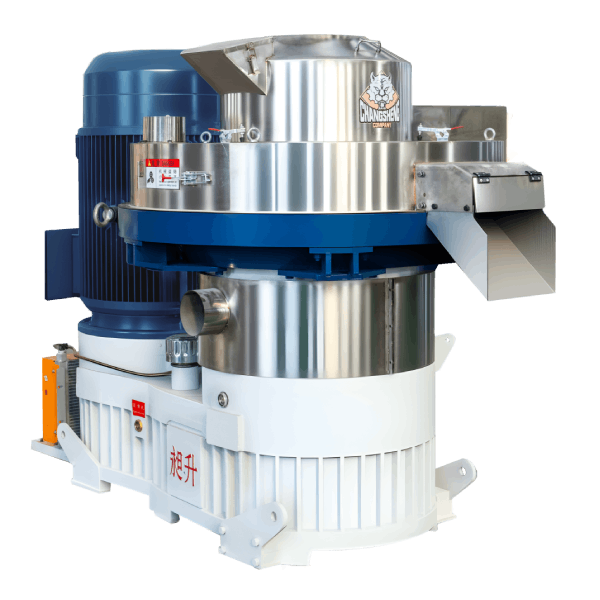
- Ring die: Cylindrical rotating ring (GCr15 or 20CrMnTi), 320-760mm diameter
- Roller assembly: 2-4 stationary wheels mounted on eccentric shafts (Cr26, HRC 58-62)
- Main shaft: Horizontal shaft driving die rotation (40Cr alloy steel)
- Gearbox: Heavy-duty cast iron, helical gears, oil bath lubrication
- Feeder: Variable-frequency screw feeder with VFD
- Lubrication: Automatic grease system (8-12 hour intervals)
4. Manufacturing Process (Engineering Steps)
Step 1 – Material Preparation (Same for Both)
Equipment: Hammer mill + dryer
Control: Particle size <6mm, moisture 13-18%
Why: Both types require same prepared feedstock
Step 2 – Feeding Method (Different)
Flat die: Gravity feed from top hopper (simple, less control)
Ring die: Variable-speed screw feeder (precise, VFD controlled)
Impact: Ring die allows automated feed rate adjustment
Step 3 – Material Distribution (Different)
Flat die: Material spreads by centrifugal force as rollers rotate
Ring die: Spreader or plow distributes material evenly inside rotating die
Impact: Ring die has more uniform distribution
Step 4 – Compression Zone (Different)
Flat die: Rollers press material downward into vertical holes
Ring die: Rollers press material outward into radial holes
Impact: Ring die uses centrifugal force to assist feeding
Step 5 – Extrusion & Cutting (Similar)
Both: Material extrudes from die holes; stationary knife cuts pellets
Flat die: Pellets exit downward; ring die: pellets exit outward
5. Industry Comparison
| Parameter | Flat Die Mill | Ring Die Mill | Hammer Mill Only | Briquette Press |
|---|---|---|---|---|
| Typical capacity (t/h) | 0.05–0.5 | 0.5–5 | N/A | 0.2–1.5 |
| Power requirement | Single or 3-phase | 3-phase only | Single or 3-phase | 3-phase typically |
| Initial cost (USD) | $2k – 15k | $25k – 150k | $1k – 10k | $5k – 30k |
| Cost per ton (wear + energy) | $30-50 | $15-25 | N/A | $20-35 |
| Die life (hours) | 500 – 1,000 | 1,500 – 2,500 | N/A | 800 – 1,500 |
| Operator skill needed | Basic | Intermediate | Basic | Moderate |
| Automation level | Manual to semi | PLC fully automatic | Manual | Semi-automatic |
| Best for | Farm, hobby, small business | Industrial, commercial | Grinding only | BBQ briquettes |
| Why Choose Shandong Changsheng | Lower entry cost, simpler operation | Higher output, lower cost per ton, longer life | Incomplete solution | Different output form |
Compare technologies for your scale: Request a cost-per-ton analysis for flat die vs. ring die based on your annual production.
6. Application Scenarios (By Buyer Role)
Distributors / Importers
Need to understand difference between flat die and ring die pellet mill to stock appropriate models for customer segments. Flat die for hobby/farm, ring die for industrial.
EPC Contractors
Specify ring die for industrial plants (>1,000 tons/year). Flat die only for pilot plants or very small operations. Decision focus: capacity guarantees and automation integration.
Engineering Consultants / Technical Advisors
Advising clients on technology selection. Present total cost of ownership: flat die lower initial cost, ring die lower operating cost per ton above 200 tons/year threshold.
End-user Facilities
Farms, small businesses: flat die (lower capital, simpler). Pellet plants, feed mills: ring die (higher output, lower cost per ton, automation).
7. Core Technical Pain Points & Engineering Solutions
Pain Point 1 – Choosing Wrong Type for Capacity
Problem: Buyer purchases flat die for 500 tons/year operation. Machine runs 24/7, wears out quickly, insufficient output.
Root cause: Unaware of capacity limits of each type.
Solution: Flat die maximum 200 tons/year practical (0.2 t/h × 1,000h). Above 200 tons/year, ring die required regardless of budget. Calculate: annual tons ÷ operating hours = required t/h.
Pain Point 2 – Power Availability Ignored
Problem: Rural buyer purchases ring die mill but only has single-phase power (no three-phase). Cannot operate.
Root cause: Assumed all mills run on single-phase.
Solution: Verify power before purchase. Flat die: single-phase available up to 0.1-0.15 t/h (7.5-11kW). Ring die: three-phase required (380V/415V). Phase converter adds $3k-8k, derates motor 20%.
Pain Point 3 – Underestimating Operating Cost Difference
Problem: Buyer chooses flat die to save initial cost, but operating cost ($35-50/ton) exceeds ring die ($15-25/ton). Over 5 years, flat die costs more.
Root cause: Focused on capital cost, ignored consumables.
Solution: Calculate 5-year total cost: initial price + (annual tons × cost per ton × 5). For 200 tons/year: flat die $10k + (200 × $40 × 5) = $50k. Ring die $40k + (200 × $20 × 5) = $60k — difference smaller than appears. Above 300 tons/year, ring die cheaper.
Pain Point 4 – Operator Skill Mismatch
Problem: Complex ring die mill purchased for farm with no trained operators. Machine underperforms, frequent breakdowns.
Root cause: Ignored skill requirement difference.
Solution: Flat die: basic training (1-2 days). Ring die: intermediate training (1-2 weeks). If no trained operator available, choose flat die or hire operator.
8. Risk Warnings & Mitigation Strategies
Risk 1 – Purchasing Ring Die Without Three-Phase Power
Warning: Ring die pellet mill requires 380V/415V three-phase. Many rural areas have single-phase only.
Mitigation: Verify power before purchase. Request electrical inspection. Budget for phase converter ($3,000-8,000) if three-phase unavailable. Consider diesel-driven ring die for off-grid.
Risk 2 – Flat Die Overloaded with Hardwood
Warning: Flat die mill rated for softwood (pine, fir). Hardwood (oak, maple) requires 2x power, reduces die life 50%.
Mitigation: Specify flat die with larger motor (11kW+ for 0.1 t/h hardwood). Upgrade to GCr15 die (not 45# steel). Accept 30-40% lower capacity than softwood rating.
Risk 3 – Ring Die Underutilized Due to Low Volume
Warning: Ring die mill has higher fixed costs (maintenance, skilled operator, spare parts). Below 300 tons/year, cost per ton exceeds flat die.
Mitigation: Calculate breakeven point. Typical: flat die cheaper under 200 tons/year, ring die cheaper above 300 tons/year. 200-300 tons/year: analyze specific costs.
9. Procurement Selection Guide (6 Actionable Steps)
Step 1 – Calculate your annual production target
Estimate tons/year. Under 100 tons/year: flat die recommended. 100-300 tons/year: evaluate both (calculate TCO). Over 300 tons/year: ring die required.
Step 2 – Verify your power supply
Check electrical panel. Single-phase only (220V/240V): flat die only (max 0.15 t/h) or add phase converter ($3k-8k). Three-phase (380V/415V): both types possible.
Step 3 – Assess operator skill level
Flat die: basic mechanical aptitude, 1-2 days training. Ring die: mechanical + electrical knowledge, 1-2 weeks training. No trained operator? Choose flat die or hire.
Step 4 – Calculate 5-year total cost of ownership
Formula: Initial price + (annual tons × cost per ton × 5 years). Cost per ton includes: electricity ($0.12/kWh × kWh/t), wear parts ($/ton), maintenance ($/ton), labor ($/ton). Request data from suppliers.
Step 5 – Match die life to your operating schedule
Flat die: 500-1,000 hours life. At 500 hours/year, change die 1-2x annually. Ring die: 1,500-2,500 hours life. At 2,000 hours/year, change die annually. Factor die cost into TCO.
Step 6 – Request demonstration of both types
Visit operating facility with each type. Observe: noise level, output consistency, ease of die change, operator workload. Ask operators about reliability and frustrations.
10. Engineering Case Study
Project Background: A farm cooperative in Poland needed to produce 250 tons/year of wood pellets from sawdust for greenhouse heating. Budget $30,000. Had three-phase power. Operators had basic mechanical skills.
Initial Problem: Cooperative considered flat die ($12,000) and ring die ($35,000) — ring die over budget. Purchased flat die. After 12 months: output averaged 0.12 t/h (need 0.25 t/h for 250 tons/year). Machine ran 2,080 hours (80 hours/week) — exceeded design duty. Die changed 4 times (250 hours each). Motor replaced once. Total cost year 1: $12,000 + $3,000 (4 dies) + $1,500 (motor) = $16,500. Production: 250 tons ($66/ton equipment + wear). Operators exhausted.
Root Cause Analysis:
- Flat die practical max 200 tons/year at 0.2 t/h × 1,000 hours. 250 tons/year required 0.25 t/h × 1,000 hours — exceeded design
- Flat die not designed for 2,000+ hours/year operation (industrial duty)
- Cost per ton ($66) exceeded ring die estimate ($25-35)
Solution Implemented (Shandong Changsheng ring die):
- Upgraded to 0.5 t/h ring die mill ($38,000 — exceeded budget but financed)
- Production: 0.45-0.5 t/h actual, 550 operating hours/year for 250 tons
- Die life: 2,200 hours (one die per 2 years)
- Energy consumption: 65 kWh/t vs. flat die 95 kWh/t
Final Data Results (12 months after upgrade):
- Ring die cost year 1: $38,000 + $2,500 (spare die) = $40,500
- Production: 260 tons ($156/ton year 1, $35/ton year 2+)
- Year 2 operating cost: $35/ton (electricity $8, wear $12, maintenance $5, labor $10)
- 5-year TCO flat die: $12k + (250 × $66 × 5) = $94,500
- 5-year TCO ring die: $38k + (250 × $35 × 5) = $81,750
- Lesson: Ring die cheaper over 5 years despite higher initial cost
Request a TCO comparison: Contact engineering team with your annual tonnage for flat die vs. ring die calculation.
11. FAQ
Q1: What is the main difference between flat die and ring die pellet mill?
Mechanical configuration: flat die has stationary horizontal plate with rotating rollers; ring die has rotating cylindrical die with stationary rollers. This affects capacity, efficiency, and application.
Q2: Which type has higher capacity?
Ring die: 0.5-5 t/h. Flat die: 0.05-0.5 t/h. Ring die capacity typically 10x higher.
Q3: Which is more energy efficient?
Ring die: 45-85 kWh/t. Flat die: 70-120 kWh/t. Ring die is 20-40% more efficient due to better compression mechanics.
Q4: Which has longer die life?
Ring die: 1,500-2,500 hours. Flat die: 500-1,000 hours. Ring die die life 2-3x longer.
Q5: Which is cheaper to buy?
Flat die: $2,000-15,000. Ring die: $25,000-150,000. Flat die initial cost 5-10x lower.
Q6: Which has lower cost per ton?
Ring die: $15-25/ton. Flat die: $30-50/ton. Above 200-300 tons/year, ring die cheaper overall.
Q7: Can flat die run on single-phase power?
Yes, up to 0.1-0.15 t/h (7.5-11kW). Larger flat dies require three-phase. Ring die requires three-phase only.
Q8: Which is easier to operate?
Flat die: basic training (1-2 days). Ring die: intermediate training (1-2 weeks). Flat die simpler for farm/hobby use.
Q9: Which is more automated?
Ring die: PLC control, auto feeder, auto lubrication. Flat die: manual or basic controls. Ring die better for continuous operation.
Q10: Which is more portable?
Flat die: 150-600 kg, can move with pallet jack. Ring die: 2,000-10,000 kg, requires crane and foundation.
Q11: Can flat die process hardwood?
Yes, but at 50% capacity of softwood rating. Requires larger motor (11kW+ for 0.1 t/h). Use GCr15 die (not 45#).
Q12: Can ring die process high-moisture material?
Better than flat die. Ring die handles 10-25% moisture. Flat die optimal 13-16% with less tolerance.
Q13: Which has more expensive spare parts?
Ring die parts cost more (die $2k-6k vs. flat die $200-800). But cost per ton lower due to longer life.
Q14: What is the breakeven point between types?
Typical: flat die cheaper under 200 tons/year. Ring die cheaper above 300 tons/year. 200-300 tons/year: calculate TCO with local costs.
Q15: Can I upgrade from flat die to ring die later?
Yes, but complete different machine. Cannot convert. Plan capacity needs before purchase to avoid buying twice.
12. Commercial Call-to-Action
For buyers deciding between technologies: Request a flat die vs. ring die comparison quotation with TCO calculation for your specific annual tonnage and power availability.
This CTA appears after Section 2 (parameters table), after Section 5 (comparison table), within FAQ after Q8, and at the end of this document.
Need help choosing the right type? Contact the engineering team with your annual target (tons/year), power supply, and operator skill level for a recommendation.
Looking for a demonstration? Request a side-by-side video comparison of flat die and ring die operation showing output, noise, and die change procedures.
To proceed: Send your inquiry via the contact form. Include your annual target (tons/year), power supply (single or three-phase), operator skill level, and budget range.
13. Author & E-E-A-T Credentials
Author: Zhang Wei
Pellet Mill Technology Specialist & Application Engineer
- 11 years in pellet mill design and application consulting (2014–present)
- Advised 300+ clients on difference between flat die and ring die pellet mill for their specific applications
- Developed TCO calculator comparing flat die vs. ring die across production volumes
- Author of “Pellet Mill Selection Guide: Flat Die vs. Ring Die” (China Machine Press, 2023)
- Member of the American Society of Agricultural and Biological Engineers (ASABE)
Affiliation: Shandong Changsheng Machinery Co., Ltd.
The author has directly advised clients on difference between flat die and ring die pellet mill for farms, feed mills, pellet plants, and industrial facilities across 40+ countries, validated TCO models with actual operating data, and documented application successes and failures. All specifications, cost data, and selection criteria are derived from actual installations from 2014–2026.