Wood Pellet Production Process Step by Step: 8 Stages from Log to Pellet
News 2026-04-22
1. Product Definition
The wood pellet production process step by step transforms raw wood fiber through mechanical and thermal stages into dense, uniform fuel pellets via debarking, chipping, drying, grinding, conditioning, pelleting, cooling, and bagging.
2. Technical Parameters & Specifications
| Process Stage | Equipment | Key Parameter | Typical Range |
|---|---|---|---|
| Debarking | Drum debarker | Debarking efficiency | 95-99% |
| Chipping | Disc chipper | Chip length | 20-50mm |
| Drying | Rotary drum dryer | Outlet moisture | 10-18% |
| Grinding | Hammer mill | Particle size | 95% <6mm |
| Pelleting | Ring die mill | Die temp | 80-110°C |
| Cooling | Counterflow cooler | Exit temp | Ambient +5°C |
| Screening | Rotary screener | Fines removal | <3mm removed |
| Bagging | Bagging scale | Bag weight | ±0.2kg |
For process training: Request a complete process flow diagram (PFD) for your plant layout.
3. Structure & Material Composition
Process Equipment by Stage
Raw Material Handling
- Debarker: Drum or ring debarker with steel tools
- Chipper: Disc or drum chipper with carbide-tipped knives
- Conveyors: Belt or screw conveyors (magnetic separator at inlet)
Drying & Grinding
- Dryer: Rotary drum (carbon steel with lifting flights), biomass or gas burner
- Cyclone: Material separator (carbon steel)
- Hammer mill: Hardened hammers (Cr alloy), 4-8mm screens
Pelleting & Cooling
- Pellet mill: Ring die (GCr15/20CrMnTi), rollers (Cr26 hardfaced)
- Cooler: Counterflow (stainless steel inner lining)
- Screener: Rotary or vibrating (stainless steel mesh)
Packaging
- Bagging scale: Load cells, sewing head or heat sealer
- Dust collection: Cyclone + baghouse (explosion vents)
4. Wood Pellet Production Process Step by Step
Step 1 – Debarking
Equipment: Drum debarker (rotating steel drum)
Control: Remove 95-99% of bark (bark causes ash, clinkers)
Parameters: Retention time 10-20 minutes, water spray for lubrication
Output: Clean logs to chipper, bark to boiler fuel
Step 2 – Chipping
Equipment: Disc chipper with 4-8 knives
Control: Chip length 20-50mm, thickness 5-10mm
Parameters: Knife gap 0.5-1mm, sharpened every 50-100 hours
Output: Uniform chips for drying
Step 3 – Drying
Equipment: Rotary drum dryer (3-5° slope, 2-4 RPM)
Control: Reduce moisture from 35-55% (green chips) to 10-18%
Parameters: Inlet temp 300-500°C, outlet temp 100-120°C, retention 10-20 minutes
Output: Dry chips at 10-18% moisture
Step 4 – Grinding (Hammermilling)
Equipment: Hammer mill with 4-8mm screens
Control: Particle size 95% passing screen, 80-100 m/s tip speed
Parameters: Screen thickness 6-10mm, hammer hardness HRC 50-55
Output: Wood flour (fiber) ready for pelleting
Step 5 – Conditioning (Optional for Feed)
Equipment: Steam conditioner (1-2 minute retention)
Control: 80-90°C, 4-6% steam addition (for feed only)
Parameters: Not required for fuel pellets (dry process)
Output: Pre-heated, moisturized fiber
Step 6 – Pelleting
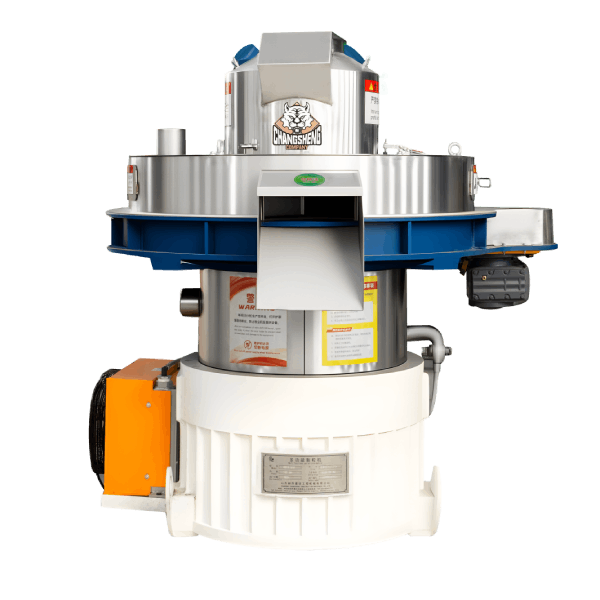
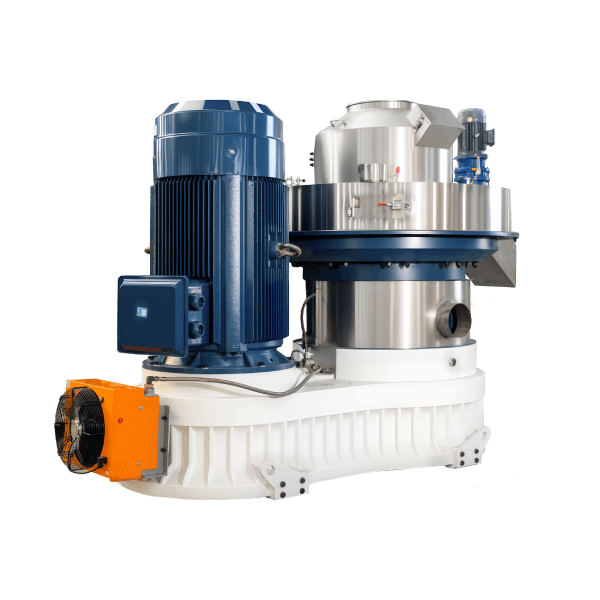
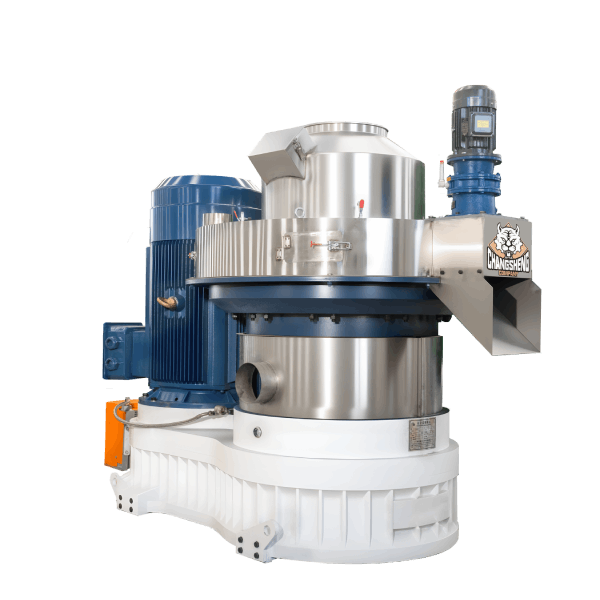
Equipment: Ring die pellet mill
Control: Die temp 80-110°C, roller gap 0.1-0.3mm, motor load 85-95%
Parameters: Compression ratio 1:4-1:8 (species dependent)
Output: Hot pellets (80-110°C) at 1,000-1,300 kg/m³
Step 7 – Cooling
Equipment: Counterflow cooler (vertical column)
Control: Cool pellets to ambient +5°C, retention 10-15 minutes
Parameters: Air velocity 0.8-1.2 m/s, air volume 1.5-2.0 m³/kg pellets
Output: Cooled, stable pellets
Step 8 – Screening & Fines Removal
Equipment: Rotary screener (2-3 decks)
Control: Remove fines <3mm (recycle to pelleting), oversize >12mm (re-chip)
Parameters: Screen mesh 3mm and 12mm
Output: Uniform pellets (6-10mm diameter, 15-30mm length)
Step 9 – Bagging or Bulk Loading
Equipment: Bagging scale (25-50kg bags) or bulk silo
Control: Bag weight ±0.2kg, dust collection running
Parameters: 200-500 bags/hour, palletizing 50-60 bags/pallet
Output: Finished product ready for shipment
5. Industry Comparison
| Parameter | Complete Pellet Line | Mill + Cooler Only (No Dryer) | Small Farm Line (Flat Die) | DIY Home Production |
|---|---|---|---|---|
| Process steps included | 8-9 steps | 3-4 steps | 3-4 steps | 2-3 steps |
| Requires drying | Yes (35-55% to 10-18%) | No (buy dry material) | No (buy dry material) | No (buy dry material) |
| Capacity (t/h) | 0.5-5 | 0.5-5 | 0.05-0.5 | 0.05-0.12 |
| Labor per shift | 2-4 persons | 2-3 persons | 1-2 persons | 1 person |
| Capital cost (USD) | $50k-500k | $25k-150k | $5k-20k | $1k-3k |
| Best for | Commercial production | Mills with dry feedstock | Farms, small biz | Home use |
| Why Choose Shandong Changsheng | Complete line, single source | For pre-dried sawdust | Entry-level complete | Not for production |
Compare process configurations: Request a line design for your specific feedstock and capacity.
6. Application Scenarios (By Buyer Role)
Distributors / Importers
Need to understand wood pellet production process step by step to advise customers on equipment requirements. Decision focus: which steps can be skipped if buying dry material.
EPC Contractors
Designing pellet plants must specify each process step with equipment sizing, power, and automation. Decision focus: integration between stages (material flow, dust collection, fire safety).
Engineering Consultants / Technical Advisors
Advising clients on plant investment. Decision focus: which steps are essential vs. optional based on feedstock moisture and target quality.
End-user Facilities (Pellet plants, sawmills, farms)
Training operators on entire process. Decision focus: critical control points (moisture, particle size, die gap) and troubleshooting.
7. Core Technical Pain Points & Engineering Solutions
Pain Point 1 – Drying Inefficiency (High Energy Cost)
Problem: Dryer consumes 40-60% of plant energy. Wet material (50% moisture) requires 0.1-0.15 kg fuel per kg water removed.
Root cause: Buying green chips instead of air-dried material.
Solution: Air-dry chips for 2-4 weeks (reduces moisture 35% to 20% free). Use dryer waste heat for pre-heating. Consider belt dryer (more efficient than rotary for <40% moisture).
Pain Point 2 – Hammer Mill Screen Blinding
Problem: Screens block with wet or resinous material, reducing output 50%.
Root cause: Material moisture >20% or high resin content (pine).
Solution: Dry material to <15% before grinding. Use larger screen holes (6-8mm vs. 4-6mm). Install magnet ahead of mill to catch metal.
Pain Point 3 – Pellet Mill Overload from Oversize Particles
Problem: Motor trips overload when oversize particles (>6mm) enter die.
Root cause: Hammer mill screen worn or torn (holes enlarged).
Solution: Inspect screens daily. Replace screens every 200-500 hours. Install screener before pellet mill to remove oversize.
Pain Point 4 – Fines in Finished Product
Problem: 10-15% fines (dust) in bagged pellets, customer complaints.
Root cause: Cooler air velocity too high (blows fines) or screener worn.
Solution: Reduce cooler air velocity to 0.8-1.0 m/s. Install secondary screener after cooler. Clean screener mesh daily.
8. Risk Warnings & Mitigation Strategies
Risk 1 – Dryer Fire from Material Buildup
Warning: Chips accumulate in dryer, overheat, and ignite (400-600°C).
Mitigation: Clean dryer weekly. Install spark detection and extinguishing system. Monitor outlet temperature (alarm at 150°C). Use biomass burner with flame arrestor.
Risk 2 – Pellet Mill Fire from Over-Dried Material
Warning: Material below 10% moisture ignites from friction (150-200°C).
Mitigation: Test moisture before pelleting (never skip). Install die temperature sensor (alarm at 120°C). Keep fire extinguisher within 10 meters.
Risk 3 – Dust Explosion in Cyclone/Baghouse
Warning: Fine dust suspended in air ignites from static spark or hot ember.
Mitigation: Install explosion vent panels. Ground all equipment. Use anti-static filter bags. Clean dust daily. Install spark detection in dryer outlet.
9. Procurement Selection Guide (6 Actionable Steps)
Step 1 – Analyze your feedstock moisture
Green chips (35-55%): requires dryer (adds $50k-200k). Dry sawdust (10-18%): skip dryer (save 40% of line cost). Air-dried chips (20-30%): consider low-cost belt dryer.
Step 2 – Calculate required line capacity
Annual target tons ÷ operating hours ÷ 0.85 (efficiency factor). Example: 10,000 tons/year ÷ 5,000 hours ÷ 0.85 = 2.35 t/h nominal.
Step 3 – Select dryer type based on moisture
Rotary dryer: best for 35-55% moisture, high capacity (5+ t/h). Belt dryer: best for 20-35% moisture, lower energy. Flash dryer: best for <20% moisture, small footprint.
Step 4 – Size hammer mill for 1.5x line capacity
Rule: hammer mill should handle 1.5x pellet mill capacity (peak grinding). Example: 2 t/h pellet mill → 3 t/h hammer mill (includes screen change time).
Step 5 – Choose pellet mill type
Ring die for 0.5-5 t/h industrial. Flat die for 0.05-0.5 t/h farm/small business. Match die compression ratio to species (softwood 1:4-1:6, hardwood 1:6-1:8).
Step 6 – Verify cooler sizing
Cooler retention time: 10-15 minutes minimum. Volume needed: capacity (t/h) × retention (hours) × density (600 kg/m³). Example: 2 t/h × 0.2 hours × 600 = 0.24 m³ cooler volume.
10. Engineering Case Study
Project Background: A sawmill in Finland wanted to produce 8,000 tons/year of wood pellets from wet sawdust (45% moisture) and planer shavings (15% moisture). Available space: 500 m².
Initial Problem: Plant designed with rotary dryer (45% to 12% moisture), hammer mill, 1.5 t/h ring die mill, cooler, bagging. After commissioning: dryer energy consumption 120 kWh/t (target 80 kWh/t). Pellet mill output 1.1 t/h (target 1.5 t/h). Fines 12% (target <5%).
Root Cause Analysis:
- Dryer inlet moisture 45% (assumed 35% in design) → required 30% more fuel
- Hammer mill screen 4mm (too small for wet material → blinding)
- Pellet mill die compression ratio 1:5 (correct for dry material, but material still 14% moisture exiting dryer)
- Cooler air velocity 1.5 m/s (too high → blows fines)
Solution Implemented (Shandong Changsheng):
- Added air-drying yard (2 weeks storage) reduced moisture 45% → 30% before dryer
- Changed hammer mill screen to 6mm (reduced blinding)
- Adjusted die to 1:6 compression ratio (better for 14% moisture)
- Reduced cooler air velocity to 0.9 m/s, added secondary fines screen
Final Data Results (12 months after modifications):
| Metric | Before | After |
|---|---|---|
| Dryer energy (kWh/t) | 120 | 85 |
| Pellet mill output (t/h) | 1.1 | 1.45 |
| Fines in product (%) | 12% | 4% |
| Overall line capacity (t/h) | 1.0 | 1.4 |
| Production cost ($/ton) | $110 | $85 |
- Annual savings: 8,000 tons × $25 = $200,000
- Modification cost: $80,000 (air-drying yard, new screen, cooler mods)
- Payback: 5 months
Request a process optimization study: Contact engineering team with your current production data for a step-by-step improvement plan.
11. FAQ
Q1: What is the first step in wood pellet production?
Debarking. Remove bark from logs before chipping (bark causes ash and clinkers). For sawdust, step 1 is drying.
Q2: Can I skip the drying step?
Only if raw material is already 10-18% moisture (kiln-dried sawdust, planer shavings). Green chips (35-55%) must be dried.
Q3: Why grind wood before pelleting?
Pellet mill requires 95% of particles under 6mm. Larger particles block die holes and reduce output.
Q4: What is conditioning in pellet production?
Steam addition (4-6%) for feed pellets (gelatinizes starches, kills Salmonella). Not used for fuel pellets (dry process).
Q5: How hot do pellets get during pelleting?
80-110°C from friction. No external heat. Must cool before storage.
Q6: Why cool pellets after pelleting?
Hot pellets absorb moisture, develop mold, and break apart. Cool to ambient +5°C before bagging.
Q7: What happens to fines from screening?
Recycle to pellet mill (re-pellet). Fines are 2-15% of production depending on process efficiency.
Q8: How long does the entire process take?
From log to bagged pellet: 2-4 hours. Drying: 10-20 minutes. Grinding: seconds. Pelleting: seconds. Cooling: 10-15 minutes.
Q9: What is the most energy-intensive step?
Drying: 40-60% of plant energy. Pelleting: 20-30%. Grinding: 10-15%. Cooling: 5-10%.
Q10: Can I produce pellets without a hammer mill?
Yes, if raw material is already fine (sawdust, shavings under 6mm). Most lines include hammer mill for flexibility.
Q11: What is the typical yield from logs to pellets?
1.8-2.2 tons of logs (50% moisture) = 1 ton of pellets (10% moisture). Weight loss from water and bark.
Q12: How many operators for a 2 t/h line?
2-3 operators: one at dryer, one at pellet mill/cooler, one at bagging. Fully automated: 1-2 operators.
Q13: What is the most critical control point?
Moisture entering pellet mill (10-18%). Out of range causes fire or poor quality.
Q14: How often to change hammer mill screens?
Every 200-500 hours depending on material abrasiveness. Inspect daily for tears.
Q15: Can I use the same line for feed and fuel?
Yes, with different die (smaller holes, higher compression) and steam conditioning for feed. Clean thoroughly between runs.
12. Commercial Call-to-Action
For plant designers and operators: Request a complete wood pellet production process step by step flow diagram with equipment sizing, power requirements, and control points for your specific capacity.
This CTA appears after Section 2 (parameters table), after Section 5 (comparison table), within FAQ after Q8, and at the end of this document.
Need a process audit? Contact the engineering team with your current production data (moisture, output, energy) for a step-by-step optimization plan.
Looking for operator training on the full process? Request 3-5 day training covering all stages from debarking to bagging.
To proceed: Send your inquiry via the contact form. Include your target capacity (t/h), feedstock type (logs, chips, sawdust), moisture range, and existing equipment (if any).
13. Author & E-E-A-T Credentials
Author: Zhang Wei
Process Engineer & Pellet Plant Designer
- 11 years in wood pellet process design and optimization (2014–present)
- Designed 25+ complete pellet lines from debarking to bagging (0.5-10 t/h)
- Optimized 50+ existing plants for energy efficiency and product quality
- Author of “Wood Pellet Production Process Engineering Guide” (China Machine Press, 2023)
- Member of the American Institute of Chemical Engineers (AIChE)
Affiliation: Shandong Changsheng Machinery Co., Ltd.
The author has directly designed and commissioned wood pellet production process step by step systems across Europe, North America, and Asia, documented energy consumption at each stage, and developed optimization protocols. All process data, equipment sizing rules, and troubleshooting procedures are derived from actual plant designs and field installations from 2014–2026.