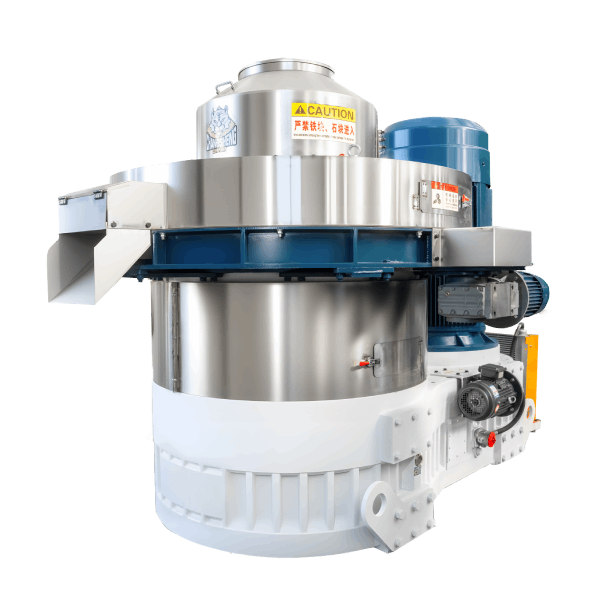
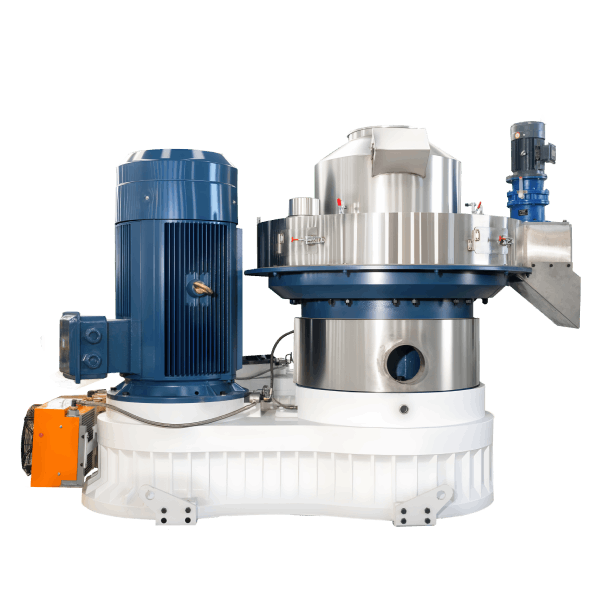
Pellet Mill Die and Roller Selection Guide: Materials & Compression Ratios
News 2026-04-22
1. Product Definition
Pellet mill die and roller selection involves choosing the correct die metallurgy, hole diameter, compression ratio, and roller shell hardness to match specific feedstock characteristics, optimizing pellet quality, output, and wear part life.
2. Technical Parameters & Specifications
| Parameter | Softwood Fuel | Hardwood Fuel | Feed (Poultry) | Feed (Cattle) |
|---|---|---|---|---|
| Die material | GCr15 or 20CrMnTi | 20CrMnTi (preferred) | GCr15 (food-grade) | GCr15 |
| Die hardness (HRC) | 52-56 | 56-60 | 50-54 | 50-54 |
| Compression ratio (L/D) | 1:4 – 1:6 | 1:6 – 1:8 | 1:10 – 1:14 | 1:8 – 1:12 |
| Hole diameter (mm) | 6, 8, 10 | 6, 8 | 2-4 | 4-6 |
| Roller shell material | Cr26 (HRC 58-62) | Tungsten carbide (HRC 68-72) | Cr26 or stainless | Cr26 |
| Expected die life (hours) | 1,800-2,500 | 1,200-1,800 | 1,500-2,500 | 1,500-2,500 |
| Optimal moisture (%) | 15-18 | 13-16 | 12-15 | 12-15 |
For die sizing: Request a compression ratio calculator for your specific feedstock.
3. Structure & Material Composition
Die Metallurgy Options
GCr15 Bearing Steel
- Composition: 1.0% C, 1.5% Cr, high hardness after heat treatment
- Hardness range: HRC 52-58 (through-hardened)
- Best for: Softwood, mixed wood, feed (moderate abrasion)
- Cost: Baseline ($2,000-4,000 for 420mm die)
20CrMnTi Alloy Steel
- Composition: 0.2% C, 1.0% Cr, 1.0% Mn, 0.06% Ti
- Hardness range: HRC 58-62 case, HRC 45-50 core (vacuum carburized)
- Best for: Hardwood, rice husk, straw (high abrasion)
- Cost: +40-60% vs. GCr15 ($3,500-6,500)
Stainless Steel (440C)
- Composition: 1.0% C, 17% Cr (corrosion resistant)
- Hardness range: HRC 52-56
- Best for: High-moisture feed, corrosive materials (citrus, fish feed)
- Cost: +80-120% vs. GCr15 ($4,500-8,000)
Roller Shell Materials
Cr26 High-Chromium Iron
- Composition: 26% Cr, 2.5% C, hardness HRC 58-62
- Best for: Softwood, mixed wood, feed (standard)
- Cost: Baseline ($500-1,200 per set)
Tungsten Carbide Hardfacing
- Composition: WC particles in Cr-Ni matrix, hardness HRC 68-72
- Best for: Hardwood, rice husk, straw, abrasive feedstocks
- Cost: +80-120% vs. Cr26 ($1,000-2,500 per set)
4. Manufacturing Process (Engineering Steps)
Step 1 – Die Forging & Rough Machining
Equipment: Forging press + lathe
Control: Grain flow direction, dimensional accuracy ±0.5mm
Material: GCr15 or 20CrMnTi billet
Step 2 – Hole Drilling
Equipment: Multi-spindle CNC drill
Control: Hole diameter tolerance ±0.02mm, pattern concentricity ±0.1mm
Parameters: 2,000-10,000 holes per die, 5-15 hours drilling time
Step 3 – Heat Treatment
Equipment: Vacuum furnace or salt bath
Control: GCr15: 840°C quench, 180°C temper (HRC 52-58)
20CrMnTi: 920°C carburize, 850°C quench, 180°C temper (case HRC 58-62)
Step 4 – Hole Polishing
Equipment: Abrasive flow or manual honing
Control: Surface finish Ra <0.4μm, taper angle 30-45°
Why: Rough holes cause material sticking, reduced output
Step 5 – Roller Shell Casting & Hardening
Equipment: Induction furnace + centrifugal casting
Control: Cr26 composition, hardness HRC 58-62
Tungsten carbide: Weld hardfacing layer (3-5mm) on Cr26 core
Step 6 – Quality Testing
Equipment: Hardness tester, CMM, dye penetrant
Control: Verify HRC, hole dimensions, no surface cracks
Documentation: Test certificate included with each die
5. Industry Comparison
| Parameter | GCr15 Die | 20CrMnTi Die | 440C Stainless | Tungsten Carbide Rollers |
|---|---|---|---|---|
| Relative cost | 1.0x | 1.5-1.6x | 1.8-2.2x | 1.8-2.2x (vs Cr26) |
| Softwood die life | 2,000-2,500h | 2,200-2,800h | 1,800-2,200h | N/A |
| Hardwood die life | 1,000-1,400h | 1,500-2,000h | 1,200-1,600h | N/A |
| Rice husk life | 400-600h | 800-1,200h | 600-900h | 1,000-1,500h |
| Corrosion resistance | Low | Low | High | Moderate |
| Abrasion resistance | Moderate | High | Moderate | Very high |
| Why Choose Shandong Changsheng | Best value for softwood | Best for hardwood/abrasive | For feed/corrosive | For rice husk/straw |
Compare die materials: Request a wear life projection for your specific feedstock.
6. Application Scenarios (By Buyer Role)
Distributors / Importers
Need pellet mill die and roller selection guidance to stock correct parts for customer feedstocks. Decision focus: regional wood species, common die sizes (320/420/520/760mm), and fast-moving SKUs.
EPC Contractors
Specifying dies for new plants must match feedstock (pine vs. oak vs. straw). Decision focus: compression ratio optimization and spare parts strategy (one spare die per mill).
Engineering Consultants / Technical Advisors
Advising clients on die life economics. Decision focus: cost per ton calculation and payback for premium materials (20CrMnTi vs. GCr15).
End-user Facilities (Pellet plants, feed mills)
Purchasing replacement dies and rollers. Decision focus: cost per ton (not die price alone), delivery lead time, and supplier technical support.
7. Core Technical Pain Points & Engineering Solutions
Pain Point 1 – Wrong Compression Ratio for Feedstock
Problem: Die life 50% of expected, output low, pellets crumbly or too dense.
Root cause: Compression ratio too low (pellets crumble) or too high (die overload, premature wear).
Solution: Softwood (low density): 1:4-1:6. Hardwood (high density): 1:6-1:8. Feed: 1:10-1:14. Test with sample die before ordering production run.
Pain Point 2 – Rapid Die Wear from Abrasive Material
Problem: GCr15 die lasts 600 hours with hardwood (should be 1,500+).
Root cause: Hardwood has higher density and silica (soil contamination).
Solution: Upgrade to 20CrMnTi die (+50% cost, +80-100% life). Install air classifier to remove sand. Blend with 30-50% softwood.
Pain Point 3 – Roller Shell Grooving Prematurely
Problem: Roller shells groove after 300 hours (expected 800+).
Root cause: Standard Cr56/Cr26 insufficient for abrasive feedstock (hardwood, rice husk).
Solution: Tungsten carbide hardfacing (3-5mm layer) on roller shells. Expect 1,000-1,500 hours life. Rebuildable (re-weld 2-3 times).
Pain Point 4 – Die Corrosion from High-Moisture Feed
Problem: Die holes pit and corrode after 500 hours (feed applications with molasses, citrus).
Root cause: GCr15 not corrosion-resistant. Organic acids attack steel.
Solution: Upgrade to 440C stainless steel die. Use stainless roller shells. Clean die daily with neutralizing wash.
8. Risk Warnings & Mitigation Strategies
Risk 1 – Die Cracking from Improper Heat Treatment
Warning: Cheap dies from uncertified suppliers have inconsistent hardness, residual stress, crack within 200-500 hours.
Mitigation: Request heat treatment certificate (time-temperature curves). Hardness test (HRC 52-58). Dye penetrant inspection before installation. Buy from reputable suppliers only.
Risk 2 – Roller Bearing Seizure from Incorrect Roller Shell
Warning: Roller shell hardness too high (>HRC 65) can damage bearings (vibration). Too low (<HRC 50) wears rapidly.
Mitigation: Specify Cr26 at HRC 58-62 for standard applications. Tungsten carbide only for abrasive feedstocks (not for softwood — overkill). Verify hardness certificate.
Risk 3 – Counterfeit Dies from Online Marketplaces
Warning: Dies labeled “GCr15” are often 45# carbon steel (unhardened). Life 50-150 hours vs. 2,000+ hours.
Mitigation: Buy direct from manufacturer or authorized distributor. Request material test report. Verify hardness with portable tester (Leeb or Rockwell). Avoid eBay/Amazon for critical wear parts.
9. Procurement Selection Guide (6 Actionable Steps)
Step 1 – Characterize your feedstock
Test: moisture (%), ash (%), silica content (for abrasion), and bulk density (kg/m³). Pine (low abrasion) vs. oak (moderate) vs. rice husk (high).
Step 2 – Calculate required compression ratio
Formula: Bulk density of raw material (kg/m³) ÷ target pellet density (kg/m³) × 1.2. Example: 250 ÷ 1,150 × 1.2 = 1:5.5 (softwood). Hardwood (300 ÷ 1,150 × 1.2 = 1:6.3).
Step 3 – Select die material based on abrasiveness
Low abrasion (pine, spruce, fir): GCr15. Moderate (oak, maple, mixed wood): 20CrMnTi. High (rice husk, straw, bagasse): 20CrMnTi with tungsten carbide rollers.
Step 4 – Determine hole diameter for application
Fuel: 6mm, 8mm, or 10mm (larger holes for higher ash material). Feed: 2-4mm (poultry), 4-6mm (cattle, pigs). Bedding: 8-12mm (low density).
Step 5 – Calculate cost per ton for die options
Formula: Die price ÷ expected tons through die. Example: GCr15 $3,000 ÷ 1,500 tons = $2.00/ton. 20CrMnTi $4,500 ÷ 2,200 tons = $2.05/ton (similar cost, longer life, less downtime).
Step 6 – Verify dimensional compatibility
Measure: Die diameter (320/420/520/760mm standard). Bolt pattern (number, diameter, pitch circle). Roller shell diameter and width. Request drawing before ordering.
10. Engineering Case Study
Project Background: A pellet plant in Vietnam processed 50% pine sawdust and 50% mixed tropical hardwood. Original GCr15 die life: 900 hours. Annual die cost: $18,000 (6 dies at $3,000 each).
Initial Problem: Plant manager frustrated with frequent die changes (every 2 months). Downtime for die change: 4 hours each (24 hours/year). Production loss: 50 tons at $150/ton = $7,500 lost.
Root Cause Analysis:
- Hardwood content (50%) increased abrasion beyond GCr15 capability
- No air classifier — sand contamination from outdoor storage
- Compression ratio 1:5 (optimized for pine) too low for hardwood
Solution Implemented (Shandong Changsheng):
- Switched to 20CrMnTi die ($4,500) with 1:7 compression ratio
- Added tungsten carbide roller shells ($1,800 vs. $1,000 for Cr26)
- Installed air classifier to remove sand (reduced silica 0.8% to 0.2%)
- Blended 70% pine + 30% hardwood (reduced abrasion)
Final Data Results (12 months):
| Metric | Before (GCr15) | After (20CrMnTi) |
|---|---|---|
| Die life (hours) | 900 | 2,100 |
| Dies per year | 6 | 2.5 |
| Die cost per year | $18,000 | $11,250 |
| Roller cost per year | $3,000 (3 sets) | $3,600 (2 sets, tungsten) |
| Downtime for changes (hours) | 24 | 10 |
| Production loss ($) | $7,500 | $3,125 |
| Total annual cost | $28,500 | $17,975 |
- Annual savings: $10,525 (37% reduction)
- Premium die payback: 2 months (extra $1,500 per die × 2.5 dies = $3,750 premium saves $10,525)
Request a die selection analysis: Contact engineering team with your feedstock composition for cost-per-ton optimization.
11. FAQ
Q1: What is compression ratio in pellet mill die selection?
Ratio of hole length to hole diameter (L/D). Higher ratio = more compression, denser pellets, higher energy. Lower ratio = softer pellets, less energy.
Q2: What compression ratio for softwood pellets?
1:4 to 1:6. Pine, spruce, fir (low bulk density, high lignin). Start with 1:5.
Q3: What compression ratio for hardwood pellets?
1:6 to 1:8. Oak, maple, beech (higher density, lower lignin). Start with 1:7.
Q4: What compression ratio for chicken feed?
1:10 to 1:14. Small holes (2-4mm), high durability required. Start with 1:12.
Q5: GCr15 vs 20CrMnTi — which is better?
GCr15 for softwood/mixed (best value). 20CrMnTi for hardwood/abrasive (longer life, higher cost). Calculate cost per ton for decision.
Q6: How long should a die last for softwood?
1,800-2,500 hours (GCr15). 2,200-2,800 hours (20CrMnTi). Track tons per die.
Q7: How long should a die last for hardwood?
1,000-1,400 hours (GCr15). 1,500-2,000 hours (20CrMnTi). Upgrade for hardwood.
Q8: When should I use tungsten carbide rollers?
For abrasive feedstocks: hardwood, rice husk, straw, bagasse. Not needed for softwood (overkill).
Q9: How do I know when a die is worn?
Output drops 20% below baseline, pellets less dense, die surface shows cracks, or holes wear oval.
Q10: Can I change die compression ratio without changing machine?
Yes, any compression ratio fits same machine as long as hole diameter and outer dimensions match.
Q11: What is the standard die diameter for ring die mills?
320mm, 420mm, 520mm, 760mm. Most common: 420mm (1-2 t/h), 520mm (2-3 t/h).
Q12: How do I prevent die hole blocking?
Maintain moisture 13-18%. Clean with oil-soaked sawdust every 200 hours. Use correct compression ratio.
Q13: What is the typical cost of a replacement die?
420mm die: GCr15 $2,500-3,500, 20CrMnTi $3,500-5,500. 520mm die: add 30-50%. 760mm die: add 100-150%.
Q14: Can I refurbish worn dies?
Some suppliers offer re-drilling (larger holes) or rebuilding (weld and re-drill). Not recommended for premium applications.
Q15: How to store spare dies?
Coat with rust preventative oil. Store vertically on edge (not flat). Keep in dry area (humidity <60%). Inspect for rust every 3 months.
12. Commercial Call-to-Action
For procurement and operations teams: Request a pellet mill die and roller selection guide with compression ratio calculator, material comparison, and cost-per-ton worksheet for your specific feedstock.
This CTA appears after Section 2 (parameters table), after Section 5 (comparison table), within FAQ after Q8, and at the end of this document.
Need a die recommendation? Contact the engineering team with your feedstock type, moisture, target output, and current die life for a cost-per-ton optimization.
Looking for a test die? Request a sample die (100mm diameter) to optimize compression ratio before ordering production quantities.
To proceed: Send your inquiry via the contact form. Include your feedstock (species, moisture, ash), target pellet diameter (mm), current die life (hours), and mill model/diameter.
13. Author & E-E-A-T Credentials
Author: Zhang Wei
Wear Parts Specialist & Metallurgical Engineer
- 11 years in pellet mill die and roller design, metallurgy, and application engineering (2014–present)
- Developed compression ratio tables for 50+ feedstock types across 40 countries
- Advised 200+ plants on pellet mill die and roller selection for cost optimization
- Author of “Pellet Mill Die and Roller Engineering Guide” (China Machine Press, 2023)
- Member of ASM International (materials society)
Affiliation: Shandong Changsheng Machinery Co., Ltd.
The author has directly designed die metallurgy specifications for softwood, hardwood, rice husk, straw, bagasse, and feed applications, validated wear life through field testing, and developed cost-per-ton models. All data, compression ratios, and material recommendations are derived from actual production data from 2014–2026.