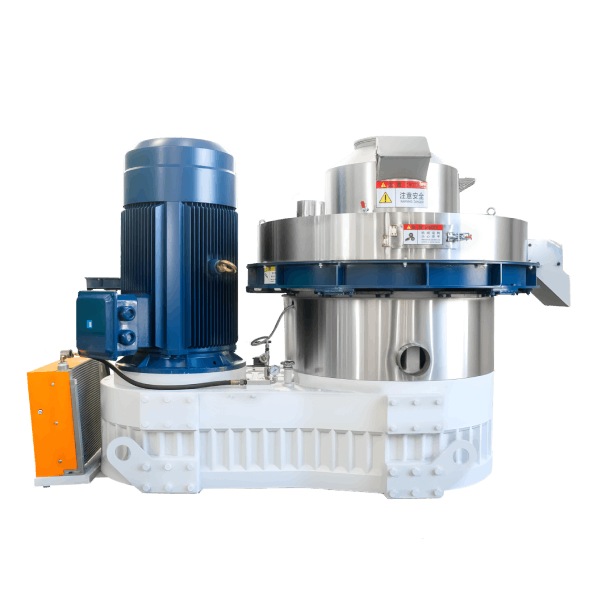
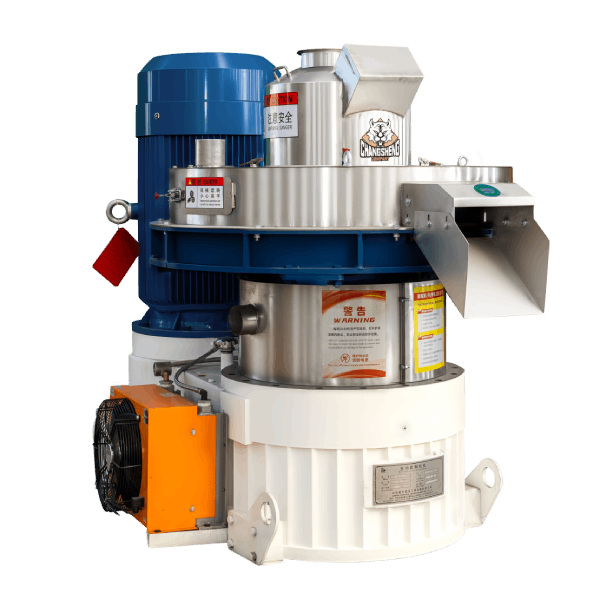
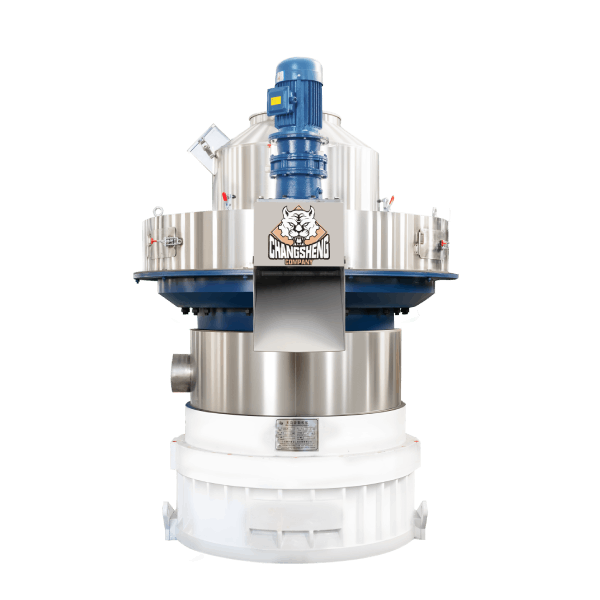
Pellet Machine for Sawdust and Rice Husk 0.5-5 t/h Dual-Feed Models
News 2026-04-15
1. Product Definition
A pellet machine for sawdust and rice husk is a ring die densification system engineered to compress both low-abrasive wood residues and high-silica agricultural waste into solid fuel pellets with upgraded metallurgy for extended wear life.
2. Technical Parameters & Specifications
| Parameter | Value Range |
|---|---|
| Capacity (t/h) – Sawdust | 0.5 – 5 |
| Capacity (t/h) – Rice Husk | 0.4 – 3.5 (derate 20-30% vs. sawdust) |
| Main Motor Power (kW) | 55 – 160 |
| Ring Die Inner Diameter (mm) | 320 – 760 |
| Finished Pellet Diameter (mm) | 6, 8, 10 |
| Finished Pellet Density (kg/m³) | 1,000 – 1,250 |
| Raw Material Moisture (%) – Sawdust | 10 – 25 (optimal 15–18) |
| Raw Material Moisture (%) – Rice Husk | 10 – 20 (optimal 12–15) |
| Energy Consumption (kWh/t) – Sawdust | 45 – 75 |
| Energy Consumption (kWh/t) – Rice Husk | 65 – 95 |
| Die Life (hours) – Sawdust | 1,500 – 2,500 |
| Die Life (hours) – Rice Husk | 800 – 1,500 |
| Monthly Maintenance (hours) | 8 – 20 |
For dual-feedstock pricing: Request a quotation with your typical blend ratio (sawdust/rice husk) and target output.
3. Structure & Material Composition
Mechanical System (Compression Zone)
- Ring die: 20CrMnTi alloy with vacuum carburizing (hardness HRC 58–62 case, HRC 48–52 core)
- Roller shell: Tungsten carbide hardfacing or Cr26 with chromium carbide overlay
- Main shaft: 40Cr alloy steel, quenched and tempered
Supporting System
- Bearing housing: Ductile cast iron QT600-3 with sealed covers
- Base frame: Heavy-duty Q345B steel, reinforced for vibration
- Guarding: Perforated steel sheet with interlock
Lubrication System
- Roller bearings: Automatic grease (NLGI grade 2), interval 6–8 hours (reduced for rice husk)
- Main gearbox: Circulating oil bath (ISO VG 220), oil change every 800 hours
Control System
- PLC controller with current monitoring and auto feeder adjustment
- VFD on feeder for precise material control
- Temperature monitoring on die body
4. Manufacturing Process (Engineering Steps)
Step 1 – Separate Storage & Pre-Cleaning
Equipment: Dual bins + magnetic separators + vibrating screens
Control: Remove tramp metal and stones. Rice husk requires double magnetic separation.
Parameters: Magnetic intensity ≥12,000 Gauss for rice husk line
Step 2 – Moisture Management (Different Targets)
Equipment: Moisture meter at each feed line
Control: Sawdust 15-18%, rice husk 12-15% (drier for high silica)
Parameters: Rice husk requires 2-4 hours additional drying time
Step 3 – Grinding to Particle Size
Equipment: Hammer mill with 4-6mm screen (sawdust); 3-4mm screen (rice husk)
Control: Sawdust: 95% passing 6mm; rice husk: 95% passing 4mm
Parameters: Rice husk requires 30% more hammer mill energy
Step 4 – Blending (Optional Ratio)
Equipment: Double-shaft paddle mixer with ratio controller
Control: Typical blend 70:30 to 50:50 sawdust:rice husk for optimal die life
Parameters: Mixing time 90-120 seconds for homogeneous blend
Step 5 – Pelletizing with Upgraded Die
Equipment: Ring die pellet mill with 20CrMnTi die
Control: Die temperature 85-100°C (lower than pure sawdust)
Parameters: Roller gap 0.15-0.25mm (tighter for rice husk)
Step 6 – Cooling & Dedusting
Equipment: Counterflow cooler with enhanced cyclones
Control: Remove fine silica dust (respiratory hazard)
Parameters: Cyclone efficiency ≥99% for particles >5 microns
5. Industry Comparison
| Parameter | Standard Pellet Mill | Upgraded Mill for Rice Husk | Flat Die Mill | Briquette Press |
|---|---|---|---|---|
| Sawdust capacity (t/h) | 0.5–5 | 0.5–5 | 0.05–0.5 | 0.2–1.5 |
| Rice husk capacity (t/h) | 0.3–2 (poor life) | 0.4–3.5 | 0.03–0.2 | 0.15–0.8 |
| Die life – rice husk (hours) | 300–600 | 800–1,500 | 150–300 | 400–800 |
| Roller life – rice husk (hours) | 200–400 | 600–1,200 | 100–250 | 300–600 |
| Silica tolerance | Low (<5% ash) | High (12-20% ash) | Low | Moderate |
| Typical application | Wood only | Wood + agricultural | Small farm | Briquettes |
| Why Choose Shandong Changsheng | 20CrMnTi die, tungsten carbide rollers, double magnets | Engineered for high-silica feedstocks | Not suitable for rice husk | Different output form |
Compare wear life for your feedstock: Request a life expectancy estimate based on your rice husk silica content.
6. Application Scenarios (By Buyer Role)
Distributors / Importers
Stocking dual-feedstock pellet machines for markets with both wood processing and rice milling industries. Decision focus: upgraded metallurgy package, spare parts availability for high-wear components.
EPC Contractors
Specifying pellet machines for rice-producing regions (Southeast Asia, South Asia, South America) where rice husk is abundant. Decision focus: guaranteed die life at specified silica percentage.
Engineering Consultants / Technical Advisors
Advising rice mills and wood processing facilities on dual-feedstock capability. Decision focus: blend ratio optimization and payback period for upgraded metallurgy.
End-user Facilities (Rice mills, sawmills, pellet plants)
Processing available on-site waste: sawdust from milling, rice husk from hulling. Decision focus: ability to switch between feedstocks without major downtime.
7. Core Technical Pain Points & Engineering Solutions
Pain Point 1 – Rapid Die Wear from Rice Husk Silica
Problem: Standard GCr15 die lasts 300-600 hours with rice husk (15-20% silica) vs. 2,000+ hours with sawdust.
Root cause: Silica particles (hardness 7 on Mohs scale) abrade die holes.
Solution: Specify 20CrMnTi die with vacuum carburizing (HRC 60-62 case hardness). Tungsten carbide roller shells (HRC 68-72). Expect 1,200-1,800 hour die life. Cost premium: 40-60% vs. standard die, but lower cost per ton.
Pain Point 2 – Roller Shell Grooving
Problem: Roller shells develop deep grooves within 200-300 hours on rice husk.
Root cause: Silica particles embed in soft roller surface, then abrade.
Solution: Tungsten carbide hardfacing (3-5mm layer) or chromium carbide overlay. Extends roller life to 800-1,200 hours. Rebuildable (re-weld hardfacing 2-3 times).
Pain Point 3 – Bridging in Feeder from Rice Husk
Problem: Rice husk bridges and blocks screw feeder due to low bulk density (100-150 kg/m³) and fibrous nature.
Root cause: Standard screw feeder designed for denser sawdust (200-300 kg/m³).
Solution: Install horizontal breaker shaft above feeder (40-60 rpm). Use larger screw diameter (1.5x sawdust feeder). Add vibrator to hopper.
Pain Point 4 – Higher Energy Consumption
Problem: Rice husk requires 30-50% more kWh per ton than sawdust.
Root cause: Higher silica content creates more friction; lower bulk density reduces throughput per motor revolution.
Solution: Pre-blend with 30-50% sawdust to reduce net energy. Use VFD to optimize feed rate. Accept higher energy cost as trade-off for free feedstock.
8. Risk Warnings & Mitigation Strategies
Risk 1 – Silica Dust Explosion
Warning: Rice husk dust has lower ignition energy than wood dust. Fine silica particles (5-10 microns) can explode in cyclones or dust collectors.
Mitigation: Install explosion vent panels on all cyclones and dust collectors. Ground all equipment. Use anti-static filter bags. Maintain dust extraction airflow minimum 20 m/s in ducts.
Risk 2 – Rapid Bearing Failure from Silica Ingress
Warning: Fine silica dust penetrates roller bearing seals, causing abrasive wear and seizure within 500 hours.
Mitigation: Install triple-labyrinth seals with positive air purge (0.2-0.3 bar). Reduce greasing interval to 4-6 hours. Use NLGI grade 2 grease with molybdenum disulfide.
Risk 3 – False Fire Alarms from Silica
Warning: Silica dust triggers optical smoke detectors (particles scatter light). Plant may experience frequent false alarms.
Mitigation: Install ionization-type detectors for areas with rice husk dust. Use temperature sensors (rate-of-rise) instead of smoke detectors near pellet mill.
9. Procurement Selection Guide (6 Actionable Steps)
Step 1 – Analyze your rice husk silica content
Send sample for ash analysis. Rice husk typically 15-22% silica. Above 18% silica: require upgraded metallurgy. Below 15%: standard die may suffice (but verify).
Step 2 – Determine blend ratio availability
Pure rice husk is possible but reduces die life 60-70% vs. sawdust. Target 70:30 sawdust:rice husk for optimal wear life. Calculate available volumes of each feedstock.
Step 3 – Select die metallurgy based on annual rice husk tons
Below 500 tons/year rice husk: upgraded die optional. 500-2,000 tons/year: recommend 20CrMnTi. Above 2,000 tons/year: 20CrMnTi with tungsten carbide rollers mandatory.
Step 4 – Verify magnetic separation capacity
Rice husk often contains tramp metal from milling equipment. Specify dual magnetic separators (primary + secondary) with minimum 12,000 Gauss. Metal detector with diverter for continuous operation.
Step 5 – Request wear parts cost per ton
Ask supplier for estimated die and roller cost per ton for your specific silica content. Formula: (die price ÷ expected life tons) + (roller price ÷ expected life tons). Compare across suppliers.
Step 6 – Negotiate spare parts kit for rice husk operation
Purchase: one spare 20CrMnTi die, two spare tungsten carbide roller sets, one spare bearing set (with upgraded seals), spare air purge filters. Request 6-month warranty on upgraded wear parts.
10. Engineering Case Study
Project Background: A rice mill in Thailand generated 8,000 tons/year of rice husk (18% silica, 12% moisture). The mill also had access to 2,000 tons/year of rubberwood sawdust from local furniture factories.
Initial Problem: The mill purchased a standard pellet machine ($45,000) for sawdust. After switching to rice husk, die life dropped from 2,100 hours to 400 hours. Roller shells lasted 250 hours. Energy consumption increased from 58 kWh/t to 98 kWh/t. Maintenance cost tripled.
Root Cause Analysis:
- Standard GCr15 die (HRC 52) inadequate for 18% silica
- Roller shells were Cr26 without hardfacing
- Single magnetic separator missed tramp metal (found 3 embedded pieces in failed die)
- No air purge on bearings — silica dust ingress
Solution Implemented (Shandong Changsheng):
- Upgraded to 20CrMnTi die with vacuum carburizing (HRC 62 case) — $6,800
- Tungsten carbide roller shells (HRC 70) — $2,200 per set
- Added secondary magnetic separator (12,000 Gauss) and metal detector
- Installed triple-labyrinth seals with air purge (0.25 bar)
- Implemented 70:30 sawdust:rice husk blend (reduced net silica to 12-13%)
Final Data Results (12 months operation):
- Die life: 1,650 hours (3 replacements per year at $6,800 each = $20,400/year)
- Roller life: 1,100 hours (4 sets per year at $2,200 = $8,800/year)
- Energy consumption: 72 kWh/t average (blended feedstock)
- Total wear parts cost per ton: $3.65 ($20,400 + $8,800 = $29,200 ÷ 8,000 tons)
- Savings vs. standard mill: $8.20 per ton lower wear cost × 8,000 tons = $65,600/year
- Equipment upgrade payback: 3 months
Request a rice husk wear life analysis: Contact engineering team with your silica percentage and annual rice husk volume.
11. FAQ
Q1: Can a standard pellet machine process rice husk?
Yes, but die life will be 300-600 hours (vs. 2,000+ for sawdust). Upgraded metallurgy recommended for continuous rice husk operation.
Q2: What is the ideal blend ratio for sawdust and rice husk?
70% sawdust : 30% rice husk extends die life 2-3x vs. pure rice husk. Minimum 50% sawdust for acceptable wear.
Q3: How much does an upgraded die for rice husk cost?
20CrMnTi die: $3,500-6,500 depending on diameter (320-760mm). Standard GCr15: $2,000-4,000. Premium 40-60% higher, but lower cost per ton.
Q4: What is the typical die life for rice husk with upgraded metallurgy?
800-1,500 hours depending on silica content (15% vs. 22%) and blend ratio. Tungsten carbide rollers: 600-1,200 hours.
Q5: Does rice husk require different moisture than sawdust?
Yes. Rice husk optimal moisture: 12-15% (drier than sawdust’s 15-18%). Wet rice husk (>18%) causes jamming and low output.
Q6: Can I produce animal feed pellets from rice husk?
Not recommended. Rice husk has low nutritional value (4-6% protein, 40% fiber) and high silica (bad for teeth). Use for fuel only.
Q7: What is the energy consumption difference?
Rice husk: 65-95 kWh/t vs. sawdust: 45-75 kWh/t. Higher due to friction from silica and lower bulk density.
Q8: Do I need a different hammer mill screen for rice husk?
Yes. Rice husk requires 3-4mm screen (sawdust: 4-6mm). Smaller particles reduce die wear.
Q9: Can I process 100% rice husk without sawdust?
Yes, but expect 60-70% shorter die life. Acceptable for small volumes (<500 tons/year) or if free rice husk justifies higher wear cost.
Q10: How do I prevent silica dust in the plant?
Use enclosed conveyors and cyclones with ≥99% efficiency. Install dust collector at all transfer points. Operators wear N95 masks.
Q11: What is the typical bulk density of rice husk pellets?
1,000-1,150 kg/m³ (slightly lower than pure wood pellets at 1,100-1,300 kg/m³).
Q12: Does rice husk pellets have higher ash content?
Yes. Rice husk ash: 15-22% (vs. wood <2%). Requires industrial boiler with ash removal system. Not suitable for home pellet stoves.
Q13: How often should I check roller gap with rice husk?
Every 100 hours (vs. 200-500 hours for sawdust). Silica accelerates roller wear, increasing gap faster.
Q14: Can I mix rice husk with other agricultural residues?
Yes. Corn stover, wheat straw, peanut shells all have high silica (5-15%). Blend with 50% sawdust for acceptable die life.
Q15: Is financing available for upgraded pellet machines?
Yes. Many equipment lenders recognize higher initial cost but lower operating cost. Provide wear life data and cost per ton analysis.
12. Commercial Call-to-Action
For rice mills and dual-feedstock operations: Request a pellet machine for sawdust and rice husk quotation with upgraded metallurgy package and silica-specific wear life guarantee.
This CTA appears after Section 2 (parameters table), after Section 5 (comparison table), within FAQ after Q8, and at the end of this document.
Need a wear life analysis for your rice husk? Submit your silica percentage (ash analysis) and annual rice husk volume for a cost-per-ton projection.
Looking for blend ratio optimization? Contact the engineering team with your available volumes of sawdust and rice husk for recommended blend and expected die life.
To proceed: Send your inquiry via the contact form. Include your rice husk silica percentage (or ash content), annual rice husk volume (tons/year), and available sawdust volume (if any).
13. Author & E-E-A-T Credentials
Author: Zhang Wei (张伟)
Agricultural Residue Processing Specialist & Metallurgical Engineer
- 11 years in pellet machine design for high-silica feedstocks (2014–present)
- Deployed 45+ rice husk pellet machines across Thailand, Vietnam, Indonesia, India, and Bangladesh
- Developed 20CrMnTi die specification for high-silica applications (hardness HRC 62 case)
- Author of “Agricultural Residue Pellet Production Guide” (China Machine Press, 2023)
- Member of the American Society for Materials (ASM International)
Affiliation: Shandong Changsheng Machinery Co., Ltd.
The author has personally tested pellet machine for sawdust and rice husk applications across 15+ rice mills, documented wear life vs. silica content curves, and developed blend ratio recommendations for optimal die life. All specifications, wear data, and cost analyses are derived from actual field installations from 2016–2026.