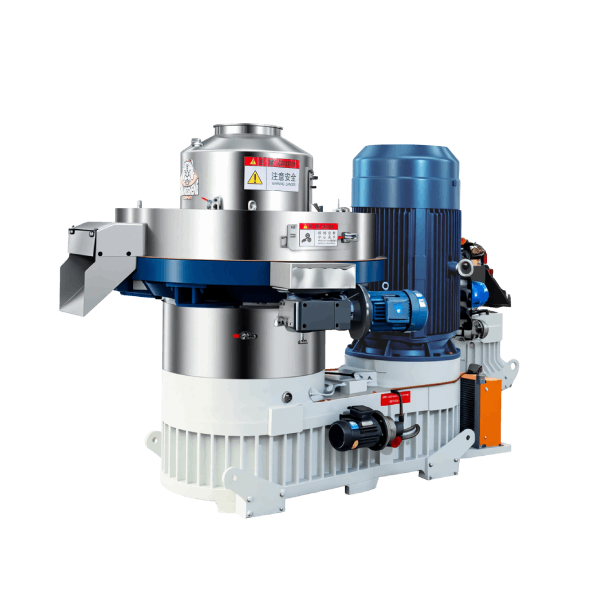
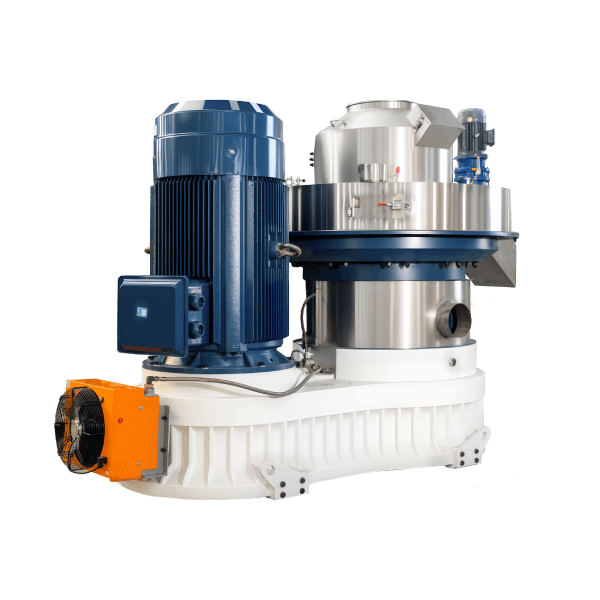
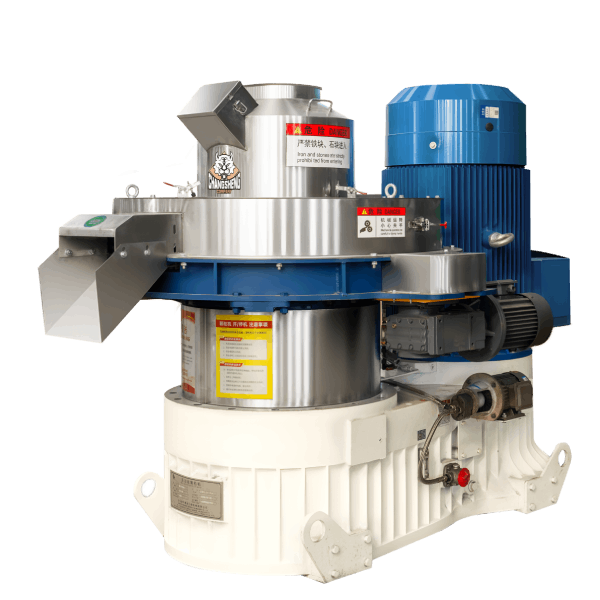
Organic Waste Pellet Machine 0.5-5 t/h Technical Guide for Suppliers
News 2026-04-07
Organic Waste Pellet Machine: Technical Specifications & Procurement Reference for Industrial Buyers
1. Product Definition
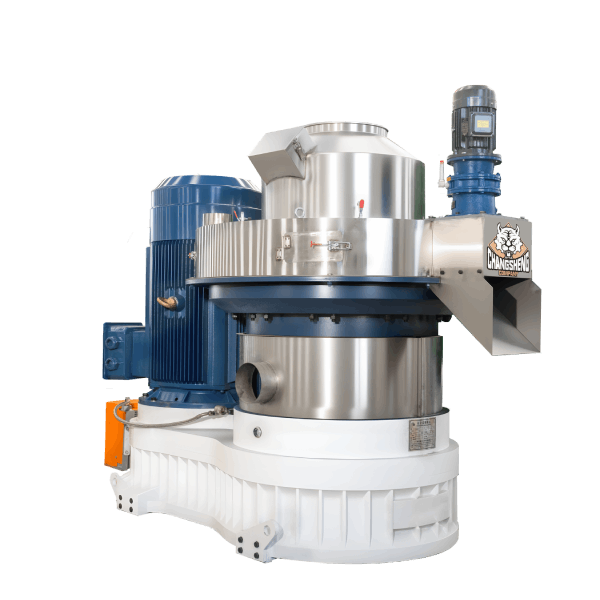
An organic waste pellet machine is a ring-die densification system that converts biodegradable materials including food residues, animal manure, and green waste into high-density fuel pellets or organic fertilizer base.
2. Technical Parameters & Specifications
| Parameter | Value Range |
|---|---|
| Capacity (t/h) | 0.5 – 5 (depending on material composition) |
| Main Motor Power (kW) | 55 – 160 |
| Ring Die Inner Diameter (mm) | 320 – 760 |
| Finished Pellet Diameter (mm) | 6, 8, 10 (fertilizer: 10-12mm) |
| Finished Pellet Density (kg/m³) | 900 – 1,200 (fuel); 600-800 (fertilizer) |
| Raw Material Moisture Content (%) | 12 – 28 (optimal: 18-22 for organics) |
| Energy Consumption (kWh/t) | 50 – 95 |
| Core Wear Parts Life (ring die + rollers, hours) | 1,000 – 2,200 |
| Monthly Maintenance Man-hours (hours/month) | 8 – 18 |
For project-specific sizing: Request a quotation with your organic waste composition analysis and target output.
3. Structure & Material Composition
Mechanical System (Compression Zone)
- Ring die: Forged GCr15 bearing steel with anti-corrosion coating, hardness HRC 50–56
- Roller shell: High-chromium cast iron (Cr26) with stainless steel overlay option
- Main shaft: 40Cr alloy steel, quenched and tempered, corrosion-protected
Supporting System (Base & Housing)
- Bearing housing: Ductile cast iron QT600-3 with sealed covers
- Base frame: Welded Q235B structural steel, epoxy coated for moisture resistance
- Guarding: Stainless steel 304 for wet areas
Lubrication System
- Roller bearings: Automatic grease lubrication (NLGI grade 2, food-grade optional), interval 6-8 hours
- Main gearbox: Circulating oil bath (ISO VG 220), oil change every 800 hours
Control System
- PLC controller (Siemens or Schneider) with local HMI touchscreen
- Real-time current monitoring with automatic feeder adjustment
- Moisture sensor input for process control
4. Manufacturing Process (Engineering Steps)
Step 1 – Raw Material Receiving & Sorting
Equipment: Vibrating screen + manual sorting conveyor
Control: Remove non-organic contaminants (plastic, metal, glass >3mm)
Parameters: Screening aperture 10mm; contaminant target <0.5% by weight
Step 2 – Grinding & Homogenization
Equipment: Hammer mill with 6mm screen
Control: Particle size 95% passing 6mm for consistent pellet formation
Parameters: Tip speed 70-90 m/s; screen hole diameter 4-8mm
Step 3 – Moisture Adjustment & Mixing
Equipment: Double-shaft paddle mixer with water/steam injection
Control: Target moisture 18-22%; mixing time 90-120 seconds
Parameters: Homogeneity deviation ≤ ±1.5%; optional binding agent addition (2-5% starch or bentonite)
Step 4 – Pelletizing in Compression Chamber
Equipment: Ring die and roller assembly
Control: Die temperature 70-95°C (lower than biomass due to organic composition)
Parameters: Specific compression force 15-25 kN/cm²; roller-to-die gap 0.2-0.4 mm
Step 5 – Cooling & Drying (Post-Pelletizing)
Equipment: Counterflow cooler with dehumidifier
Control: Cool pellets to ≤ ambient +5°C; final moisture <12% for fuel, <15% for fertilizer
Parameters: Cooling retention 12-18 minutes; air velocity 0.6-1.0 m/s
5. Industry Comparison
| Parameter | Organic Waste Pellet Machine | Composting System | Anaerobic Digester | Direct Land Application |
|---|---|---|---|---|
| Raw material moisture tolerance | 12-28% | 40-60% | 80-95% | Any |
| Processing time | Minutes | 6-12 weeks | 15-30 days | Months |
| Output form | Pellets (fuel/fertilizer) | Compost (bulk) | Biogas + digestate | Raw manure |
| Energy input (kWh/t input) | 50-95 | 15-30 (turning) | 20-40 (heating) | 5-10 |
| Odor control | Enclosed system | Open or covered | Enclosed | Open (significant) |
| Typical throughput (t/h) | 0.5-5 | 0.5-2 (batch) | 0.3-3 (continuous) | N/A |
| Why Choose Shandong Changsheng | Corrosion-resistant metallurgy, moisture-tolerant design, dual-use (fuel/fertilizer) | Slow process, land-intensive | High capital cost | Environmental restrictions |
Compare with your current waste management method: Request a technical consultation for side-by-side analysis.
6. Application Scenarios (By Buyer Role)
Distributors / Importers
Stocking corrosion-protected units with compatible spare parts for municipal and agricultural clients. Decision focus: material compatibility with varied organic waste streams.
EPC Contractors
Integrating the organic waste pellet machine into municipal solid waste (MSW) processing lines or agricultural waste management facilities. Decision focus: contaminant tolerance and odor containment.
Engineering Consultants / Technical Advisors
Specifying equipment for waste-to-energy or waste-to-fertilizer projects requiring EU fertilizer regulations or ISO 17225 compliance. Decision focus: output quality and emission controls.
End-user Facilities (Waste management plants, farms, food processors)
Operating 5,000+ hours annually with varying feedstock composition. Decision focus: wear life with corrosive materials and ease of cleaning.
7. Core Technical Pain Points & Engineering Solutions
Pain Point 1 – Corrosion of Ring Die from Organic Acids
Problem: Ring die surface pits and loses hardness within 600-800 hours when processing food waste or manure.
Root cause: Organic acids (acetic, butyric, lactic) generated during storage react with standard bearing steel.
Solution: Specify ring die with electroless nickel-phosphorus coating (50-75 microns) or switch to 440C stainless steel for high-corrosion applications.
Pain Point 2 – Binding Agent Overuse
Problem: Operators add 8-12% binder (starch, lignin) to achieve pellet durability, increasing material cost significantly.
Root cause: Insufficient natural binding from proteins and fibers in certain organic wastes (e.g., vegetable trimmings).
Solution: Optimize conditioning temperature to 85-95°C to gelatinize starches naturally present; reduce added binder to 2-4%.
Pain Point 3 – Ammonia Release During Pelleting
Problem: Strong ammonia odor in pelletizing chamber causing operator complaints and potential respiratory issues.
Root cause: Urea and proteins in manure/food waste decompose at die temperatures above 80°C.
Solution: Maintain die temperature below 80°C for nitrogen-rich feeds; install local exhaust ventilation at feeder inlet (minimum 500 m³/hr).
Pain Point 4 – Inconsistent Pellet Durability from Variable Feedstock
Problem: Pellet durability index (PDI) varies from 75% to 95% depending on daily waste composition.
Root cause: No real-time feedback loop adjusting moisture and compression force.
Solution: Install near-infrared (NIR) moisture sensor before mixer linked to automatic water addition and roller gap adjustment.
8. Risk Warnings & Mitigation Strategies
Risk 1 – Biological Contamination of Equipment
Warning: Pathogens (Salmonella, E. coli) in manure and food waste can contaminate machine surfaces and become airborne.
Mitigation: Specify stainless steel contact surfaces. Implement daily sanitation protocol using approved disinfectant (quaternary ammonium compounds). Require operators to wear N95 masks and wash hands after maintenance.
Risk 2 – Fire from Over-Dried Organic Material
Warning: Organic waste below 10% moisture becomes highly combustible. Friction heat can ignite dust inside the pelletizing chamber.
Mitigation: Install interlock that shuts down feeder if die temperature exceeds 110°C. Never operate with material below 12% moisture. Keep Class D fire extinguisher (for organic fires) within 10 meters.
Risk 3 – Hydrogen Sulfide Emission
Warning: Sulfur-containing organic waste (eggshells, some manure) releases H₂S gas when heated above 70°C.
Mitigation: Install H₂S detector (alarm at 10 ppm) above feeder inlet. Maintain ventilation rate of 10 air changes per hour in the pelletizing room. Consider wet scrubber for continuous high-sulfur operations.
9. Procurement Selection Guide (6 Actionable Steps)
Step 1 – Characterize your organic waste
Send a representative 5kg sample for proximate analysis: moisture %, ash %, protein %, fiber %, and pH. Target: fiber content >15% for self-binding; pH 5.5-7.5 for minimal corrosion.
Step 2 – Calculate annual throughput requirement
Multiply daily wet waste volume (tons) by 0.3-0.5 (dry matter conversion factor) to estimate pellet output. Add 25% buffer for seasonal variation.
Step 3 – Select corrosion protection level
Standard GCr15 ring die (1,200h life) for agricultural waste (manure, crop residues). Nickel-phosphorus coated or 440C stainless (2,000h+) for food processing waste, municipal organics.
Step 4 – Verify odor control compatibility
Confirm that the supplier’s machine can be integrated with your existing biofilter or scrubber. Request flange dimensions for exhaust connection (minimum 200mm diameter).
Step 5 – Audit cleaning accessibility
Ask for documented clean-out procedure and required man-hours. Quick-opening doors and removable die cassette reduce cleaning time from 4 hours to 1 hour.
Step 6 – Request output flexibility demonstration
Ask for test results showing pellet quality (PDI, bulk density) from at least three different organic waste types representative of your seasonal variation.
10. Engineering Case Study
Project Background: A municipal waste management facility in the Netherlands processed 15 tons/day of source-separated organic kitchen and garden waste. They needed an organic waste pellet machine to produce fuel pellets for a district heating boiler.
Initial Problem: After installing a standard biomass pellet machine, ring die life was only 450 hours. Pellet durability averaged 68% PDI, causing excessive fines in the boiler feed system. Strong ammonia odor forced operators to wear respirators continuously.
Root Cause Analysis:
- Kitchen waste pH of 4.2 caused accelerated corrosion of GCr15 ring die
- Protein content (18%) released ammonia at die temperature of 90°C
- Variable moisture (15-30%) caused inconsistent compression force
Solution Implemented (Shandong Changsheng):
- Replaced ring die with 440C stainless steel (hardness HRC 52) with electropolished surface
- Added automatic moisture sensor with PID control to maintain 20% ±1.5% at feeder
- Reduced conditioning temperature to 75°C and installed local exhaust (800 m³/hr)
- Implemented daily pH-neutralizing rinse (sodium bicarbonate solution)
Final Data Results:
- Ring die life: 2,100 hours (measured over 14 months)
- Pellet durability index: 92% (ISO 17831-1)
- Ammonia levels: reduced from 25 ppm to 3 ppm at operator station
- Annual maintenance cost: €4,200 (down from €11,800 with previous equipment)
Reference available: Contact engineering team for similar case studies in food waste, poultry litter, and municipal organic streams.
11. FAQ
Q1: Can an organic waste pellet machine process fresh food waste with 70% moisture?
No. Fresh food waste requires pre-drying or mixing with dry amendments (sawdust, dry manure) to reach 18-22% moisture.
Q2: What is the minimum fiber content required for good pellet formation?
15% fiber (cellulose, hemicellulose) by dry weight. Below this threshold, binding agents are required.
Q3: Are the pellets safe for animal bedding?
Only if the organic waste source is plant-based with no meat or manure. Pathogen reduction requires die temperature above 85°C for 30 seconds.
Q4: How often should the ring die be inspected for corrosion?
Weekly visual inspection for pitting. Monthly hardness test on a non-working surface. Replace when hardness drops below HRC 48.
Q5: Can the same machine produce both fuel pellets and fertilizer pellets?
Yes, but fertilizer pellets require lower density (600-800 kg/m³) and no binder. Change die to larger holes (10-12mm) and reduce compression force.
Q6: What is the typical ammonia emission level?
5-15 ppm at the feeder with proper exhaust. Without ventilation, levels can exceed 50 ppm (above permissible exposure limit).
Q7: Does the machine require special electrical classification for organic dust?
Yes. Organic dust is combustible. Motor and controls must meet ATEX or NEC Class II, Division 2 standards for facilities handling fine organic particles.
Q8: What is the warranty period for corrosion-related failure?
Standard warranty excludes corrosion. Extended coverage (12 months on ring die) requires documented pH-neutral feedstock (5.5-7.5) and daily cleaning logs.
Q9: Can I use the pellets in a standard wood pellet stove?
Only if ash content is below 3% and chlorine below 0.1%. Most organic waste pellets have higher ash (5-15%) and require industrial boilers with ash removal systems.
Q10: What binding agents work best for low-fiber organic waste?
Bentonite clay (2-4%) for fertilizer pellets. Corn starch (3-5%) for fuel pellets. Avoid chemical binders that produce toxic emissions when burned.
Q11: How does the machine handle stringy materials like banana peels?
Stringy materials require pre-cutting with a rotary shear (50mm gap) before hammer milling. Standard hammer mills will wrap around the rotor.
Q12: What is the typical energy payback ratio?
For fuel pellets replacing coal: 8:1 to 12:1 (energy output divided by electricity input). For fertilizer replacing synthetic: 3:1 to 5:1.
Q13: Can the machine process expired packaged food?
Yes, but packaging (plastic, metal cans) must be removed completely. Contamination above 0.5% will damage the ring die.
Q14: How do I dispose of the accumulated dust from the exhaust system?
Dust is organic and can be recycled back into the pellet machine. Test moisture first — dust is typically below 10% and requires remoistening.
Q15: What is the maximum acceptable ammonia level in the feedstock?
Above 2,000 ppm ammonia in feedstock will cause severe operator discomfort. Pre-aerate the material for 24-48 hours before pelleting.
12. Commercial Call-to-Action
For procurement engineers and waste management consultants: Request a technical datasheet with corrosion protection specifications, dimensional drawings, and complete wear parts list.
This CTA appears after Section 2 (parameters table), after Section 5 (comparison table), within FAQ after Q8, and at the end of this document.
Ready to evaluate your organic waste stream? Submit your feedstock analysis (moisture %, pH, fiber content, contaminant estimate) for a project-specific quotation with performance guarantees.
Need engineering drawings for facility integration? Contact the technical sales team with your site layout, ventilation requirements, and local emission regulations.
To proceed: Send your inquiry to the engineering team via the contact form on this page. Include your daily organic waste volume, waste composition breakdown, and intended end-use (fuel, fertilizer, or both).
13. Author & E-E-A-T Credentials
Author: Zhang Wei (张伟)
Senior Mechanical Engineer & Organic Waste Processing Specialist
- 11 years in densification equipment design and field commissioning (2014–present)
- Led 18 organic waste-to-energy and waste-to-fertilizer projects across Europe, Southeast Asia, and North America
- Co-author of “Organic Waste Densification for Fuel and Fertilizer” (China Machine Press, 2022)
- Member of the International Waste Management Association (IWMA)
Affiliation: Shandong Changsheng Machinery Co., Ltd.
The author has directly supervised corrosion testing, ammonia emission measurements, and on-site commissioning for organic waste pellet machine installations in municipal, agricultural, and food processing facilities. All technical parameters are derived from factory acceptance tests and site validation reports from 2020–2025.