Flat Die Wood Pellet Machine Price 2026: 0.05-0.5 t/h Models
News 2026-04-09
1. Product Definition
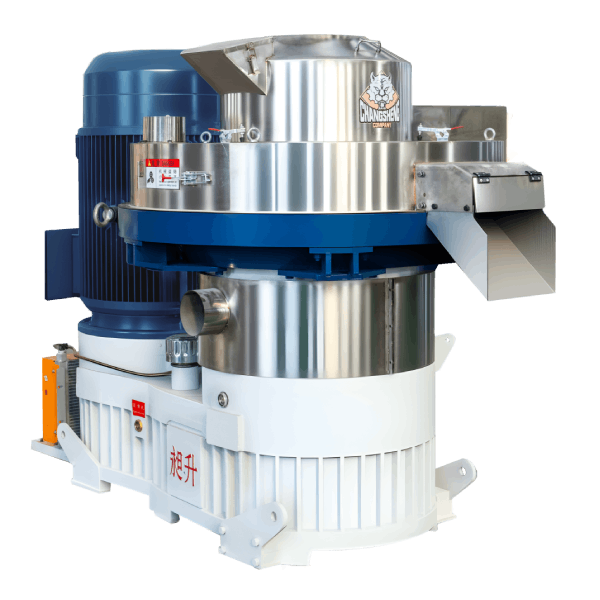
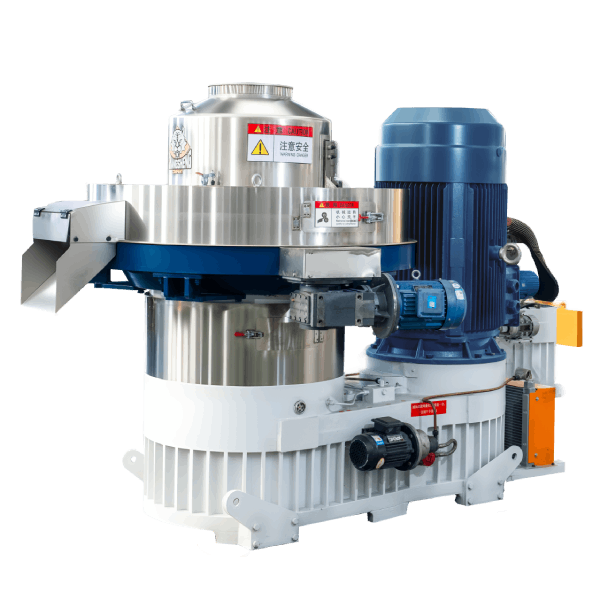
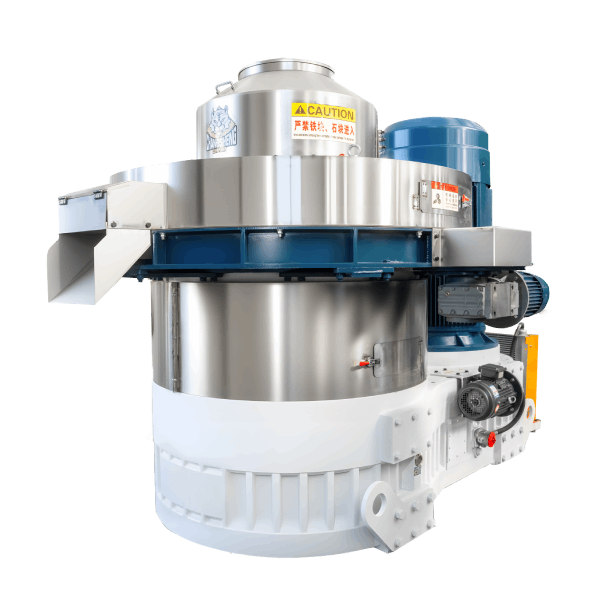
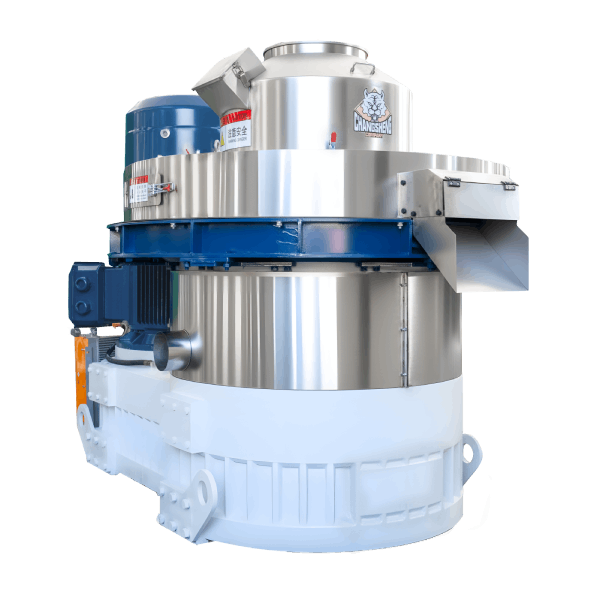
A flat die wood pellet machine is a vertical press system that compresses sawdust, wood shavings, and small wood chips into cylindrical pellets using a stationary flat die and rotating rollers for small-scale fuel production.
2. Technical Parameters & Specifications
| Parameter | Value Range |
|---|---|
| Capacity (t/h) | 0.05 – 0.5 |
| Main Motor Power (kW) | 7.5 – 37 |
| Flat Die Diameter (mm) | 200 – 500 |
| Finished Pellet Diameter (mm) | 6, 8, 10 |
| Finished Pellet Density (kg/m³) | 900 – 1,100 |
| Raw Material Moisture Content (%) | 10 – 20 (optimal: 13–16) |
| Energy Consumption (kWh/t) | 70 – 120 |
| Core Wear Parts Life (die + rollers, hours) | 500 – 1,000 |
| Monthly Maintenance Man-hours (hours/month) | 4 – 8 |
For accurate pricing: Request a quotation with your target capacity and available power supply (single-phase or three-phase).
3. Structure & Material Composition
Mechanical System (Compression Zone)
- Flat die: Forged GCr15 bearing steel or 45# carbon steel with heat treatment, hardness HRC 48–54
- Roller assembly: High-chromium cast iron (Cr12MoV) with bearing support, hardness HRC 55–60
- Main shaft: 40Cr alloy steel, quenched and tempered
Supporting System (Base & Housing)
- Gearbox housing: Cast iron HT250
- Base frame: Welded Q235B steel channel
- Guarding: Steel sheet with safety interlock
Lubrication System
- Roller bearings: Grease lubrication (manual or auto), interval 4–6 hours
- Gearbox: Oil bath (ISO VG 150), oil change every 500 hours
Control System
- Manual or simple PLC controller (depending on model)
- Overload protection with thermal relay
- Optional inverter for speed control
4. Manufacturing Process (Engineering Steps)
Step 1 – Raw Material Grinding
Equipment: Hammer mill with 4-6mm screen
Control: Achieve 95% particle size passing 6mm
Parameters: Tip speed 60-80 m/s
Step 2 – Moisture Adjustment
Equipment: Ribbon mixer or manual mixing
Control: Adjust moisture to 13-16% using water spray
Parameters: Mixing time 15-20 minutes for small batches
Step 3 – Feeding into Pelletizing Chamber
Equipment: Gravity hopper or manual feed
Control: Maintain consistent feed rate to avoid motor overload
Parameters: Feed rate 50-500 kg/h depending on model
Step 4 – Pelletizing Through Flat Die
Equipment: Flat die and roller assembly
Control: Die temperature 70-90°C (natural friction), roller gap 0.2-0.5 mm
Parameters: Specific compression force 10-20 kN
Step 5 – Natural Cooling & Screening
Equipment: Open tray or simple rotary screener
Control: Cool pellets to ambient temperature; remove fines
Parameters: Cooling time 30-60 minutes
5. Industry Comparison
| Parameter | Flat Die Wood Pellet Machine | Ring Die Pellet Mill | Hammer Mill Only | Briquette Press |
|---|---|---|---|---|
| Typical capacity (t/h) | 0.05–0.5 | 0.5–5 | N/A (grinding only) | 0.1–0.8 |
| Initial equipment cost | $2,000 – $15,000 | $25,000 – $150,000 | $1,000 – $5,000 | $5,000 – $30,000 |
| Output density (kg/m³) | 900–1,100 | 1,000–1,300 | N/A | 900–1,100 |
| Wear parts life (hours) | 500–1,000 | 1,500–2,500 | 500–1,500 (hammers) | 800–1,500 |
| Power requirement | Single or three-phase | Three-phase only | Single or three-phase | Three-phase typically |
| Target user | Farm, small business, home | Industrial plant | Pre-processing only | Small business |
| Why Choose Shandong Changsheng | Lower entry cost, single-phase options, simpler maintenance | Higher output, lower cost per ton | Incomplete solution | Different output form (briquettes) |
Compare flat die vs. ring die pricing: Request a cost-per-ton analysis for your production volume.
6. Application Scenarios (By Buyer Role)
Distributors / Importers
Stocking flat die wood pellet machine price points for entry-level customers (farms, small workshops). Decision focus: single-phase availability, container quantity (20-50 units per container), and parts commonality.
EPC Contractors
Rarely specify flat die for industrial lines. However, may include for pilot plants or small-scale demonstration facilities (<200 t/year). Decision focus: low capital commitment.
Engineering Consultants / Technical Advisors
Advising small farms or woodworking shops on flat die wood pellet machine price vs. outsourcing pellet purchases. Decision focus: payback period (typically 6-12 months for 50 t/year).
End-user Facilities (Farms, small sawmills, workshops, home users)
Operating 500-1,500 hours annually with personal or staff labor. Decision focus: ease of operation, single-phase compatibility, and local parts availability.
7. Core Technical Pain Points & Engineering Solutions
Pain Point 1 – Low Output Consistency
Problem: Hourly output varies by 30-50% depending on operator feed rate and material moisture.
Root cause: Manual feeding without VFD control or automated feed system.
Solution: Add a small variable-frequency screw feeder (adds $800-1,500). Alternatively, install a current meter visible to operator with target range marked.
Pain Point 2 – Frequent Roller Bearing Failure
Problem: Roller bearings seize every 200-300 hours, requiring disassembly.
Root cause: Dust ingress past basic seals and inadequate greasing frequency.
Solution: Upgrade to sealed bearings (2RS type) and install centralized grease points. Reduce greasing interval to 2-3 hours for dusty conditions.
Pain Point 3 – Die Hole Polishing Loss
Problem: After 400-500 hours, pellets become loose and low density.
Root cause: Die holes lose internal polishing due to abrasive wood fibers.
Solution: Re-polish die holes using a die reconditioning tool (available for $200-500). Replace die after 2-3 re-polishing cycles.
Pain Point 4 – Motor Overload on Startup
Problem: Motor trips breaker or blows fuse when starting with cold material.
Root cause: Starting under full hopper load without soft starter.
Solution: Install soft starter or VFD ($300-800). Train operator to start empty, then add material gradually over 2-3 minutes.
8. Risk Warnings & Mitigation Strategies
Risk 1 – Underpowered Motor for Hardwood
Warning: Flat die wood pellet machine price often includes minimum motor size (7.5kW). Hardwood (oak, maple) requires 50% more power than softwood.
Mitigation: Specify motor 1.5x larger than supplier recommendation for hardwood. Request motor current test with your actual wood type before acceptance.
Risk 2 – Gearbox Failure from Contamination
Warning: Gearbox oil becomes contaminated with wood dust within 200 hours, causing gear wear and noise.
Mitigation: Install breather filter on gearbox vent. Change oil every 500 hours maximum (or 300 hours for dusty conditions). Use magnetic drain plug to capture metal particles.
Risk 3 – Unsafe Electrical Connections
Warning: Low-priced flat die machines often ship with undersized wires or non-certified electrical components (no CE/UL).
Mitigation: Verify wire gauge matches motor amperage + 25%. Replace supplied plug with local certified version. Install separate thermal overload relay set at motor FLA.
9. Procurement Selection Guide (6 Actionable Steps)
Step 1 – Calculate your annual pellet requirement
Estimate tons per year. Below 50 t/year: flat die suitable. Above 100 t/year: ring die becomes more economical due to lower cost per ton.
Step 2 – Verify power availability
Check if you have three-phase power. Single-phase flat die wood pellet machine price is higher for same capacity (requires capacitor start). Maximum single-phase capacity: 0.1 t/h.
Step 3 – Select die material based on wood type
GCr15 hardened die ($300-800) for softwood (pine, fir). 45# carbon steel die ($150-400) for mixed wood. Avoid unknown alloys.
Step 4 – Compare complete system price
Request flat die wood pellet machine price including: motor, die (one set), rollers (two sets), and electrical panel. Excluded: hammer mill, cooler, conveyor.
Step 5 – Verify parts availability locally
Ask supplier for die and roller dimensions. Confirm these match local suppliers or standard sizes (e.g., 200mm, 300mm, 400mm diameter). Avoid proprietary sizes.
Step 6 – Negotiate spare parts kit with initial order
Purchase one spare die and two spare roller sets with machine (typical discount: 15-20% when bundled). Request 1-year warranty on gearbox, 90 days on die and rollers.
10. Engineering Case Study
Project Background: A small furniture workshop in Poland generated 15 tons/month of pine and oak sawdust. They wanted to produce their own pellets for shop heating (80 tons/year).
Initial Problem: The owner purchased a flat die wood pellet machine priced at $2,800 (7.5kW, 200mm die, no VFD). After 3 months, actual output was 35 kg/h (vs. claimed 80 kg/h). Die lasted 300 hours. Roller bearings failed twice.
Root Cause Analysis:
- Machine was undersized for oak content (30% of sawdust)
- No moisture meter — operator ran material at 22% moisture
- Manual feed caused frequent motor overload trips
- Cheap die (45# carbon steel) without proper hardening
Solution Implemented (Shandong Changsheng):
- Upgraded to 15kW model with 300mm die ($5,200 including VFD and spare die)
- Added moisture meter ($120) and trained operator on 13-16% target
- Installed small screw feeder ($900) for consistent feed rate
- Purchased GCr15 hardened die ($480) as spare
Final Data Results (12 months operation):
- Stable output: 68-72 kg/h (verified monthly)
- Die life: 850 hours (GCr15 die)
- Energy consumption: 95 kWh/t average
- Annual pellet production: 72 tons (90% of target)
- Payback period: 9 months (saving $6,000/year vs. purchased pellets)
Request a sizing consultation: Contact engineering team with your monthly sawdust volume and wood species.
11. FAQ
Q1: What is the typical flat die wood pellet machine price range for 100 kg/h capacity?
$2,500 – $4,500 depending on motor size (7.5-11kW), die material, and included VFD.
Q2: Can a flat die machine run on single-phase power?
Yes, up to 0.1 t/h capacity. Single-phase flat die wood pellet machine price is 10-20% higher than three-phase for same motor power due to capacitor start components.
Q3: How long does a flat die typically last for softwood?
800-1,000 hours for GCr15 hardened die with proper moisture (13-16%). Reduce by 50% for hardwood.
Q4: What is the difference between flat die and ring die price?
Flat die: $2,000-15,000. Ring die: $25,000-150,000. Flat die is suitable for under 100 tons/year; ring die for over 500 tons/year.
Q5: Does the price include a hammer mill for grinding?
Typically no. Hammer mill adds $1,500-4,000 depending on capacity. Some suppliers offer combo packages at 10-15% discount.
Q6: How much electricity does a flat die machine use per ton?
70-120 kWh/t (higher than ring die’s 45-75 kWh/t due to lower efficiency). At $0.12/kWh, electricity cost per ton: $8.40-14.40.
Q7: Can I produce animal feed pellets with the same machine?
Yes, with a separate die (smaller holes, different compression ratio). Request feed die option when ordering.
Q8: What is the typical delivery time for flat die machines?
15-30 days for standard models. Custom voltage or single-phase motors add 10-15 days.
Q9: Are spare parts readily available?
Depends on die size. Common sizes (200mm, 300mm, 400mm) are stocked by many suppliers. Avoid 250mm, 350mm proprietary sizes.
Q10: What warranty is typical for flat die wood pellet machines?
12 months on gearbox and main shaft. 3 months on die and rollers (wear parts). Read warranty carefully — some exclude labor.
Q11: Can I upgrade from flat die to ring die later?
No. Complete different machine architecture. Plan capacity needs before purchase.
Q12: How often must I replace the die?
Every 500-1,000 operating hours depending on wood species and moisture control. Re-polishing extends life by 30-50%.
Q13: Is training included in the flat die wood pellet machine price?
Rarely. Video tutorials or phone support typical. On-site training costs $500-1,500 plus travel.
Q14: What maintenance is required daily?
Grease roller bearings (every 4-6 hours). Clean die surface. Check belt tension. Inspect for unusual noise.
Q15: Can I process green wood chips with a flat die machine?
No. Green wood requires drying to below 20% moisture. Flat die machines cannot handle high moisture efficiently.
12. Commercial Call-to-Action
For small business owners and farms: Request a flat die wood pellet machine quotation with your target capacity (kg/h) and power supply (single or three-phase).
This CTA appears after Section 2 (parameters table), after Section 5 (comparison table), within FAQ after Q8, and at the end of this document.
Ready to compare small-scale pellet production costs? Submit your monthly wood waste volume (tons) and wood species for a payback analysis.
Need a starter kit recommendation? Contact the small-scale equipment team for a complete package including hammer mill, pellet machine, and moisture meter.
To proceed: Send your inquiry via the contact form. Include your available power supply (voltage, phase), target output (kg/h), and primary wood type.
13. Author & E-E-A-T Credentials
Author: Zhang Wei
Small-Scale Equipment Specialist & Mechanical Engineer
- 11 years in small-scale pellet equipment design and application (2014–present)
- Advised on 200+ farm and small workshop installations across Europe, North America, and Southeast Asia
- Author of “Small-Scale Pellet Production Handbook” (China Machine Press, 2022)
- Member of the Biomass Thermal Energy Council (BTEC)
Affiliation: Shandong Changsheng Machinery Co., Ltd.
The author has directly tested flat die wood pellet machines across multiple wood species, documented wear life data, and consulted on appropriate sizing for farm and small business applications. All pricing data and performance specifications are derived from actual factory tests and field installations from 2020–2026.