Pellet Mill Motor Keeps Tripping: Causes and Checks
News 2026-10-26
A pellet mill motor that keeps tripping is usually telling you one of three things: the motor is drawing more current than the protection allows, the protection is set lower than the motor’s actual load, or the motor or the supply has a fault that produces a current the protection correctly detects. These three groups cover most trips, but a faulty protection device, a sensor error, or a loose connection can produce the same result, and these must be ruled out before the trip is assigned to one of the three. The trip is not the problem. The trip is the protection doing its job. Resetting the protection without finding the cause removes the protection from the fault, and the next event can damage the motor.
The first useful observation is when the trip happens. A trip on start-up, a trip after a period of normal running, and a trip under a load change are three different faults. A trip on start-up points to a start circuit, a supply, or a mechanical jam. A trip after normal running points to a gradual load rise, a die condition, or a motor cooling problem. A trip under a load change points to a feed surge or a material change.
This article covers how to identify which of the three fault groups applies, how the motor type and the starting method change what you see, how the protection type changes what the trip means, which checks to run before resetting, when to stop rather than reset again, and what to record before contacting a supplier.
Overload, Motor Fault, or Protection Fault
The three groups are separated by the current reading and by the timing of the trip.
| What you observe | Likely group | First check |
|---|---|---|
| Trip on start-up, current high before the motor reaches speed | Mechanical jam or start circuit fault | Die chamber, start circuit, supply voltage |
| Trip after normal running, current gradually rising | Overload from a die or feed condition | Die hole condition, feed rate, moisture |
| Trip immediately on start-up, current normal or low | Motor or supply fault | Supply voltage, winding resistance, contactor |
| Trip at a current below the motor rating | Protection setting fault | Protection setting against the nameplate |
| Trip with a hot motor and a normal current | Motor cooling or ambient fault | Motor ventilation, ambient temperature |
| Trip with an unbalanced current | Supply or winding fault | Voltage and current on each phase |
A trip at a current above the motor rating is a genuine overload and the load must be reduced or the cause must be found. A trip at a current below the motor rating is a protection setting problem, and the setting must be corrected against the nameplate and the manufacturer data. A trip at a current that is normal but with a hot motor points to a cooling or ambient problem, not an electrical fault.
Motor Type and Starting Method Change What You See
The symptom and the checks differ by motor type and starting method. The machine manual, the motor nameplate, and the control cabinet documentation take precedence over this section.
| Motor type | How the trip usually appears | What to check |
|---|---|---|
| Three-phase asynchronous motor | Trip with an unbalanced current or a phase loss; may trip on start-up if a phase is missing | Supply voltage on all phases, current balance, winding resistance |
| Single-phase motor | Trip on start-up, often with a failed capacitor or a centrifugal switch fault | Capacitor condition, centrifugal switch, winding resistance |
| Variable frequency drive motor | Trip may come from the drive overcurrent or stall protection rather than the motor | Drive fault code, output frequency, motor current from the drive display |
| Starting method | What changes in the trip behaviour | What to check |
|---|---|---|
| Direct-on-line | High locked-rotor current at each start attempt; a long start may trip the thermal relay | Current against nameplate, thermal protection setting, start time |
| Star-delta | Current is lower at start but the transition may fail if the timer or contactor is faulty | Timer setting, contactor condition, transition sequence |
| Soft starter | Start may be aborted before full torque is reached | Soft starter fault code, setting, bypass contactor |
| Variable frequency drive | Drive may trip on overcurrent before the motor reaches full torque | Drive fault code, current limit setting, ramp setting |
A single-phase motor with a failed capacitor trips on start-up, and the fix is the capacitor or the centrifugal switch, not the die chamber. A three-phase motor with a phase loss trips and draws unbalanced current, and the fix is the supply, not the drive. The checks differ, and the wrong first check wastes time.
The locked-rotor current of a motor is typically several times the rated current, and the exact multiple is stated on the motor nameplate and in the manufacturer data. A start that takes longer than the normal start time keeps the motor at locked-rotor current for longer, and the thermal relay trips because the heat accumulates faster than the motor can dissipate it.
Protection Type Changes What the Trip Means
Different protection devices respond to a trip differently, and the trip record should be read against the device.
| Protection device | How it responds | What the trip tells you |
|---|---|---|
| Thermal overload relay | Trips after a time delay proportional to the current | The current has been above the setting for long enough to heat the relay |
| Motor protection circuit breaker | Trips on current above the set threshold | The current exceeded the threshold, often quickly |
| Variable frequency drive overcurrent protection | Trips on current above the drive limit | The drive detected an overcurrent, which may be a motor fault or a load fault |
| Drive stall protection | Trips when the motor does not accelerate | The load is preventing acceleration, not necessarily an overcurrent |
| Phase failure relay | Trips on a missing or unbalanced phase | The supply is not delivering a balanced three-phase voltage |
A thermal relay trip and a drive overcurrent trip are not the same event. The thermal relay responds to sustained current, and the drive responds to a rapid current change. The trip record, the drive fault code, and the time to trip together identify which device acted and why.
Mechanical Overload
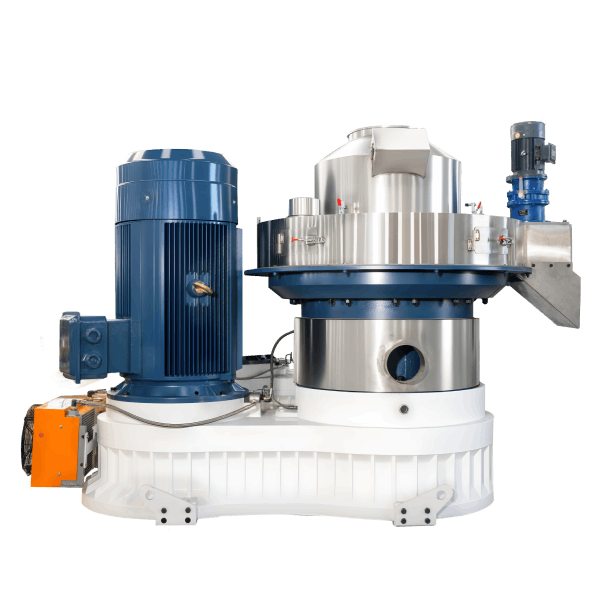
Why it trips: The die chamber is loaded above what the motor can drive. The causes are a feed rate above the die capacity, a partially blocked die, a moisture level that increases friction, or a foreign object in the die chamber. The current rises, the protection acts, and the motor stops.
What to check: Feed rate against motor current. Die hole condition. Moisture at the mill inlet. Die chamber contents with the power isolated.
What to do: Isolate the power and clear the jam if one is present. Reduce the feed rate and correct the moisture before restarting. Do not increase the protection setting to allow the machine to run through an overload, because the motor and the die both pay for it.
Motor and Supply Fault
Why it trips: The motor draws current that the protection correctly detects, but the cause is in the motor or the supply, not in the load. Causes include a phase loss, a winding fault, a failed capacitor on a single-phase motor, a contactor that is not closing fully, and a supply voltage that is too low or too high.
What to check: Supply voltage on all phases. Motor current on all phases. Contactor condition. Winding resistance where the manual permits. Capacitor condition on a single-phase motor.
What to do: Stop the machine and isolate the power. The electrical source must be inspected by a qualified electrical person. Do not reset the protection repeatedly on a motor fault, because each reset energises a faulty circuit.
Protection Setting Fault
Why it trips: The protection is set below the motor’s actual load, or the setting does not match the motor nameplate. The motor is running correctly, but the protection trips because the setting was never adjusted for the installation.
What to check: Protection setting against the motor nameplate full load amperage. Protection setting against the manufacturer data for the specific motor and the specific starting method. The setting should come from the motor nameplate, the motor manufacturer documentation, the control cabinet documentation, and the applicable electrical standard, not from a general figure.
What to do: Correct the setting to the nameplate and the manufacturer data. If the setting is below the nameplate value, correct it. If the setting matches the nameplate and the motor still trips, the cause is the load, and the setting must not be raised. Raising the setting on an overloaded motor removes the protection without removing the cause.
Motor Cooling and Ambient
Why it trips: The motor is drawing a normal current but cannot dissipate the heat it produces. The causes are a blocked motor fan cover, a dirty motor, a high ambient temperature, or an installation that does not provide the ventilation the motor requires.
What to check: Motor fan and fan cover. Motor surface condition. Ambient temperature against the motor rating. Ventilation around the motor.
What to do: Clean the motor and the fan cover. Restore the ventilation. If the ambient temperature is above the motor rating, the motor is undersized for the installation and the motor or the installation must be reviewed.
Checks Before Resetting the Protection
These checks should be made before the protection is reset, and the power should be isolated before any mechanical check.
| Check | What to record | What it tells you |
|---|---|---|
| Time to trip | From start or from the load change | Separates a start fault from a running fault |
| Motor current on each phase | Value against the nameplate | Confirms overload or detects an unbalance |
| Supply voltage on each phase | Value against the nameplate | Detects a phase loss or a voltage fault |
| Protection setting | Value against the nameplate and the manufacturer data | Detects a setting fault |
| Motor temperature | Value after cooldown | Confirms a cooling or ambient problem |
| Die chamber and feed condition | Jam, blockage, moisture, feed rate | Confirms a mechanical overload |
When to Stop Rather Than Reset
Stop the machine and do not reset the protection when any of the following applies.
| Condition | Action |
|---|---|
| Trip with an unbalanced current | Stop. Have the supply and the motor inspected by a qualified electrical person. |
| Trip with a burning smell or smoke from the motor | Stop immediately. Isolate power. |
| Trip with a protection setting below the motor rating | Stop. Correct the setting before restart. |
| Trip with a mechanical jam | Stop. Isolate power and clear the jam. |
| Trip that repeats after the cause has been corrected | Stop. The cause has not been found. |
Repeated resets on a fault that has not been corrected add heat to the motor and to the protection device, and they hide the trend that would identify the cause.
Damage Inspection After Repeated Trips
Repeated trips can damage the motor, the contactor, and the protection device.
| Component | What to check |
|---|---|
| Motor winding | Insulation resistance and winding resistance by a qualified electrical person |
| Motor bearing | Noise, temperature, lubricant condition |
| Contactor | Contact condition, pitting, coil condition |
| Thermal relay | Reset function, setting, calibration |
| Drive | Fault history, parameter settings, cooling |
| Supply | Voltage balance, connection tightness |
Whether the motor, the contactor, or the protection device needs replacement depends on the inspection result and the limits in the motor manufacturer data and the control cabinet documentation. Insulation resistance, bearing temperature and noise, contactor contact condition, thermal relay calibration, drive fault history, and voltage balance are the criteria. The limits are not universal and must come from those documents.
Restart After a Trip Fault
Confirm the following before returning to normal feed rate.
| Acceptance item | What to confirm |
|---|---|
| Motor current on each phase | Balanced and within the nameplate range at no load and at normal load |
| Supply voltage on each phase | Balanced and within the nameplate range |
| Protection setting | Correct against the nameplate and the manufacturer data |
| Motor temperature | Stable and within the motor rating |
| Die chamber and feed | Clear, with a stable feed rate |
| Noise and vibration | No abnormal sound or vibration |
| Output and pellet quality | Consistent with the normal production baseline |
If the trip repeats after these items are confirmed, stop and record the conditions before contacting the supplier. A repeat trip after a confirmed correction is a different fault from the first trip.
Frequently Asked Questions
Why does the motor trip immediately on start-up?
An immediate trip on start-up points to a start circuit fault, a supply fault, a mechanical jam, or a motor fault. The current reading and the supply voltage separate them. A jam should be cleared with the power isolated before another start is attempted.
Can I increase the protection setting to stop the tripping?
Only if the setting is below the motor nameplate rating. If the setting matches the nameplate and the motor still trips, the cause is the load, and raising the setting removes the protection without removing the cause. The setting should come from the motor nameplate, the manufacturer documentation, and the applicable electrical standard.
Why does the motor trip after running for a while?
A trip after normal running usually points to a gradual load rise, such as a partial die blockage, a feed change, or a moisture change. It can also point to a motor cooling problem when the motor heats up over time. The current trend and the die condition separate the two.
What is the difference between a thermal relay trip and a drive overcurrent trip?
A thermal relay trips after a sustained current above the setting. A drive overcurrent trip responds to a rapid current change. The trip record and the drive fault code identify which device acted.
When should I call an electrician instead of a mechanic?
When the current is unbalanced, when the supply voltage is abnormal, when there is a burning smell from the motor or the panel, or when the protection setting needs to be changed. These are electrical causes and should be inspected by a qualified electrical person.
Get Diagnostic Support for Your Pellet Mill
Send the machine model, the motor nameplate data, the protection device type and setting, the current and voltage readings on each phase, the time to trip, the starting method, the die and feed condition, and the motor temperature at the time of the trip. A diagnostic review can be prepared against the machine and the operating conditions rather than against a general checklist.
Motor protection settings, current limits, voltage limits, and acceptance criteria in this article must be confirmed against the machine manual, the motor nameplate, the control cabinet documentation, and the applicable electrical standards. This article does not provide universal values for these items.