Pellet Mill Buyer Guide: Step-by-Step Procurement Process
News 2026-09-18
Buying a pellet mill is not a single decision—it is a process. The buyers who get the best results are the ones who follow a structured approach: define requirements, specify the machine, evaluate suppliers, compare quotes properly, control contract risk, and manage delivery and commissioning.
This guide is written for procurement managers, importers, project engineers, and business owners who are buying a pellet mill for the first time or who want a more disciplined process. It provides a seven-stage procurement framework, practical checklists, and the procurement mistakes that most often lead to underperformance or disputes.
This guide does not repeat technical explanations of how a pellet mill works. It assumes you already know what a pellet mill does. The focus is on how to buy one correctly.
The Pellet Mill Buying Process at a Glance
Seven Stages from Needs Assessment to Production
| Stage | Activity | Typical Duration |
|---|---|---|
| 1 | Define requirements | 2–4 weeks |
| 2 | Choose machine type | 1–2 weeks |
| 3 | Prepare technical specification | 1–2 weeks |
| 4 | Identify and evaluate suppliers | 3–6 weeks |
| 5 | Compare quotes and negotiate | 2–4 weeks |
| 6 | Contract and payment terms | 1–2 weeks |
| 7 | Manufacturing, inspection, delivery | 8–16 weeks |
| 8 | Installation and commissioning | 2–6 weeks |
Total timeline from decision to production is typically 4–9 months, depending on machine complexity and site readiness.
Who Should Be Involved in the Decision
A pellet mill purchase affects production, maintenance, finance, and operations. The decision should involve:
- Procurement: Supplier evaluation, contract terms, payment
- Engineering/Technical: Specification, machine selection, commissioning
- Operations: Capacity requirements, operating pattern, maintenance capability
- Finance: Budget, payment terms, ROI evaluation
A purchase made by procurement alone, without technical input, often results in a machine that does not match the actual production requirements.
Stage 1: Define Your Requirements
Feedstock Assessment
Before anything else, confirm what you will feed the machine. The feedstock determines machine type, die specification, drying requirements, and capacity.
Confirm:
- Material type (wood, agricultural residue, feed ingredients, etc.)
- Moisture content (as received and target)
- Particle size (as received and required)
- Contamination risk
- Annual and peak availability
If you cannot confirm feedstock characteristics, the specification is incomplete.
Capacity Calculation
Capacity should be based on actual production requirements, not on a target that sounds good.
Required capacity = Daily production requirement ÷ Effective operating hours
Consider:
- Daily production target (tonnes or kg)
- Operating hours per day (accounting for maintenance and changeover)
- Seasonal variation
- Future growth
Do not size for peak demand only. A machine running at 70–80% of rated capacity typically achieves better die life and pellet quality than one running intermittently at full capacity.
Power Supply and Site Constraints
Confirm before specifying:
- Available voltage, frequency, and phase
- Total connected load capacity
- Space available for machine and auxiliary equipment
- Access for delivery and installation
- Dust collection and ventilation provisions
Electrical configuration is one of the most common sources of delay and additional cost. Confirm it early.
End Product Specification
Define the end product:
- Pellet diameter (mm)
- Pellet durability target
- Moisture content target
- Fines content limit
- Certification or quality standard (if applicable)
Different end uses require different pellet specifications. Export markets may require certification (ENplus, PFI, etc.), which affects die selection, feedstock preparation, and quality control.
Requirement Definition Checklist
- Feedstock type and characteristics confirmed
- Moisture content measured
- Capacity requirement calculated
- Power supply confirmed
- Site space and access confirmed
- End product specification defined
- Budget range established
Complete this checklist before contacting suppliers. Suppliers cannot provide accurate quotes without this information.
Stage 2: Choose the Right Machine Type
Ring Die vs Flat Die: Decision Criteria
The two main types of pellet mills are ring die and flat die. The choice depends on capacity, operating pattern, pellet quality requirements, and budget.
| Factor | Flat Die | Ring Die |
|---|---|---|
| Capacity | 30–500 kg/h | 500 kg/h – 10 t/h+ |
| Continuous operation | Limited | Better suited |
| Pellet quality | Moderate | High, consistent |
| Die life | 300–600 hours | 800–1,500 hours |
| Capital cost | Lower | Higher |
| Maintenance | Simple | More specialized |
When Flat Die Is the Right Choice
- Small-scale production (under 500 kg/h)
- On-farm or workshop use
- Pilot or trial production
- Limited capital budget
- Simple maintenance capability
- Intermittent operating pattern
When Ring Die Is the Right Choice
- Commercial or industrial production
- Continuous operation (8+ hours per day)
- Consistent pellet quality required
- Higher capacity (500 kg/h+)
- Export or certification requirements
- Automated production line integration
Machine Type Decision Table
| Your Situation | Recommended Type |
|---|---|
| Small farm, intermittent use | Flat die |
| Workshop, pilot production | Flat die |
| Commercial production, 1 t/h+ | Ring die |
| Export market, certification required | Ring die |
| Continuous operation, 8+ hours/day | Ring die |
Stage 3: Prepare a Technical Specification
What to Include in the Specification
A complete technical specification includes:
- Capacity (t/h or kg/h) at specified feedstock and moisture
- Machine type (ring die or flat die)
- Die specification (diameter, compression ratio, material)
- Roller specification (number, material, hardness)
- Motor power, voltage, frequency, phase
- Drive system (gearbox, belt, direct)
- Control system (manual, semi-auto, PLC)
- Safety devices (overload, emergency stop, temperature)
- Auxiliary equipment (feeder, conditioner, cooler)
- Documentation and certification requirements
Die and Roller Requirements
Specify die compression ratio based on feedstock:
- Softwood: 1:5 to 1:6
- Hardwood: 1:6 to 1:8
- Agricultural residues: varies; may require higher ratio and wear-resistant material
Specify roller material and hardness to match die.
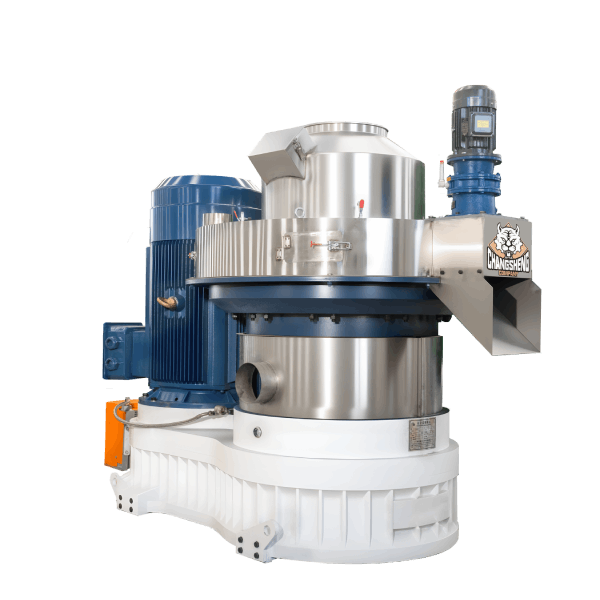
Motor and Drive Requirements
Specify:
- Motor brand and power rating
- Voltage, frequency, and phase
- Protection class and insulation class
- Gearbox brand and configuration
- Bearing brand
These specifications directly affect reliability, energy consumption, and maintenance cost.
Control and Safety Requirements
Specify:
- Control type (manual, semi-auto, PLC)
- Overload protection
- Emergency stop
- Temperature and current monitoring
- Dust and fire safety provisions
Safety devices are not optional. Include them in the specification.
Specification Template
| Item | Specification |
|---|---|
| Capacity | [ ] t/h at [ ]% moisture |
| Machine type | Ring die / Flat die |
| Die specification | Diameter [ ] mm; compression ratio [ ] |
| Roller specification | Number [ ]; material [ ] |
| Motor | [ ] kW; [ ] V; [ ] Hz; [ ] phase |
| Drive | Gearbox / Belt |
| Control | Manual / Semi-auto / PLC |
| Safety | Overload; E-stop; Temperature |
| Auxiliary | Feeder; Conditioner; Cooler |
| Documentation | Manual; Test report; Certification |
Use this template as the basis for your request for quotation. A complete specification produces comparable quotes.
Stage 4: Identify and Evaluate Suppliers
Where to Find Suppliers
- Industry trade shows and exhibitions
- B2B platforms and directories
- Industry associations and referrals
- Existing equipment suppliers
- Direct search for manufacturers in target regions
Supplier Evaluation Criteria
| Criterion | What to Check |
|---|---|
| Manufacturing capability | Factory equipment, production capacity |
| Quality control | Process, records, testing |
| Technical capability | Engineering staff, customization |
| References | Similar installations, contactable customers |
| After-sales support | Response time, spare parts, training |
| Financial stability | Ability to honor warranty and long-term support |
Factory Audit Checklist
- Manufacturing equipment and process
- Quality control records
- Material certificates for critical components
- Assembly and testing procedures
- Production capacity vs order volume
- Reference installations
Reference Checks
Ask for references from:
- Similar material type
- Similar capacity
- Similar operating conditions
- Contactable customers
Contact references directly. Ask about machine performance, support responsiveness, and any issues.
Supplier Scoring Matrix
| Criterion | Weight | Supplier A | Supplier B | Supplier C |
|---|---|---|---|---|
| Technical capability | 25% | |||
| Manufacturing quality | 20% | |||
| References | 15% | |||
| After-sales support | 15% | |||
| Price | 15% | |||
| Delivery time | 10% | |||
| Total | 100% |
Score each supplier on a consistent scale (e.g., 1–5). The highest total score is not always the winner—weighting should reflect your project priorities.
Stage 5: Compare Quotes and Negotiate
How to Normalize Quotes for Comparison
Quotes are often not directly comparable. Normalize before comparing:
- Capacity at the same feedstock and moisture
- Scope: what equipment is included?
- Spare parts: included or separate?
- Commissioning: included or additional?
- Warranty: duration and coverage
- Delivery terms (Incoterms)
What to Compare Beyond Price
| Item | Why It Matters |
|---|---|
| Die and roller material | Affects die life and operating cost |
| Motor and gearbox brand | Affects reliability and maintenance |
| Control system | Affects labor and consistency |
| Spare parts list | Affects downtime and operating cost |
| Warranty terms | Affects risk |
| After-sales support | Affects uptime |
| Delivery time | Affects project schedule |
Total Delivered Cost Calculation
Total delivered cost = Machine price + Freight + Duties + Electrical modifications + Installation + Commissioning + Spare parts + Training
A lower machine price with a narrower scope may be more expensive overall.
Negotiation Points
- Spare parts included in initial purchase
- Extended warranty
- Commissioning and training included
- Payment terms
- Delivery schedule
- Performance guarantee
Quote Comparison Template
| Item | Supplier A | Supplier B | Supplier C |
|---|---|---|---|
| Machine price | |||
| Scope included | |||
| Die and roller | |||
| Motor and gearbox | |||
| Control system | |||
| Spare parts | |||
| Warranty | |||
| Delivery time | |||
| Payment terms | |||
| Total delivered cost |
Stage 6: Contract and Payment Terms
What the Contract Should Include
- Complete technical specification
- Scope of supply
- Delivery schedule and Incoterms
- Payment terms
- Inspection and testing requirements
- Performance guarantees
- Warranty terms
- After-sales support commitments
- Dispute resolution mechanism
Payment Terms and Risk
Standard payment terms typically include:
- Deposit (20–30%) on order
- Progress payment (30–40%) before shipment
- Balance (30–40%) after commissioning or against documents
Avoid full prepayment. Paying 100% before production removes your leverage if issues arise.
Performance Guarantees
Request performance guarantees tied to:
- Capacity at specified feedstock and moisture
- Pellet quality (durability, density)
- Power consumption
Performance guarantees should be verified during commissioning.
Inspection and Testing Clauses
Include the right to:
- Factory testing before shipment
- Third-party inspection
- Test with your material (or similar)
- Access to test reports and video
Warranty and After-Sales Terms
Confirm:
- Warranty duration and coverage
- Spare parts availability and lead time
- Technical support response time
- Training included or additional
Stage 7: Manufacturing, Inspection, and Delivery
Factory Testing and Inspection
Before shipment, confirm:
- Machine assembled and tested
- Test with your material (or similar)
- Power consumption measured
- Pellet quality verified
- Test report and video provided
If on-site inspection is not possible, arrange third-party inspection.
Shipping and Documentation
Confirm:
- Incoterms (FOB, CIF, DDP)
- Packing suitable for ocean transport
- Shipping documents (invoice, packing list, bill of lading)
- Certificate of origin
- Compliance documentation (CE, UKCA, etc. as applicable)
Customs and Import
Confirm:
- Duty rates and tariff classification
- Import license requirements (if any)
- Customs clearance process
- Local transport from port
Receiving and Unpacking
On receipt:
- Inspect for shipping damage
- Check against packing list
- Document any issues with photos
- Report damage to supplier and insurer immediately
Installation, Commissioning, and Handover
Site Preparation
Before installation:
- Foundation completed and cured
- Power supply connected
- Dust collection ductwork installed
- Material handling access clear
- Spare parts and tools on site
Installation Supervision
Confirm:
- Installation drawings provided
- Remote or on-site supervision available
- Alignment and leveling procedures
- Electrical connection and verification
Commissioning and Performance Test
Commissioning sequence:
- Mechanical inspection
- Electrical verification
- Dry run without material
- First material feed and parameter adjustment
- Moisture and quality testing
- Performance test at rated capacity
- Operator training
- Handover
Operator Training
Training should cover:
- Start-up and shutdown procedures
- Normal operating parameters
- Die and roller inspection
- Lubrication and maintenance
- Troubleshooting common issues
- Safety procedures
Handover Documentation
Confirm receipt of:
- Operation and maintenance manual
- Electrical diagrams
- Spare parts list
- Commissioning report
- Warranty documentation
Common Procurement Mistakes and How to Avoid Them
Selecting on Price Alone
The lowest-priced machine may have shorter die life, higher energy consumption, or inadequate support. Compare total cost of ownership, not machine price.
Incomplete Specification
A vague specification produces vague quotes that cannot be compared. Define feedstock, capacity, moisture, power, and end product before requesting quotes.
Ignoring Electrical Configuration
Equipment configured for a different voltage or frequency requires modification. Confirm electrical requirements before ordering.
No Performance Guarantee
Without a performance guarantee, there is no recourse if the machine does not achieve rated output. Request guarantees tied to material testing.
Underestimating Installation Requirements
Installation, foundation, electrical, and dust collection are often underestimated. Budget for them from the start.
Pellet Mill Buyer Guide: Master Checklist
Requirements Phase
- Feedstock type and characteristics confirmed
- Moisture content measured
- Capacity requirement calculated
- Power supply confirmed
- Site space and access confirmed
- End product specification defined
- Budget range established
Supplier Phase
- Multiple suppliers identified
- Technical specification prepared
- Quotes requested with complete specification
- Supplier capability evaluated
- References contacted
- Factory audit completed (or remote verification)
Contract Phase
- Quotes normalized and compared
- Total delivered cost calculated
- Contract terms reviewed
- Payment terms agreed
- Performance guarantees included
- Warranty and after-sales terms confirmed
Delivery and Commissioning Phase
- Factory testing arranged
- Shipping and documentation confirmed
- Customs and import process planned
- Site preparation completed
- Installation supervision arranged
- Commissioning and performance test scheduled
- Operator training planned
- Handover documentation received
FAQ
What is the first step in buying a pellet mill?
Define your requirements: feedstock, capacity, moisture, power supply, and end product specification. Without this information, you cannot prepare a meaningful specification or compare quotes.
How do I choose between ring die and flat die?
Ring die is for commercial production (500 kg/h+), continuous operation, and consistent pellet quality. Flat die is for small-scale, intermittent, or pilot production. The choice depends on capacity, operating pattern, and budget.
How many suppliers should I compare?
Compare at least three suppliers. More than five is usually not productive. Focus on suppliers with relevant references and capability, not just the lowest price.
How do I compare quotes from different suppliers?
Normalize capacity, scope, spare parts, commissioning, and warranty before comparing price. Calculate total delivered cost, not just machine price.
What payment terms are standard for pellet mill purchases?
Typical terms: 20–30% deposit on order, 30–40% before shipment, 30–40% after commissioning. Avoid full prepayment.
What should be included in the contract?
Technical specification, scope of supply, delivery schedule, payment terms, inspection and testing requirements, performance guarantees, warranty terms, after-sales commitments, and dispute resolution.
How do I verify machine quality before shipment?
Request factory testing with your material (or similar), test reports, power consumption data, and video. Arrange third-party inspection if on-site inspection is not possible.
What documents should I receive at handover?
Operation and maintenance manual, electrical diagrams, spare parts list, commissioning report, and warranty documentation.
What is the most common mistake in pellet mill procurement?
Selecting on price alone and using an incomplete specification. Both lead to machines that do not match requirements and quotes that cannot be compared.
How long does the procurement process take?
From decision to production, typically 4–9 months, depending on machine complexity, manufacturing schedule, shipping, and site readiness.
About the Author
Zhang Wei – Senior International Sales Engineer, Shandong Changsheng Machinery Co., Ltd.
Zhang Wei has over 12 years of experience in the pellet mill industry, with a background in mechanical engineering and international project execution. He has supported procurement processes for wood, biomass, and feed pellet projects across Europe, Southeast Asia, the Middle East, Africa, and the Americas.
With hands-on experience in both the manufacturing workshop and client-side operations, Zhang brings practical insights into pellet mill procurement—from requirement definition and supplier evaluation to contract negotiation, inspection, and commissioning.