Pellet Mill Canada: How to Choose a Pellet Mill for Canadian Biomass
News 2026-08-07
Canada has one of the most developed wood pellet industries in the world, supported by abundant forestry resources and growing demand for renewable heating and export fuel. For Canadian buyers—whether you are a sawmill owner, farmer, small commercial producer, or industrial project developer—selecting the right pellet mill depends on your specific raw material, moisture conditions, capacity target, and power supply.
This guide is written for Canadian buyers who need to make a practical equipment decision. It covers material-specific configuration, capacity selection, supplier comparison, compliance considerations, and the questions you should ask before committing to a purchase.
Pellet Mill Applications in Canada
Canada’s biomass resources are diverse, and different raw materials require different pellet mill configurations. The table below summarizes common Canadian feedstock and the processing implications.
| Raw Material | Typical Moisture | Particle Size | Processing Focus | Pellet Mill Configuration |
|---|---|---|---|---|
| Sawmill sawdust | 25–50% | Fine to medium | Drying + screening | Ring die or flat die; dryer essential |
| Wood chips | 30–50% | Oversized | Crushing + grinding + drying | Ring die; hammer mill upstream |
| Forestry residues | 30–55% | Variable | Crushing + grinding + drying | Heavy-duty ring die; robust preparation |
| Agricultural residues | 15–30% | Variable | Grinding + possibly drying | Ring die with wear-resistant die |
| Softwood (pine, spruce, fir) | 25–50% | Fine to medium | Drying + grinding | Standard configuration; natural lignin aids binding |
| Hardwood (oak, maple, birch) | 20–45% | Fine to medium | Drying + grinding | Higher compression ratio; more die wear |
The key principle: material properties determine equipment configuration. A system designed for dry softwood sawdust will not perform well with wet wood chips or abrasive agricultural residues. Understanding your material—moisture content, particle size, fiber structure, hardness—is the first step in selecting the right pellet mill.
Hardwood typically requires a higher compression ratio and more motor power than softwood. Softwood’s higher natural lignin content aids binding, while hardwood may require finer grinding and tighter die specifications.
Why Material-Specific Configuration Matters in Canada
Canadian producers work with a wide range of materials depending on region and industry. A sawmill in British Columbia processing softwood sawdust has different requirements from a farm in Alberta processing agricultural residues or a forestry operation in Quebec handling mixed wood chips.
Each material affects:
- Drying capacity: Higher moisture requires larger dryers and more energy.
- Grinding requirements: Oversized material requires crushing and grinding before pelletizing.
- Die selection: Harder, more abrasive materials require wear-resistant dies and higher compression ratios.
- Pellet quality: Lignin content, fiber structure, and ash content affect pellet durability and density.
Matching the pellet mill to the actual material is the foundation of a successful installation.
How to Choose a Pellet Mill for Canadian Wood Materials
Use the following checklist to define your requirements before contacting suppliers. Each factor affects equipment selection and must be confirmed with material testing.
| Decision Factor | What to Determine | Why It Matters |
|---|---|---|
| Raw material | Softwood, hardwood, chips, sawdust, agricultural residues | Determines die type and compression ratio |
| Moisture content | Actual moisture as received and target after drying | Determines dryer size and energy consumption |
| Feed particle size | Initial size and required size before pelletizing | Determines crushing and grinding equipment |
| Pellet diameter | 6 mm, 8 mm, or other | Determines die specification |
| Required capacity | kg/h or t/h based on feedstock and operating hours | Determines pellet mill size and motor power |
| Continuous operating hours | Hours per day and days per week | Determines whether single or multiple lines are needed |
| Motor and power supply | Voltage, frequency, phase available on site | Determines motor selection and electrical configuration |
| Ring die or flat die | Based on capacity and pellet quality requirements | Determines machine type and cost |
| Spare parts | Die, roller, bearings availability and lead time | Determines downtime risk |
| Installation and service | Remote or on-site support availability | Determines commissioning and long-term support |
Canadian buyers should confirm each of these factors with the supplier before purchase. Suppliers who cannot provide material-specific answers or test data are a procurement risk, regardless of price.
Power Supply Considerations in Canada
Canadian electrical configurations vary by province and site. Common industrial voltages include 600V, 480V, and 240V, with 60 Hz frequency. Equipment manufactured for other markets may be configured for 380V/50Hz, which requires transformer or motor replacement.
Confirm the following before ordering:
- Available voltage and phase at your site
- Frequency (60 Hz in Canada)
- Motor control and starter compatibility
- CSA or equivalent certification for electrical components
Electrical configuration is one of the most common sources of delay and additional cost in imported equipment projects. Confirm it early.
Pellet Mill Capacity for Canadian Buyers
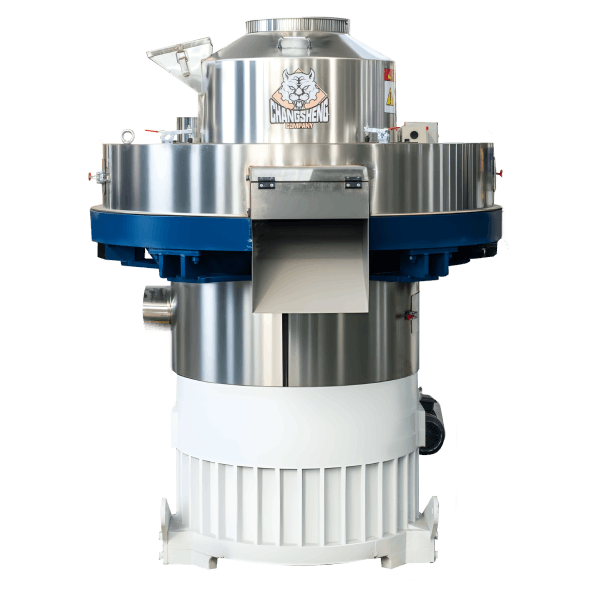
Capacity selection should be based on your actual feedstock availability and operating hours, not on a generic price table. The table below provides indicative capacity ranges for common Canadian applications.
| Application | Typical Capacity | Operating Hours | Line Configuration |
|---|---|---|---|
| Small farm / workshop | 100–300 kg/h | 2–8 hours/day | Flat die; manual or semi-auto |
| Small commercial | 500 kg/h | 8–16 hours/day | Flat die or small ring die; semi-auto |
| Commercial (medium) | 1 t/h | 8–20 hours/day | Ring die; complete line |
| Commercial (large) | 2 t/h | 16–20 hours/day | Ring die; automated line |
| Industrial (small) | 3 t/h | 20+ hours/day | Ring die; fully automated line |
| Industrial (large) | 5 t/h+ | 20+ hours/day | Multiple lines; integrated control |
Actual output depends on raw material characteristics, moisture content, and target pellet quality. Always confirm capacity with the supplier based on your specific material and operating conditions.
Matching Capacity to Feedstock
Do not size the pellet mill larger than your reliable feedstock supply. Intermittent operation wastes energy and accelerates wear. A pellet mill running consistently at 70–80% of rated capacity typically achieves better die life and pellet quality than one running intermittently at full capacity.
For Canadian sawmills and woodworking operations, feedstock supply is often the limiting factor. Measure your actual waste generation over a representative period before selecting equipment.
Buying a Pellet Mill from China vs Canada: Why Canadian Buyers Compare Local Suppliers With Chinese Manufacturers
Canadian buyers typically compare three sourcing routes: local Canadian distributors, US suppliers, and direct import from Chinese manufacturers. Each route has different trade-offs. Rather than assuming one option is always cheaper, evaluate the following factors for your specific project.
| Factor | Local Canadian Supplier | Direct Import from China |
|---|---|---|
| Machine price | Higher | Typically lower, but varies by specification, capacity, and configuration. Compare total delivered cost, not machine price alone. |
| Shipping | Included or local delivery | Ocean freight, port charges, inland transport |
| Import duties | None (local stock) | Applicable duties and taxes |
| Electrical configuration | CSA/ULC compliant | Must specify voltage, frequency, certification |
| Installation | Local support available | Remote or third-party support |
| Spare parts | Readily available | Lead time from manufacturer |
| Warranty | Canadian service | International warranty terms |
| Remote commissioning | Not applicable | Increasingly common; requires preparation |
| Factory testing | Not applicable | Can be arranged; verify with video or third party |
| Sample testing | Not typically offered | Can be arranged with raw material samples |
What to Evaluate Before Choosing a Source
The decision between local purchase and direct import depends on:
- Total delivered cost: Include machine price, shipping, duties, electrical modifications, and installation.
- Timeline: Local stock delivers quickly; direct import requires 6–12 weeks or more.
- Technical support: Local suppliers offer immediate support; direct import requires remote support or third-party arrangements.
- Customization: Direct import allows specification to your material and power supply.
- Risk tolerance: Direct import requires more due diligence and project management.
Neither option is universally better. The right choice depends on your project requirements, budget, timeline, and willingness to manage the import process.
Reducing Risk in Direct Import
Canadian buyers who choose direct import can reduce risk by:
- Requesting material testing with your actual raw material
- Confirming electrical configuration in writing
- Requesting factory test video before shipment
- Arranging third-party inspection if needed
- Confirming spare parts availability and lead time
- Clarifying warranty terms and remote support process
Compliance Considerations for Pellet Mills in Canada
Electrical equipment sold or installed in Canada must meet applicable safety standards. The primary requirement is CSA certification, with ULC and ETL as accepted alternatives in many applications.
| Standard | Requirement | Applicability |
|---|---|---|
| CSA | Electrical safety | All electrical equipment |
| ULC | Canadian certification | Equipment and components |
| ETL | Accepted alternative to CSA | Electrical equipment |
| CSA B365 | Biomass combustion | Heating equipment (if applicable) |
| ISO 9001 | Quality management | Supplier quality system |
Imported equipment may require field evaluation or modification to meet Canadian electrical standards. Confirm certification requirements with your local electrical authority before purchase. Retrofitting for compliance is expensive and delays commissioning.
For producers targeting export markets, ENplus or PFI certification may be required by the pellet buyer. Confirm quality requirements with your offtake partner before selecting equipment.
For wood pellet quality, Canadian producers may follow ENplus, PFI, or other certification schemes depending on the target market. Confirm quality requirements with your pellet buyer before selecting equipment.
Questions to Ask Before Buying a Pellet Mill in Canada
The following questions help Canadian buyers evaluate suppliers and confirm equipment suitability. Ask these before committing to a purchase.
- Can you test my raw material?
- What moisture range does the machine require?
- What output can you achieve with my material?
- What pellet diameter can you produce?
- What is the die compression ratio for my material?
- What is the rated motor power and actual power consumption per tonne?
- What motor voltage and frequency is available?
- What spare parts are included?
- How long does die and roller replacement normally take?
- Can you provide remote commissioning?
- Can I visit your factory?
- Can you provide a test video using my raw material?
Suppliers who can answer these questions with specific, material-based responses are more likely to deliver equipment that performs as expected. Suppliers who provide only generic answers or standard specifications should be evaluated with additional caution.
Procurement Checklist for Canadian Buyers
Needs Assessment
- Raw material identified and sampled
- Moisture content measured
- Capacity requirement defined based on actual feedstock
- Power supply confirmed (voltage, frequency, phase)
- Budget established including duties and installation
Supplier Evaluation
- Multiple suppliers compared
- Material test report requested
- Electrical configuration confirmed in writing
- Spare parts availability and lead time confirmed
- Warranty terms and remote support clarified
- References contacted
Compliance
- CSA/ULC/ETL certification confirmed
- Documentation available
- Wood pellet quality requirements confirmed with buyer
Final Decision
- Total delivered cost calculated
- Delivery date confirmed
- Installation and commissioning plan agreed
- Payment terms reviewed
Frequently Asked Questions
1. Where can I buy a pellet mill in Canada?
Canadian buyers can purchase from local distributors, US suppliers, or directly from overseas manufacturers. Local distributors offer faster delivery and local support; direct import typically offers lower machine cost but requires more project management.
2. What capacity pellet mill do I need for my operation?
Capacity depends on your feedstock availability, operating hours, and target output. A small farm or workshop may need 100–300 kg/h; a commercial operation may need 1–2 t/h; industrial projects may require 3–5 t/h or more. Confirm with material testing.
3. How do I compare the total cost of a local pellet mill versus direct import?
Compare machine price, shipping, import duties, electrical modifications, installation, spare parts, and warranty support. The lowest machine price does not always produce the lowest total delivered cost. Evaluate all factors for your specific project.
4. What certifications are required in Canada?
CSA certification is the primary requirement for electrical equipment. ULC and ETL are accepted alternatives in many applications. Confirm requirements with your local electrical authority.
5. What raw materials can be pelletized in Canada?
Common Canadian feedstocks include sawmill sawdust, wood chips, forestry residues, softwood, hardwood, and agricultural residues. Each material requires different equipment configuration.
6. Do Canadian suppliers offer support and spare parts?
Canadian distributors typically offer local support, installation assistance, and readily available spare parts. Direct import requires remote support or third-party arrangements, and spare parts may have longer lead times.
7. What power supply do I need for a pellet mill?
Canadian industrial power is typically 600V, 480V, or 240V at 60 Hz. Confirm motor voltage and frequency before ordering. Imported equipment may require transformer or motor replacement.
8. Can I test my raw material before buying a pellet mill?
Yes. Reputable suppliers offer material testing to confirm equipment performance, pellet quality, and actual output with your specific feedstock. Always request a test report before purchase.
9. How long does delivery take?
Local stock can deliver within days to weeks. Direct import from overseas typically takes 6–12 weeks or more, depending on manufacturing schedule, shipping, and customs clearance.
10. What should I ask a pellet mill supplier before buying?
Ask about material testing, moisture requirements, actual output with your material, pellet diameter, die compression ratio, motor power and power consumption, electrical configuration, spare parts, die replacement time, remote commissioning, factory visits, and test video availability.
About the Author
Zhang Wei – Senior International Sales Engineer, Shandong Changsheng Machinery Co., Ltd.
Zhang Wei has over 12 years of experience in the biomass pelletizing equipment industry, with extensive experience supporting Canadian wood and agricultural biomass projects. His background in mechanical engineering and international project execution has helped clients across British Columbia, Quebec, Alberta, and Ontario evaluate and select pellet mills for wood and biomass materials.
With hands-on experience in both the manufacturing workshop and client-side operations, Zhang brings practical insights into successful equipment procurement—from material testing and electrical configuration to commissioning and long-term support.