Automatic Lubrication System for Pellet Mill: Complete Buyer’s Guide
News 2026-07-14
Page SEO Summary: This technical guide helps procurement professionals and maintenance engineers evaluate automatic lubrication systems for pellet mills—covering system types, component selection, installation considerations, and the return on investment compared to manual lubrication methods.
Every pellet mill operator has experienced the same scenario: a scheduled production run interrupted by an unexpected bearing failure, followed by hours of downtime, a costly replacement, and the nagging question of whether proper lubrication could have prevented the failure.
For a pellet mill, lubrication is not a minor maintenance detail—it is a critical operational function. The main shaft bearings, roller bearings, and drive components operate under extreme loads and in challenging environments characterized by heat, dust, and continuous operation. The difference between a pellet mill that runs reliably for 8,000 hours between major overhauls and one that fails every 2,000 hours often comes down to one factor: the quality and consistency of lubrication.
This guide provides procurement professionals and maintenance engineers with a comprehensive framework for evaluating automatic lubrication systems for pellet mills—from understanding the technology to specifying the right configuration for specific operating conditions.
The True Cost of Inadequate Lubrication
Before evaluating automatic lubrication systems, it is essential to understand the cost implications of manual or inadequate lubrication. These costs are often hidden in maintenance budgets, production losses, and premature component replacement.
Direct Costs of Manual Lubrication
| Cost Category | Annual Impact (Typical 10 t/h Mill) | Calculation Basis |
|---|---|---|
| Lubricant consumption (manual over-greasing) | $1,500–$2,500 | 30–50% waste due to over-application |
| Labor cost for lubrication rounds | $3,000–$6,000 | 2–3 hours per shift × 2 shifts × 365 days |
| Bearing replacement (premature failure) | $3,000–$12,000 | 1–3 main shaft bearing failures per year |
| Production loss during bearing failure | $15,000–$60,000 per event | 8–24 hours downtime × line output value |
Hidden Costs of Manual Lubrication
Beyond direct expenses, manual lubrication creates additional operational risks:
- Human error variability: Different operators apply different amounts of grease, at different intervals, using different techniques
- Contamination risk: Manual greasing introduces opportunities for dust and debris to enter bearing housings
- Access limitations: Some lubrication points on a pellet mill are difficult to reach safely, leading to skipped lubrication
- Inconsistent intervals: Production pressures often cause maintenance rounds to be rushed or postponed
- Documentation gaps: Without automatic recording, maintenance history is often incomplete
Real-World Engineering Experience: In a survey of pellet mill maintenance records across feed mills, approximately 65% of unscheduled bearing replacements were attributed to lubrication-related issues—either insufficient grease, contaminated grease, or incorrect grease type.
Understanding Automatic Lubrication Systems for Pellet Mills
An automatic lubrication system delivers precise quantities of lubricant to designated points at programmed intervals while the equipment is operating. The system eliminates the need for manual greasing, ensures consistent lubricant delivery, and can provide real-time monitoring of system status.
Core System Components
| Component | Function | Selection Criteria |
|---|---|---|
| Grease pump | Pressurizes and delivers lubricant from reservoir | Pressure rating; flow rate; reservoir capacity |
| Progressive distributor | Divides flow to multiple lubrication points | Number of outlets; metering accuracy; pressure rating |
| Control unit | Manages timing, cycles, and monitoring | Programming flexibility; alarm outputs; communication capability |
| Feed lines | Transports lubricant from distributor to points | Inner diameter; pressure rating; material compatibility |
| Fittings and connectors | Connect lines to lubrication points | Thread type; size; material |
| Level sensors and alarms | Monitor lubricant level and system pressure | Reliability; integration with plant control system |
System Operating Principle
An automatic lubrication system operates on a simple but precisely controlled sequence. The pump draws lubricant from the reservoir and pressurizes it to the required operating pressure—typically 200 to 400 bar for progressive systems. This pressurized lubricant flows through the main line to the distributor block, where internal metering pistons divide the flow into measured volumes for each outlet line.
Each outlet delivers a precise quantity of lubricant—typically 0.1 to 1.0 cm³ per cycle—to the connected lubrication point. The control unit activates the pump at programmed intervals, ranging from every few minutes to once per shift, depending on the lubrication requirements of each point.
The system’s logic ensures that all lubrication points receive lubricant in sequence. If any distributor outlet becomes blocked, the entire distributor stops, triggering an alarm that alerts maintenance personnel to the fault.
Automatic Lubrication System Types: Configuration Comparison
Three primary system configurations are available for pellet mill applications. The selection depends on the number of lubrication points, required pressure, and integration with existing equipment.
Type 1: Single-Line Parallel System
How It Works: A single main line carries pressurized lubricant to each lubrication point through individual branch lines. Each branch line is equipped with a metering valve that delivers a measured amount of lubricant.
| Characteristic | Detail |
|---|---|
| Typical operating pressure | 200–300 bar |
| Number of lubrication points | Up to approximately 20 points |
| Ideal for | Small to medium pellet mills with moderate lubrication needs |
| Advantages | Simple design; easy to diagnose; lower initial cost |
| Limitations | Each point needs individual metering; longer lines increase pressure drop |
Type 2: Progressive (Series) System
How It Works: Lubricant flows through a series of distributor blocks in sequence. Each piston in the distributor advances only after the previous piston has completed its stroke, ensuring all points receive lubricant in a precise, measured sequence.
| Characteristic | Detail |
|---|---|
| Typical operating pressure | 250–400 bar |
| Number of lubrication points | Up to approximately 40 points |
| Ideal for | Most industrial pellet mill applications |
| Advantages | Positive displacement—each point receives exactly the metered amount; built-in fault detection (system stops if any line blocks) |
| Limitations | Higher initial cost than single-line; requires specific distributor configuration |
Type 3: Dual-Line Parallel System
How It Works: Two main lines carry lubricant alternately. The system pressurizes one line to deliver lubricant to all points connected to it, then switches to the second line. This design allows for longer lubrication line runs and larger systems.
| Characteristic | Detail |
|---|---|
| Typical operating pressure | 200–400 bar |
| Number of lubrication points | Up to 100+ points |
| Ideal for | Very large pellet mills or multiple mills sharing a system |
| Advantages | Can handle large numbers of points; long line runs; excellent for high-pressure applications |
| Limitations | Highest cost; most complex design; more points of potential failure |
Recommended Configuration for Pellet Mills
For the majority of industrial pellet mill applications, the progressive (series) system provides the optimal balance of reliability, cost, and monitoring capability. The positive displacement feature ensures each lubrication point receives its intended volume, and the inherent fault detection—the system stops cycling if any blockage occurs—prevents dry running of any bearing.
The single-line system may be appropriate for smaller pellet mills with fewer lubrication points and for retrofitting older equipment where space constraints limit distributor installation.
Pellet Mill Lubrication Points: Understanding the Requirements
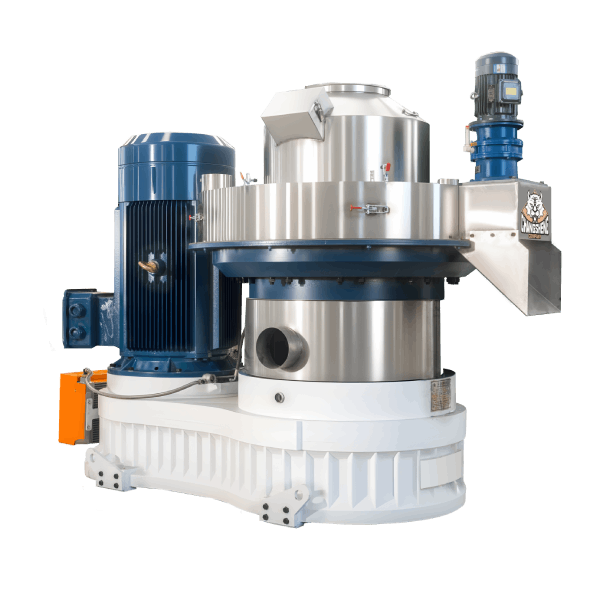
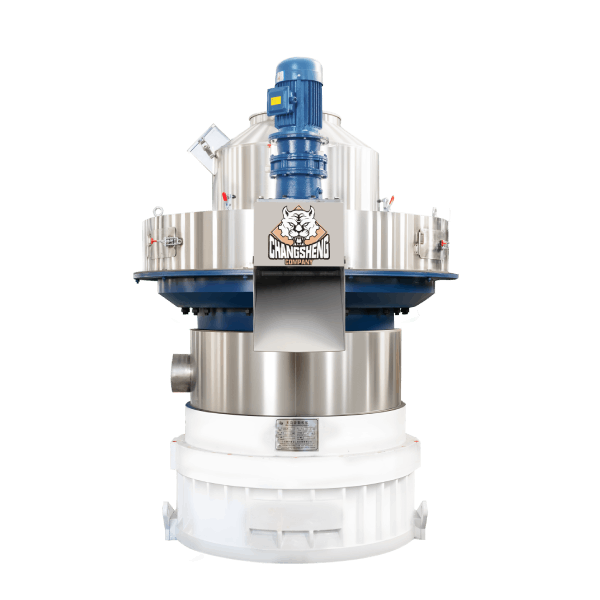
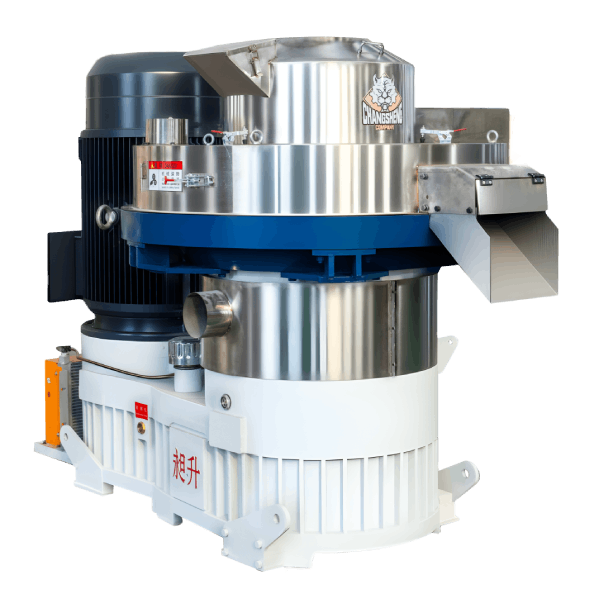
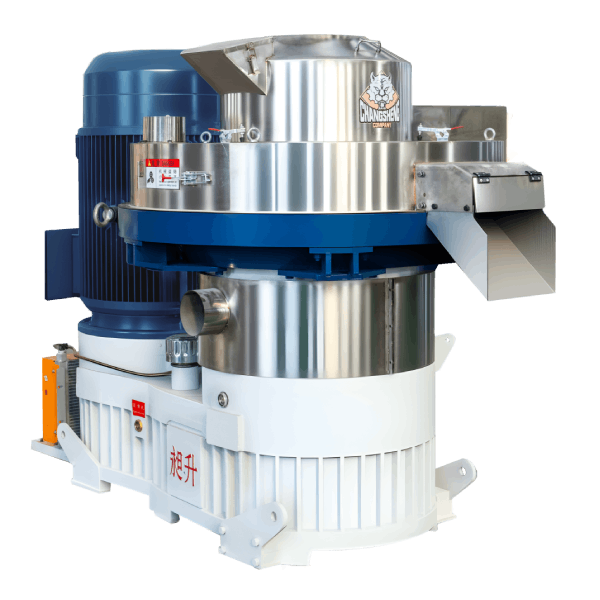
A typical ring die pellet mill requires lubrication at multiple points, each with different lubrication frequency and volume requirements.
Lubrication Points by Location
| Lubrication Point | Recommended Grease Type | Typical Volume per Cycle | Recommended Interval |
|---|---|---|---|
| Main shaft (drive side) | Lithium complex EP2 | 2.0–4.0 cm³ | Every 2–4 hours |
| Main shaft (fan side) | Lithium complex EP2 | 2.0–4.0 cm³ | Every 2–4 hours |
| Roller shaft bearings (×2) | Lithium complex EP2 | 1.0–2.0 cm³ | Every 2–4 hours |
| Bypass/tension shaft (if applicable) | Lithium complex EP2 | 1.0–2.0 cm³ | Every 4–8 hours |
| Gearbox output shaft (additional point) | Lithium complex EP2 | 1.0–2.0 cm³ | Every 8 hours |
Technical Note: Grease specification should follow the pellet mill manufacturer’s recommendation. For most industrial applications, an NLGI Grade 2 lithium-complex grease with EP additives and good oxidation stability is suitable. For high-temperature operation (above 100°C at the bearing housing), consider a synthetic grease with higher dropping point.
Quantifying System Requirements
A 10 t/h ring die pellet mill with a 110 kW motor typically requires the automatic lubrication system to serve 5 to 7 lubrication points. The total lubricant consumption depends on operating hours and programmed intervals.
Calculation Example:
- 5 lubrication points
- Average volume per point per cycle: 2.5 cm³
- 2 cycles per hour
- 16 hours per day operation
- Total daily consumption: 5 × 2.5 × 2 × 16 = 400 cm³ per day
- Reservoir capacity required: minimum 5–7 days (2.0–2.8 liters)
Key Technical Specifications for Procurement Evaluation
When evaluating automatic lubrication systems for pellet mill applications, the following specifications are critical decision factors.
1. Operating Pressure Rating
| Pressure Range | Suitability |
|---|---|
| Below 200 bar | Suitable for single-line systems only; insufficient for progressive distributors |
| 200–300 bar | Standard range; adequate for most progressive systems on 5–7 point mills |
| 300–400 bar | Required for longer line runs; provides margin for cold start and line resistance |
Recommendation: Specify a pump and distributor rated for at least 300 bar to provide adequate pressure for all operating conditions, including cold startup and extended line lengths.
2. Reservoir Capacity
Larger reservoirs reduce refilling frequency but require more space and add initial cost.
| Reservoir Size | Refilling Interval (16 hr/day operation) | Suitability |
|---|---|---|
| 2 liters | 5–7 days | Adequate for small mills |
| 4 liters | 10–12 days | Preferred for most industrial mills |
| 8 liters | 20–25 days | Recommended where access is limited |
Procurement Advice: Specify a reservoir with an integral low-level alarm. This provides advance warning before lubricant depletion, preventing system shutdown due to empty reservoir.
3. Distributor Material and Construction
| Material | Advantages | Limitations |
|---|---|---|
| Carbon steel | Lower cost | Prone to corrosion; not suitable for moist environments |
| Stainless steel | Corrosion resistant | Higher cost; better for pellet mill environment |
| Hardened steel with coating | Wear resistant | Moderate cost; suitable for most applications |
Recommendation: For pellet mill applications where moisture and steam are present, specify stainless steel distributors and components. The incremental cost is justified by longer service life and reduced maintenance.
4. Control Unit Capabilities
The controller is the intelligence of the automatic lubrication system. Evaluate:
- Programming flexibility: Can intervals be programmed independently for different zones?
- Monitoring capability: Does the system provide pressure monitoring and flow verification?
- Alarm outputs: Does it provide dry contacts or communication protocols (Modbus, Profibus) for connection to plant DCS?
- Diagnostics: Can the controller identify which distributor outlet is blocked?
- Power supply: Is it compatible with plant voltage (24VDC, 110VAC, 220VAC)?
Installation Considerations: Beyond the Equipment
The success of an automatic lubrication system depends not only on component quality but also on proper installation. Procurement professionals should ensure these installation considerations are addressed in the supplier’s proposal.
Line Routing and Protection
- Lubrication lines should be routed away from moving components and heat sources
- Lines should be securely clamped to prevent vibration-induced wear
- Protective sleeves or conduit should be used where lines cross walkways or high-traffic areas
- Minimum bend radius for nylon tubing is typically 5× the tube diameter
Fitting Selection
| Fitting Type | Application | Advantage |
|---|---|---|
| Compression fittings | Standard connections | Secure; suitable for high pressure |
| Push-to-connect fittings | Quick connections | Easy installation; lower pressure rating |
| Threaded adapters | Connecting to existing ports | Essential for retrofit applications |
Pre-commissioning Checks
Before the system is placed into service, the following checks should be completed:
- All lines and fittings inspected for leaks under pressure
- Each lubrication point verified to receive the correct lubricant volume
- Controller programming confirmed for each point’s interval and volume
- Alarm functions tested (low level, low pressure, distributor fault)
- System documented with line routing diagram and point schedule
Return on Investment Analysis
The investment in an automatic lubrication system is typically recovered within 12 to 24 months through reduced maintenance costs, lubricant savings, and increased production uptime.
Sample ROI Calculation (10 t/h Pellet Mill)
Assumptions:
- 2-shift operation (16 hours/day, 300 days/year)
- Manual lubrication currently requires 3 hours per shift
- Current average bearing failure: 2 per year (6 hours downtime each)
- Production line value: $200/hour contribution
| Factor | Before (Manual) | After (Auto) | Annual Savings |
|---|---|---|---|
| Lubricant consumption | $2,000 | $1,200 | $800 |
| Labor cost (lubrication) | $6,000 | $500 | $5,500 |
| Bearing replacement cost | $6,000 | $1,000 | $5,000 |
| Production loss from failures | $12,000 | $2,000 | $10,000 |
| Total annual savings | $21,300 |
Total system investment (typical): $6,000–$15,000
Payback Period: 4 to 9 months, depending on system complexity
Note: These calculations are based on typical operational data. Actual savings vary based on labor rates, production value, and current failure rates. For plants experiencing higher failure rates, the payback period is shorter.
Procurement Decision Checklist
Use this checklist to evaluate automatic lubrication system proposals for pellet mill applications.
System Specifications
- Operating pressure: Is the pump rated for at least 300 bar?
- Reservoir capacity: Is it adequate for plant operating schedule?
- Distributor type: Progressive system selected for positive displacement?
- Distributor material: Stainless steel specified for pellet mill environment?
- Number of outlets: Adequate for all required lubrication points?
- Control unit: Programmable intervals, alarms, communication capability?
Installation and Support
- Installation scope: Does the supplier provide line routing and installation?
- Commissioning: Is system start-up and verification included?
- Documentation: Are line diagrams and point schedules provided?
- Training: Is operator and maintenance training included?
- Spare parts: Are spare distributor sections and fittings recommended?
Commercial Terms
- Price quoted: Full system including all components, lines, and fittings?
- Warranty: Typical 12–24 months on system components?
- Technical support: Availability of remote or on-site support?
Frequently Asked Questions
1. Is an automatic lubrication system worth the investment for a pellet mill?
For pellet mills operating on a continuous schedule (two or three shifts per day), the return on investment is typically achieved within 6 to 12 months. The primary benefits are reduced bearing failures, elimination of manual greasing labor, and improved operational reliability.
2. Which type of automatic lubrication system is best for a pellet mill?
The progressive (series) system is recommended for most pellet mill applications. It ensures each lubrication point receives its exact metered volume and provides automatic fault detection—if any line blocks, the system stops and alarms, preventing dry bearings.
3. Can an automatic lubrication system be retrofitted to an existing pellet mill?
Yes. Retrofitting is common and often more cost-effective than purchasing a new mill with an integrated system. The primary considerations are access to lubrication points, space for the pump and reservoir, and routing for lubrication lines.
4. What happens if the automatic lubrication system fails?
Modern systems include alarm functions that alert operators to low pressure, empty reservoir, or distributor blockage. The control unit should be programmed to provide an immediate alarm when the system stops cycling, allowing maintenance personnel to respond before bearings run dry.
5. How often should the lubricant reservoir be refilled?
Refilling frequency depends on the reservoir size and the pellet mill’s lubrication consumption. A 4-liter reservoir on a typical 10 t/h mill operating 16 hours per day will typically require refilling every 10 to 12 days. Low-level alarms provide advance warning.
6. What type of grease should be used?
Follow the pellet mill manufacturer’s recommendation. For most industrial applications, an NLGI Grade 2 lithium-complex grease with extreme pressure additives is suitable. For high-temperature applications, synthetic greases with higher dropping points should be considered.
7. How do I know each lubrication point is actually receiving grease?
Progressive systems provide inherent verification—when any point is blocked, the distributor stops, triggering an alarm. Some advanced systems also include pressure transducers or flow sensors on individual lines for continuous monitoring.
8. What maintenance does the automatic lubrication system itself require?
Regular maintenance includes checking the reservoir level, inspecting lines for leaks or damage, cleaning the pump filter, and periodically checking distributor piston wear. With proper installation and routine monitoring, the system should operate for years with minimal intervention.
About the Author
Zhang Wei – Senior International Sales Engineer, Shandong Changsheng Machinery Co., Ltd.
Zhang Wei has over 12 years of experience in the biomass and feed pellet mill industry, with a background in mechanical engineering and international project execution. He has managed pellet mill supply projects for clients across Southeast Asia, the Middle East, Africa, Europe, and Latin America, overseeing everything from initial technical specification to production coordination, factory acceptance testing, and delivery logistics.
With hands-on experience in both the manufacturing workshop and client-side operations, Zhang brings practical insights into what drives successful international equipment procurement—from the factory floor to the customer’s production site.