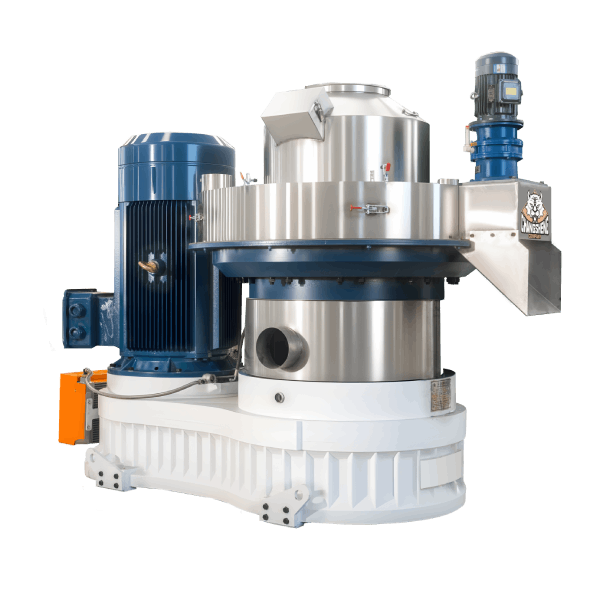
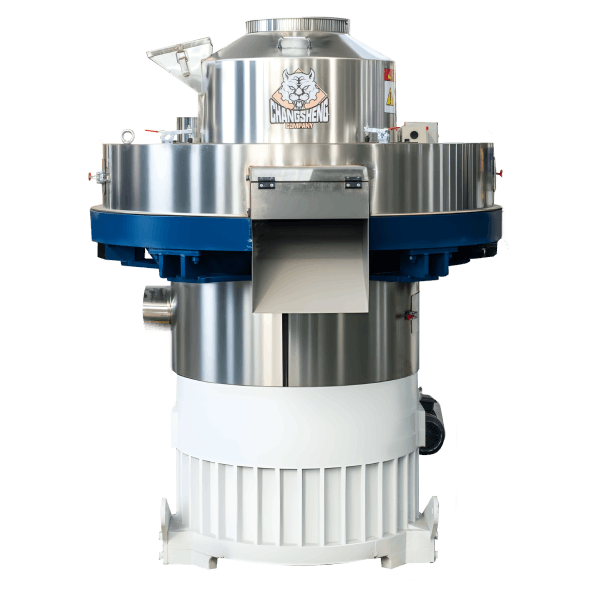
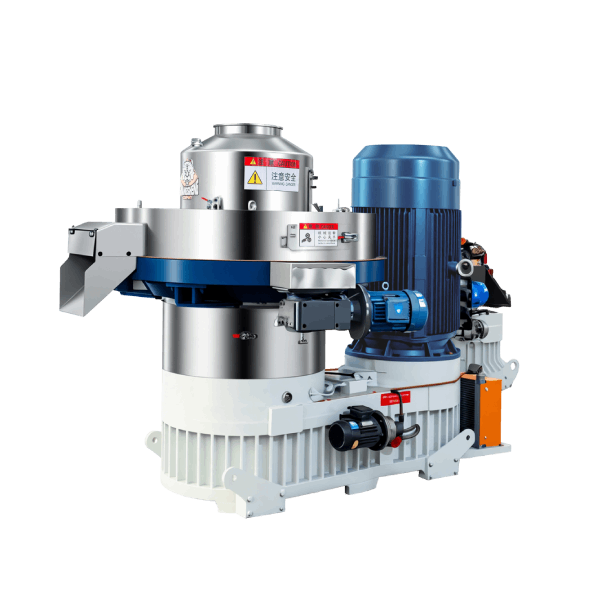
Pellet Mill with Magnetic Separator and Dust Collector 0.5-5t/h | Supplier Guide
News 2026-07-09
Product Definition
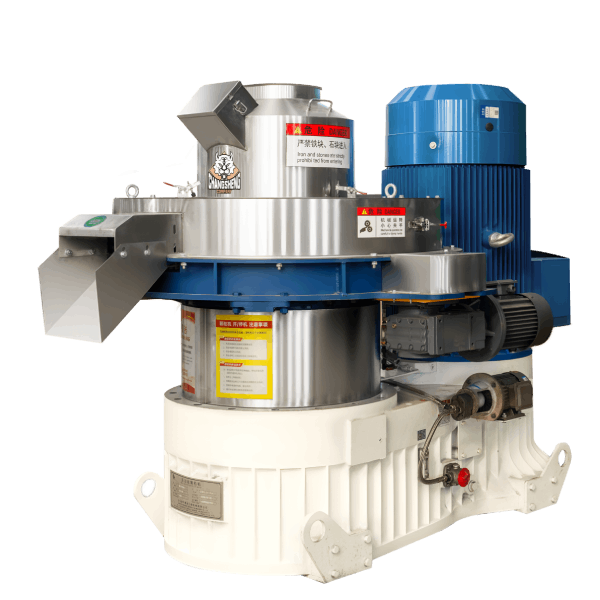
A pellet mill with magnetic separator and dust collector is a ring die compaction system equipped with integrated metal removal and dust control auxiliaries. The magnetic separator removes ferrous contaminants from feedstock to protect die and roller surfaces, while the dust collector captures airborne particles generated during grinding and pelletising, ensuring equipment protection and workplace safety.
Technical Specifications & Performance Parameters
| Parameter | Value Range / Specification |
|---|---|
| Throughput capacity | 0.5 – 5.0 t/h (feedstock-dependent) |
| Main motor power | 55 – 160 kW (IE3 / IE4 compatible) |
| Ring die inner diameter | 400 – 800 mm |
| Pellet diameter | 6 – 12 mm (customisable) |
| Pellet bulk density | 600 – 750 kg/m³ |
| Raw material moisture | 12% – 18% (optimal: 14% – 16%) |
| Magnetic separator strength | 10,000 – 12,000 Gauss |
| Dust collector efficiency | ≥ 99% particle capture |
| Specific energy consumption | 28 – 38 kWh/t |
| Die service life | 800 – 1,200 hours |
| Roller shell service life | 600 – 900 hours |
| Maintenance man-hours | 4 – 6 h / month |
Structural Composition & Material Selection
The integrated protection system pellet mill comprises four functional subsystems with defined material grades:
Mechanical System
- Ring die: Forged alloy steel (20CrMnTi) with carburised hardening layer (HRC 58–62)
- Roller shells: High-chromium cast iron (Cr26) with wear-resistant overlay
- Main shaft: Heat-treated 42CrMo4 steel with induction-hardened journals
- Gearbox: Helical-gear configuration, case-hardened to HRC 58–60
Magnetic Separation System
- Magnetic drum or grid: Neodymium-iron-boron (Nd-Fe-B) permanent magnets, 10,000–12,000 Gauss strength
- Housing: Stainless steel (304 grade), with inspection hatch for cleaning
- Placement: Upstream of pellet mill feed inlet
Dust Collection System
- Pulse-jet bag filter or cyclone separator: Captures fines from grinding and pelletising
- Filter media: Polyester or PTFE-coated bags, suitable for wood dust and feed fines
- Airflow: Matched to system capacity, with explosion venting for combustible dust
Support & Control Systems
- Bearing housings: Ductile cast iron (QT600-3) with precision-machined seating
- Base frame: Welded structural steel, stress-relief annealed
- PLC with HMI: Monitors magnet status and dust collector pressure drop
Manufacturing Process – Engineering Workflow
Step 1 – Raw Material Receiving & Magnetic Separation
Incoming feedstock passes through magnetic separator (10,000–12,000 Gauss) to remove ferrous metal fragments including nails, screws, and wire before material enters grinding stage.
Step 2 – Grinding & Dust Extraction
Material ground in hammer mill to 2.0–3.0mm for feed or 4.0–6.0mm for biomass. Pulse-jet dust collector captures airborne fines at transfer points, maintaining air quality and recovering material.
Step 3 – Conditioning & Steam Treatment
Double-shaft paddle conditioner with steam injection at 0.2–0.4 MPa. Retention time 45–60 seconds. Mash temperature elevated to 80–95°C.
Step 4 – Pelletising (Core Forming Process)
Main motor drives ring die rotation at 4–8 m/s peripheral speed. Roller gap maintained at 0.15–0.30 mm. Magnetic separator and dust collector operate continuously during pelletising.
Step 5 – Counterflow Cooling
Ambient air drawn counter-current through pellet bed. Retention time 6–10 minutes. Pellet exit temperature ≤ ambient +5°C. Final moisture ≤12%.
Step 6 – Final Screening & Packaging
Vibrating screener removes fines. Automatic bagging scale with ±0.2% tolerance. Dust collector continues operation at packaging points.
Industry Comparison – Protection System Options
| System Configuration | Metal Removal Efficiency | Dust Capture Efficiency | Equipment Protection | Typical Application |
|---|---|---|---|---|
| Magnetic Separator + Dust Collector | ≥99% | ≥99% | Comprehensive | Feed, biomass, wood pellet plants |
| Magnetic Separator Only | ≥99% | None | Partial – die only | Small farms, clean feedstock |
| Dust Collector Only | None | ≥99% | Partial – air quality only | Facilities with clean feedstock |
| No Protection System | None | None | None | High-risk, not recommended |
Differentiation (Shandong Changsheng Machinery):
Our integrated protection package combines high-strength magnetic separation (10,000–12,000 Gauss) with high-efficiency pulse-jet dust collection. The magnetic separator prevents ferrous metal damage to dies and rollers, extending component life. The dust collector captures airborne particles, reducing fire risk and maintaining workplace air quality.
Application Scenarios by Buyer Role
Distributors / Importers
Focus on protection system specification for customer safety and equipment longevity. Require magnetic strength and dust collector efficiency data.
EPC Contractors
Integrating protection systems into pellet plant layouts. Need airflow and magnetic separation specifications for system design.
Engineering Consultants / Technical Advisors
Evaluate protection system effectiveness for specific feedstocks. Require fire safety and air quality data for compliance.
End-user Production Facilities
Feed mills, biomass plants, and wood pellet facilities. Demand metal removal and dust control to protect equipment and personnel.
Core Pain Points & Engineering Solutions
Pain Point 1 – Metal contamination damaging dies and rollers
Root cause: Nails, screws, and wire fragments in feedstock score die holes and roller surfaces.
Solution: High-strength magnetic separator (10,000–12,000 Gauss) removes ferrous metal before pelletising – protecting dies and rollers.
Pain Point 2 – Dust accumulation creating fire and explosion risk
Root cause: Fine wood dust and feed fines accumulate in processing equipment and ducts.
Solution: Pulse-jet dust collector captures airborne particles at transfer points – reducing combustible dust accumulation.
Pain Point 3 – Dust emissions affecting operator health
Root cause: Airborne particles from grinding and pelletising exceed exposure limits.
Solution: High-efficiency dust collection maintains workplace air quality within safe limits.
Pain Point 4 – Product contamination from metal fragments
Root cause: Metal particles enter finished pellets – quality and safety issues.
Solution: Magnetic separation removes metal before pelleting, ensuring clean final product.
Critical Risk Warnings & Mitigation Measures
Risk 1 – Fire from dust accumulation in ductwork
Mitigation: Install spark detection and extinguishing systems. Schedule regular duct cleaning. Monitor dust collector pressure drop.
Risk 2 – Magnet overload from high metal content
Mitigation: Inspect magnetic separator daily. Remove captured metal. Install secondary magnet for high-risk feedstocks.
Risk 3 – Dust collector explosion from combustible dust
Mitigation: Install explosion vents. Ensure static grounding. Maintain proper airflow. Regular filter inspection.
Procurement Selection Guide – 7 Executable Steps
Step 1 – Analyse feedstock contamination risk
Identify potential metal contaminants and dust generation characteristics. Higher risk feedstocks require stronger protection.
Step 2 – Determine magnetic separator strength
10,000–12,000 Gauss for general applications. Higher strength for contaminated feedstocks.
Step 3 – Specify dust collector capacity
Match airflow to system capacity. Ensure capture at all dust-generating points (grinding, transfer, pelletising).
Step 4 – Verify filter media compatibility
Polyester for general applications. PTFE-coated for moist or sticky materials. Confirm temperature rating.
Step 5 – Confirm safety features
Explosion venting for combustible dust. Static grounding. Spark detection. Fire suppression.
Step 6 – Plan for maintenance access
Magnet cleaning access. Dust collector filter replacement. Pressure drop monitoring.
Step 7 – Establish inspection schedule
Daily magnet inspection and cleaning. Weekly dust collector check. Monthly filter inspection.
Engineering Case Study – Wood Pellet Plant in Canada
Project Background
A wood pellet plant in British Columbia processes 4.0 t/h of sawdust and shavings. Feedstock contains nails and wire fragments from recycled lumber.
Initial Problem
Metal contamination caused die damage every 400–500 hours – below target. Dust emissions exceeded workplace exposure limits. Fire incidents occurred twice in 18 months.
Root Cause Analysis
No magnetic separator installed – metal fragments scored die holes and roller surfaces. Dust collector undersized – airborne dust accumulation created fire risk.
Solution Implemented
Installed magnetic separator (12,000 Gauss) at feed inlet – removed 15–20 kg of metal fragments monthly. Upgraded dust collector with pulse-jet bag filters and explosion venting.
Final Data Results
| Metric | Before | After |
|---|---|---|
| Die service life | 450 h | 1,100 h |
| Metal fragments removed | 0 kg/month | 18 kg/month |
| Workplace dust levels | Above limit | Within safe limits |
| Fire incidents (annual) | 1.3 | 0 |
| Annual maintenance cost | $18,000 | $9,200 |
Frequently Asked Questions (FAQ)
1. What does a magnetic separator do on a pellet mill?
Removes ferrous metal fragments (nails, screws, wire) from feedstock before pelletising – protecting dies and rollers.
2. What is the magnetic strength?
10,000 – 12,000 Gauss – suitable for most feed and biomass applications.
3. What does the dust collector do?
Captures airborne dust particles generated during grinding and pelletising – maintaining air quality and reducing fire risk.
4. What is the dust collector efficiency?
≥99% particle capture – high-efficiency filtration.
5. Is the dust collector suitable for combustible dust?
Yes – with explosion venting and static grounding for wood dust and other combustible materials.
6. What filter media is recommended?
Polyester for general applications. PTFE-coated for moist or sticky materials.
7. How often should the magnetic separator be cleaned?
Daily – remove captured metal. More frequently for contaminated feedstocks.
8. How often should dust collector filters be inspected?
Weekly pressure drop check. Monthly visual inspection. Replacement based on condition.
9. Can the system be retrofitted?
Yes – magnetic separators and dust collectors can be added to existing lines.
10. What safety features are included?
Explosion venting, static grounding, and spark detection options for combustible dust.
11. Does the dust collector recover material?
Yes – captured fines can be returned to the process, improving yield.
12. What is the payback period?
Typically 12 – 18 months based on die life extension and reduced maintenance.
Author & E-E-A-T Credentials
Author: Dr. Chen Wei
Title: Senior Mechanical Engineer, Pelletising Systems Division
Experience: 14 years in biomass densification and feed processing equipment design
Notable Projects:
- Commissioned 10 integrated protection system pellet lines across Canada, United States, and China
- Developed magnetic separation and dust collection specifications for wood and feed applications
- Co-author of “Industrial Pellet Mill Maintenance and Optimisation” (Engineering Press, 2022)
Affiliation: Shandong Changsheng Machinery Co., Ltd.