Industrial Pellet Production Line Design Specifications
News 2026-02-05
Industrial Pellet Production Line Design Specifications: Engineering and Procurement Guide
Product Definition
Industrial pellet production line design specifications define the engineered capacity, equipment configuration, material handling logic, and process control requirements for converting biomass or industrial residues into uniform pellets under continuous, commercial-scale production conditions.
Technical Parameters and Design Specifications
Industrial pellet production line design specifications must be established based on industrial duty cycles rather than nominal or short-term output.
Design Capacity
Single-line capacity: 1–20 tons per hour
Annual operating hours: 6,000–8,000 hours
Scalability: capacity expansion through parallel production lines
Load stability requirement: ±5% fluctuation under steady operation
Raw Material Conditions
Acceptable feedstock moisture: ≤35% (wet basis)
Optimal pelletizing moisture: 10–15%
Feedstock particle size: ≤5 mm for 90% of material
Bulk density (raw material): 150–350 kg/m³
Finished Pellet Specifications
Pellet diameter: 6–12 mm (6 mm and 8 mm most common)
Pellet length: 10–30 mm
Bulk density: 600–750 kg/m³
Pellet durability index (PDI): ≥95%
Fine content after cooling: ≤3%
Energy and Electrical Parameters
Main drive power: 90–450 kW depending on throughput
Total electrical consumption: 90–120 kWh per ton (excluding thermal energy for drying)
Control system: centralized PLC with VFD integration
Continuous operation capability: ≥20 hours per day
Structural and Material Composition
Well-defined industrial pellet production line design specifications require clear material selection for durability and maintenance control.
Feeding and Conveying System
Carbon steel storage hopper with anti-bridging design
Variable-frequency screw or belt feeders
Sealed conveyors for dust containment
Size Reduction Unit
Hammer mill with alloy steel hammers
Replaceable wear liners
Dynamic balancing for continuous operation
Drying System
Rotary drum dryer or belt dryer
Carbon steel shell with wear-resistant internal flights
Hot air contact zones using heat-resistant steel
Pelletizing Unit
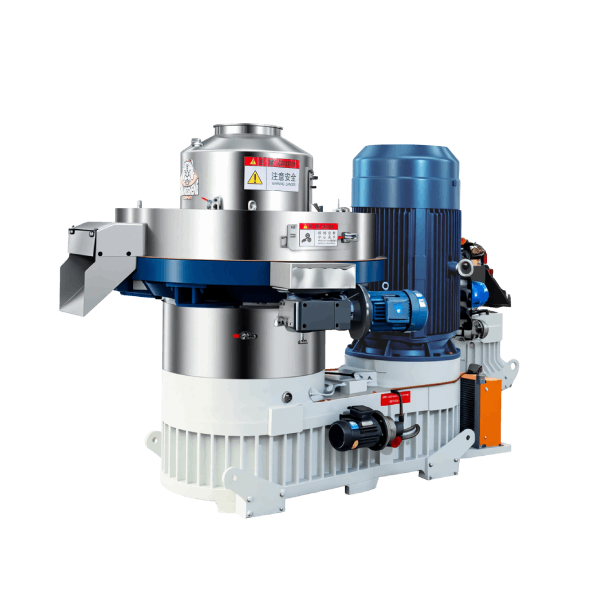
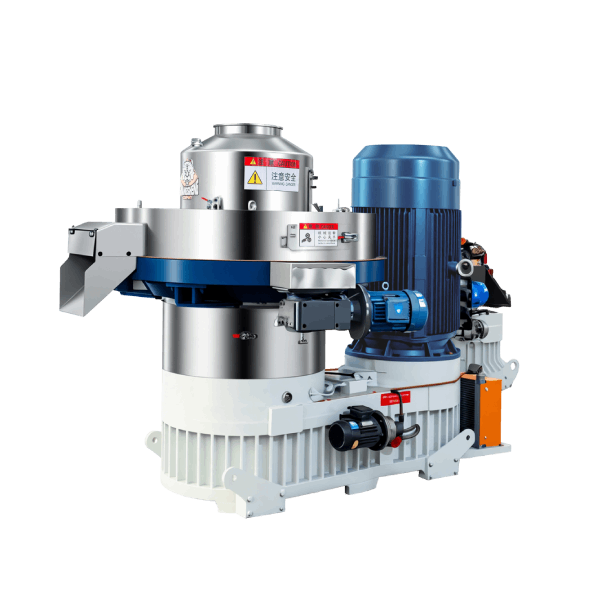
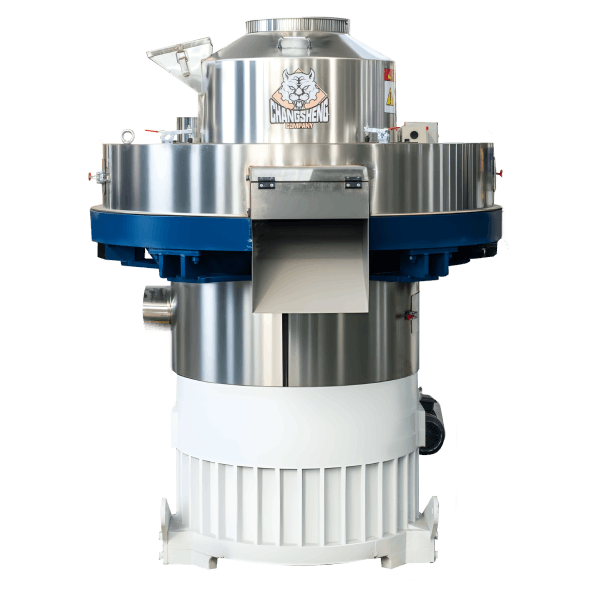
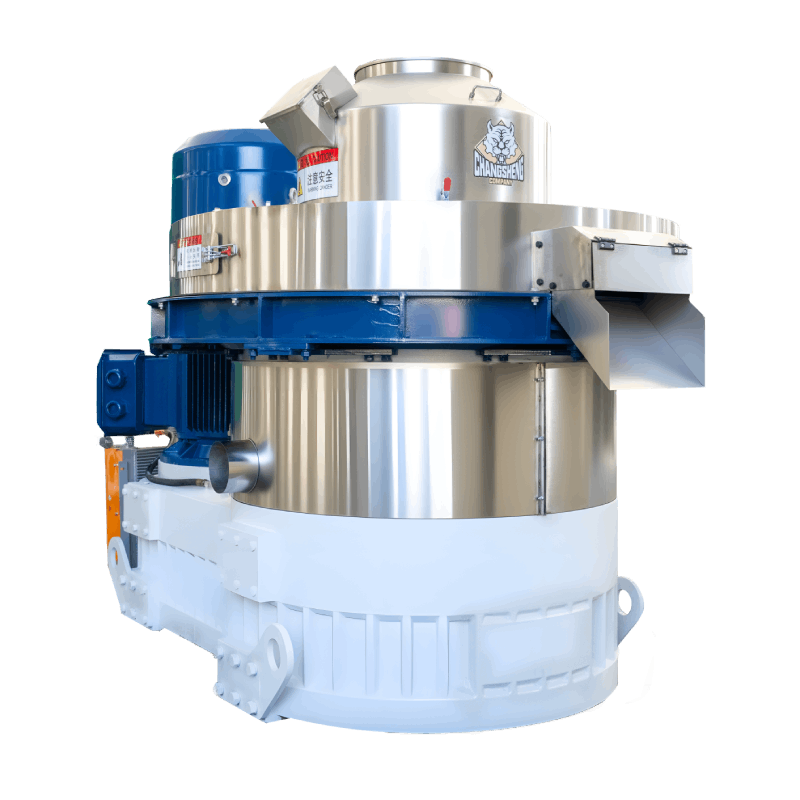
Ring die pellet mill
Die and rollers manufactured from 42CrMo or equivalent alloy steel
Forced lubrication system for bearing protection
Cooling and Screening
Counterflow pellet cooler with galvanized steel frame
Vibrating screen for fines separation and recycling
Electrical and Control
IP54-rated electrical cabinets
Thermal, overload, and interlock protection
Centralized operation interface
Manufacturing Process and Engineering Flow
Industrial pellet production line design specifications must define each process step with corresponding equipment and control logic.
- Raw Material Reception
Bulk materials are unloaded into storage hoppers with buffer capacity to stabilize upstream supply. - Size Reduction
Oversized feedstock is milled to controlled particle size to ensure uniform pellet formation. - Moisture Adjustment
Thermal drying reduces moisture to the pelletizing window while maintaining fiber integrity. - Conditioning
Material temperature and plasticity are improved using controlled heat or steam conditioning. - Pellet Formation
High-pressure extrusion through ring die channels forms dense and uniform pellets. - Cooling
Pellets are cooled from approximately 80–90°C to near-ambient temperature to stabilize structure. - Screening and Recycling
Fines are separated and returned to the pellet mill inlet. - Packaging or Storage
Finished pellets are directed to bulk silos, bagging systems, or container loading.
Industry Comparison
Comparison of Industrial Pellet Lines with Alternative Solutions
Parameter | Industrial Pellet Line | Briquette Line | Loose Biomass Handling
Bulk Density | 600–750 kg/m³ | 450–550 kg/m³ | 150–250 kg/m³
Transport Efficiency | High | Medium | Low
Automation Level | High | Medium | Low
Storage Stability | High | Medium | Low
Fuel Consistency | Stable | Moderate | Unstable
Application Scenarios
Industrial pellet production line design specifications are commonly applied in the following B2B contexts:
Distributors supplying industrial biomass fuel markets
EPC contractors executing turnkey pellet plant projects
Engineering firms designing waste-to-energy facilities
Importers and wholesalers sourcing standardized pellet systems
Industrial users converting internal residues into fuel pellets
Core Pain Points and Engineering Solutions
Inconsistent Pellet Quality
Cause: unstable moisture and die compression mismatch
Solution: closed-loop moisture control and application-specific die selection
Excessive Wear and Downtime
Cause: low-grade materials and overloaded operation
Solution: alloy steel wear parts and conservative load design
Unstable Throughput
Cause: improper feeder and motor matching
Solution: variable-frequency drives and load feedback control
Dust and Environmental Issues
Cause: open conveying and inadequate filtration
Solution: sealed conveyors and negative-pressure dust collection systems
Risk Warnings and Mitigation Strategies
Incorrect Raw Material Assessment
Risk: mill overload and die blockage
Mitigation: pre-project material testing and pilot trials
Undersized Electrical Systems
Risk: frequent trips and thermal damage
Mitigation: power margin design and thermal monitoring
Poor Layout Planning
Risk: maintenance inefficiency and extended downtime
Mitigation: maintenance access zoning during layout design
Overestimated Nominal Capacity
Risk: failure to achieve long-term rated output
Mitigation: design based on sustained, not peak, capacity
Procurement and Selection Guide
- Define target hourly capacity and annual operating hours
- Analyze raw material type, moisture, and ash content
- Confirm pellet diameter and applicable fuel standards
- Review equipment duty ratings and wear component materials
- Evaluate automation level and operator skill requirements
- Request detailed process flow and power balance data
- Verify installation, commissioning, and training scope
- Assess spare parts availability and lifecycle cost
Engineering Case Scenario
A 6-ton-per-hour agricultural residue pellet plant was designed based on industrial pellet production line design specifications for rice husk and corn stover. The project utilized dual hammer mills, a three-pass rotary dryer, and a 250 kW ring die pellet mill. Continuous operation achieved stable throughput with a pellet durability index exceeding 96% and fine content below 3%.
Frequently Asked Questions (FAQ)
What determines pellet mill power selection?
Material hardness, throughput, and die compression ratio.
Is steam conditioning mandatory?
Recommended for fibrous biomass but not mandatory for all materials.
Can one line process multiple materials?
Yes, within similar density and moisture ranges.
What is typical commissioning time?
Usually 7–14 days depending on line complexity.
What is the average die lifespan?
Approximately 800–1,200 operating hours.
How is dust controlled in industrial lines?
Through sealed conveying, cyclones, and bag filters.
Can capacity be expanded later?
Yes, by adding parallel production lines.
What drying system is preferred for large scale?
Rotary dryers are commonly used for industrial capacity.
Is automation customizable?
Yes, PLC systems are modular and scalable.
What certifications are typically required?
CE and applicable electrical and safety standards.
Call to Action
For detailed industrial pellet production line design specifications, technical datasheets, process drawings, or budgetary quotations, procurement teams may request engineering documentation or arrange material testing prior to project approval.
E-E-A-T Author Credentials
This article is prepared by an industrial process engineer with over 15 years of experience in biomass pellet plant design, EPC coordination, and international industrial equipment specification for commercial-scale production facilities.