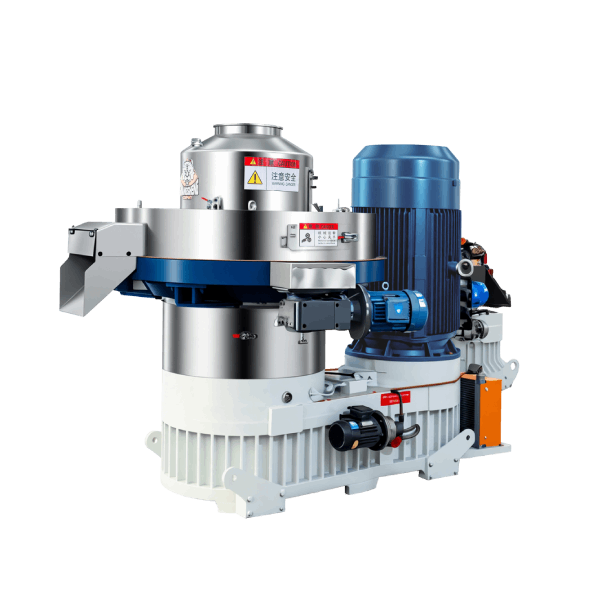
Automatic Lubrication System Pellet Machine Manufacturer 0.5-5t/h | Supplier Guide
News 2026-07-08
Product Definition
An automatic lubrication system pellet machine manufacturer is a ring die pellet mill equipped with a programmable centralised lubrication system that delivers precise grease volumes to critical bearings at preset intervals. The system eliminates manual greasing, extends bearing life, and reduces maintenance labour in continuous industrial operation.
Technical Specifications & Performance Parameters
| Parameter | Value Range / Specification |
|---|---|
| Throughput capacity | 0.5 – 5.0 t/h (feedstock-dependent) |
| Main motor power | 55 – 160 kW (IE3 / IE4 compatible) |
| Ring die inner diameter | 400 – 800 mm |
| Pellet diameter | 6 – 12 mm (customisable) |
| Pellet bulk density | 600 – 750 kg/m³ |
| Raw material moisture | 12% – 18% (optimal: 14% – 16%) |
| Specific energy consumption | 26 – 35 kWh/t |
| Die service life | 800 – 1,200 hours |
| Roller shell service life | 600 – 900 hours |
| Bearing L10 design life | 15,000 – 20,000 hours |
| Grease reservoir capacity | 5 – 15 litres |
| Lubrication interval | 1 – 999 minutes (programmable) |
| Grease consumption per point per cycle | 0.1 – 0.5 cc |
| Lubrication points | 8 – 16 (bearings and shaft seals) |
| Manual maintenance reduction | Up to 80% |
| Scheduled maintenance man-hours | 2 – 3 h / month |
Structural Composition & Material Selection
The automatic lubrication pellet machine integrates four functional subsystems with defined material grades:
Mechanical System
- Ring die: Forged alloy steel (20CrMnTi) with carburised hardening layer (HRC 58–62)
- Roller shells: High-chromium cast iron (Cr26) with wear-resistant overlay
- Main shaft: Heat-treated 42CrMo4 steel with induction-hardened journals
- Gearbox: Helical-gear configuration, case-hardened to HRC 58–60
Lubrication System
- Grease pump: Electric or pneumatic driven, progressive distributor block
- Reservoir: 5–15 litres stainless steel or plastic
- Distribution lines: Stainless steel tubing (6mm OD) with compression fittings
- Pressure relief valve: Set at 25 MPa
- Low-level sensor: Capacitance or ultrasonic
- Pressure switch: Monitors line pressure for blockage detection
Support System
- Bearing housings: Ductile cast iron (QT600-3) with precision-machined seating
- Base frame: Welded structural steel, stress-relief annealed, with vibration-damping mounts
Control System
- PLC-based lubrication controller with HMI interval programming
- Memory stores 12 months of lubrication history
- Optional MODBUS RTU for remote monitoring
- Alarm outputs for low grease and line blockage
Manufacturing Process – Engineering Workflow
Step 1 – Raw Material Preparation & Grinding
Feedstock ground to 2.0–3.0mm for feed or 4.0–6.0mm for biomass. Magnetic separator removes ferrous contaminants. Moisture adjusted to 14%–16%.
Step 2 – Conditioning & Steam Treatment
Double-shaft paddle conditioner with steam injection at 0.2–0.4 MPa. Retention time 45–60 seconds. Mash temperature elevated to 80–95°C.
Step 3 – Pelletising (Core Forming Process)
Main motor drives ring die rotation at 4–8 m/s peripheral speed. Roller gap maintained at 0.15–0.30 mm. Automatic lubrication system delivers grease to bearings at programmable intervals.
Step 4 – Counterflow Cooling
Ambient air drawn counter-current through pellet bed. Retention time 6–10 minutes. Pellet exit temperature ≤ ambient +5°C. Final moisture ≤12%.
Step 5 – Screening & Bagging
Vibrating screener removes fines. Automatic bagging scale with ±0.2% tolerance.
Industry Comparison – Lubrication Systems
| Lubrication Type | Labour Required | Bearing Life | Grease Consumption | Maintenance Cost |
|---|---|---|---|---|
| Automatic Centralised System | Very Low (2-3 h/month) | 15,000-20,000 h | Controlled | Low |
| Manual Greasing | High (8-12 h/month) | 8,000-12,000 h | Inconsistent | High |
| Oil Bath | Low | 10,000-15,000 h | High | Moderate |
| Sealed Bearings | None | 5,000-8,000 h | N/A | High (replacement cost) |
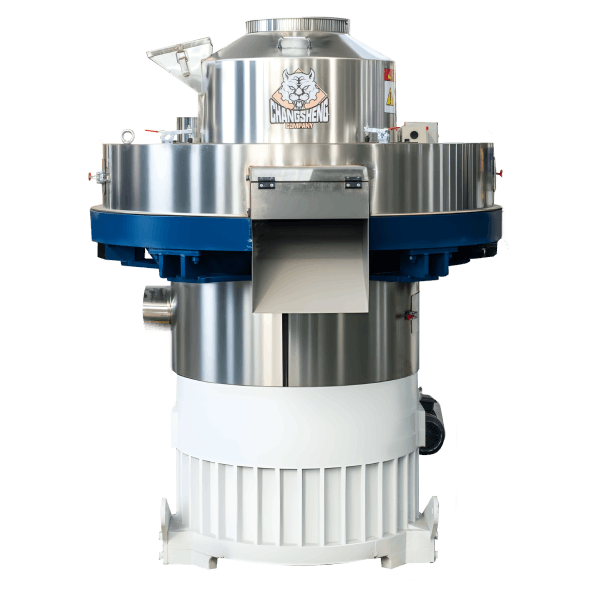
Differentiation (Shandong Changsheng Machinery):
Our automatic lubrication systems feature programmable controllers with 12-month memory for full lubrication traceability. Progressive distributor blocks ensure each bearing receives equal grease volume regardless of line resistance. Low-level and pressure alarms provide early warning of system issues. Integration with PLC enables remote monitoring and fault detection.
Application Scenarios by Buyer Role
Distributors / Importers
Focus on system reliability and compatibility with local grease grades. Require programming flexibility for different operating conditions.
EPC Contractors
Integrating automatic lubrication into plant maintenance systems. Need control interface details and alarm integration for DCS.
Engineering Consultants / Technical Advisors
Evaluate maintenance cost reduction and bearing life extension. Require reliability data for lifecycle cost analysis.
End-user Production Facilities
24/7 operations with limited maintenance staff. Demand automated greasing to reduce labour and extend bearing life.
Core Pain Points & Engineering Solutions
Pain Point 1 – Inconsistent manual greasing
Root cause: Operators skip lubrication during peak production or apply inconsistent grease volumes.
Solution: Programmable system delivers fixed grease volumes at preset intervals – eliminating human error.
Pain Point 2 – Grease contamination from over-lubrication
Root cause: Manual greasing often results in excess grease purging past seals, attracting dust and abrasive particles.
Solution: PLC-controlled dosing matches manufacturer-recommended grease volumes. Pressure switch detects blocked lines.
Pain Point 3 – Unplanned downtime during night shifts
Root cause: Maintenance crews unavailable during off-hours; manual greasing neglected for extended periods.
Solution: System operates continuously. Low-level alarm gives advance warning before reservoir refill is required.
Pain Point 4 – Bearing temperature monitoring
Root cause: Lack of lubrication monitoring allows bearing overheating without detection.
Solution: Optional temperature monitoring with alarm and shutdown interlock.
Critical Risk Warnings & Mitigation Measures
Risk 1 – Grease line blockage causing bearing starvation
Mitigation: Pressure sensor at each distributor outlet. Alert at 18 MPa (normal: 20–23 MPa). Schedule quarterly line flushing.
Risk 2 – Incompatible grease grades causing pump failure
Mitigation: Specify NLGI grade 2 lithium-complex grease. Confirm base oil viscosity (ISO VG 220) with supplier.
Risk 3 – Low-level alarm ignored during continuous operation
Mitigation: Integrate low-level signal into central DCS with audible annunciator. Maintain one spare grease reservoir.
Procurement Selection Guide – 7 Executable Steps
Step 1 – Determine grease grade compatibility
Confirm NLGI grade 2 availability in your region. System calibrated for 220 cSt base oil – substitutions require re-calibration.
Step 2 – Define lubrication points
Bearings, shaft seals, and other points. Typically 8–16 points. Confirm with machine layout.
Step 3 – Select pump type
Electric pump for continuous availability. Pneumatic pump for explosion-proof environments.
Step 4 – Specify reservoir capacity
5–15 litres depending on consumption and refill interval. Larger reservoir extends refill interval.
Step 5 – Verify control integration
MODBUS RTU or hardwired I/O for central monitoring. Confirm PLC compatibility.
Step 6 – Establish maintenance schedule
Quarterly line flushing. Annual pump inspection. Weekly grease reservoir check.
Step 7 – Train maintenance team
System operation, refill procedure, fault diagnosis, and troubleshooting.
Engineering Case Study – Feed Mill in Vietnam
Project Background
A poultry feed mill in Dong Nai operates two 90kW pellet mills at 2.5 t/h each. Manual greasing required 8 hours/week per machine – total 16 hours/week.
Initial Problem
Maintenance labour cost high. Bearing life averaged 8,000 hours – below design target. Grease consumption inconsistent between operators.
Root Cause Analysis
Manual greasing interval varied 6–18 hours depending on operator workload. Over-greasing caused seal contamination and bearing overheating.
Solution Implemented
Retrofitted automatic lubrication systems (programmed 10-minute intervals, 0.2 cc per cycle). Low-level and pressure alarms integrated with PLC.
Final Data Results (12-month average)
| Metric | Before (Manual Greasing) | After (Automatic System) |
|---|---|---|
| Maintenance labour | 16 h/week | 4 h/week |
| Bearing life | 8,200 h | 16,500 h |
| Grease consumption | 85 L/year | 42 L/year |
| Bearings replaced/year | 8 | 3 |
| Annual maintenance cost | $6,800 | $2,500 |
Frequently Asked Questions (FAQ)
1. What does an automatic lubrication system do?
Delivers precise grease volumes to critical bearings at programmable intervals, eliminating manual greasing and extending bearing life.
2. How does the system work?
A pump delivers grease to a progressive distributor block, which divides flow equally to each lubrication point. The PLC controls interval and volume.
3. What grease grade is recommended?
NLGI grade 2 lithium-complex grease with ISO VG 220 base oil.
4. How often does the grease reservoir need refilling?
Every 200–400 operating hours depending on model and cycle setting. PLC displays remaining volume percentage.
5. Can the system be integrated with existing control systems?
Yes – supports MODBUS RTU, Profibus DP, and hardwired I/O signals for central monitoring.
6. What happens if a grease line is blocked?
Pressure switch detects blockage and triggers alarm. PLC logs event for maintenance action.
7. How much maintenance labour is saved?
Up to 80% reduction – from 8–12 hours/month to 2–3 hours/month for inspection and refilling.
8. What is the expected bearing life with automatic lubrication?
15,000 – 20,000 hours – up to 2× longer than manual greasing.
9. Can the system operate in extreme temperatures?
Yes – specified grease grade for -20°C to +100°C. System components rated for industrial environments.
10. What is the warranty on the lubrication system?
12 months or 8,000 hours – subject to proper installation and maintenance.
11. Is the system suitable for 24/7 operation?
Yes – designed for continuous industrial operation with automatic low-level alert.
12. Can the system be retrofitted to existing pellet mills?
Yes – available as a retrofit kit. Consult factory for specific machine configuration.
Author & E-E-A-T Credentials
Author: Dr. Chen Wei
Title: Senior Mechanical Engineer, Pelletising Systems Division
Experience: 14 years in biomass densification and feed processing equipment design
Notable Projects:
- Commissioned 15 automatic lubrication systems across Asia and Africa
- Developed lubrication interval optimisation protocol for extended bearing life
- Co-author of “Industrial Pellet Mill Maintenance and Optimisation” (Engineering Press, 2022)
Affiliation: Shandong Changsheng Machinery Co., Ltd.