Pellet Machine for Poultry Litter Processing 0.5-5t/h | Supplier Guide
News 2026-07-04
Product Definition
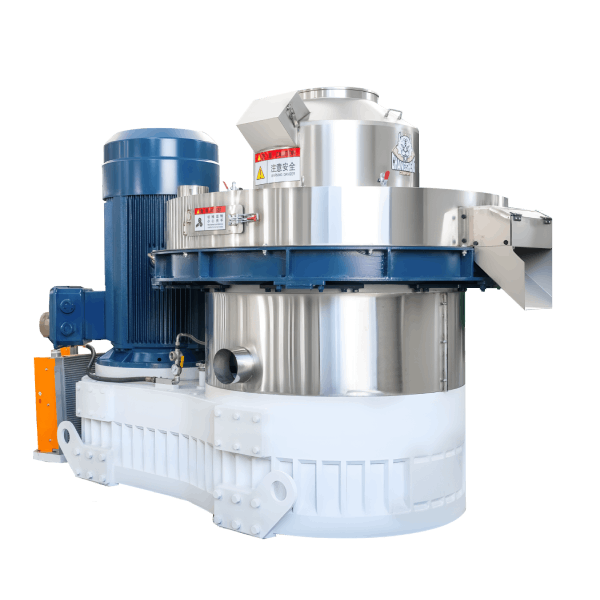
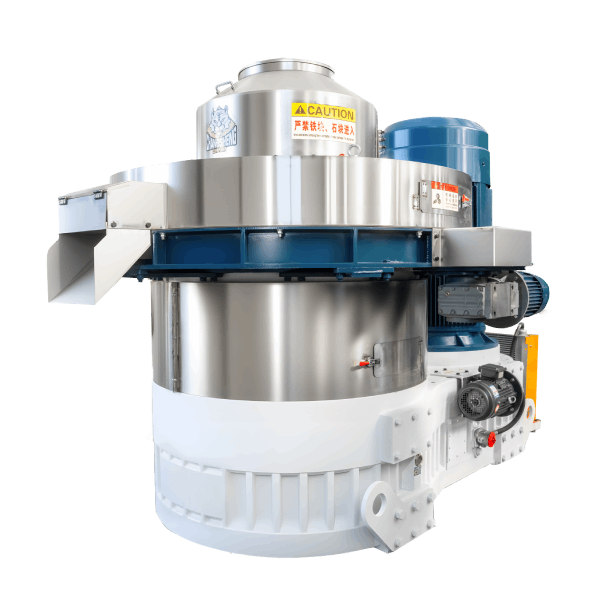
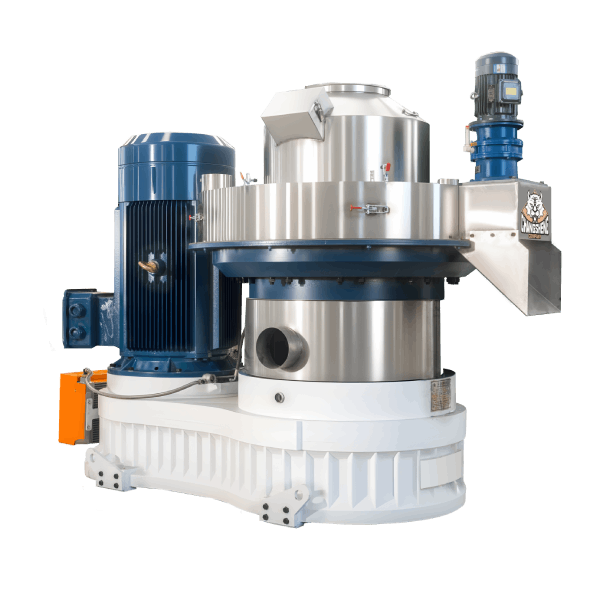
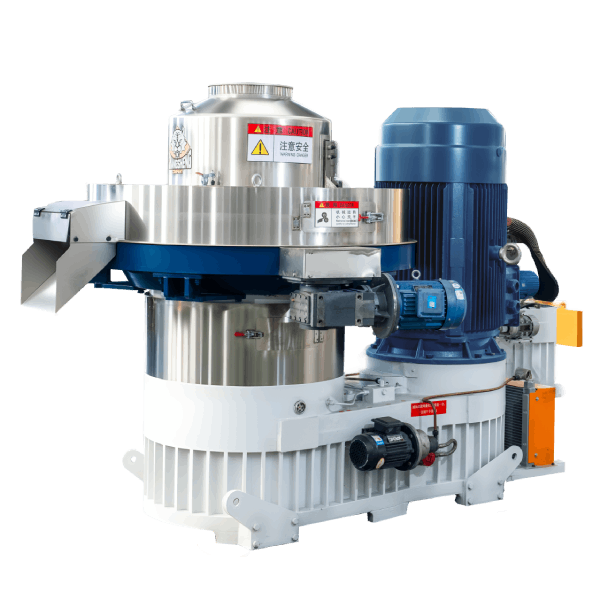
A pellet machine for poultry litter processing is a ring die compaction system that converts broiler litter, layer manure, and bedding waste into dense, manageable pellets for fertiliser, soil amendment, or fuel applications. The machine transforms a problematic waste stream with high moisture and nutrient content into a stable, transportable product with reduced odour and volume.
Technical Specifications & Performance Parameters
| Parameter | Value Range / Specification |
|---|---|
| Throughput capacity | 0.5 – 5.0 t/h (feedstock-dependent) |
| Main motor power | 55 – 160 kW (IE3 / IE4 compatible) |
| Ring die inner diameter | 400 – 800 mm |
| Pellet diameter | 6 – 12 mm (customisable) |
| Pellet bulk density | 550 – 700 kg/m³ |
| Raw material moisture (pre-drying) | 25% – 40% (after dewatering) |
| Target pelletising moisture | 12% – 16% (optimal: 13% – 15%) |
| Specific energy consumption | 35 – 50 kWh/t |
| Die service life | 400 – 700 hours (abrasive litter) |
| Roller shell service life | 300 – 500 hours |
| Maintenance man-hours | 6 – 8 h / month |
Structural Composition & Material Selection
The poultry litter processing pellet machine integrates four functional subsystems with defined material grades:
Mechanical System
- Ring die: Premium forged alloy steel with enhanced carburised hardening (HRC 58–62) – heavy-duty specification
- Roller shells: High-chromium cast iron (Cr26) with wear-resistant overlay
- Main shaft: Heat-treated 42CrMo4 steel with induction-hardened journals
- Gearbox: Heavy-duty helical-gear configuration for continuous operation
- Forced feeder: For variable moisture and fibrous material
Support System
- Bearing housings: Ductile cast iron (QT600-3) with precision-machined seating
- Base frame: Heavy welded structural steel with vibration-damping mounts
- Corrosion-resistant coating for ammonia and moisture exposure
Lubrication System
- Centralised grease lubrication for bearings (NLGI grade 2)
- Forced oil circulation for gearbox (ISO VG 460) with temperature monitor
- Sealed bearings to prevent contamination
Control System
- PLC with HMI touchscreen for process monitoring
- Motor current feedback for load control
- VFD for speed variation
- Moisture monitoring integration
Manufacturing Process – Engineering Workflow
Step 1 – Litter Collection & Screening
Poultry litter collected from houses. Remove feathers, stones, and debris using rotary screener. Magnetic separator removes tramp metal.
Step 2 – Drying & Moisture Control
Fresh litter contains 25%–40% moisture. Rotary drum dryer or belt dryer reduces to 13%–15% for pelletising. Ammonia extraction system may be required.
Step 3 – Grinding & Particle Size Reduction
Hammer mill reduces litter to ≤3–5mm. Uniform particle size essential for consistent pellet formation.
Step 4 – Pelletising (Core Forming Process)
Main motor drives ring die rotation at 3–5 m/s peripheral speed. Rollers compress litter through die holes under high pressure. Manure nutrients and fibre provide natural binding.
Step 5 – Counterflow Cooling
Pellets exit at 80–95°C. Cooling reduces temperature to ambient +5°C and moisture to ≤12% for storage stability.
Step 6 – Screening & Bagging
Vibrating screener removes fines and weak pellets. Product bagged or stored in bulk for fertiliser application.
Industry Comparison – Poultry Litter Processing Options
| Processing Method | Output Product | Moisture Required | Odour Control | Typical Application |
|---|---|---|---|---|
| Litter Pelletising | Fertiliser/fuel pellets | 12%–16% | Good | Farms, fertiliser plants |
| Direct Land Application | Raw litter | N/A | Poor | Local farms |
| Composting | Compost | 40%–60% | Moderate | Soil amendment |
| Incineration | Ash | 10%–20% | Good | Energy recovery |
Differentiation (Shandong Changsheng Machinery):
Our poultry litter pellet mills feature enhanced corrosion protection and heavy-duty wear components for the abrasive nature of litter containing grit and feathers. The forced feeder system handles variable material characteristics. Lower die speeds (3–5 m/s) minimise friction heating and reduce ammonia release. Complete systems including dryer and cooler available.
Application Scenarios by Buyer Role
Distributors / Importers
Focus on machine suitability for regional poultry operations. Require corrosion-resistant specification and wear part availability.
EPC Contractors
Integrating litter-to-pellet lines – collection, drying, pelletising, storage. Need system design and odour control.
Engineering Consultants / Technical Advisors
Evaluate litter-to-fertiliser project viability. Require nutrient analysis and technoeconomic modelling.
End-user Production Facilities
Poultry farms, egg producers, and fertiliser plants. Demand reliable processing of high-moisture, abrasive litter.
Core Pain Points & Engineering Solutions
Pain Point 1 – High moisture content requiring drying
Root cause: Fresh litter contains 25%–40% moisture – pelletising requires 12%–16%.
Solution: Integrated rotary or belt dryer. Heat source from biogas or biomass. Waste heat recovery.
Pain Point 2 – Abrasive grit causing rapid die wear
Root cause: Litter contains sand, grit, and feathers – abrasive to die holes.
Solution: Premium alloy dies with HRC 58–62 hardness. Enhanced roller shell material. Regular inspection and rotation.
Pain Point 3 – Ammonia release during processing
Root cause: Urea in manure breaks down to ammonia at elevated temperature.
Solution: Lower die speed. Acid injection or ammonia capture system. Proper ventilation.
Pain Point 4 – Odour from storage and handling
Root cause: Wet litter and drying release odorous compounds.
Solution: Enclosed processing. Air scrubbers. Covered storage. Rapid processing to minimise storage time.
Critical Risk Warnings & Mitigation Measures
Risk 1 – Fire in dryer from flammable dust
Mitigation: Temperature monitoring. Fire suppression system. Inert gas injection. Daily cleaning.
Risk 2 – Pathogen survival in pellets
Mitigation: Ensure pellet temperature ≥70°C during processing. Drying kills pathogens. Testing for Salmonella and E. coli.
Risk 3 – Ammonia emissions exceeding limits
Mitigation: Acid scrubbing. Ammonia recovery system. Lower process temperature.
Procurement Selection Guide – 7 Executable Steps
Step 1 – Analyse poultry litter composition
Moisture, nutrient content (N, P, K), ammonia level, and contaminant content. Test for pathogens.
Step 2 – Determine required capacity
Calculate litter volume from poultry operation. Select model with 20% capacity margin.
Step 3 – Select die compression ratio for litter
Lower ratio for high-fibre litter (1:5–1:7). Higher ratio for manure-rich litter (1:7–1:9). Consult factory.
Step 4 – Specify drying system
Rotary dryer for high-volume. Belt dryer for gentle handling. Heat source options.
Step 5 – Specify corrosion protection
Stainless steel components for wet sections. Corrosion-resistant coatings. Sealed bearings.
Step 6 – Plan for odour and dust control
Dust extraction. Air scrubbers. Enclosed handling. Storage with odour control.
Step 7 – Establish quality control
Moisture testing. Nutrient testing. Pathogen testing. Production records.
Engineering Case Study – Broiler Farm in Arkansas
Project Background
A broiler farm in Arkansas produces 8,000 tonnes/year of litter. Land application restricted due to nutrient runoff concerns. Disposal cost $15/tonne.
Initial Problem
Litter disposal was a growing cost and environmental issue. Nutrient runoff from land application. No value recovery from litter.
Root Cause Analysis
No pelletising system. Litter had high moisture (30%) and ammonia content. Processing to produce fertiliser pellets could solve disposal and generate revenue.
Solution Implemented
Installed Shandong Changsheng litter pellet mill (2.0 t/h capacity). Integrated rotary dryer, hammer mill, and cooler. Product sold as organic fertiliser pellets.
Final Data Results (12-month average)
| Metric | Before (Land Application) | After (Pellet Production) |
|---|---|---|
| Disposal cost | $15/tonne | Revenue $40/tonne (pellets) |
| Litter processed | 8,000 t/year | 7,200 t/year (pellets) |
| Annual net benefit | -$120,000 | +$288,000 |
| Nutrient runoff | High | Low |
| Payback period | N/A | 16 months |
Frequently Asked Questions (FAQ)
1. What poultry litter can be pelletised?
Broiler litter, layer manure, turkey litter, and hatchery waste.
2. What moisture is required for litter pelletising?
12% – 16%, with 13% – 15% optimal. Drying required for fresh litter.
3. What is the typical capacity range?
0.5 – 5.0 t/h depending on model and feedstock.
4. Does pelletising kill pathogens?
Yes – processing temperature ≥70°C reduces Salmonella, E. coli, and other pathogens.
5. What is the nutrient value of litter pellets?
Typically 3–4% N, 2–3% P₂O₅, 2–3% K₂O – depends on original litter.
6. What causes die wear in litter pelletising?
Grit, sand, and feathers are abrasive. Premium alloy dies required.
7. What is the expected die life for litter?
400 – 700 hours – lower than feed due to abrasiveness.
8. Is drying required for poultry litter?
Yes – fresh litter is 25%–40% moisture. Drying to 12%–16% essential.
9. What is the specific energy consumption?
35 – 50 kWh/t plus significant energy for drying.
10. What odour control is required?
Dust extraction and air scrubbers. Enclosed processing. Acid injection for ammonia.
11. Can litter pellets be used as fertiliser?
Yes – organic fertiliser pellets with controlled nutrient release.
12. What is the payback period?
Typically 16 – 24 months based on disposal cost avoided and fertiliser revenue.
Author & E-E-A-T Credentials
Author: Dr. Chen Wei
Title: Senior Mechanical Engineer, Pelletising Systems Division
Experience: 14 years in biomass densification and feed processing equipment design
Notable Projects:
- Commissioned 3 poultry litter pelletisation lines across United States and Europe (2020–2025)
- Developed ammonia capture and pathogen reduction protocols for litter processing
- Co-author of “Industrial Pellet Mill Maintenance and Optimisation” (Engineering Press, 2022)
Affiliation: Shandong Changsheng Machinery Co., Ltd.