Pellet Mill Power Consumption 30kW 0.3-1.5 t/h | Efficiency Guide
News 2026-06-22
Product Definition
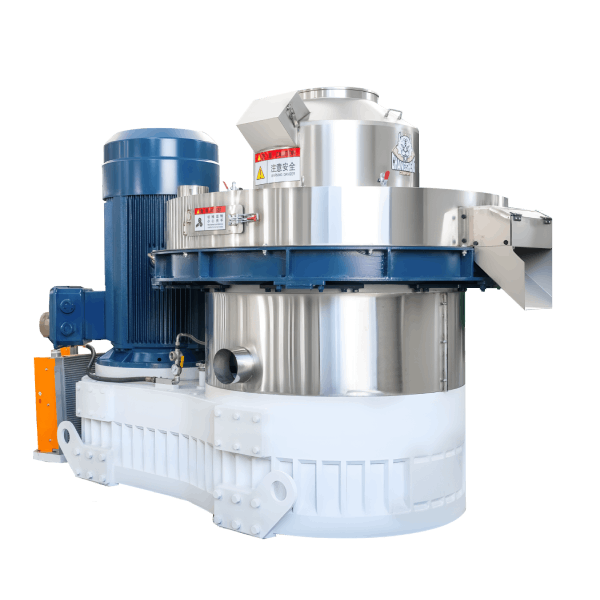
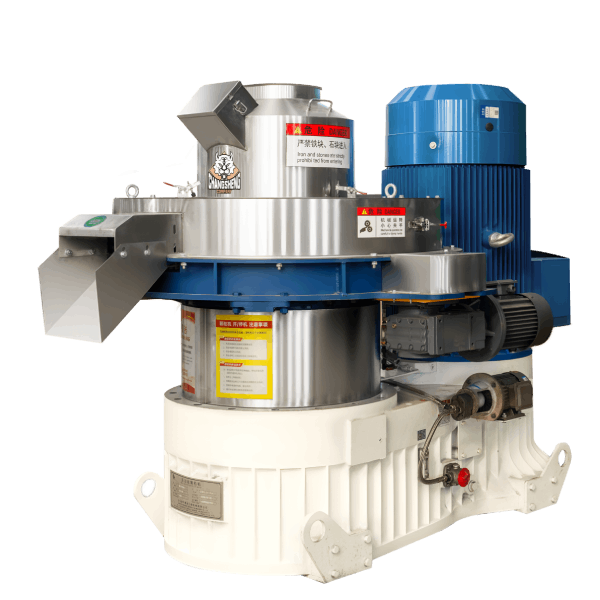
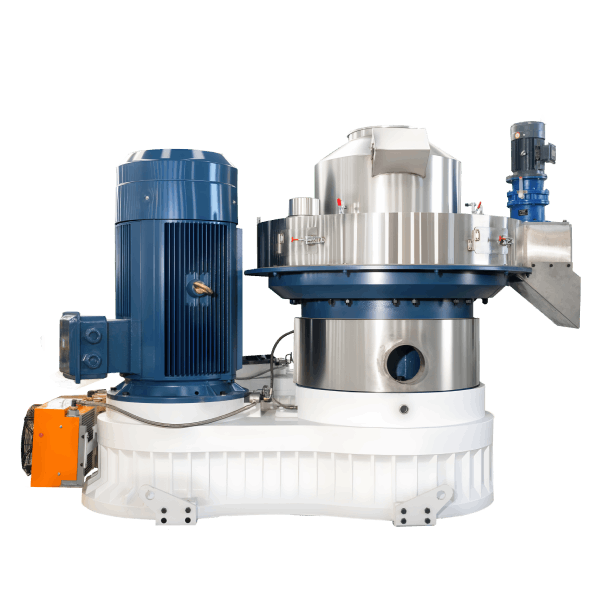
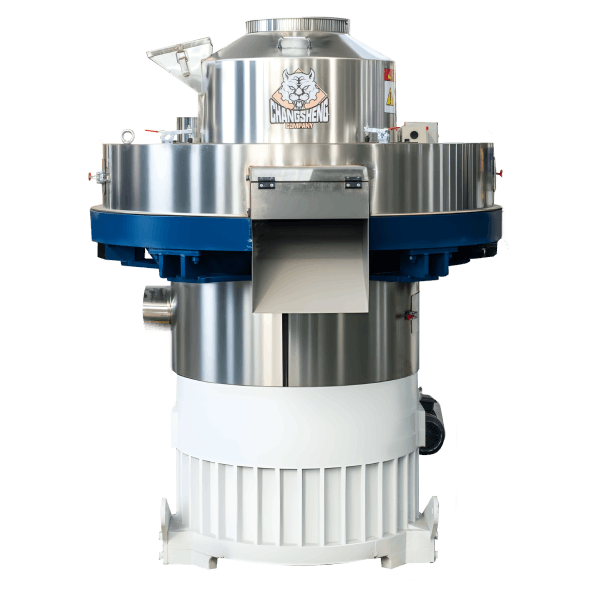
A pellet mill power consumption 30kW refers to a medium-capacity compaction system that converts biomass residues, feed ingredients, or agricultural by-products into dense cylindrical pellets. The 30kW motor provides sufficient torque for small to medium production volumes while maintaining energy efficiency through optimised drive train design and load-matched operation.
Technical Specifications & Performance Parameters
| Parameter | Value Range / Specification |
|---|---|
| Throughput capacity | 0.3 – 1.5 t/h (feedstock-dependent) |
| Main motor power | 30 kW (IE3 / IE4 compatible, 380V/400V/415V, 50/60Hz) |
| Rated motor current | 55 – 65 A (at 400V, depending on efficiency class) |
| Ring die inner diameter | 300 – 500 mm |
| Pellet diameter | 4 – 12 mm (customisable) |
| Pellet bulk density | 600 – 750 kg/m³ |
| Raw material moisture | 12% – 18% (optimal: 14% – 16%) |
| Specific energy consumption | 28 – 35 kWh/t (actual, depending on feedstock) |
| No-load power consumption | 3.5 – 5.0 kW (idling) |
| Core wear parts service life | Ring die: 800 – 1,200 h; Roller shells: 600 – 900 h |
| Scheduled maintenance man-hours | 4 – 6 h / month |
Structural Composition & Material Selection
The 30kW pellet mill integrates four functional subsystems with defined material grades:
Mechanical System
- Ring die: Forged alloy steel (20CrMnTi) with carburised hardening layer (HRC 58–62)
- Roller shells: High-chromium cast iron (Cr26) with wear-resistant overlay
- Main shaft: Heat-treated 42CrMo4 steel with induction-hardened journals
- Gearbox: Helical-gear configuration, case-hardened to HRC 58–60
- V-belt or direct coupling drive: Energy-efficient transmission
Support System
- Bearing housings: Ductile cast iron (QT600-3) with precision-machined seating
- Base frame: Welded structural steel, stress-relief annealed, with vibration-damping mounts
Lubrication System
- Centralised grease lubrication for bearings (NLGI grade 2)
- Forced oil circulation for gearbox (ISO VG 460) with temperature monitor
Control System
- PLC with HMI touchscreen for process monitoring
- Motor starter with overload protection relay
- Energy monitoring module: Real-time kW consumption display
- Soft-starter option for reduced inrush current
Manufacturing Process – Engineering Workflow
Step 1 – Raw Material Preparation & Grinding
Hammer mill with 2.0–3.0 mm screen for feed; 4.0–6.0 mm for biomass. Magnetic separator removes ferrous contaminants. Moisture adjusted to 14%–16% via batch dryer.
Step 2 – Conditioning & Steam Treatment
Double-shaft paddle conditioner with steam injection at 0.2–0.4 MPa. Retention time 45–60 seconds. Mash temperature elevated to 80–95°C for starch gelatinisation.
Step 3 – Pelletising (Core Forming Process)
30kW motor drives ring die rotation at 4–8 m/s peripheral speed. Roller gap maintained at 0.15–0.30 mm. Energy consumption monitored via integrated power meter.
Step 4 – Counterflow Cooling
Ambient air drawn counter-current through pellet bed. Retention time 6–10 minutes. Pellet exit temperature ≤ ambient +5°C. Final moisture ≤12%.
Step 5 – Screening & Bagging
Vibrating screener (two decks: 4 mm and 2 mm apertures) removes fines and broken pellets. Fines recirculated to conditioning. Automatic bagging scale with ±0.2% tolerance.
Industry Comparison – Alternative Technologies
| Machine Type | Motor Power | Capacity (t/h) | Specific Energy (kWh/t) | Typical Application |
|---|---|---|---|---|
| 30kW Pellet Mill | 30 kW | 0.3 – 1.5 | 28 – 35 | Small-medium feed & biomass |
| 22kW Pellet Mill | 22 kW | 0.2 – 1.0 | 30 – 38 | Pilot plants, small farms |
| 37kW Pellet Mill | 37 kW | 0.5 – 2.0 | 27 – 33 | Medium-capacity production |
| 55kW Pellet Mill | 55 kW | 0.8 – 3.0 | 26 – 32 | Industrial-scale production |
| 90kW Pellet Mill | 90 kW | 1.5 – 5.0 | 25 – 31 | High-volume industrial lines |
Differentiation (Shandong Changsheng Machinery):
Our 30kW pellet mill achieves specific energy consumption of 28–35 kWh/t – comparable to larger machines on a per-tonne basis. The optimised gearbox design and high-efficiency IE3 motor reduce no-load losses to 3.5–5.0 kW (11%–16% of rated power). For small to medium-scale operations, this represents optimal balance between capital investment and operating efficiency.
Application Scenarios by Buyer Role
Distributors / Importers
Focus on 30kW motor compatibility with local voltage and frequency (380V/400V/415V, 50/60 Hz). Require power consumption data for customer energy cost projections.
EPC Contractors
Integrating the 30kW pellet mill into small to medium production lines. Need motor starting current and power factor data for electrical system design.
Engineering Consultants / Technical Advisors
Evaluate energy efficiency – 30kW represents optimal scale for operations with 0.5–1.5 t/h requirements. Require load profile data for energy optimisation studies.
End-user Production Facilities
Small to medium feed mills or biomass plants with limited power supply capacity. Demand energy-efficient operation to minimise operating costs and stay within grid capacity.
Core Pain Points & Engineering Solutions
Pain Point 1 – High specific energy consumption ( >38 kWh/t)
Root cause: Inefficient motor selection, worn drive components, or improper die/roller settings causing excessive friction.
Solution: IE3 high-efficiency motor reduces electrical losses by 3%–5% compared to IE2. Correct roller gap (0.15–0.30 mm) minimises friction losses. Regular maintenance maintains efficiency.
Pain Point 2 – Limited power supply capacity
Root cause: Facilities with 50–75 kVA transformers cannot support larger motors without infrastructure upgrade.
Solution: 30kW motor with soft-start reduces inrush current to 2–3× FLA (vs 6–8× direct-on-line). No-load consumption at 3.5–5.0 kW minimises idle losses.
Pain Point 3 – Energy cost uncertainty
Root cause: Variable feedstock moisture and density affect energy consumption – making cost projection difficult.
Solution: Integrated power meter provides real-time kWh consumption data. Operators can adjust feed rate and die speed to optimise energy per tonne.
Pain Point 4 – Inefficient operation at partial load
Root cause: Production below rated capacity results in higher specific energy consumption.
Solution: 30kW motor operates at 70%–90% load at rated throughput. Below 50% load, energy efficiency declines – schedule production accordingly.
Critical Risk Warnings & Mitigation Measures
Risk 1 – Motor overload causing thermal trip
Mitigation: Set overload relay at 105%–110% of motor FLA. Monitor motor current via HMI. Reduce feed rate if current exceeds 90% of rated value.
Risk 2 – Low power factor affecting site energy charges
Mitigation: Install power factor correction capacitor bank (minimum 15 kVAr). Target power factor > 0.85.
Risk 3 – Voltage drop during motor start
Mitigation: Specify soft-starter or star-delta starter. Verify transformer capacity ≥ 1.5× motor kVA. Conduct voltage drop calculation during engineering phase.
Procurement Selection Guide – 7 Executable Steps
Step 1 – Calculate your required throughput
Determine target production (tonnes/hour). 30kW model suitable for 0.3–1.5 t/h. For >1.5 t/h, consider 37kW or 55kW.
Step 2 – Verify site power supply capacity
Confirm transformer capacity (minimum 50 kVA for 30kW motor). Check voltage stability (±10% of nominal).
Step 3 – Select motor efficiency class
Specify IE3 or IE4 for energy efficiency. Higher initial cost but lower operating cost – payback typically 12–24 months.
Step 4 – Determine starting method
Direct-on-line (DOL) for unlimited grid capacity. Soft-start or star-delta for limited transformer capacity.
Step 5 – Evaluate variable frequency drive option
VFD enables speed adjustment and energy savings at partial load. Consider if feedstock varies significantly.
Step 6 – Plan for energy monitoring
Specify integrated power meter or separate energy logger. Essential for energy cost tracking and optimisation.
Step 7 – Calculate annual energy cost
Estimate annual operating hours × kWh consumption × electricity rate. Include motor efficiency and expected load factor.
Engineering Case Study – Small Feed Mill in Kenya
Project Background
A poultry feed mill in Nakuru, Kenya processes 0.8 t/h of maize-soya mash for local distribution. Grid capacity is limited (60 kVA transformer) and electricity costs are $0.22/kWh.
Initial Problem
Existing 37kW pellet mill was oversized for the facility – operating at only 55% load, resulting in specific energy consumption of 42 kWh/t (energy cost $9.24/tonne). High energy bills were eroding profit margins.
Root Cause Analysis
37kW motor operation at partial load reduced efficiency from 92% to 86%. Idle losses and friction losses were significant relative to throughput. Facility paid for capacity it did not require.
Solution Implemented
Replaced 37kW mill with Shandong Changsheng 30kW pellet mill, precisely matched to 0.8 t/h requirement. Added soft-starter to reduce start-up current. Integrated power meter for energy monitoring.
Final Data Results (12-month average)
| Metric | Before (37kW, 55% load) | After (30kW, 80% load) |
|---|---|---|
| Throughput | 0.8 t/h | 0.8 t/h |
| Specific energy consumption | 42.0 kWh/t | 32.5 kWh/t (-23%) |
| Energy cost / tonne | $9.24 | $7.15 |
| Annual energy cost (4,000h) | $29,568 | $22,880 |
| Annual energy savings | – | $6,688 |
| Transformer load | 85% | 68% |
Frequently Asked Questions (FAQ)
1. What throughput can I expect with 30kW motor?
0.3–1.5 t/h depending on feedstock, die size, and moisture. Typical feed production: 0.8–1.2 t/h.
2. What is the typical specific energy consumption?
28–35 kWh/t for feed production, 30–38 kWh/t for biomass, depending on feedstock characteristics.
3. What is the no-load power consumption?
3.5–5.0 kW (11%–16% of rated power) – minimise idle time to reduce energy waste.
4. What voltage and frequency are required?
380V/400V/415V, 50Hz or 60Hz. Specify at order.
5. What is the motor starting current?
Direct-on-line: 6–8× FLA (330–520A). With soft-start: 2–3× FLA (110–195A).
6. What transformer capacity is required?
Minimum 50 kVA for DOL start, 40 kVA with soft-start. Verify with electrical engineer.
7. Is VFD recommended for the 30kW model?
Yes – VFD enables speed control and energy savings at partial load. Recommend if feedstock or production varies.
8. What is the annual energy cost for the 30kW mill?
Assume 4,000 hours/year, 30kW average load, $0.15/kWh: 30 × 4,000 × 0.15 = $18,000/year (estimate).
9. How can I reduce energy consumption?
Maintain correct roller gap (0.15–0.30mm), ensure proper moisture (14%–16%), use high-efficiency motor, minimise idle time.
10. What is the efficiency of the 30kW motor?
IE3: 91%–93%, IE4: 93%–95%, depending on load and speed.
11. Can I run the 30kW mill on single-phase power?
No – 30kW requires 3-phase power supply. Consider single-phase to 3-phase converter (consult factory).
12. What is the payback period for upgrading to IE4 motor?
Typically 12–18 months, depending on electricity rate and annual operating hours.
Author & E-E-A-T Credentials
Author: Dr. Chen Wei
Title: Senior Mechanical Engineer, Pelletising Systems Division
Experience: 14 years in biomass densification and feed processing equipment design
Notable Projects:
- Commissioned 20+ pellet lines with 22–37kW motors across Africa and Southeast Asia (2016–2025)
- Developed energy efficiency optimisation protocol for small-medium feed mills
- Co-author of “Industrial Pellet Mill Maintenance and Optimisation” (Engineering Press, 2022)
Affiliation: Shandong Changsheng Machinery Co., Ltd.