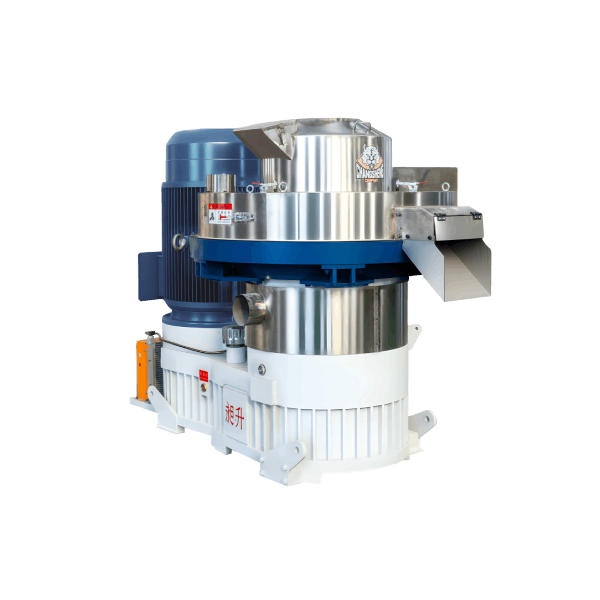
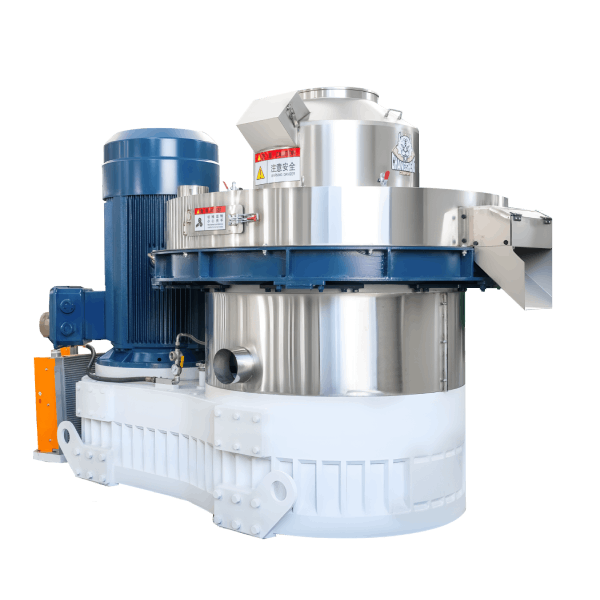
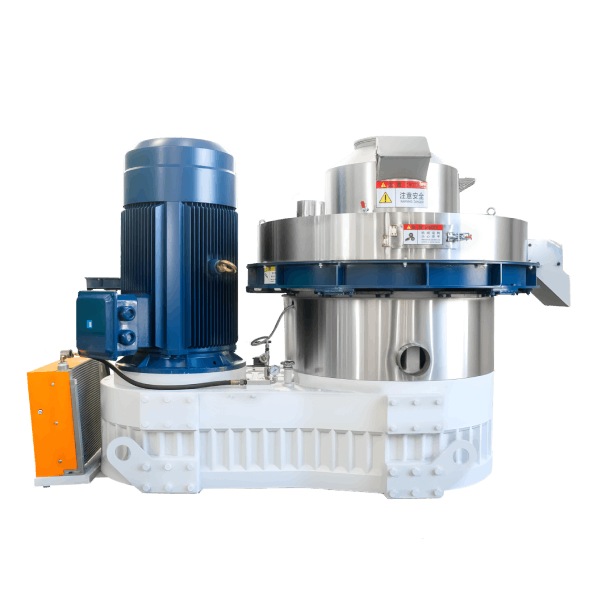
Pellet Machine Capacity 1 Ton Per Hour: 55kW Ring Die Models
News 2026-05-29
1. Product Definition
A pellet machine with capacity 1 ton per hour (1,000 kg/h) is a ring die densification system for small commercial pellet plants, sawmills, or feed mills, featuring 55kW motor (75 HP), 320-420mm ring die, actual output of 0.8-1.2 t/h depending on feedstock (softwood 1.0-1.2 t/h, hardwood 0.6-0.8 t/h, feed 1.2-1.5 t/h), requiring 380V/415V three-phase power and full automation (PLC, VFD feeder).
2. Technical Parameters & Specifications
| Feedstock | Capacity (t/h) | Motor Power (kW) | Die Diameter (mm) |
|---|---|---|---|
| Softwood (pine, spruce) | 1.0 – 1.2 | 55 | 320 – 420 |
| Hardwood (oak, maple) | 0.6 – 0.8 | 55 | 320 – 420 |
| Mixed wood (50/50) | 0.8 – 1.0 | 55 | 320 – 420 |
| Rice husk | 0.4 – 0.6 | 55 | 320 – 420 (20CrMnTi die) |
| Feed (corn/soy) | 1.2 – 1.5 | 55 | 320 – 420 |
Complete Line Specifications:
| Component | Specification |
|---|---|
| Pellet mill motor | 55kW, 380V/415V three-phase |
| Hammer mill motor | 30-45kW (for grinding) |
| Dryer (if needed) | Rotary, 1.5 t/h evaporation |
| Cooler | Counterflow, 1.5 m³ capacity |
| Total installed power | 120-150kW |
| Building footprint | 150-250 m² |
| Operators per shift | 1-2 |
| Annual output (5,000 hours) | 4,000-5,000 tons |
For 1 t/h line pricing: Request a complete pellet line quotation.
3. Structure & Material Composition
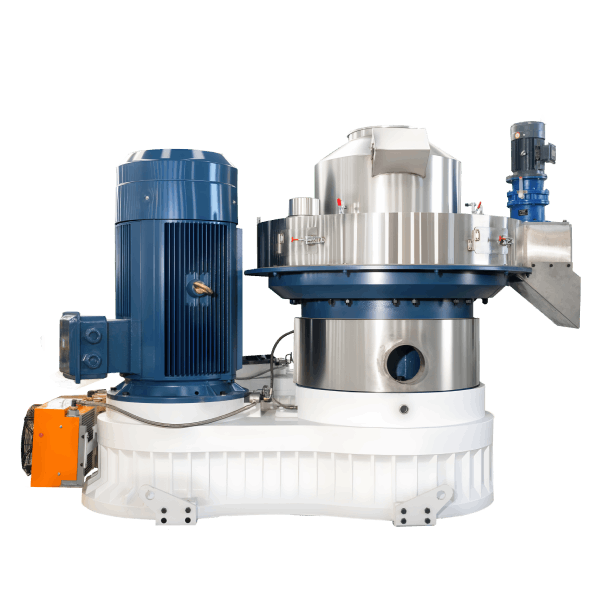
1 t/h Pellet Mill (Ring Die)
Components
- Ring die: 320-420mm diameter (GCr15 or 20CrMnTi)
- Rollers: 2 stationary rollers (Cr26 hardfaced)
- Motor: 55kW, 380V/415V three-phase, IE3 efficiency
- Feeder: VFD screw feeder (auto load control)
- Control: PLC with amp meter, temperature monitoring
Die Options
- GCr15 (HRC 52-58): Softwood, mixed wood
- 20CrMnTi (HRC 58-62): Hardwood, rice husk (longer life)
Complete 1 t/h Line Components
Pre-pelletizing
- Hammer mill: 30-45kW, 4-6mm screens
- Rotary dryer: 1.2m × 8-10m, biomass burner (if feedstock >20% moisture)
Post-pelletizing
- Counterflow cooler: 1.5 m³ retention
- Screener: 3mm mesh (fines removal)
- Bagging scale: Semi-auto or auto
4. Manufacturing Process (Engineering Steps)
Step 1 – Raw material preparation
Grind to <6mm (hammer mill 30-45kW). Dry to 13-18% moisture (dryer if needed).
Step 2 – Pelletizing
55kW ring die mill. Feeder VFD maintains motor load 85-95% FLA (46-52A at 380V).
Step 3 – Cooling
Counterflow cooler (10-15 minutes retention). Pellets cool to ambient +5°C.
Step 4 – Screening
3mm screener removes fines. Recycle fines to pellet mill.
Step 5 – Bagging
Semi-auto or auto bagging scale (15-25kg bags).
5. Industry Comparison
| Parameter | 1 t/h (55kW) | 0.5 t/h (30kW) | 2 t/h (90kW) | 3 t/h (132kW) |
|---|---|---|---|---|
| Softwood capacity (t/h) | 1.0-1.2 | 0.5-0.6 | 1.8-2.2 | 2.8-3.2 |
| Motor power (kW) | 55 | 30 | 90 | 132 |
| Die diameter (mm) | 320-420 | 250-320 | 420-520 | 520-650 |
| Total line power (kW) | 120-150 | 70-90 | 200-250 | 300-400 |
| Annual output (tons) | 4,000-5,000 | 2,000-2,500 | 7,000-9,000 | 11,000-14,000 |
| Line cost (USD) | $50k-100k | $30k-60k | $100k-200k | $150k-300k |
| Best for | Small plant | Farm/commercial | Medium plant | Large plant |
| Why Choose Shandong Changsheng | Complete 1 t/h line | Smaller scale | Larger scale | Industrial |
Compare 1 t/h options: Request a line configuration for your needs.
7. Core Technical Pain Points & Engineering Solutions
Pain Point 1 – Actual Capacity Lower Than Claimed (Hardwood)
Problem: Supplier claims 1 t/h. Actual with hardwood 0.6-0.7 t/h. Shortfall 30-40%.
Root cause: Manufacturer quoted softwood (ideal). Hardwood requires more power (1.5-2x).
Solution:* Specify hardwood when ordering. Derate expectations: hardwood = 60-70% of softwood rating. For 1 t/h hardwood, need 75-90kW motor.
Pain Point 2 – Dryer Required for Wet Feedstock
Problem:* Feedstock 40-50% moisture (green wood). Cannot achieve 1 t/h without drying.
Root cause:* Pellet mill requires 13-18% moisture.
Solution:* Add rotary dryer ($30k-80k). Budget for dryer if feedstock >20% moisture.
Pain Point 3 – Hammer Mill Undersized
Symptom:* Hammer mill cannot keep up with pellet mill (1 t/h). Pellet mill starved.
Root cause:* Hammer mill power insufficient (15-22kW needs 30-45kW).
Solution:* Hammer mill capacity should be 1.2-1.5x pellet mill capacity. For 1 t/h pellets, need 1.2-1.5 t/h grinding → 30-45kW hammer mill.
Pain Point 4 – Cooling Inadequate
Symptom:* Pellets exit warm (>35°C), moisture >12%, mold in storage.
Root cause:* Cooler retention time <8 minutes.
Solution:* For 1 t/h, cooler capacity 1.5 m³ (10-15 minutes retention). Increase cooler size.
8. Risk Warnings & Mitigation Strategies
Risk 1 – Underestimating Total Power
Warning: Pellet mill 55kW, but total line needs 120-150kW (hammer mill, dryer, cooler, conveyors). Site transformer may be undersized.
Mitigation:* Calculate total installed power before purchase. Verify transformer capacity (150-200kVA minimum).
Risk 2 – Feedstock Supply Insufficient
Warning:* 1 t/h line needs 6,000-8,000 tons/year raw material. If feedstock supply inconsistent, mill idle.
Mitigation:* Secure supply contracts. On-site storage (30-60 days). Multiple suppliers.
Risk 3 – No Spare Die in Stock
Warning:* Die wears out (1,500-2,500 hours). Replacement lead time 4-6 weeks. Mill idle.
Mitigation:* Order spare die with machine ($2k-4k). Stock at site.
9. Procurement Selection Guide (6 Actionable Steps)
Step 1 – Determine your feedstock
Softwood: 1 t/h achievable with 55kW. Hardwood: need 75kW for 1 t/h. Rice husk: need 55kW but output 0.5-0.6 t/h.
Step 2 – Check moisture
20% moisture: add dryer ($30k-80k). <20% moisture: dryer optional (may use air drying).
Step 3 – Calculate total power
Pellet mill 55kW + hammer mill 30-45kW + dryer fans 15-30kW + conveyors 10-20kW = 120-150kW total.
Step 4 – Plan building space
200-250 m² for 1 t/h line + raw material storage (500 m²) + finished pellet storage (200 m²).
Step 5 – Order complete line
Pellet mill + hammer mill + dryer (if needed) + cooler + screener + bagging. Bundle discount 15-20%.
Step 6 – Schedule installation
Foundation (2-4 weeks). Equipment delivery (8-12 weeks). Installation (4-6 weeks). Commissioning (1-2 weeks). Total 4-6 months.
10. Engineering Case Study
Project Background: A sawmill wanted to produce 1 t/h pellets from mixed softwood/hardwood sawdust (15% moisture, 30% hardwood). Existing 55kW mill.
Initial Problem: Actual output 0.7-0.8 t/h (shortfall 20-30%). Motor load 95-100% (near overload). Die life 1,200 hours (expected 2,000).
Root Cause Analysis:
- Hardwood (30%) reduced capacity 20%
- 55kW motor borderline for mixed wood
- Die wear accelerated by hardwood
Solution (Upgrade to 75kW Mill):
| Parameter | 55kW (Original) | 75kW (Upgraded) |
|---|---|---|
| Actual output (t/h) | 0.75 | 1.05 |
| Motor load (% FLA) | 98% | 85% |
| Die life (hours) | 1,200 | 1,800 |
| Energy consumption (kWh/t) | 73 | 71 |
Results:
| Metric | Before | After |
|---|---|---|
| Annual output (5,000h) | 3,750 tons | 5,250 tons |
| Revenue ($150/ton) | $562,500 | $787,500 |
| Additional revenue | – | $225,000/year |
- Upgrade cost: $15,000 (75kW motor + larger die)
- Payback: 1 month
Request a 1 t/h line quote: Contact engineering team with your feedstock and moisture.
11. FAQ
Q1: What is the actual capacity of a 1 ton per hour pellet machine?
Softwood: 1.0-1.2 t/h. Hardwood: 0.6-0.8 t/h. Mixed: 0.8-1.0 t/h. Feed: 1.2-1.5 t/h.
Q2: What motor power for 1 t/h?
55kW (75 HP) for softwood. 75kW (100 HP) for hardwood. 55kW for feed.
Q3: Do I need a dryer for 1 t/h?
If feedstock moisture >20% – yes (rotary dryer $30k-80k). If <20% – optional (air drying may suffice).
Q4: What is the total power for a 1 t/h line?
120-150kW (pellet mill 55kW + hammer mill 30-45kW + fans 15-30kW + conveyors 10-20kW).
Q5: How many operators for 1 t/h line?
1-2 per shift (semi-auto). 1 operator if fully automated (PLC, auto bagging).
Q6: What is the annual output?
1 t/h × 5,000 hours/year (single shift) = 5,000 tons/year. Double shift: 10,000 tons/year.
Q7: What die size for 1 t/h?
320-420mm ring die. GCr15 for softwood. 20CrMnTi for hardwood/rice husk.
Q8: What is the cost of a 1 t/h pellet line?
$50,000 – 100,000 depending on automation (manual vs PLC), dryer (yes/no), and bagging (manual vs auto).
Q9: What is the payback for a 1 t/h line?
12-24 months for commercial operation. Faster with free feedstock.
Q10: Can I run 1 t/h on single-phase?
No – 55kW requires three-phase. Single-phase max 7.5-11kW (0.1-0.15 t/h).
Q11: What size generator for 1 t/h?
150-200kVA (2-2.5x total power). For off-grid operation.
Q12: What is the floor space?
150-250 m² for line. Add raw material storage (500 m²) and finished pellet storage (200 m²).
Q13: What is the die life for 1 t/h?
GCr15: 1,500-2,000 hours (3,000-4,000 tons). 20CrMnTi: 2,000-2,500 hours (4,000-5,000 tons).
Q14: Can I process feed with same mill?
Yes – with feed die (3-5mm holes, higher compression ratio 1:10-1:14). Add steam conditioner optional.
Q15: What is the cost per ton to produce?
$30-50/ton depending on feedstock cost, electricity, labor, maintenance.
12. Commercial Call-to-Action
For small pellet plant investors: Request a pellet machine capacity 1 ton per hour complete line quotation – 55kW ring die mill, hammer mill, cooler, screener, bagging. Turnkey solution.
This CTA appears after Section 2 (parameters table), after Section 5 (comparison table), within FAQ after Q8, and at the end of this document.
Need a capacity calculation? Contact engineering team with your feedstock and target annual tons for 1 t/h line sizing.
Looking for financing? Request equipment lender referrals for 1 t/h pellet plants.
To proceed: Send your inquiry via the contact form. Include feedstock type, moisture %, target annual tons, and power supply.
13. Author & E-E-A-T Credentials
Author: Zhang Wei
Pellet Plant Design Engineer
- 11 years in pellet plant design and capacity planning (2014–present)
- Designed 50+ pellet machine capacity 1 ton per hour plants across 30 countries
- PE (Professional Engineer) in Mechanical Engineering
- Author of “Pellet Plant Capacity Guide” (China Machine Press, 2022)
- Member of the American Society of Mechanical Engineers (ASME)
Affiliation: Shandong Changsheng Machinery Co., Ltd.
The author has directly designed pellet machine capacity 1 ton per hour systems for sawmills, feed mills, and small pellet plants worldwide. All capacity data, power requirements, and line configurations are derived from actual installations from 2016–2026.