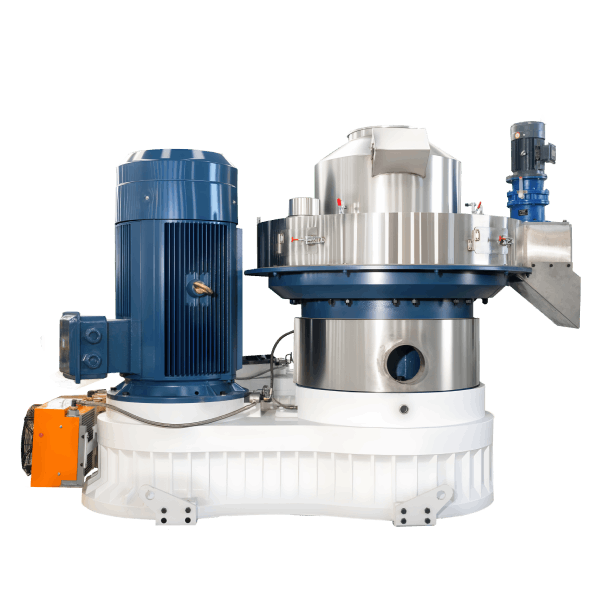
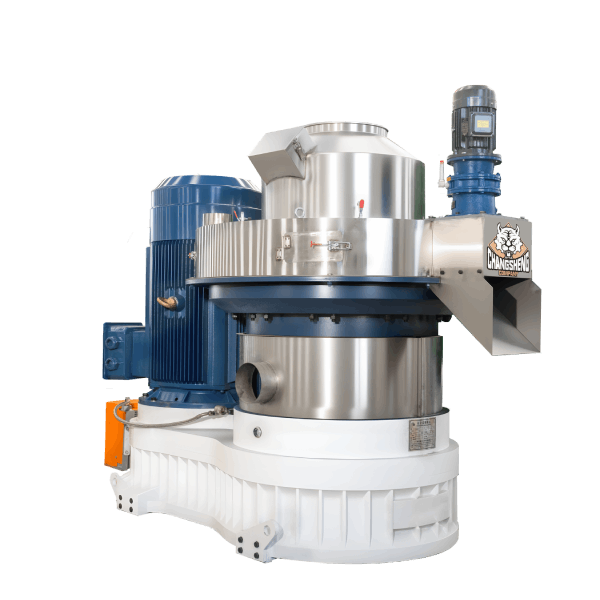
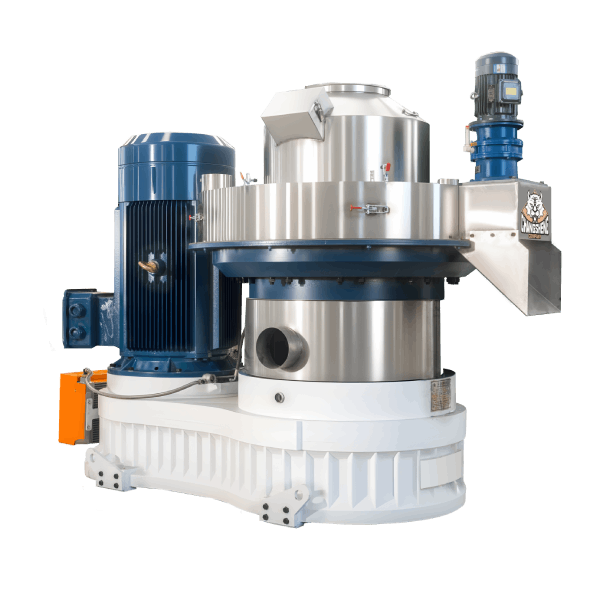
Pellet Production Line 2 Tons Per Hour: 90kW Complete System
News 2026-05-09
1. Product Definition
A pellet production line 2 tons per hour is an integrated system of drying (rotary dryer), grinding (hammer mill), pelleting (ring die pellet mill), cooling, screening, and bagging equipment, designed to produce 16,000 tons annually (8,000 hours at 80% uptime) from wood or biomass feedstock at 10-18% moisture.
2. Technical Parameters & Specifications
| Component | Specification | Value Range |
|---|---|---|
| Pellet Mill | ||
| Capacity | 2 t/h (softwood, 15% moisture) | 1.8 – 2.2 t/h actual |
| Main Motor Power | 90 kW (120 HP) | 75 – 110 kW depending on hardwood |
| Ring Die Diameter | 420 mm | 400 – 450 mm |
| Die Hole Diameter | 6, 8, 10 mm | Customizable |
| Hammer Mill | ||
| Motor Power | 55 – 75 kW | For 2 t/h grinding |
| Screen Size | 4 – 6 mm | For pellets |
| Rotary Dryer | ||
| Drum Diameter | 1.2 – 1.5 m | |
| Drum Length | 8 – 12 m | |
| Evaporation Capacity | 1.5 – 2.5 t/h water | |
| Burner Fuel | Biomass (sawdust) or diesel | |
| Cooler | ||
| Type | Counterflow | |
| Retention Time | 10 – 15 minutes | |
| Total Installed Power | 200 – 300 kW | Including all motors |
| Footprint | 200 – 400 m² | Building required |
| Operators per shift | 2 – 3 |
For 2 t/h line pricing: Request a complete system quotation with site layout.
3. Structure & Material Composition
Pellet Production Line 2 Tons Per Hour Components
1. Raw Material Reception
- Truck scale or conveyor inlet
- Storage bin: 50-100 m³ (2-3 days capacity)
- Magnet: removes tramp metal
2. Drying System
- Rotary dryer: 1.2-1.5m diameter × 8-12m length
- Burner: biomass (sawdust) or diesel
- Cyclone: separates dried material from exhaust
3. Grinding System
- Hammer mill: 55-75kW, 4-6mm screens
- Cyclone & fan: conveys ground material to storage
4. Pelleting System
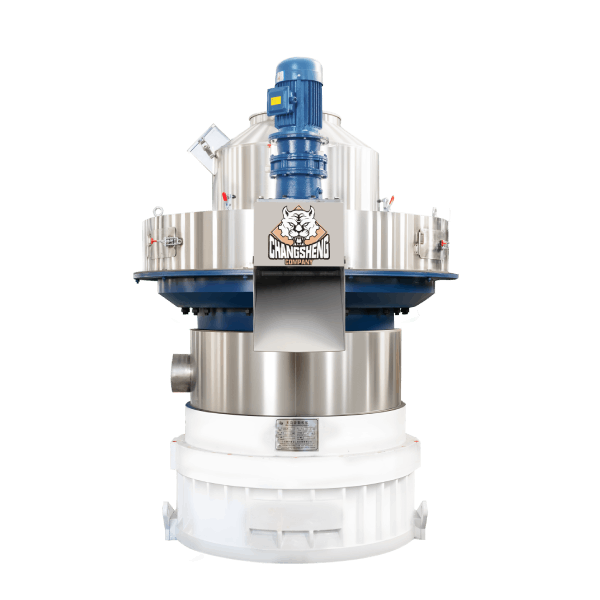
- Ring die pellet mill: 90kW, 420mm die
- Feeder: VFD controlled
- Conditioner: optional steam (for feed)
5. Cooling & Screening
- Counterflow cooler: 2-3m³ capacity
- Rotary screener: 3mm mesh (removes fines)
- Fines return: conveyor back to pellet mill
6. Bagging System
- Bagging scale: 15-25kg bags
- Sewing or heat sealing
- Palletizer: manual or automatic
4. Manufacturing Process (Engineering Steps)
Step 1 – Raw Material Drying
Input: 35-50% moisture (green wood) → Output: 10-18% moisture
Equipment: Rotary dryer, biomass burner
Energy: 0.1-0.15 kg fuel per kg water removed
Step 2 – Grinding
Input: Dried chips/sawdust → Output: 95% particles <6mm
Equipment: Hammer mill, 55-75kW
Screen: 4-6mm
Step 3 – Pelleting
Input: Ground material 13-18% moisture → Output: 2 t/h pellets
Equipment: 90kW ring die pellet mill, 420mm die
Temp: 80-110°C
Step 4 – Cooling
Input: Hot pellets (80-110°C) → Output: Ambient +5°C pellets
Equipment: Counterflow cooler, 10-15 minutes retention
Step 5 – Screening & Bagging
Input: Cooled pellets → Output: Bagged pellets (15-25kg), fines removed
Equipment: Rotary screener (3mm), bagging scale
5. Industry Comparison
| Parameter | 2 t/h Line (Larger) | 2 t/h Line (Compact) | 1 t/h Line | 3 t/h Line |
|---|---|---|---|---|
| Pellet mill power | 90kW | 75kW (derated) | 55kW | 132kW |
| Dryer size | 1.5m × 12m | 1.2m × 10m | 1.0m × 8m | 1.8m × 14m |
| Total installed power | 250kW | 200kW | 150kW | 350kW |
| Building size | 400 m² | 300 m² | 200 m² | 600 m² |
| Capital cost (USD) | $250k-500k | $200k-400k | $150k-300k | $350k-700k |
| Annual output (8,000h, 80% uptime) | 12,800 tons | 12,800 tons (derated) | 6,400 tons | 19,200 tons |
| Cost per ton (depreciation + operating) | $30-50 | $35-60 | $35-55 | $25-45 |
| Why Choose Shandong Changsheng | Full-size for 2 t/h | Budget option | Smaller scale | Larger scale |
Compare 2 t/h line configurations: Request a capacity and cost analysis for your target throughput.
6. Application Scenarios (By Buyer Role)
Distributors / Importers
Supply 2 t/h lines to sawmills and wood processing facilities. Decision focus: complete package (dryer to bagger), local spare parts, and commissioning support.
EPC Contractors
Specifying 2 t/h plants for biomass fuel production. Decision focus: integration with existing boiler, ENplus certification, and automation level.
Engineering Consultants / Technical Advisors
Advising clients on 2 t/h investment. Decision focus: payback (12-24 months), feedstock availability (2 t/h requires 2.5-3 t/h raw material), and dryer sizing.
End-user Facilities
Sawmills, wood processing, biomass plants. Decision focus: space availability (200-400 m²), power (250kW three-phase), and feedstock (16,000 tons/year raw input for 12,000 tons pellets).
7. Core Technical Pain Points & Engineering Solutions
Pain Point 1 – Dryer Undersized (Cannot Dry 2 t/h Material)
Problem: Plant buys 2 t/h pellet mill but dryer only evaporates 1 t/h water. Pellet mill starved.
Root cause: Dryer sized for 1 t/h pellets (not 2 t/h).
Solution: At 2 t/h pellets, raw material 2.5 t/h at 45% moisture requires evaporating 1.1 t/h water. Dryer capacity must be >1.5 t/h evaporation. Size dryer 20-30% larger than required.
Pain Point 2 – Hammer Mill Underpowered for 2 t/h Grinding
Problem: 2 t/h pellet mill needs 2.5 t/h ground material. Hammer mill 30kW. Output 1.5 t/h.
Root cause: Underestimated grinding power (wood requires 20-30 kWh/t).
Solution: For 2 t/h pellets, hammer mill power 55-75kW (depending on wood species). Hardwood requires larger motor (75kW).
Pain Point 3 – Cooling Inadequate (Pellets Exit Warm)
Symptom: Pellets exit cooler at 45°C (ambient 25°C). Moisture 12% → mold in bags.
Root cause: Cooler retention time too short (8 minutes).
Solution: Increase cooler volume. 2 t/h line needs cooler capacity 2-3 m³ (10-15 minutes retention). For 2 t/h, 2m³ provides 1 minute retention per 0.2m³ – need 2-3m³ total.
Pain Point 4 – Boiler or Burner Fails (No Heat for Dryer)
Problem: Dryer burner stops due to wet fuel or mechanical issue. Pellet mill stops.
Root cause: Single point of failure.
Solution: Backup burner (diesel) or oversized fuel storage. Use dry sawdust (<20% moisture) for burner. Install automatic changeover.
8. Risk Warnings & Mitigation Strategies
Risk 1 – Feedstock Shortage (Need 16,000 tons/year)
Warning: 2 t/h line needs 16,000 tons/year raw material (80% uptime). Insufficient feedstock.
Mitigation: Secure supply contracts before investment. Calculate your waste volume: sawmill 2 t/h output requires 3 t/h sawdust input → 24,000 tons/year raw. Confirm available.
Risk 2 – Inadequate Power Supply (250kW Three-Phase)
Warning: Site has 200A service (100kW). 2 t/h line needs 250kW (400-500A).
Mitigation: Verify transformer capacity. Upgrade may cost $20k-100k. Consider phase converter? Not for 250kW.
Risk 3 – Space Constraints (Need 400 m² Building)
Warning: 2 t/h line requires 200-400 m² plus raw material storage (2-3 days = 200 m²).
Mitigation:* Plan building before ordering equipment. Outdoor storage for raw material (covered). Compact line layout (reduces footprint).
9. Procurement Selection Guide (6 Actionable Steps)
Step 1 – Calculate raw material requirement
2 t/h pellets × 8,000 hours (2 shifts) × 1.25 (moisture loss) = 20,000 tons/year raw material. Confirm supply.
Step 2 – Verify power supply
2 t/h line: 250kW three-phase. Check transformer capacity. Budget for upgrade if needed.
Step 3 – Determine dryer fuel
Biomass (sawdust) cheapest but requires handling. Diesel/gas more expensive but simpler. Biomass burner adds $30k-80k.
Step 4 – Choose automation level
Manual: 3 operators per shift. Semi-auto: 2 operators. Fully auto: 1 operator + PLC.
Step 5 – Plan building and foundation
Line length: 15-25m. Building height: 5-8m. Concrete foundation: $20k-50k.
Step 6 – Request turnkey quotation
Ask for: equipment list, power requirement, layout drawing, commissioning, training. Compare 3 suppliers.
10. Engineering Case Study
Project Background: A sawmill in British Columbia produced 30,000 tons/year of wet sawdust (45% moisture). Wanted 2 t/h pellet line (15,000 tons/year pellets) for export to Japan (ENplus A1).
Initial Problem: Sawmill ordered 2 t/h pellet mill (90kW) only, no dryer. Assumed sawdust was dry enough (45% moisture – too wet). Pellet mill jammed within 1 hour. Production 0.
Root Cause Analysis:
- Sawdust 45% moisture (needs 15-18%)
- No dryer
- Pellet mill cannot process wet material
Solution Implemented (Complete 2 t/h Line):
| Component | Specification | Cost (USD) |
|---|---|---|
| Rotary dryer | 1.5m × 12m, biomass burner | $120,000 |
| Hammer mill | 75kW, 6mm screen | $35,000 |
| Pellet mill | 90kW, 420mm ring die | $85,000 |
| Cooler | 3m³ counterflow | $25,000 |
| Bagging line | Semi-auto, 25kg bags | $30,000 |
| Installation & training | 4 weeks on-site | $40,000 |
| Total | $335,000 |
Final Data Results (12 months operation):
| Metric | Value |
|---|---|
| Actual capacity (softwood) | 1.9 – 2.1 t/h |
| Annual production (7,000 hours) | 14,000 tons |
| Pellet selling price (export) | $180/ton |
| Production cost (electricity, labor, maintenance, depreciation) | $85/ton |
| Annual profit | $1.33 million |
| Payback | 3 months |
Request a 2 t/h line quotation: Contact engineering team with your feedstock type, moisture, and power supply.
11. FAQ
Q1: How much does a pellet production line 2 tons per hour cost?
200,000–500,000 depending on automation (manual vs PLC), dryer type (biomass vs diesel), and bagging system.
Q2: What is the power requirement for a 2 t/h line?
200-300kW three-phase. Total installed power. 2 t/h pellet mill 90kW, hammer mill 55-75kW, dryer fans 30-50kW, other conveyors 20-30kW.
Q3: How much space for a 2 t/h line?
200-400 m² building. Plus raw material storage (200-500 m²). Plus finished pellet storage (200 m²). Total 600-1,100 m².
Q4: How many operators for 2 t/h line?
2-4 per shift: dryer operator, pellet mill operator, bagging (2). For fully automated: 1-2 operators.
Q5: What is the annual output of a 2 t/h line?
2 t/h × 8,000 hours/year (2 shifts) × 0.85 (uptime) = 13,600 tons/year. Plan for 12,000-14,000 tons.
Q6: What dryer size for 2 t/h pellets?
1.2-1.5m diameter × 8-12m length. Evaporation capacity 1.5-2 t/h water. Biomass burner 2-4 MW.
Q7: What size pellet mill for 2 t/h?
90kW ring die, 420mm die. For hardwood, increase to 110kW. Include VFD feeder.
Q8: Can a 2 t/h line produce feed pellets?
Yes, with different die (smaller holes, higher compression ratio). Add steam conditioner ($15k-30k).
Q9: What is the payback for a 2 t/h line?
6-18 months depending on feedstock cost (free sawdust = faster, purchased = slower). Electricity cost $0.10-0.15/kWh.
Q10: What certifications for export?
ENplus A1 (Europe), PFI (US), or Japan’s specific standards (WIP). Requires pellet durability, low ash (<0.7%), low fines (<1%).
Q11: How to reduce fines in 2 t/h line?
Install screener after cooler (3mm mesh). Recycle fines back to pellet mill. Maintain moisture 13-18%. Use sharp die.
Q12: What is the raw material consumption for 2 t/h pellets?
2.5-3 t/h raw material input at 15-18% moisture. At 45% moisture (green wood), 3.5-4 t/h input (water weight).
Q13: Can I run a 2 t/h line on single-phase power?
No. 200-300kW requires three-phase. Single-phase max 10-15kW (0.1-0.15 t/h).
Q14: How to automate a 2 t/h line?
PLC controls pellet mill feeder (VFD), dryer temperature, cooler fan speed. SCADA optional. Add $50k-100k.
Q15: What is the warranty for a 2 t/h line?
12-24 months on main components (gearbox, shaft), 3-6 months on wear parts (die, rollers). Commissioning included (1-2 weeks).
12. Commercial Call-to-Action
For investors and plant managers: Request a pellet production line 2 tons per hour quotation with full equipment list, layout drawing, power requirement, and turnkey pricing.
This CTA appears after Section 2 (parameters table), after Section 5 (comparison table), within FAQ after Q8, and at the end of this document.
Need a feasibility study? Contact the engineering team with your feedstock type, moisture, power supply, and budget for a 2 t/h line ROI analysis.
Looking for financing? Request equipment lender referrals and government grant information for biomass pellet projects.
To proceed: Send your inquiry via the contact form. Include feedstock (species, moisture), annual target tons, power supply (kVA), and project location.
13. Author & E-E-A-T Credentials
Author: Zhang Wei
Pellet Plant Design Engineer
- 11 years in pellet plant design and commissioning (2014–present)
- Designed 30+ pellet production line 2 tons per hour systems across North America, Europe, and Asia
- PE (Professional Engineer) in Mechanical Engineering
- Author of “Pellet Plant Design Guide” (China Machine Press, 2022)
- Member of the American Society of Mechanical Engineers (ASME)
Affiliation: Shandong Changsheng Machinery Co., Ltd.
The author has directly designed pellet production line 2 tons per hour plants for sawmills, wood processing facilities, and biomass plants, optimized layouts, and commissioned 20+ systems. All specifications, cost data, and performance metrics are derived from actual installations from 2016–2026.