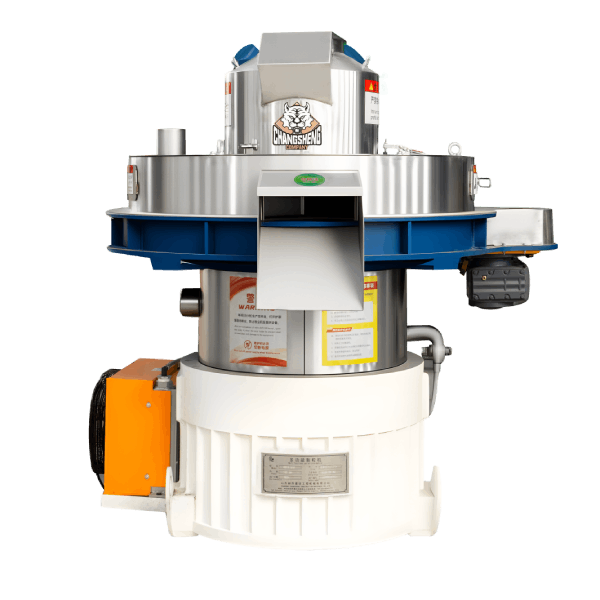
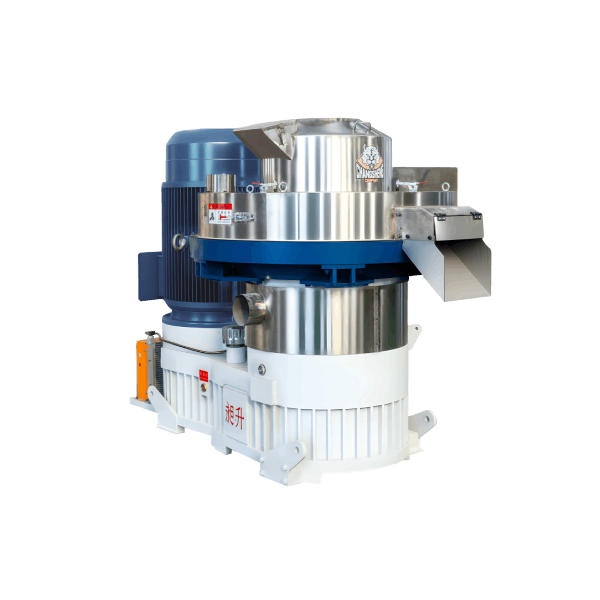
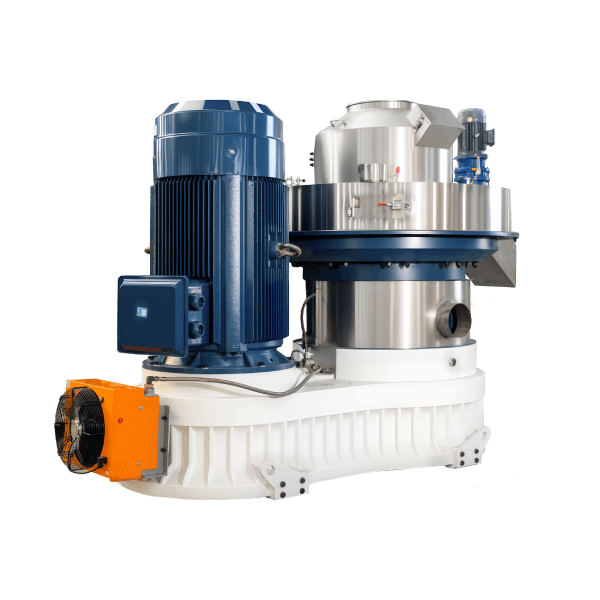
Pellet Machine with Hammer Mill Integrated: 0.1-0.5 t/h Combo Units
News 2026-04-24
1. Product Definition
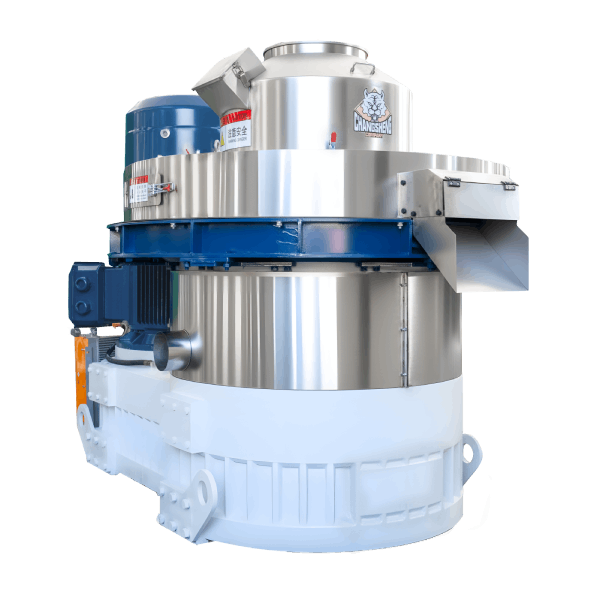
A pellet machine with hammer mill integrated is a combined unit that grinds raw biomass (chips, shavings, straw) to 3-6mm particles then immediately pellets the material, eliminating separate grinding equipment and material handling between stages.
2. Technical Parameters & Specifications
| Parameter | Small Combo | Standard Combo | Heavy-Duty Combo |
|---|---|---|---|
| Capacity (t/h) | 0.05 – 0.15 | 0.15 – 0.3 | 0.3 – 0.5 |
| Pellet Mill Motor Power (kW) | 7.5 – 11 | 11 – 15 | 15 – 22 |
| Hammer Mill Motor Power (kW) | 3 – 5.5 | 5.5 – 7.5 | 7.5 – 11 |
| Total Installed Power (kW) | 10.5 – 16.5 | 16.5 – 22.5 | 22.5 – 33 |
| Hammer Mill Screen (mm) | 3 – 4 | 4 – 6 | 6 – 8 |
| Die Diameter (mm) | 150 – 200 | 200 – 250 | 250 – 300 |
| Finished Pellet Diameter (mm) | 6, 8 | 6, 8, 10 | 8, 10 |
| Pellet Density (kg/m³) | 900 – 1,050 | 950 – 1,100 | 1,000 – 1,100 |
| Raw Material Max Size (mm) | <30 | <40 | <50 |
| Raw Material Moisture (%) | 10 – 18 | 10 – 18 | 10 – 18 |
| Power Requirement | 220V single-phase or 380V three-phase | 380V three-phase | 380V three-phase |
| Footprint (L×W×H, m) | 1.5×0.8×1.2 | 2.0×1.0×1.5 | 2.5×1.2×1.8 |
| Price Range (USD) | $3,000 – 5,000 | $5,000 – 8,000 | $8,000 – 12,000 |
For combo system pricing: Request a quotation with your raw material type and target capacity.
3. Structure & Material Composition
Integrated Combo System Components
Hammer Mill Section
- Hammer mill: Horizontal or vertical rotor with hardened steel hammers (Cr alloy)
- Screen: Perforated steel sheet, 3-8mm holes, quick-change frame
- Inlet hopper: 50-100L capacity, magnetic separator at throat
- Drive: Belt or direct coupled to motor
Pellet Mill Section
- Flat die: GCr15 bearing steel, 150-300mm diameter, hardened HRC 48-54
- Roller assembly: 2 rollers, Cr12MoV or Cr26 steel, HRC 55-60
- Gearbox: Cast iron, oil bath
- Feeder: Gravity from hammer mill outlet or small screw
Material Connection
- Chute: Sealed transition between hammer mill outlet and pellet mill inlet
- Optional: Cyclone after hammer mill (for dusty materials)
- Controls: Single panel for both motors, thermal protection
4. Manufacturing Process (Engineering Steps)
Step 1 – Raw Material Feeding
Equipment: Manual or conveyor feed into hammer mill hopper
Control: Remove tramp metal (magnet at inlet), break large pieces (<30-50mm)
Max size: Depends on combo model (30-50mm input acceptable)
Step 2 – Grinding to Particle Size
Equipment: Hammer mill with 3-8mm screen
Control: Target 95% of particles passing screen
Parameters: Material exits via screen into chute to pellet mill
Step 3 – Gravity Transfer to Pellet Mill
Equipment: Sealed chute (no additional motor required)
Control: Ensure chute remains clear (no bridging)
Why: Eliminates separate conveyor or screw feeder
Step 4 – Pelletizing
Equipment: Flat die pellet mill
Control: Grinding and pelletizing occur simultaneously (continuous flow)
Parameters: Die temperature 70-90°C, monitor motor load on pellet mill
Step 5 – Cooling & Storage (External)
Equipment: Cooling trays or small cooler (not integrated, sold separately)
Control: Cool pellets to ambient temperature before bagging
Time: 30-60 minutes
5. Industry Comparison
| Parameter | Integrated Combo | Separate Mill + Hammer Mill | Hammer Mill Only | Pellet Mill Only (Buy Pre-Ground) |
|---|---|---|---|---|
| Floor space (m²) | 1.5 – 4.5 | 4 – 8 | 2 – 4 | 1 – 2 |
| Total cost (USD) | $3k – 12k | $4k – 15k | $1k – 5k | $2k – 10k |
| Labor for material handling | Low (direct transfer) | Moderate (convey or bucket) | N/A | Low (buy material) |
| Flexibility (different materials) | Moderate (screen change) | High (separate control) | High | Low (need grinding partner) |
| Best for | Farm, small business, workshop | Commercial plant | Grinding service | Home with pre-ground |
| Raw material max size | 30-50mm | 50-200mm | 50-200mm | <6mm (pre-ground) |
| Why Choose Shandong Changsheng | Most space-efficient, lowest labor | Higher capacity, more flexible | Incomplete solution | No grinding control |
Compare combo vs. separate components: Request a space and cost comparison for your workshop.
6. Application Scenarios (By Buyer Role)
Distributors / Importers
Stocking pellet machine with hammer mill integrated for small businesses with limited space. Decision focus: single-phase availability, magnetic separator included, and screen size options.
EPC Contractors
Rarely specify combos for industrial plants (separate components preferred for capacity). May specify for pilot plants or small-scale demonstration.
Engineering Consultants / Technical Advisors
Advising small businesses on space-efficient solutions. Decision focus: footprint, flexibility for different materials (screen changes), and ease of operation.
End-user Facilities (Small farms, woodshops, pellet startups)
Limited space (garage, small workshop), want to process raw materials (wood chips, shavings) without buying separate grinder and conveyor. Decision focus: all-in-one simplicity, space savings.
7. Core Technical Pain Points & Engineering Solutions
Pain Point 1 – Hammer Mill Screen Changes Are Inconvenient
Problem: Changing from 6mm (pellets) to 3mm (finer feed) requires disassembly, takes 20-30 minutes.
Root cause: Integrated combo has hammer mill mounted below pellet mill, screen access restricted.
Solution: Choose combo with slide-out screen drawer (tool-less change, 2-3 minutes). Plan screen changes between batches, not during.
Pain Point 2 – Chute Blockage from Fibrous Material
Problem: Straw, hay, or long-fiber material bridges in chute between hammer mill and pellet mill. Production stops.
Root cause: Chute design assumes free-flowing granular material (sawdust). Fibrous materials hang up.
Solution: Add vibrator to chute ($200-500). Use combo designed for agricultural materials (wider chute, steeper angle). Pre-chopp long material (<20mm) before feeding.
Pain Point 3 – Single Motor Overload Stops Entire Line
Problem: Hammer mill hits hard object (knot, metal) and trips overload, stopping pellet mill also (same panel). Production stops.
Root cause: Combo shares single control panel with common overload protection.
Solution: Specify combo with independent motor starters (each motor has own protection). Hammer mill overload stops hammer mill only; pellet mill continues (clears remaining material).
Pain Point 4 – Dust Accumulation in Combo Unit
Problem: Dust from hammer mill accumulates in chute and pellet mill inlet, creating fire hazard.
Root cause: No dust collection on combo (hammer mill generates dust).
Solution: Add dust port to hammer mill, connect shop vacuum or small cyclone. Clean chute and pellet mill inlet daily. Operate with dust collection running.
8. Risk Warnings & Mitigation Strategies
Risk 1 – Motor Overload from Overfeeding
Warning: Operators feed raw material too fast, hammer mill overloads, pellet mill starves (or both overload).
Mitigation: Train operators on feed rate (watch motor amps on pellet mill). Use combo with amp meters on both motors. Install feeder with VFD on hammer mill inlet.
Risk 2 – Fire from Metal Sparks
Warning: Tramp metal (screw, nail) enters hammer mill, creates spark, ignites wood dust in chute. Fire spreads to pellet mill.
Mitigation: Inspect magnetic separator daily. Install second magnet at chute exit. Keep 9kg ABC fire extinguisher within 5 meters. Never leave unattended.
Risk 3 – Screen Blinding from Wet Material
Warning: Material above 20% moisture blinds hammer mill screen, output drops 80%. Operator increases feed rate, motor overloads.
Mitigation: Test moisture before feeding (reject >18%). Use larger screen holes (6mm vs 4mm) for wetter material. Dry material first.
9. Procurement Selection Guide (6 Actionable Steps)
Step 1 – Define your raw material
Wood chips/shaving (max 30-50mm): combo works. Straw/hay (long fibers): need combo with wider chute and vibrator. Agricultural residues: require screen sizes 3-6mm.
Step 2 – Calculate required output
Annual tons ÷ operating hours ÷ 0.8 (efficiency). For 150 tons/year ÷ 500 hours ÷ 0.8 = 0.375 t/h → choose standard or heavy-duty combo.
Step 3 – Verify power supply
220V single-phase: small combo only (0.05-0.15 t/h). 380V three-phase: all combos (0.05-0.5 t/h). Need dedicated circuit (20-50A depending on total kW).
Step 4 – Determine screen sizes needed
Pellets (6-8mm): 4-6mm screen. Feed (3-5mm): 3-4mm screen. Bedding (8-12mm): 6-8mm screen. Order combo with 2-3 screens.
Step 5 – Request dust collection port
Ask for dust outlet on hammer mill. If not standard, add adapter. Budget for shop vacuum or small cyclone ($200-500).
Step 6 – Negotiate operator training
Request video training on screen change, moisture testing, and daily cleaning. On-site training adds $500-1,000 (recommended for first-time users).
10. Engineering Case Study
Project Background: A small woodworking shop in Tennessee, USA, produced 10 tons/month of wood chips and shavings from hardwood (oak, maple). They wanted to make 50 tons/year of pellets for shop heating. Space limited: 20 m² workshop. Only 220V single-phase power.
Initial Problem: Shop bought separate hammer mill ($1,500) and flat die pellet mill ($2,000). Total footprint 4 m² (too large for space). Operators had to grind chips (10 minutes), collect in buckets, carry to pellet mill (chute height mismatch), then feed pellet mill. Labor 4 hours per 100kg pellets. High dust in workshop.
Root Cause Analysis:
- Separate units required 2x floor space of combo
- No gravity transfer — manual handling between stages (labor intensive)
- Hammer mill outlet too high for pellet mill inlet — could not connect directly
- Dust from both units — no collection
Solution Implemented (Shandong Changsheng combo):
- Purchased small combo unit (7.5kW pellet mill + 3kW hammer mill, 220V single-phase) — $3,800
- Added 4mm screen for pellets, 6mm screen for animal bedding (optional)
- Dust port connected to shop vacuum ($300)
- Footprint: 1.5 m × 0.8 m = 1.2 m² (saved 2.8 m²)
Final Data Results (12 months operation):
| Metric | Separate Units | Integrated Combo |
|---|---|---|
| Floor space (m²) | 4.0 | 1.2 |
| Labor per 100kg pellets (hours) | 4.0 | 1.5 |
| Dust in workshop | High (visible on surfaces) | Low (vacuum collection) |
| Capacity (kg/h) | 25-30 | 45-55 |
| Annual production (tons) | 35 (labor limited) | 52 |
| Pellet quality (PDI) | 88% | 93% |
- Equipment cost: Separate $3,500 vs Combo $3,800 (+$300)
- Labor savings: 2.5 hours per 100kg × 500 hours × $20/hr = $2,500/year
- Space savings allowed additional equipment (dust collector, cooler)
- Payback on combo premium: 1.4 months
Request a combo system space assessment: Contact engineering team with your workshop dimensions and raw material type for a space-saving layout.
11. FAQ
Q1: What is a pellet machine with hammer mill integrated?
A combined unit that grinds raw material then immediately pellets it in one continuous process, eliminating separate grinding and material handling.
Q2: What size raw material can I feed into a combo?
30-50mm maximum (wood chips, shavings, small branches). Larger material (logs, stumps) requires pre-chipper.
Q3: Do I need a separate conveyor between hammer mill and pellet mill?
No. Gravity chute transfers material directly (chute included).
Q4: Can I use a combo for wet material (20%+ moisture)?
No. Material over 18% moisture will blind hammer mill screen. Dry to 13-16% before feeding.
Q5: How do I change hammer mill screens on a combo?
Some combos have slide-out drawer (tool-less, 2-3 minutes). Others require partial disassembly (20-30 minutes). Ask before buying.
Q6: What is the footprint of a typical combo unit?
1.5-2.5 m long × 0.8-1.2 m wide × 1.2-1.8 m high. Allow 1m clearance for screen changes and maintenance.
Q7: Can I run a combo on single-phase power?
Small combos (7.5-11kW total) offer 220V single-phase. Larger combos require 380V three-phase.
Q8: Does the combo include a dust collection system?
Typically no. Dust port provided; you connect shop vacuum or small cyclone ($200-500 extra).
Q9: How much does a pellet machine with hammer mill integrated cost?
$3,000 – $12,000 depending on capacity (0.05-0.5 t/h) and included features (dust port, magnetic separator, spare screens).
Q10: What is the typical capacity of a combo unit?
0.05 – 0.5 t/h (50-500 kg/h). For higher capacity, use separate components.
Q11: Can I make animal feed with a combo?
Yes, with 3-4mm hammer mill screen and 3-5mm pellet die. Clean thoroughly between fuel and feed.
Q12: What maintenance is required for a combo?
Daily: clean magnets, check screens, empty dust collector. Weekly: grease roller bearings, check belt tension. Monthly: inspect hammers, replace worn screens.
Q13: Can I use a combo for straw or hay?
Yes, but requires combo with wider chute and vibrator (fibrous materials bridge easily). Pre-chopp to <20mm if possible.
Q14: What is the difference between integrated combo and separate units?
Combo: single frame, shared controls, gravity transfer (compact, less labor). Separate: larger footprint, more flexible (different capacities, easier screen changes), conveyor or manual transfer.
Q15: Is a combo suitable for a small business?
Yes, for 50-300 tons/year with limited space. For larger volumes (>500 tons/year), separate components recommended for higher capacity and maintenance access.
12. Commercial Call-to-Action
For small businesses and farms with limited space: Request a pellet machine with hammer mill integrated quotation with your raw material type, power supply, and target capacity.
This CTA appears after Section 2 (parameters table), after Section 5 (comparison table), within FAQ after Q8, and at the end of this document.
Need help choosing between combo and separate components? Contact the engineering team with your workshop dimensions, raw material, and annual target for a space and cost comparison.
Looking for a dust collection package? Request a combo + dust collector bundle (15-20% discount) including vacuum or small cyclone.
To proceed: Send your inquiry via the contact form. Include your raw material (wood chips, shavings, straw), max feed size (mm), target capacity (kg/h), and power supply (single or three-phase).
13. Author & E-E-A-T Credentials
Author: Zhang Wei
Small-Scale Equipment Integration Specialist
- 11 years in small-scale pellet equipment and system integration (2014–present)
- Designed 50+ combo systems for woodshops, farms, and small businesses
- Developed space-optimized layouts for facilities under 50 m²
- Author of “Small-Space Pellet Production Guide” (China Machine Press, 2023)
- Member of the National Wood Flooring Association (NWFA)
Affiliation: Shandong Changsheng Machinery Co., Ltd.
The author has directly designed pellet machine with hammer mill integrated systems for woodshops, farms, and small pellet startups across North America, Europe, and Australia. All specifications, space requirements, and labor data are derived from actual combo installations from 2016–2026.