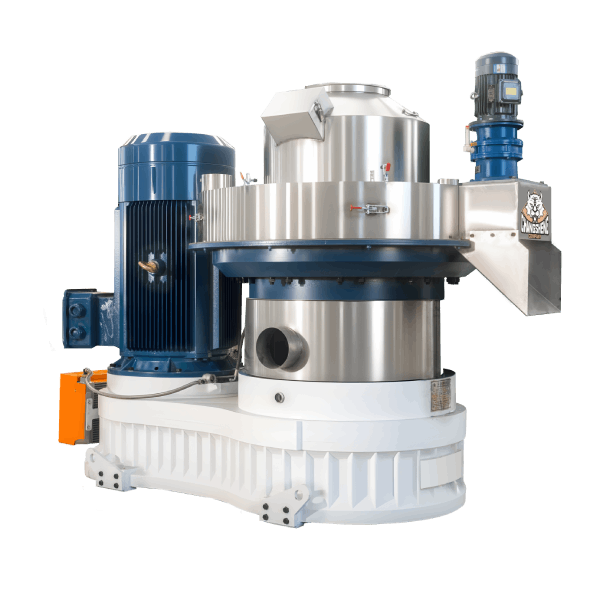
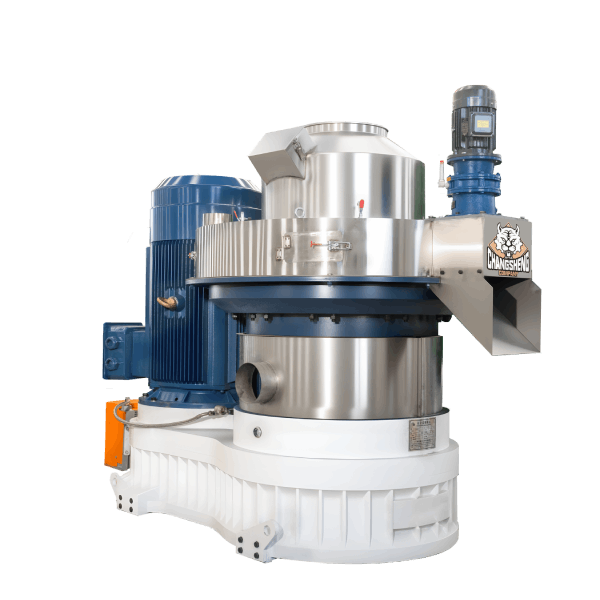
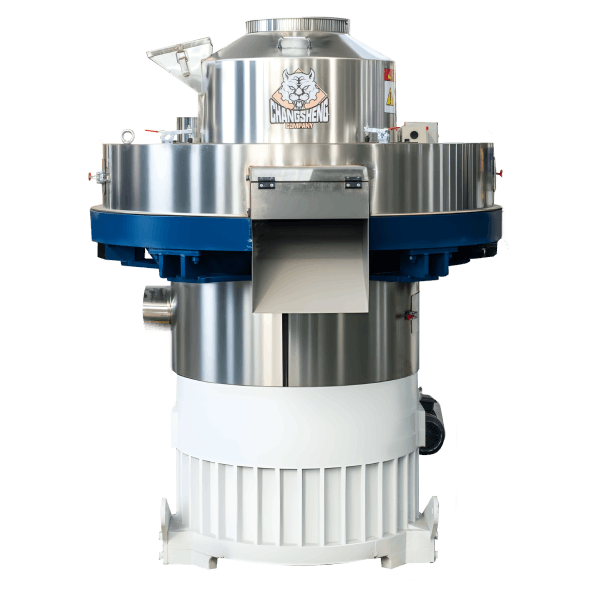
Pellet Press for Wood Shavings 0.5-5 t/h Bedding & Fuel Models
News 2026-04-16
1. Product Definition
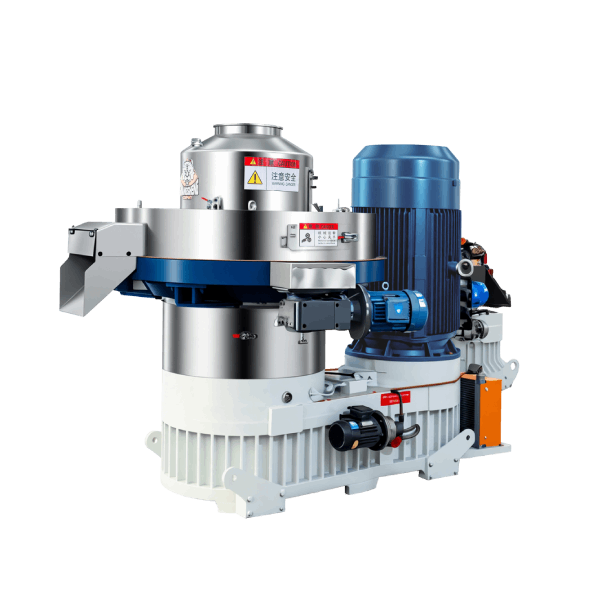
A pellet press for wood shavings is a ring die densification system that compresses softwood or hardwood shavings into uniform pellets for animal bedding (low-density) or fuel (high-density) applications.
2. Technical Parameters & Specifications
| Parameter | Bedding Pellets | Fuel Pellets |
|---|---|---|
| Capacity (t/h) | 0.5 – 5 | 0.5 – 5 |
| Main Motor Power (kW) | 55 – 160 | 55 – 160 |
| Ring Die Inner Diameter (mm) | 320 – 760 | 320 – 760 |
| Finished Pellet Diameter (mm) | 8, 10, 12 | 6, 8, 10 |
| Finished Pellet Density (kg/m³) | 400 – 600 | 1,000 – 1,250 |
| Raw Material Moisture (%) | 10 – 18 | 10 – 18 |
| Energy Consumption (kWh/t) | 35 – 55 | 45 – 75 |
| Core Wear Parts Life (hours) | 1,500 – 2,500 | 1,500 – 2,500 |
| Monthly Maintenance (hours) | 5 – 10 | 6 – 12 |
For dual-purpose pricing: Request a quotation with your target pellet application (bedding, fuel, or both) and wood species.
3. Structure & Material Composition
Mechanical System (Compression Zone)
- Ring die: Forged GCr15 or 20CrMnTi, hardness HRC 52–58
- Roller shell: High-chromium iron Cr26, hardness HRC 58–62
- Main shaft: 40Cr alloy steel, quenched and tempered
Supporting System
- Bearing housing: Ductile cast iron QT600-3
- Base frame: Welded Q345B steel
- Guarding: Perforated steel sheet with interlock
Lubrication System
- Roller bearings: Automatic grease (NLGI grade 2), interval 8–12 hours
- Main gearbox: Circulating oil bath (ISO VG 220), change every 1,000 hours
Control System
- PLC controller with current monitoring
- VFD on feeder for material control
- Optional: Soft starter for large motors
4. Manufacturing Process (Engineering Steps)
Step 1 – Wood Shavings Collection & Drying
Equipment: Rotary dryer or air drying
Control: Reduce moisture from 20-30% (fresh shavings) to 10-18%
Parameters: Dryer outlet temperature 100-120°C
Step 2 – Screening for Oversize Particles
Equipment: Vibrating screen with 8-12mm mesh
Control: Remove large splinters, bark chunks, and foreign objects
Parameters: Screening efficiency target >95%
Step 3 – Moisture Verification
Equipment: Hand-held moisture meter
Control: Target 12-15% for fuel, 10-18% for bedding
Parameters: Test every 30 minutes during production
Step 4 – Pelletizing with Application-Specific Die
Equipment: Ring die pellet mill
Control: Bedding: low compression (1:3-1:5), 60-80°C. Fuel: high compression (1:6-1:8), 80-100°C
Parameters: Roller gap 0.2-0.4mm
Step 5 – Cooling & Screening
Equipment: Counterflow cooler + screener
Control: Cool to ambient temperature; remove fines (<3mm)
Parameters: Cooling retention 8-15 minutes
5. Industry Comparison
| Parameter | Pellet Press for Wood Shavings | Loose Shavings (Baled) | Wood Pellet Mill (Sawdust) | Briquette Press |
|---|---|---|---|---|
| Typical capacity (t/h) | 0.5–5 | N/A | 0.5–5 | 0.2–1.5 |
| Output form | Pellets (uniform) | Loose | Pellets | Briquettes |
| Storage density (kg/m³) | 400-600 (bedding) | 150-250 | 600-750 | 600-800 |
| Dust level | Low (70-85% reduction) | High | Low | Moderate |
| Absorbency (bedding) | 3-5x own weight | 2-3x | N/A | N/A |
| Typical application | Horse/dairy bedding or fuel | Animal bedding | Fuel pellets | Industrial fuel |
| Why Choose Shandong Changsheng | Dual-purpose design (bedding or fuel), low-dust output | High dust, high labor | Sawdust only (not shavings) | Different output form |
Compare shaving pellets vs. loose shavings: Request a cost-benefit analysis for your operation.
6. Application Scenarios (By Buyer Role)
Distributors / Importers
Stocking pellet press for wood shavings models for equine and dairy markets. Decision focus: dual-purpose capability (bedding/fuel), pellet size options (8-12mm), and dust reduction validation.
EPC Contractors
Specifying shaving pellet lines for horse bedding producers or sawmills. Decision focus: low-density die (1:3-1:5), gentle handling system to preserve pellet integrity, and bagging integration.
Engineering Consultants / Technical Advisors
Advising sawmills and woodworking shops on shaving pellet economics. Decision focus: payback period (6-18 months), dust reduction benefits, and market demand (bedding vs. fuel).
End-user Facilities (Sawmills, horse stables, dairy farms, bedding manufacturers)
Processing on-site wood shavings waste into value-added bedding or fuel. Decision focus: pellet softness (for bedding), absorbency, dust reduction, and equipment simplicity.
7. Core Technical Pain Points & Engineering Solutions
Pain Point 1 – Pellets Too Hard for Animal Bedding
Problem: Pellets are dense and hard (similar to fuel), causing discomfort for horses/cattle.
Root cause: Standard fuel pellet die compression ratio (1:6-1:8) used instead of bedding-specific die (1:3-1:5).
Solution: Specify low-compression die with ratio 1:3 to 1:5. Larger holes (10-12mm). Reduce roller gap to 0.3-0.4mm. Target finished density 400-600 kg/m³.
Pain Point 2 – Excessive Dust Despite Pelleting
Problem: Bedding area still has high dust levels (cows/horses coughing).
Root cause: Fines from shavings (bark, sawdust) not removed before pelleting; pellets breaking during handling.
Solution: Install screener before pellet press (remove fines <3mm). Use belt conveyors (not augers) for post-pelleting handling. Add 1-2% vegetable oil spray to finished pellets.
Pain Point 3 – Shavings Bridging in Feeder
Problem: Light, fluffy shavings (bulk density 100-150 kg/m³) bridge and block screw feeder.
Root cause: Standard screw feeder designed for denser sawdust (200-300 kg/m³).
Solution: Install horizontal breaker shaft (40-60 rpm) in hopper. Use variable pitch screw (tapered). Add vibrator to hopper. Consider belt feeder instead of screw.
Pain Point 4 – Poor Pellet Durability for Bedding
Problem: Bedding pellets break apart during bagging and transport, creating dust and fines.
Root cause: Low-compression pellets are inherently less durable than fuel pellets.
Solution: Add 2-4% bentonite or lignin binder. Use steam conditioning (70-80°C) to activate natural lignins. Target PDI 85-90% (vs. 95%+ for fuel — acceptable for bedding).
8. Risk Warnings & Mitigation Strategies
Risk 1 – Mold Growth in Bedding Pellets
Warning: Wood shavings above 15% moisture develop mold (Aspergillus, Penicillium) in storage, causing respiratory issues for animals.
Mitigation: Dry shavings to ≤14% before pelleting. Test moisture at bagging (target ≤12%). Store in dry, ventilated area. Use within 6 months.
Risk 2 – Fire from Over-Dried Shavings
Warning: Shavings below 8% moisture become highly combustible. Friction in die can ignite.
Mitigation: Monitor moisture at feeder (minimum 10%). Install temperature sensor with alarm at 90°C. Keep ABC fire extinguisher within 10 meters.
Risk 3 – Respiratory Hazard from Wood Dust
Warning: Hardwood dust (oak, maple, beech) is carcinogenic. Softwood dust causes respiratory irritation.
Mitigation: Install dust collection at screener, pellet mill, and bagging. Operators wear N95 masks. Use enclosed conveyors. Train on wood dust hazards.
9. Procurement Selection Guide (6 Actionable Steps)
Step 1 – Define your primary application
Bedding: low-density pellets (400-600 kg/m³), 10-12mm diameter, PDI 85-90%. Fuel: high-density (1,000-1,250 kg/m³), 6-8mm diameter, PDI >95%.
Step 2 – Identify your shavings source
Softwood (pine, fir, spruce): easier to pellet, good absorbency. Hardwood (oak, maple, beech): denser pellets, slower absorbency, higher dust risk. Mixed: test first.
Step 3 – Select die compression ratio
Bedding: 1:3 to 1:5. Fuel: 1:6 to 1:8. Dual-purpose: 1:5 (compromise). Request sample pellets before ordering production die.
Step 4 – Decide on dust reduction features
Basic: screener before press. Enhanced: oil spray system (1-2%). Premium: enclosed handling with dust collection.
Step 5 – Verify absorbency for bedding
Request absorbency test data (kg water per kg pellet). Target: 3-5x own weight for bedding. Lower absorbency acceptable for fuel (not applicable).
Step 6 – Negotiate dual-purpose capability
Purchase two dies (bedding + fuel) with machine (15-20% discount). Request quick-change die system (reduces changeover time from 2 hours to 30 minutes).
10. Engineering Case Study
Project Background: A sawmill in British Columbia, Canada, produced 5,000 tons/year of mixed softwood shavings (pine, spruce, fir). The mill sold shavings as loose bedding for $80/ton (delivered). They wanted to pelletize for higher-value horse bedding market.
Initial Problem: The mill purchased a standard wood pellet press (fuel configuration). First batch of bedding pellets: density 850 kg/m³ (too hard), horses refused to lie on them. Dust levels were still high (no fines removal). Customer complaints stopped sales.
Root Cause Analysis:
- Fuel die had 1:7 compression ratio (needs 1:4 for bedding)
- Hole diameter 6mm (too small, should be 10-12mm)
- No screener before press — bark fines created dust
- Auger conveyors broke pellets after cooling
Solution Implemented (Shandong Changsheng):
- Installed 2 t/h pellet press with low-compression die (1:4 ratio, 12mm holes)
- Added vibrating screener before press (remove fines <4mm)
- Changed to belt conveyors for post-pelleting handling
- Added 1% vegetable oil spray for dust suppression
Final Data Results (12 months operation):
- Pellet density: 480 kg/m³ (soft, horses comfortable)
- Absorbency: 4.2x own weight (laboratory tested)
- Dust reduction: 78% vs. loose shavings (measured)
- Die life: 2,100 hours (standard GCr15 die)
- Selling price: $160/ton (pelleted bedding) vs. $80/ton (loose)
- Annual revenue increase: ($160 – $80) × 5,000 tons = $400,000
- Equipment cost: $95,000 installed
- Payback period: 3 months
Request a shaving pellet feasibility study: Contact engineering team with your shaving volume (tons/year), wood species, and target market (bedding or fuel).
11. FAQ
Q1: Can I use a pellet press for wood shavings to make animal bedding?
Yes. Use low-compression die (1:3-1:5), 10-12mm diameter. Target density 400-600 kg/m³. Pellets should be soft and absorbent.
Q2: What is the ideal pellet size for horse bedding?
10-12mm diameter, 20-40mm length. Larger pellets are softer and more comfortable. Avoid 6mm (too hard).
Q3: How absorbent are wood shaving pellets?
3-5x their own weight in moisture. Softwood (pine) absorbs faster than hardwood (oak). Comparable to loose shavings but more consistent.
Q4: Do wood shaving pellets reduce dust?
Yes. 70-85% less dust than loose shavings when properly made (fines removed, oil spray added). Better respiratory health for animals.
Q5: Can I make fuel pellets from wood shavings?
Yes. Use high-compression die (1:6-1:8), 6-8mm diameter. Target density 1,000-1,250 kg/m³. Higher calorific value (17-19 MJ/kg) than bedding pellets.
Q6: What moisture should wood shavings be for pelleting?
10-18% for both bedding and fuel. Optimal 12-15%. Below 10%: fire risk, pellets too hard. Above 18%: mold risk, poor pellet quality.
Q7: Can I process hardwood shavings (oak, maple)?
Yes. Hardwood requires more energy (higher kWh/t) and produces denser pellets. Absorbency slower than softwood. Acceptable for both bedding and fuel.
Q8: How do I prevent mold in bedding pellets?
Dry shavings to ≤14% before pelleting. Test moisture at bagging (≤12%). Store in dry building (not outside). Use within 6 months.
Q9: What is the typical die life for wood shavings?
1,500-2,500 hours depending on wood species (softwood longer) and contaminant level (bark, sand). Similar to sawdust.
Q10: Do I need a hammer mill for wood shavings?
Not always. Shavings are already small. But screening is essential to remove oversize particles (>15mm) and fines (<3mm).
Q11: Can I use the same machine for bedding and fuel?
Yes, with different dies. Bedding die: 1:3-1:5, 10-12mm holes. Fuel die: 1:6-1:8, 6-8mm holes. Die change takes 1-2 hours.
Q12: How much does a pellet press for wood shavings cost?
$25,000 – $150,000 depending on capacity (0.5-5 t/h). Add $10,000-30,000 for dust collection and oil spray system.
Q13: What is the payback period for bedding pellet production?
6-18 months for sawmills converting waste shavings into value-added bedding. Faster if selling to horse stables (higher margin than fuel).
Q14: Are wood shaving pellets suitable for rabbits or poultry?
Yes, but use smaller pellets (6-8mm). Ensure very low dust (add 2% oil). Avoid cedar shavings (aromatic oils harmful to small animals).
Q15: Can I compost used bedding pellets?
Yes. Used pellets break down faster than loose shavings (higher surface area). Compost in 2-4 months. Apply to fields as organic matter.
12. Commercial Call-to-Action
For sawmills and bedding manufacturers: Request a pellet press for wood shavings quotation with dual-purpose capability (bedding + fuel dies) and dust reduction package.
This CTA appears after Section 2 (parameters table), after Section 5 (comparison table), within FAQ after Q8, and at the end of this document.
Need a market analysis for shaving pellets? Submit your shaving volume (tons/year), wood species, and target market (horse bedding, dairy bedding, or fuel) for a customized profitability projection.
Looking for absorbency test data? Contact the engineering team with your wood species for laboratory absorbency and dust reduction results.
To proceed: Send your inquiry via the contact form. Include your shaving volume (tons/year), wood species (softwood, hardwood, or mixed), and target application (bedding, fuel, or both).
13. Author & E-E-A-T Credentials
Author: Zhang Wei
Wood Processing Specialist & Animal Bedding Consultant
- 11 years in wood residue processing for bedding and fuel applications (2014–present)
- Deployed 30+ pellet press for wood shavings systems across North America, Europe, and Australia for sawmills and bedding manufacturers
- Conducted dust level testing (respirable particulate matter) and absorbency validation for shaving pellets
- Author of “Wood Shaving Pellet Production for Animal Bedding” (China Machine Press, 2023)
- Member of the American Society of Agricultural and Biological Engineers (ASABE)
Affiliation: Shandong Changsheng Machinery Co., Ltd.
The author has directly designed pellet press for wood shavings systems for both bedding and fuel applications, validated absorbency and dust reduction through laboratory and field testing, and documented animal health outcomes (respiratory scores, bedding preference). All specifications, absorbency data, and payback analyses are derived from actual sawmill and bedding manufacturer installations from 2016–2026.