Pellet Production Line with Hammer Mill and Cooler: Complete System Guide
News 2026-07-13
Page SEO Summary: This comprehensive guide helps procurement managers and project engineers plan a complete pellet production line with hammer mill and cooler—covering equipment selection, capacity matching, system integration, and procurement strategies for turnkey industrial solutions.
When a feed manufacturer, biomass processor, or wood pellet producer decides to invest in a pellet production line with hammer mill and cooler, they are not buying individual machines. They are acquiring an integrated production system that must operate as a cohesive unit from the moment raw material enters the process to the point finished pellets are ready for storage or packaging.
A production line is only as strong as its weakest link. A high-capacity pellet mill starved by an undersized hammer mill, or a cooling system that cannot adequately reduce pellet temperature and moisture, compromises the entire operation. This guide provides a systematic framework for planning, specifying, and procuring a complete pellet production line—from the hammer mill intake to the cooler discharge—ensuring all components work together reliably.
Understanding the Complete Pellet Production Line: System Architecture
A standard pellet production line with hammer mill and cooler follows a logical process flow. Understanding this flow is the foundation of effective system planning.
Complete Process Flow Overview
The production sequence begins with raw material receiving, where incoming ingredients are inspected and stored. From there, material passes through a cleaning and screening stage to remove foreign objects such as stones, metal fragments, or oversized debris that could damage downstream equipment. The cleaned material then enters the hammer mill for size reduction, producing a uniform grind that is suitable for pelletizing.
After grinding, the material is batched and weighed according to the formulation recipe. If additives, binders, or supplemental ingredients are required, they are introduced at the mixing stage to ensure homogeneous distribution throughout the batch. The conditioned material—now at the optimal moisture and temperature for pelletizing—feeds into the pellet mill, where it is compressed through the die to form cylindrical pellets.
The hot, freshly extruded pellets exit the pellet mill at temperatures typically ranging from 70°C to 90°C. These pellets are conveyed to the cooler, where they are cooled to within 3°C to 5°C of ambient temperature while moisture is reduced to the required storage level. For feed applications requiring smaller particle sizes, an optional crumbler reduces pellets to granules. A screening stage then separates fines from finished product, with fines returned to the pellet mill for reprocessing. Finally, the finished pellets are either packaged or conveyed to bulk storage.
Sequence and Equipment Dependencies
| Process Stage | Equipment | Dependency |
|---|---|---|
| Raw material receiving | Intake pit, screw conveyor, bucket elevator | Feeds cleaning system |
| Cleaning and screening | Vibrating screen, magnetic separator, destoner | Protects hammer mill from damage |
| Size reduction | Hammer mill | Determines particle size for pelletizing |
| Batching and weighing | Batch scales, weigh hoppers | Controls formulation accuracy |
| Mixing | Ribbon mixer, paddle mixer | Required for multi-ingredient formulas |
| Pre-conditioning | Conditioner with steam injection | Optimizes temperature and moisture for pelletizing |
| Pelletizing | Ring die pellet mill | Core process; determines line capacity |
| Cooling | Counterflow cooler, vertical cooler | Stabilizes pellets for storage |
| Crumbling (optional) | Crumbler roll assembly | Reduces pellet size for specific feed applications |
| Fines screening | Sieve shaker, rotary screen | Removes fines; returns them to pellet mill |
| Packaging or storage | Bagging scale, bulk loader | Final product handling |
Detailed Equipment Analysis: Hammer Mill
The hammer mill serves a foundational role in the pellet production line. The quality of grinding directly affects pellet mill performance, die life, and final product quality.
Grinding Principle and Key Components
A hammer mill operates on the principle of impact grinding. Raw material is fed into the grinding chamber where high-speed rotating hammers—typically operating at tip speeds of 80 to 110 meters per second—strike the material, breaking it into smaller particles. A perforated screen at the bottom of the chamber retains material until it reaches the desired particle size, at which point it passes through the screen openings.
The key components of a hammer mill relevant to procurement decisions include:
| Component | Function | Selection Criteria |
|---|---|---|
| Rotor assembly | Carries hammers; determines impact energy | Rotor diameter and length; number of hammer rows |
| Hammers | Impact the material; wear parts | Material grade (hardened steel); thickness; number |
| Screen | Controls finished particle size | Screen opening diameter (typically 2–6 mm for pellet feed) |
| Air assist system | Transports ground material out of chamber | Suction fan capacity; air volume |
| Feeding mechanism | Controls material entry rate | Regulated feed gate; variable speed feeder |
Sizing the Hammer Mill for Line Capacity
For a complete pellet production line, the hammer mill must have sufficient capacity to meet the pellet mill’s consumption rate plus a practical operating margin.
Standard sizing rule: The hammer mill should have at least 1.1 to 1.2 times the capacity of the pellet mill when grinding the intended raw material. This margin accounts for:
- Variations in raw material grindability
- Screen wear and reduced throughput over time
- Planned maintenance downtime for hammer rotation and replacement
Procurement Recommendation: When specifying a hammer mill for a complete line, provide the supplier with a representative material sample. Grinding performance varies significantly by material type—corn, soybean meal, rice husk, wood chips, and straw all exhibit different grinding characteristics.
Detailed Equipment Analysis: Pellet Mill
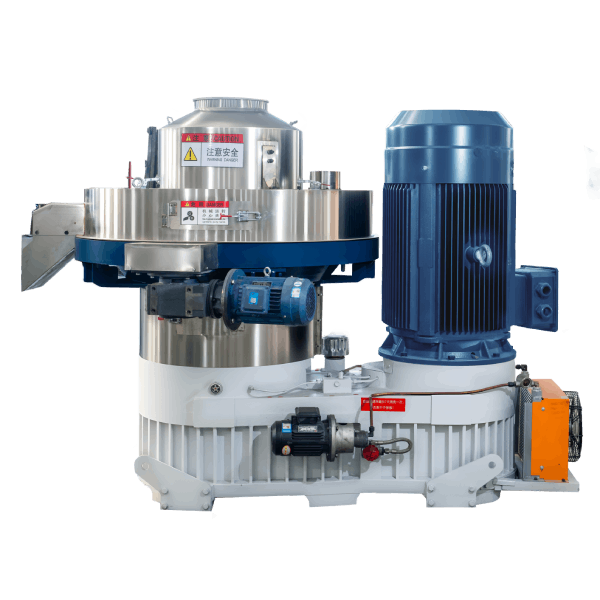
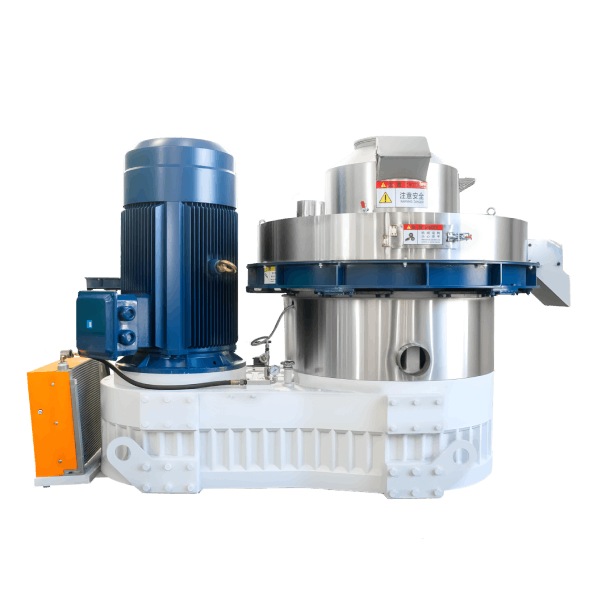
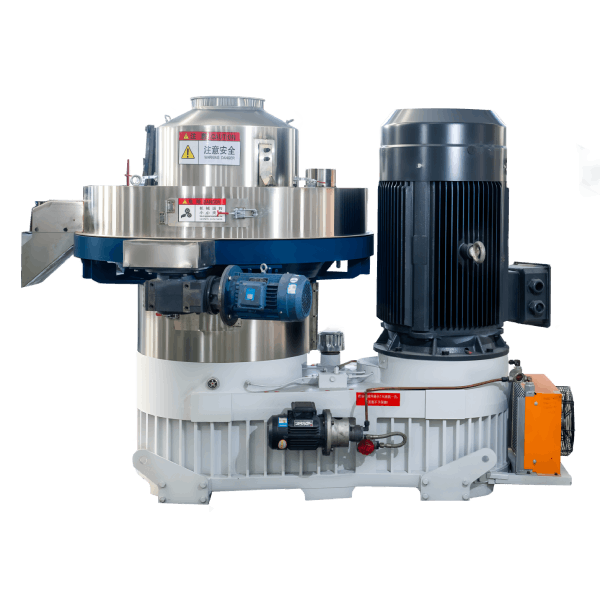
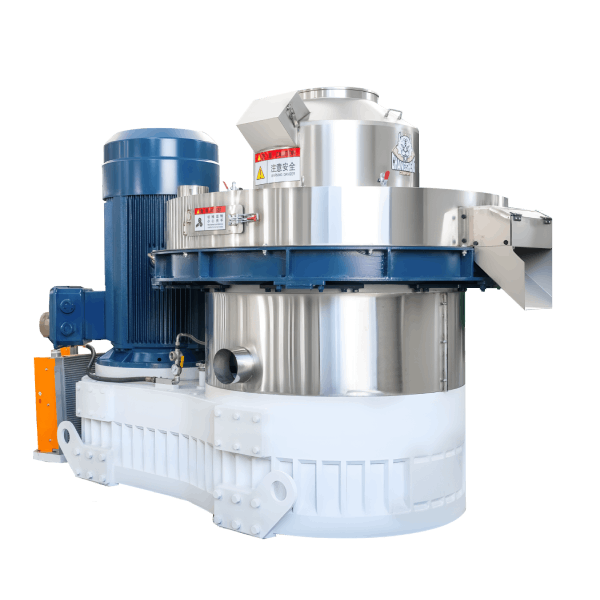
The pellet mill is the core of the production line, and its selection determines the line’s overall capacity. A complete line’s output is defined by the pellet mill’s rated capacity under specified operating conditions.
Ring Die Pellet Mill Basics
Modern industrial pellet production lines almost exclusively use ring die pellet mills. The ring die rotates while the rollers remain stationary (or vice versa, depending on design), forcing material through the die holes under high compression.
Key Specifications for Procurement Evaluation:
| Parameter | Technical Consideration | Impact on Operation |
|---|---|---|
| Die diameter | Larger dies provide higher output | 400–800 mm typical for industrial lines |
| Die rotation speed | Controls production rate and pellet quality | Typically 200–350 RPM depending on die size |
| Motor power | Determines capacity and material hardness | 37 kW to 250 kW common range |
| Roller configuration | Number and design of rollers | 2–3 rollers typical; more rollers = smoother operation |
| Feeder design | Controls material feed rate and distribution | Variable speed screw or force feeder required |
Die Specification: A Critical Procurement Detail
The die—the perforated ring that forms pellets—is the most important consumable component in the pellet production line. Its specification affects both production capacity and pellet quality.
Die Hole Diameter:
- Feed pellets: 2.0 mm to 4.5 mm
- Biomass pellets: 6.0 mm to 12.0 mm
- Wood pellets: 6.0 mm to 8.0 mm (residential) or 10.0 mm to 12.0 mm (industrial)
Compression Ratio (L/D Ratio):
The compression ratio is the ratio of the hole length (through the die thickness) to the hole diameter. Higher ratios produce denser, more durable pellets but reduce throughput and increase energy consumption.
| Application | Typical L/D Ratio | Effect |
|---|---|---|
| Feed (low fiber) | 1:8 to 1:12 | Low ratio; easier extrusion |
| Feed (high fiber) | 1:10 to 1:14 | Moderate ratio; increased compression |
| Biomass | 1:14 to 1:20 | High ratio; hard-to-pellet materials |
| Wood | 1:18 to 1:25 | Very high ratio; high density required |
Die Material:
- Alloy steel with chromium plating (standard)
- Stainless steel (for high-corrosion materials)
- X46Cr13 or similar hardened steels for extended wear life
Detailed Equipment Analysis: Cooler
The cooler is an often-overlooked component in pellet production line procurement, yet it is critical to product quality and storage stability.
Cooling Principle
Hot pellets exiting the pellet mill at 70°C to 90°C contain substantial heat and moisture. If not cooled properly:
- Pellets remain soft and can deform during handling
- Moisture trapped inside causes mold growth and spoilage
- Pellets may crack due to thermal stress
- Bagged warm pellets cause condensation inside packaging
The cooler reduces pellet temperature to within 3°C to 5°C of ambient temperature and lowers moisture content to 10–12% for safe storage.
Cooler Types: Selection Framework
| Type | Operating Principle | Capacity Range | Best For |
|---|---|---|---|
| Counterflow cooler | Ambient air passes upward through the pellet column | 1–20 t/h | Most applications; best cooling efficiency; lowest energy consumption |
| Vertical cooler | Pellets cascade downward while air passes horizontally | 2–10 t/h | Facilities with height constraints |
| Horizontal belt cooler | Pellets conveyed on perforated belt; air drawn from below | 5–50 t/h | Very high capacity lines; space with adequate footprint |
Procurement Recommendation: Counterflow coolers are the industry standard for pellet production lines with hammer mill and cooler configurations. They offer the highest cooling efficiency per unit of air volume and require the least floor space relative to capacity. For capacities above 10 t/h, belt coolers become more common due to bed depth limitations in counterflow designs.
Cooler Retention Time
The retention time—how long pellets remain in the cooler—determines final pellet temperature and moisture. Typical retention times:
| Pellet Type | Recommended Retention Time | Airflow Requirement |
|---|---|---|
| Feed pellets (small diameter) | 5–10 minutes | 80–120 m³/min per ton |
| Biomass pellets | 10–15 minutes | 100–140 m³/min per ton |
| Wood pellets | 15–20 minutes | 120–160 m³/min per ton |
Sizing Check: Ensure the cooler’s retention volume matches the production line output. A cooler that is too small forces operators to run at reduced capacity; a cooler that is too large results in uneven cooling as pellet flow becomes inconsistent.
System Matching: The Critical Integration Step
The most common source of poor performance in complete pellet production lines is mismatched equipment capacities. Individual components may meet their rated specifications, but the system as a whole underperforms due to bottlenecks.
Capacity Matching Table
| Production Target (t/h) | Hammer Mill Required (kW) | Pellet Mill Motor (kW) | Cooler Capacity (t/h) | Cooler Retention (min) |
|---|---|---|---|---|
| 1–2 | 37–55 | 37–55 | 2–3 | 8–10 |
| 2–4 | 55–75 | 55–75 | 4–6 | 8–10 |
| 4–6 | 75–90 | 75–90 | 6–8 | 10–12 |
| 6–8 | 90–110 | 90–110 | 8–10 | 10–12 |
| 8–10 | 110–132 | 110–132 | 10–12 | 12–15 |
| 10–12 | 132–160 | 132–160 | 12–15 | 12–15 |
| 12–15 | 160–200 | 160–200 | 15–20 | 15–20 |
Note: These values represent typical matching for feed applications. Wood and biomass applications require higher motor ratings at the same capacity due to increased compression energy requirements.
Material Handling Compatibility
Beyond capacity matching, the interfaces between equipment must be engineered for reliability:
Hammer Mill to Pellet Mill Transfer:
- Material conveying method (pneumatic, bucket elevator, screw conveyor)
- Surge bin capacity (typically 15–30 minutes of pellet mill consumption)
- Flow control device to regulate feed rate to the pellet mill
Pellet Mill to Cooler Transfer:
- Pellet conveying system design (pneumatic or mechanical)
- Drop height limitations to prevent pellet breakage
- Flow pattern ensuring even distribution across the cooler width
Return of Fines:
- Screened fines returned to pellet mill
- Conveying system design for abrasive material
- Dust control measures
Complete System Procurement Strategies
When procuring a pellet production line with hammer mill and cooler, buyers face a fundamental decision: source all equipment from a single supplier or assemble a line from multiple specialized manufacturers.
Single Supplier (Turnkey) Approach
Advantages:
- Single point of contact for the entire line
- Guaranteed system integration and capacity matching
- Consistent electrical and control system architecture
- Coordinated delivery schedule
- Unified warranty coverage
- Single team for installation and commissioning
Risks:
- Limited choice in equipment brands
- Potential for “all eggs in one basket” if supplier experiences production issues
- May require compromise on specific components
Multi-Supplier (Best-of-Breed) Approach
Advantages:
- Access to market-leading equipment for each component
- Potentially optimized performance from each specialized supplier
- Competitive pressure on pricing
Risks:
- Integration challenges—equipment may not work seamlessly together
- Multiple warranty contacts—disputes over responsibility
- Coordinating delivery from multiple suppliers
- Higher project management burden
- No single party accepts responsibility for line performance
Procurement Recommendation: For first-time pellet line buyers or projects with tight timelines, the single supplier approach is strongly preferred. The reduced coordination burden and guaranteed system performance typically outweigh marginal equipment advantages. For experienced buyers with dedicated engineering teams, the multi-supplier approach can yield a higher performing line—but requires significantly more project management.
Implementation Timeline: From Order to Operation
A complete pellet production line with hammer mill and cooler represents a substantial capital project. Understanding the implementation timeline supports realistic project planning and helps procurement professionals avoid schedule overruns.
| Phase | Duration (Weeks) | Key Activities |
|---|---|---|
| Engineering and design | 4–6 | Layout drawings; foundation design; electrical schematics; control philosophy |
| Equipment manufacturing | 8–14 | Fabrication of all line components; quality control inspections |
| Factory acceptance testing (FAT) | 1–2 | Component testing; line simulation; client inspection |
| Packing and logistics | 2–3 | Container packing; shipping coordination |
| Sea freight | 3–6 | Dependent on destination; weather and shipping schedule |
| Site civil works (parallel to manufacturing) | 8–12 | Foundation construction; electrical installation; steel structure |
| Installation and mechanical completion | 6–10 | Equipment placement; alignment; interconnections |
| Commissioning and start-up | 2–4 | Individual equipment testing; system integration testing; trial production |
| Performance acceptance | 1–2 | Capacity verification; pellet quality testing; client sign-off |
Total Typical Timeline: 26 to 52 weeks from order to full acceptance, depending on line complexity and destination.
Real-World Example: Complete Line Project
A Middle Eastern feed producer with an existing 5 t/h facility decided to expand to a new 10 t/h greenfield plant. The company had previously purchased individual machines from multiple suppliers and experienced significant integration difficulties. For the new facility, they selected a single supplier approach.
Project Requirements:
- Target capacity: 10 t/h compound feed pellets
- Raw materials: corn, soybean meal, wheat middlings, rice bran
- Pellet diameter: 3.5 mm and 4.5 mm
- Site: 380V/50Hz power supply; 40°C ambient
Line Configuration Selected:
| Component | Specification |
|---|---|
| Raw material receiving | Two receiving pits; 30 t/h capacity each |
| Cleaning | Vibrating screen with magnetic separator |
| Hammer mill | 132 kW; screen openings 3.0 mm for feed; capacity 12–14 t/h |
| Batching | 8-bin overhead scale system; 1.5 t batch capacity |
| Mixer | 2 t/batch ribbon mixer; 37 kW motor |
| Conditioner | Double-shaft conditioner; variable retention time |
| Pellet mill | 132 kW ring die; die diameter 560 mm; capacity 10–12 t/h |
| Cooler | Counterflow cooler; 10 t/h; 12-minute retention |
| Crumbler | Optional; installed but bypassable |
| Screening | Rotary screen; double-deck design |
| Packaging | 40 kg bagging scale with automatic stitching |
Project Outcomes:
The line was installed, commissioned, and accepted within 46 weeks from contract signing—two weeks ahead of the client’s internal schedule. The single supplier approach enabled coordinated delivery, with equipment arriving in three shipments matching the installation sequence. The client’s commissioning team worked alongside the supplier’s engineers for four weeks, resulting in a smooth handover.
Key Success Factors:
- Early provision of site details enabled pre-fabrication design
- The supplier maintained a dedicated project manager throughout
- FAT included a full line simulation
- Local representation ensured on-site support during installation
Risk Mitigation in Complete Line Procurement
When procuring a complete pellet production line with hammer mill and cooler, several specific risks must be addressed.
Technical Risk: Component Integration Failure
Mitigation: Require the supplier to provide a system capacity guarantee with liquidated damages for underperformance. Ensure the guarantee covers all specified materials and operating conditions.
Schedule Risk: Manufacturing Delays
Mitigation: Establish clear milestone dates with payment tied to completion of key manufacturing stages. Request monthly photographic progress reports and consider a third-party inspection service for critical components.
Logistics Risk: Shipping and Delivery Issues
Mitigation: Confirm all equipment dimensions and weights early. Ensure site unloading equipment is adequate. Consider shipping in multiple containers arranged by installation sequence.
Installation Risk: Site Readiness
Mitigation: Require the supplier to provide detailed foundation drawings, anchor bolt templates, and installation manuals before shipment. Confirm local resources (cranes, tools, skilled labor) availability before delivery.
Start-up Risk: Performance Verification
Mitigation: Include performance acceptance testing in the contract with specific criteria for capacity, pellet quality, power consumption, and downtime. Have spare parts for critical wear components on site before commissioning begins.
Procurement Checklist: Complete Pellet Production Line
Use the following checklist to systematically evaluate proposals for a complete pellet production line.
Technical Specifications
- Line capacity: Does the supplier guarantee the required t/h on specified materials?
- Hammer mill: Is the motor power and screen size adequate for intended materials?
- Pellet mill: Is the die diameter and motor power appropriate for target capacity?
- Cooler: Does the retention time and airflow meet pellet type requirements?
- Material handling: Are conveyors, elevators, and surge bins sized for the line?
- Control system: Is the automation philosophy clearly defined and scoped?
- Utilities: Are steam, water, compressed air, and power requirements specified?
Integration and Engineering
- Layout drawing: Does the supplier provide full plant layout with dimensions?
- Foundation loads: Are all equipment loadings provided for civil design?
- Electrical integration: Are motor controls, MCC, and panel details included?
- Interconnection points: Are all mechanical connections clearly shown?
Commercial and Legal
- Scope of supply: Is the inclusion/exclusion list clear?
- Delivery schedule: Is there a clear timeline with milestone dates?
- Payment terms: Is payment tied to measurable milestones?
- Performance guarantee: Are penalties and remedy clearly defined?
- Warranty: What is covered and for what duration?
- After-sales support: Are spare parts, training, and on-site service defined?
Frequently Asked Questions
1. What is included in a complete pellet production line with hammer mill and cooler?
A complete line typically includes: raw material receiving pit and conveyor, cleaning equipment (screen and magnetic separator), hammer mill, transfer conveyors, batching scales, mixer (for multi-ingredient lines), conditioner with steam system, ring die pellet mill, cooler (counterflow or belt), fines screen and return conveyor, and packaging equipment. Ancillary items include dust collection, control panels, and electrical cables.
2. Should I choose a counterflow or belt cooler for my pellet production line?
Counterflow coolers are preferred for most applications up to approximately 10 t/h due to their excellent cooling efficiency, compact footprint, and low energy consumption. Belt coolers are better suited for capacities above 10 t/h or where very gentle handling is required.
3. How do I ensure the hammer mill and pellet mill capacities match?
The hammer mill should be sized at 110–120% of the pellet mill’s consumption rate on the intended raw material. Confirm capacity based on the actual material to be ground—grindability varies widely between materials.
4. Is it cheaper to buy equipment from separate suppliers or one turnkey supplier?
The equipment cost may be slightly lower with separate suppliers, but the total project cost—including engineering coordination, logistics management, installation support, and commissioning—is almost always higher. For most buyers, the turnkey approach provides better overall value.
5. How long does it take to get a complete line installed and operational?
Typical timeline from order to production is 9 to 12 months for a mid-sized line of 5–10 t/h, depending on destination and site readiness. This includes engineering, manufacturing, shipping, installation, and commissioning.
6. What is the most common problem in complete pellet line projects?
Capacity mismatch between components is the most common issue, followed by inadequate site civil preparation and utility supply. Both can be avoided by thorough engineering review during the proposal stage.
7. Can I expand the line later to higher capacity?
Expansion is possible but requires careful planning. The main constraints are building space, foundation loads, and utility capacity. If expansion is anticipated, design the building and utilities for the future capacity from the beginning.
8. Who is responsible for installation and commissioning in a turnkey contract?
This is a critical negotiation point. Some suppliers offer full turnkey installation; others provide supervision only. For international projects, clarify whether the supplier’s engineers will be on-site for installation guidance and commissioning, and who covers travel and living expenses.
Final Recommendation for Procurement Professionals
A pellet production line with hammer mill and cooler is a significant capital investment and a long-term operational asset. The procurement process should therefore prioritize system performance and reliability over short-term cost savings.
The most successful projects share three characteristics: clear technical specifications from the buyer, a supplier with demonstrated system integration capability, and transparent project management throughout the implementation phase. When evaluating proposals, look beyond equipment prices to the supplier’s engineering support, delivery reliability, and after-sales service track record.
For buyers without dedicated in-house engineering teams, the turnkey approach from a single manufacturer is strongly recommended. The premium paid for integration certainty typically pays for itself many times over in reduced installation time, faster commissioning, and more reliable operation.
About the Author
Zhang Wei – Senior International Sales Engineer, Shandong Changsheng Machinery Co., Ltd.
Zhang Wei has over 12 years of experience in the biomass and feed pellet mill industry, with a background in mechanical engineering and international project execution. He has managed complete pellet production line projects for clients across Southeast Asia, the Middle East, Africa, Europe, and Latin America, overseeing everything from initial system design to installation support and commissioning.
With hands-on experience in both the manufacturing workshop and client-side operations, Zhang brings practical insights into successful pellet line planning and procurement—from the factory floor to the customer’s production site.