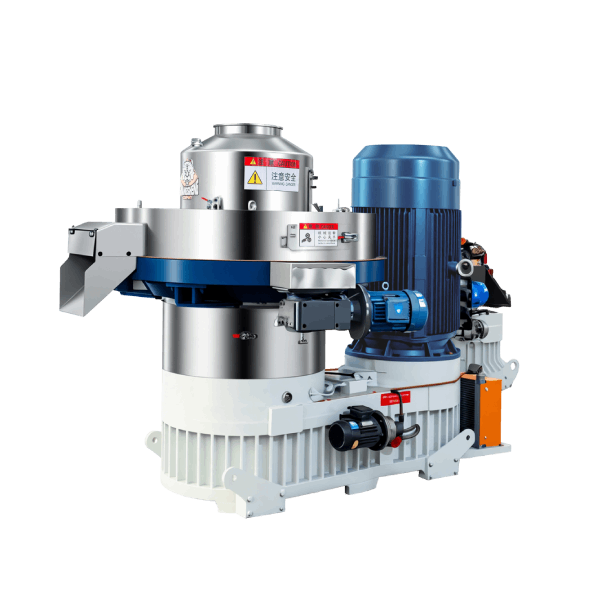
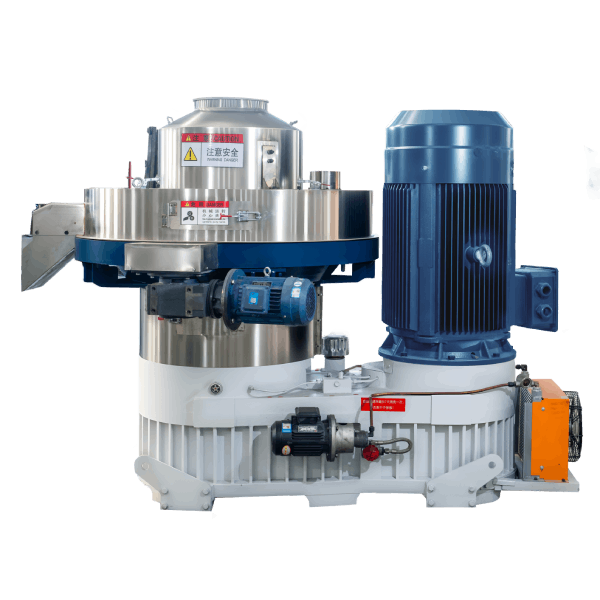
Biomass Waste Pellet Machine 0.5-5 t/h Technical Guide for Buyers
News 2026-04-07
1. Product Definition
A biomass waste pellet machine is a ring-die densification system that compresses agricultural residues, wood waste, and organic by-products into cylindrical solid fuel pellets under high pressure and controlled temperature.
2. Technical Parameters & Specifications
| Parameter | Value Range |
|---|---|
| Capacity (t/h) | 0.5 – 5 (depending on material bulk density) |
| Main Motor Power (kW) | 55 – 160 |
| Ring Die Inner Diameter (mm) | 320 – 760 |
| Finished Pellet Diameter (mm) | 6, 8, 10, 12 |
| Finished Pellet Density (kg/m³) | 1,000 – 1,300 |
| Raw Material Moisture Content (%) | 10 – 25 (optimal: 15–18) |
| Energy Consumption (kWh/t) | 45 – 85 |
| Core Wear Parts Life (ring die + rollers, hours) | 1,200 – 2,500 |
| Monthly Maintenance Man-hours (hours/month) | 6 – 15 |
For project-specific sizing: Request a quotation with your feedstock analysis and target output.
3. Structure & Material Composition
Mechanical System (Compression Zone)
- Ring die: Forged GCr15 bearing steel or 20CrMnTi alloy, vacuum heat-treated, hardness HRC 52–58
- Roller shell: High-chromium cast iron (Cr26) with hardfacing layer, hardness HRC 58–62
- Main shaft: 40Cr alloy steel, quenched and tempered, yield strength ≥785 MPa
Supporting System (Base & Housing)
- Bearing housing: Ductile cast iron QT600-3
- Base frame: Welded Q235B structural steel, stress-relieved after welding
- Guarding: Perforated steel sheet, interlocked with main power
Lubrication System
- Roller bearings: Automatic grease lubrication (NLGI grade 2), interval 8–12 hours
- Main gearbox: Circulating oil bath (ISO VG 220), oil change every 1,000 operating hours
Control System
- PLC controller (Siemens or Schneider) with local HMI touchscreen
- Real-time current monitoring with automatic feeder speed adjustment
- Emergency stop and overload protection
4. Manufacturing Process (Engineering Steps)
Step 1 – Raw Material Receiving & Pre-Cleaning
Equipment: Magnetic separator + vibrating screen
Control: Remove tramp metal (>1mm) and stones (>5mm)
Parameters: Magnetic intensity ≥10,000 Gauss; screening aperture 6mm
Step 2 – Moisture Regulation & Mixing
Equipment: Double-shaft paddle mixer with water injection nozzles
Control: Maintain target moisture ±1.5% homogeneity
Parameters: Mixing time 60–90 seconds, paddle tip speed 1.5 m/s
Step 3 – Forced Feeding into Conditioning Chamber
Equipment: Variable-frequency screw feeder + steam conditioner (optional)
Control: Match feed rate to main motor load (80–95% of rated current)
Parameters: Screw speed 50–120 rpm, conditioning temperature 60–80°C for high-lignin materials
Step 4 – Pelletizing in Compression Chamber
Equipment: Ring die and roller assembly
Control: Die temperature 80–110°C (natural friction), roller-to-die gap 0.1–0.3 mm
Parameters: Specific compression force 20–35 kN/cm² of die working area
Step 5 – Counterflow Cooling & Grading
Equipment: Counterflow cooler with air suction + rotary screener
Control: Cool pellets to ≤ ambient +5°C; remove fines (<2mm) and oversized (>12mm)
Parameters: Cooling retention 10–15 minutes, air velocity 0.8–1.2 m/s
5. Industry Comparison
| Parameter | Biomass Waste Pellet Machine | Hammer Mill + Briquette Press | Flat Die Pellet Mill | Disc Pelletizer |
|---|---|---|---|---|
| Raw material moisture tolerance | 10–25% | 8–15% (requires drying) | 12–20% | 25–35% |
| Output density (kg/m³) | 1,000–1,300 | 900–1,100 (briquettes) | 900–1,100 | 600–800 (low durability) |
| Typical capacity (t/h) | 0.5–5 | 0.2–1.5 | 0.05–0.5 | 1–8 |
| Wear parts life (hours) | 1,200–2,500 | 800–1,500 | 500–1,000 | Not applicable |
| Typical application | Industrial fuel pellets, animal bedding | BBQ briquettes, industrial fuel | Small-scale feed/fuel | Agglomeration only |
| Why Choose Shandong Changsheng | Matched ring die & roller metallurgy, automatic gap control, field-proven 2,000h+ die life | Not a direct alternative (different output form) | Limited to sub-1t/h applications | Unsuitable for high-durability fuel pellets |
Compare with your current equipment: Request a technical consultation for side-by-side analysis.
6. Application Scenarios (By Buyer Role)
Distributors / Importers
Stocking standardized container-ready units with common wear parts across multiple end-user sites. Decision focus: spare parts interchangeability and documentation quality.
EPC Contractors
Integrating the biomass waste pellet machine into complete biomass processing lines (drying → pelleting → cooling → bagging). Decision focus: guaranteed throughput at specified moisture and power draw.
Engineering Consultants / Technical Advisors
Specifying equipment for client tenders requiring ISO 17225-6 compliance. Decision focus: wear life data, maintenance access, and energy efficiency verification.
End-user Factories (Pellet plants, power plants, feed mills)
Operating 6,000+ hours annually with local maintenance teams. Decision focus: mean time between failures (MTBF) and consumables cost per ton.
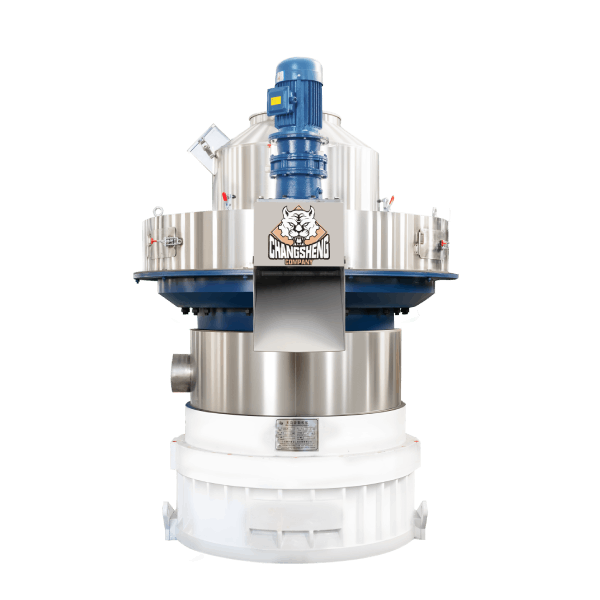
7. Core Technical Pain Points & Engineering Solutions
Pain Point 1 – Bridging & Blockage in Feeding Hopper
Problem: Fibrous materials (corn stover, straw, switchgrass) form arches above the screw feeder, causing starvation.
Root cause: Particle interlocking and low bulk density (<150 kg/m³).
Solution: Install a horizontal breaker shaft with finger plates rotating at 40–60 rpm above the feeder inlet.
Pain Point 2 – Ring Die Cracking from Thermal Stress
Problem: Premature die fracture after 800–1,000 hours instead of expected 2,000 hours.
Root cause: Uneven thermal expansion when cold material enters a die operating above 110°C.
Solution: Implement a ramp-down cooling cycle before shutdown; monitor die temperature with alarm at 120°C.
Pain Point 3 – Roller Bearing Seizure
Problem: Roller stops rotating, causing die scoring and production stop.
Root cause: Dust ingress past single-lip seals under negative chamber pressure.
Solution: Retrofit triple-labyrinth seals with positive air purge at 0.2–0.3 bar.
Pain Point 4 – Pellet Cracking After Cooling
Problem: Pellets show longitudinal cracks and generate >5% fines during transport.
Root cause: Residual internal stresses from moisture gradient >3% between core and surface.
Solution: Control conditioning temperature to 85–95°C; limit cooling air velocity to ≤1.2 m/s for minimum 10 minutes.
8. Risk Warnings & Mitigation Strategies
Risk 1 – Fire in Pelletizing Chamber
Warning: Friction ignition of dry, fine particles (<10% moisture) can cause smoldering fires inside the die.
Mitigation: Install a thermocouple in the chamber wall interlocked with the feeder. Shut down feed if temperature exceeds 130°C. Keep a CO₂ fire suppression system within 15 meters of the machine.
Risk 2 – Overloading Main Motor from Abrasive Materials
Warning: High-silica content (rice husks >12% ash, sand-contaminated sawdust) increases current draw by 30–50% above nominal.
Mitigation: Derate nameplate capacity by 0.7x for rice husks. Inspect magnetic separator before every shift.
Risk 3 – Rapid Roller Shell Wear from Tramp Metal
Warning: A single 5mm screw or stone fragment can groove the roller shell beyond repair within minutes.
Mitigation: Install a metal detector with diverter valve ahead of the mixer. Train operators to stop the line immediately if unusual noise is heard.
9. Procurement Selection Guide (6 Actionable Steps)
Step 1 – Analyze your feedstock
Send a representative 5kg sample for sieve analysis. Target: 95% of particles passing through 8mm screen. Maximum particle size must not exceed one-third of the die hole diameter.
Step 2 – Calculate true required capacity
Multiply your target output by 1.2 (safety factor for moisture and density variation). Example: 3 t/h required → specify 3.6 t/h nominal capacity.
Step 3 – Verify power density
Divide main motor power (kW) by ring die working surface area (m²). For biomass applications, target 1,800–2,400 kW/m². Below this range, throughput will suffer.
Step 4 – Confirm wear parts metallurgy
Request certified material test reports: ring die must be GCr15 or 20CrMnTi with hardness HRC 52–58; roller shell must be Cr26 with hardness HRC 58–62.
Step 5 – Audit local service capability
Ask for documented average response time for spare parts (≤48 hours recommended) and inventory list of 50+ critical wear parts.
Step 6 – Review commercial terms
Request a split quotation showing machine base, first set of wear parts, and consumables separately. Negotiate a stock discount for repeat orders above 2 sets annually.
10. Engineering Case Study
Project Background: An EPC contractor in Vietnam required a 2 t/h pellet line using sawdust (12% moisture) for a 10MW biomass power plant.
Initial Problem: After commissioning, actual throughput fluctuated between 1.2–1.7 t/h. Ring die life was only 800 hours versus the expected 2,000 hours.
Root Cause Analysis:
- Sawdust contained 8% fine sand (passing 200 mesh) from open-yard storage
- Feeder speed control was manual, causing main motor load to drop to 55% during low-density material pockets
- Ring die material was standard GCr15 without surface hardening
Solution Implemented (Shandong Changsheng):
- Installed a cyclonic sand remover (cut point 45 microns) ahead of the pellet machine
- Added a closed-loop PID controller linking feeder VFD to main motor current (target 85–90% of rated load)
- Upgraded ring die to 20CrMnTi with vacuum carburizing (case hardness HRC 60–62, core HRC 45–50)
Final Data Results:
- Stable capacity: 1.95–2.08 t/h verified over 480 continuous hours
- Ring die life: 2,150 hours (measured from installation to retirement)
- Energy consumption: 58 kWh/t (down from 76 kWh/t)
- Pellet durability index (PDI): 98.2% per ISO 17831-1
Reference available: Contact engineering team for similar case studies in rice husk, palm kernel shell, and municipal wood waste.
11. FAQ
Q1: Can a biomass waste pellet machine process 100% green wood chips?
Yes, but green wood requires pre-drying to ≤20% moisture and a larger die hole (10mm minimum) for steam escape.
Q2: What is the minimum moisture content allowed?
10%. Below this threshold, lignin becomes brittle and pellet fractures increase significantly.
Q3: How many tons of pellets can a ring die produce before replacement?
Approximately 600–1,500 tons depending on material abrasiveness (pine vs. rice husk vs. straw).
Q4: Does the machine require three-phase power?
Yes, 380V/50Hz or 460V/60Hz typical. A variable frequency drive is recommended for feeder control.
Q5: Can I switch between 6mm and 10mm pellets on the same machine?
Yes, by replacing the ring die and adjusting roller gap. Changeover takes 2–3 hours for two technicians.
Q6: What is the typical daily maintenance routine?
Daily: grease roller bearings (8–12 hour intervals), inspect magnetic separator. Weekly: check roller shell wear pattern. Monthly: measure ring die inner surface.
Q7: Is the machine suitable for municipal solid waste digestate?
Only if inorganic content (glass, metal, stones) is below 0.5% by weight. Otherwise, wear parts life drops to 200–300 hours.
Q8: What is the noise level at full load?
95–105 dB at 1 meter distance. Hearing protection is mandatory. An optional acoustic enclosure reduces noise to 85 dB.
Q9: What certifications are available for this equipment?
CE (EN 16500-1) and ISO 9001:2015 manufacturing certifications. Test reports for ENplus® A1 compliance available upon request.
Q10: Do you provide on-site commissioning support?
Yes, on-site commissioning (3–5 days) is included for orders above $50,000. Remote technical support is available globally.
Q11: Can I run the machine with 100% agricultural straw?
Yes, but straw requires pre-chopping to ≤30mm length and mixing with 15–20% sawdust to reduce die friction and prevent bridging.
Q12: What is the typical return on investment period?
For a 2 t/h system producing industrial pellets at $120/ton, payback is 9–14 months excluding feedstock cost.
Q13: Does the machine handle frozen raw material?
No. Frozen material (>5% ice content by visual inspection) requires thawing and moisture re-checking before feeding.
Q14: What is the normal operating temperature of the ring die?
80–110°C under stable conditions. Above 120°C, risk of lignin burning and thermal die cracking increases rapidly.
Q15: Can vegetable oil be used as a die lubricant?
Yes, at 0.5–1.0% by weight of output. Not recommended for food-contact applications or when pellets are used for animal bedding.
12. Commercial Call-to-Action
For procurement engineers and EPC teams: Request a technical datasheet with dimensional drawings, P&ID, and complete wear parts list.
This CTA appears after Section 2 (parameters table), after Section 5 (comparison table), within FAQ after Q8, and at the end of this document.
Ready to size your line? Submit your feedstock analysis (moisture %, ash %, particle size distribution) for a project-specific quotation with performance guarantees.
Need engineering drawings for plant layout? Contact the technical sales team with your site dimensions and required clearance.
To proceed: Send your inquiry to the engineering team via the contact form on this page. Include your target capacity, primary feedstock type, and project location.
13. Author & E-E-A-T Credentials
Author: Zhang Wei
Senior Mechanical Engineer & Biomass Processing Specialist
- 11 years in densification equipment design and field commissioning (2014–present)
- Led 23 biomass pellet plant projects across Southeast Asia, Eastern Europe, and West Africa
- Co-author of “Ring Die Pellet Mill Engineering Handbook” (China Machine Press, 2021)
- Member of the Chinese Society of Agricultural Engineering (CSAE)
Affiliation: Shandong Changsheng Machinery Co., Ltd.
The author has directly supervised factory acceptance tests, failure analysis investigations, and on-site commissioning for all biomass waste pellet machine models described above. All technical parameters are derived from FAT protocols and site commissioning logs from 2020–2025.