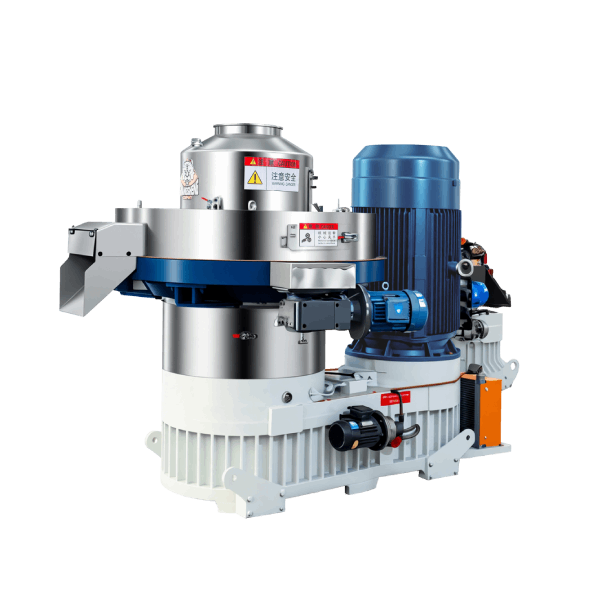
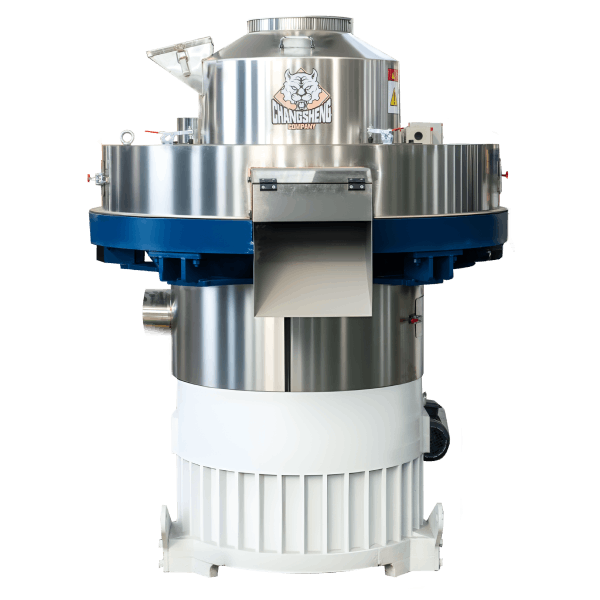
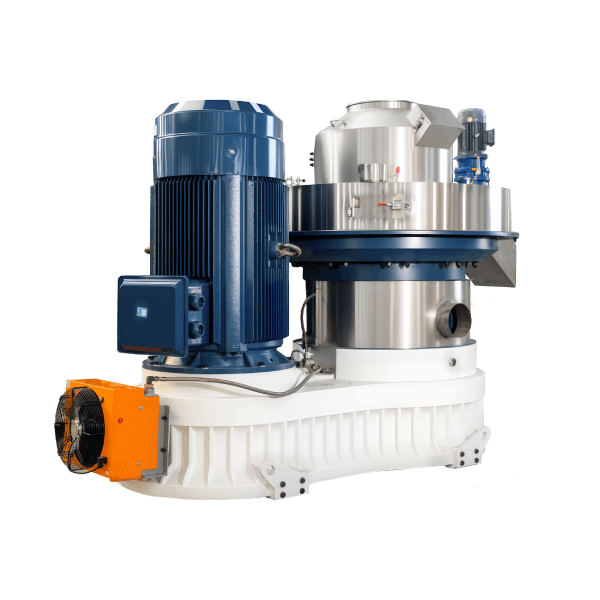
Pellet Machine for Straw Pellets Without Binder
News 2026-02-27
Pellet Machine for Straw Pellets Without Binder – Engineering Guide for Industrial Biomass Projects
Product Definition (40–60 words)
A pellet machine for straw pellets without binder is an industrial densification system engineered to compress agricultural straw into high-density fuel pellets using only natural lignin activation under pressure and heat, eliminating chemical additives. It is designed for controlled moisture, optimized compression ratios, and stable torque output.
Technical Parameters and Specifications
Straw differs significantly from wood in bulk density, fiber length, ash content, and silica level. A pellet machine for straw pellets without binder must compensate through higher compression stability and proper die configuration.
Typical industrial parameters:
Capacity range: 1–4 tons/hour per unit
Main motor power: 90–250 kW
Die type: Ring die (industrial scale)
Pellet diameter: 6–8 mm (standard fuel grade)
Compression ratio: 1:5 to 1:7 (material dependent)
Raw material moisture: 12%–18%
Final pellet density: 1.0–1.25 t/m³
Bulk density: 600–750 kg/m³
Energy consumption: 85–120 kWh per ton
Roller configuration: 2–3 heavy-duty rollers
Die material hardness: HRC 50–58 alloy steel
Cooling method: Counter-flow cooling
Because no binder is added, moisture control and compression temperature (typically 70–95°C in the die chamber) are critical process variables.
Structure and Material Composition
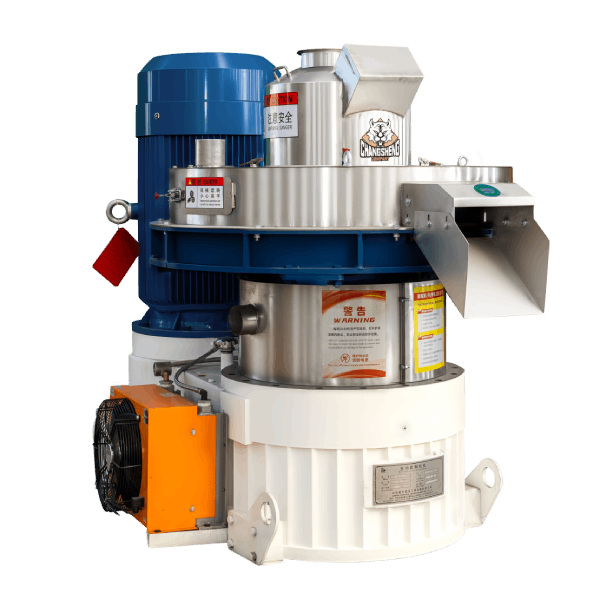
A pellet machine for straw pellets without binder typically includes the following core assemblies:
Feeding Module
– Variable frequency controlled feeder
– Anti-blocking hopper design
– Magnetic separator for impurity removal
Pelletizing Chamber
– Reinforced ring die
– Wear-resistant alloy rollers
– Adjustable roller clearance system
Drive System
– High-efficiency motor (IP55/IP65)
– Hardened gear transmission
– Safety coupling
Lubrication and Monitoring
– Automatic centralized lubrication
– Bearing temperature monitoring
– Overload protection sensors
Structural Frame
– Heavy-duty carbon steel base
– Vibration-damping foundation structure
The reinforced chamber design ensures sufficient mechanical friction to activate lignin in straw without chemical binders.
Manufacturing Process (Engineering Workflow)
Step 1: Raw Material Collection and Pre-treatment
Equipment: Straw cutter or shredder
Target particle length: ≤10 mm
Step 2: Fine Crushing
Equipment: Hammer mill
Final particle size: ≤4–5 mm
Uniform size improves compression consistency.
Step 3: Drying
Equipment: Rotary drum dryer
Target moisture: 12%–18%
Excess moisture reduces pellet strength; low moisture increases power load.
Step 4: Pelletizing
Equipment: Pellet machine for straw pellets without binder
Key control points:
– Stable feed rate
– Die temperature 70–95°C
– Proper compression ratio
Step 5: Cooling and Stabilization
Equipment: Counter-flow cooler
Objective: Reduce pellet temperature to near ambient and improve hardness.
Step 6: Screening and Packaging
Equipment: Vibrating screen and automatic packing system
In industrial operations, production lines typically run 16–20 hours per day.
Industry Comparison
Material Type | Natural Binder Content | Ash Level | Energy Demand | Binder Required
Wood Sawdust | High lignin | Low | Medium | No
Straw | Moderate lignin | Medium–High | Medium–High | No (if optimized)
Rice Husk | Low–Moderate | High silica | High | Sometimes
Compared with wood, straw requires stricter moisture and compression control when using a pellet machine for straw pellets without binder.
Application Scenarios
Distributors
– Supply biomass fuel to regional heating markets
– Export agricultural pellet production lines
EPC Contractors
– Biomass power plant fuel preparation systems
– Straw recycling industrial parks
Engineering Firms
– Boiler retrofitting projects
– Rural biomass energy transformation projects
Straw pelletization without binder is particularly attractive in regions with large seasonal agricultural residue volumes.
Core Problems and Engineering Solutions
Problem 1: Low Pellet Durability
Cause: Insufficient lignin activation
Solution: Optimize moisture (14–16%) and compression ratio.
Problem 2: High Ash Content
Cause: Field contamination with soil
Solution: Install cleaning and impurity removal systems before crushing.
Problem 3: Die Blockage
Cause: Fiber entanglement
Solution: Maintain uniform particle size under 5 mm.
Problem 4: High Energy Consumption
Cause: Over-dried material
Solution: Implement precise moisture monitoring and automated feed control.
Problem 5: Pellet Cracking After Cooling
Cause: Rapid temperature drop
Solution: Use counter-flow cooling with controlled airflow.
Risk Warnings and Avoidance Strategies
Risk 1: Incorrect Moisture Range
Moisture below 12% increases mechanical stress; above 18% reduces pellet integrity.
Risk 2: Inadequate Pre-crushing
Long fibers may cause unstable compression and die wear.
Risk 3: Oversized Motor Selection Without Load Matching
Leads to inefficient energy utilization.
Risk 4: Ignoring Ash Fusion Temperature
High ash straw may cause slagging in combustion systems.
Procurement Selection Guide
- Define annual raw straw supply volume and seasonal fluctuation.
- Test raw material for moisture, ash content, and fiber length.
- Confirm production capacity requirement (tons/hour).
- Verify die compression ratio suitable for straw without binder.
- Evaluate motor power reserve (≥10–15% buffer).
- Assess automation level for moisture and feed control.
- Calculate total energy consumption per ton.
- Review supplier’s commissioning and technical support capability.
Engineering Case Study
Project: Northern Agricultural Biomass Fuel Plant
Capacity: 2.5 tons/hour
Raw material: Wheat straw, moisture 15%
Configuration: Straw cutter + hammer mill + dryer + pellet machine for straw pellets without binder + cooler + packing line
Operating data:
Average output: 2.3–2.6 t/h
Pellet density: 1.1 t/m³
Energy consumption: Approximately 100 kWh per ton
Application: Industrial heating boilers supplying district heating.
Result: Eliminated chemical binder cost and reduced operating expenses by approximately 6–8% compared to additive-based systems.
FAQ
- Can straw pellets be produced without binder?
Yes, if moisture and compression conditions are properly controlled. - What moisture level is optimal?
Typically 14–16% for stable production. - Is ring die recommended?
For industrial scale, yes. - What pellet diameter is standard?
6–8 mm for fuel markets. - Does straw damage the die faster than wood?
Yes, due to higher ash and silica. - Is drying always necessary?
If moisture exceeds 18%, drying is required. - What is the typical energy consumption?
Generally 85–120 kWh per ton. - Can mixed straw types be processed?
Yes, but uniform blending is recommended. - Is automation important?
Highly recommended for consistent moisture control. - Are straw pellets suitable for export?
Yes, provided ash specifications meet buyer requirements.
Call to Action
For technical drawings, detailed specifications, raw material testing, or a formal quotation for a pellet machine for straw pellets without binder, contact our engineering department. We provide capacity analysis, layout design, and pilot-scale testing support.
E-E-A-T Author Qualification
This technical guide is prepared by a biomass mechanical engineer with over a decade of experience in agricultural residue pelletizing systems, covering equipment design, commissioning, and EPC plant integration. All data is derived from practical project implementation and industrial operation benchmarks.