Pellet Machine Vibration Severe: Diagnosis and Fixes
News 2026-11-16
Severe vibration in a pellet machine is a stop condition, not something to monitor while production continues. A small amount of vibration is normal under load. When the machine starts to shake, bounce, or transmit vibration into the floor and frame, something in the rotating assembly, the mounting, or the drive has changed, and running on converts a correctable fault into a damaged die, shaft or bearing.
The cause is usually one of five things: an unbalanced or damaged die, a worn or incorrectly seated roller, a failed bearing, a loose or uneven foundation, or a bent shaft or misaligned coupling. The source decides the fix, and the source is located from the vibration itself before the machine is opened.
This article covers how to tell normal vibration from a fault, how to use vibration characteristics to locate the source, the five main causes, a diagnostic sequence, what vibration does to the machine if ignored, installation factors that set the vibration level, and what to confirm when buying or installing a mill.
Normal Vibration vs Severe Vibration
Normal vibration has a consistent pattern for a given machine, load and material.
- It is present under load and reduces when the mill runs empty.
- It is steady, without sudden changes in amplitude.
- It does not transmit strongly into the floor or the surrounding structure.
- It does not change when feed rate or material changes slightly.
Severe vibration has a different pattern.
- It is present even when the mill runs empty.
- It changes suddenly, or grows over minutes or hours.
- It transmits into the floor, the frame and adjacent equipment.
- It is accompanied by noise, heat or a change in motor load.
- It appears after a specific event: a die change, a roller change, foundation work, a bearing replacement or a material change.
A quick field check is to place a hand on the frame and on the foundation and compare. Vibration strong on the frame but not on the foundation points to the machine. Vibration strong on both points to the foundation or the mounting.
Locating the Source from the Vibration Itself
Where the vibration is felt, and how it changes with speed and load, narrows the cause before anything is opened.
| Vibration characteristic | Likely source | Where to check first |
|---|---|---|
| Present with the mill empty, stronger under load, follows die rotation | Unbalanced or damaged die | Die surface, die bolts, die seating on flange |
| Follows the roller position, comes and goes on a multi-roller machine | Worn or unseated roller | Roller surface, roller mounting, roller gap |
| Accompanied by heat and noise at the bearing, present at all loads | Failed bearing | Roller bearings, main shaft bearings |
| Strong at the frame and the floor, worse at certain loads | Loose or uneven foundation | Foundation bolts, mounts, floor flatness |
| Rhythmic, follows shaft rotation, noise at the coupling | Bent shaft or misaligned coupling | Main shaft, coupling alignment |
| Present even when empty, located at the drive end | Gearbox, coupling or motor mount | Gearbox, coupling, motor mounting |
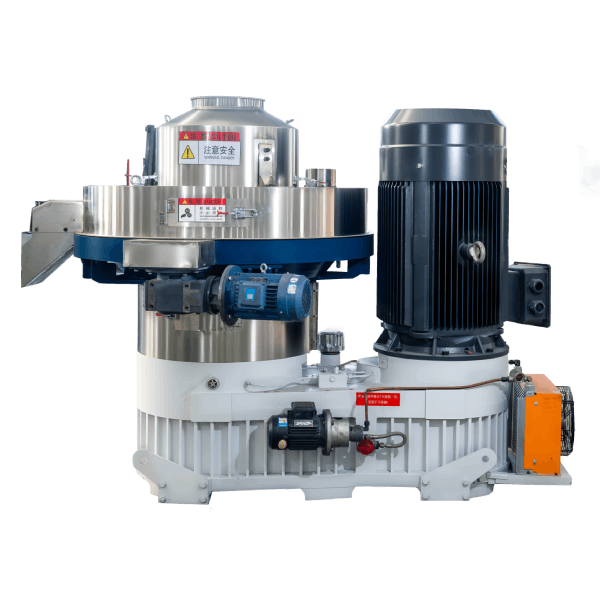
Vibration from the rotor. Felt at the die chamber and main frame, worse under load, often accompanied by a change in pellet quality. Causes: die imbalance, roller wear or seating, main shaft bend.
Vibration from the drive. Felt at the gearbox, coupling or motor, often present when the mill runs empty. Causes: coupling misalignment, gearbox fault, motor mount looseness.
Vibration from the foundation. Felt at the floor and base frame, often worse at certain loads. Causes: loose foundation bolts, cracked mounts, uneven floor.
Checking where the vibration is strongest, and whether it changes with load or with speed, saves time before the machine is opened.
The Five Main Causes
Unbalanced or damaged die
A die that has worn unevenly, has a blocked section, or has been damaged by metal or by a previous event is no longer balanced. The imbalance produces vibration that is worse under load and repeats with the die rotation. This is common after a die change if the die is not seated flat, or after a long period of uneven feed distribution.
Worn or unseated roller
A roller that is not seated or locked correctly, or a roller with a flat spot or heavy wear, produces vibration that follows the roller position. On a multi-roller machine the vibration may come and go as different rollers contact the die.
Failed bearing
A failed or failing bearing produces vibration with heat and noise. It is one of the most serious causes, because a bearing that fails under load can damage the shaft, the rotor and the die.
Loose or uneven foundation
A foundation that is not flat, foundation bolts that have loosened, or mounts that have failed allow the machine to move under load. The vibration is often worse at certain loads and is transmitted into the floor.
Bent shaft or misaligned coupling
A bent main shaft or a misaligned coupling produces a rhythmic vibration that follows the shaft rotation, often with noise at the coupling and uneven wear on the coupling.
Diagnosing Severe Vibration
Work through these with the mill stopped and isolated.
- Stop and isolate. Severe vibration is a stop condition. Confirm zero energy before opening any access point.
- Check the foundation and mounting first. Loose foundation bolts, cracked mounts and an uneven floor are quick to check and easy to correct. They are also a common cause after installation or foundation work.
- Check the die. Look for uneven wear, blocked sections, damage from metal and correct seating on the flange. Check the die bolts for looseness and correct torque.
- Check the rollers. Look for flat spots, heavy wear and correct seating. Check the roller gap on every station.
- Check the bearings. Check for play, heat and roughness. A bearing that is hot after running is failing.
- Check the shaft and coupling. Check the main shaft for bend and the coupling for alignment and wear.
- Check the drive. A gearbox or belt drive fault can also produce vibration, and it is usually located at the drive end rather than at the die.
- Check what changed. A die change, a roller change, foundation work, a material change or a bearing replacement explains most sudden vibration.
If the vibration is present with the mill empty, the cause is in the machine. If it appears only under load, the cause may be in the material or the feed distribution.
Installation Factors That Set the Vibration Level
Vibration is partly decided before the machine is switched on, and installation faults are a common reason a new mill vibrates.
- Foundation flatness and strength. The base must be flat and rigid enough to carry the machine’s dynamic load. A foundation that flexes under load transmits vibration into the structure.
- Foundation bolt torque and condition. Loose or unevenly torqued bolts allow the machine to move. Bolts should be checked after the first running period and at intervals.
- Mount condition. Vibration isolation mounts, where fitted, degrade and should be inspected. A collapsed or hardened mount transfers vibration instead of isolating it.
- Alignment of the drive. Coupling misalignment between the motor or gearbox and the mill produces vibration at the drive end.
- Piping and duct connections. Rigid connections to the machine can transmit vibration and, in some cases, impose loads on the machine frame.
A machine that vibrates from the first run should be treated as an installation problem until the foundation and alignment have been checked, not as a machine fault.
What Severe Vibration Does if Ignored
Vibration damages the machine and the surrounding structure.
- Die and roller damage. Vibration accelerates uneven wear on the die and rollers, and a die that is already unbalanced wears faster.
- Bearing damage. Vibration loads the bearings and shortens their life. A bearing that is already failing produces more vibration, which accelerates the failure.
- Shaft and coupling damage. Vibration from a bent shaft or misaligned coupling damages the coupling and can crack the shaft over time.
- Foundation and structural damage. Vibration transmitted into the floor and frame can crack foundations and loosen structural connections.
- Product quality loss. Vibration changes how material is distributed across the die, which affects pellet quality and output.
- Secondary failures. A loose component shaken by vibration can fail and enter the die chamber, causing the kind of damage described in the metallic-sound case.
Correcting Vibration
The correction follows from the cause.
- Die imbalance. Inspect the die for uneven wear and damage, check the seating and the die bolt torque, and replace the die if it is damaged. Do not attempt to balance a damaged die in place.
- Roller wear or seating. Reset the roller gap on every station, reseat and lock the roller, and replace a roller that is worn or damaged.
- Bearing failure. Replace the bearing, and inspect the shaft for damage caused by the failed bearing before fitting the new one.
- Foundation and mounting. Re-torque or replace foundation bolts, replace collapsed mounts, and correct floor flatness where it is out of tolerance.
- Shaft and coupling. Correct the coupling alignment, and replace a bent shaft rather than attempting to straighten it in place.
After correction, run the mill empty first, then at reduced feed, and observe the vibration level before returning to full rate.
Prevention and Maintenance
- Check foundation bolts and mounts at defined intervals, and after any foundation or installation work.
- Record vibration level at a reference point at each inspection, so a trend is visible before it becomes severe.
- Check bearing temperature and noise at each shift.
- Inspect the die and rollers at each die or roller change, and check seating and torque.
- Check coupling alignment after any drive work.
- Keep feed distribution even, because uneven distribution is a common origin of die imbalance.
- Train operators to treat severe vibration as a stop condition, not as a condition to monitor.
Spare Parts Planning
- Bearings. Hold a spare set for the roller and main shaft bearings, because bearing failure is both a cause and a consequence of vibration.
- Mounts and foundation bolts. Vibration isolation mounts and foundation bolts are inexpensive and should be available.
- Couplings. A misaligned coupling wears and should be replaceable without a long lead time.
- Die and rollers. Vibration accelerates wear, so the wear part plan should account for it.
What to Confirm When Buying or Installing a Mill
Foundation and installation requirements. Confirm the foundation specification, the flatness tolerance, the bolt arrangement and the mount specification, and confirm who is responsible for the foundation.
Vibration acceptance. Confirm the vibration level at the reference points at acceptance, so that a baseline exists for later comparison.
Bearing specification and access. Confirm the bearing type, lubrication method and access for replacement.
Alignment procedure for the drive. Confirm the coupling alignment method and tolerance.
Wear parts availability. Confirm die, roller, bearing and coupling availability, lead time and cost.
Acceptance testing. Confirm the mill is run with your material at the intended feed rate, and that vibration is measured and recorded before acceptance.
If severe vibration has appeared and the source is not clear from the checks above, send the machine model, where the vibration is strongest, whether it changes with load or speed, and what changed before it appeared, and the die, roller, bearing and installation condition can be reviewed against the machine.
AUTHOR / COMPANY INFORMATION
Shandong Changsheng Machinery Co., Ltd. is a manufacturer of biomass pellet production equipment, including ring die pellet mills, complete pellet lines and related process equipment, serving overseas importers, EPC contractors, engineering companies and biomass fuel producers.